app development
Building a Doctor Booking Platform Like Okadoc in 2027: Features, Revenue Model and Real Costs
 TechQware
November 24, 2026
 TechQware
November 24, 2026
A patient in Dubai can book a flight, a table and a taxi in under a minute. Finding a confirmed appointment with the right doctor, on the right insurance plan, still takes phone calls and guesswork. That gap is why Okadoc, a Dubai-based booking marketplace, raised a $10 million Series A. It is also why founders keep asking whether a similar doctor booking platform is worth building in 2027. This guide gives an honest answer: what Okadoc does, which features matter, how the money is made, which UAE rules apply, and what a build really costs in AED and USD. You will leave with a clear scope, a budget range and a list of risks to test first.
Okadoc is a Dubai-based marketplace where patients book confirmed appointments with doctors across many clinics, filtered by insurance, location, specialty, language and gender. Its model works because it solves the clinic's problem (empty slots and no-shows) as much as the patient's problem (finding a doctor).
The company was founded in 2018 by Fodhil Benturquia, who has said he started it after struggling to book a doctor himself . In February 2020 it announced a $10 million Series A on top of a $2.3 million seed round, bringing total funding to over $12 million.
Three parties meet on one platform. Patients search by insurance network, location, specialty, language spoken or gender, then see live availability and book. Clinics and hospitals connect their schedules, so the slot a patient sees is the slot that exists. Insurers connect through their own apps: Daman, for example, offers Okadoc booking to members inside its mobile app, and providers in the Daman network can join Okadoc free of charge.
The founder's own description is useful here. He said the platform integrates with most international and local hospital information systems, covering over 60 percent of UAE doctors, and had onboarded more than 1,000 bookable doctors across 70 specialties in all seven emirates. These are company claims from 2020, so treat them as direction, not audited fact.
A basic appointment tool takes a request. Okadoc confirms a booking. A 2019 Gulf News report quoted the founder contrasting the two: other portals only sent booking requests, while Okadoc offered confirmed slots, with booking in about 40 seconds, rescheduling in 10 and cancelling in five.
Think of it like the difference between emailing a restaurant and using a reservation app that shows open tables. The second only works if the restaurant's system feeds it live data. That integration layer is the hard part and the real moat.
Three types of founder tend to fit:
If you have none of these assets, plan for a longer, more expensive road to your first 50 active doctors.
Whether you are a clinic group, an insurer or a healthtech founder, our team can help you shape the idea into a working booking platform. Tell us what you want to build and we will come back with clear next steps, honest advice and a plan that fits your goals.
Talk to Our ExpertsThe market is real but crowded at the top. Demand is strong because connectivity is near universal, and supply-side digitisation is improving, yet established players already hold the best hospital integrations. Study both before you commit budget.
The UAE had 11.3 million internet users in October 2025 in a population of about 11.4 million, so almost every resident can reach an app. Mobile is the main door: GSMA data counted 21.9 million cellular connections at the start of 2025, roughly two per resident.
Market-size estimates vary widely by publisher. BlueWeave valued UAE telemedicine at USD 0.66 billion in 2024, growing at 18.9% a year to 2031, while TechSci Research puts the 2025 market at USD 431 million with Dubai as the largest marke. The gap between those two numbers is a reminder to build your business case on your own bottom-up assumptions, not on a headline forecast.
At Okadoc's 2020 launch phase, its UAE competitors included Meddy and Doctoruna, a sign that local aggregators have come and gone.
Gaps tend to sit in specialties (dental, dermatology, fertility, mental health), languages (Arabic, Urdu, Tagalog, Russian) and workflows (corporate health plans, home visits, follow-up care). In our experience, a narrow platform that does one thing better than a general marketplace wins its first 100 providers faster than a broad one.
Pick the model before you pick features. The right model depends on whether you own doctors, rent access to them, or sell software to them.
A marketplace aggregator lists many providers, earns per booking or subscription, and needs both sides to grow. A single-provider app serves one hospital group, needs no cold-start effort, and earns through patient retention and lower front-desk costs. The aggregator has the bigger upside; the single-provider app has the faster, safer path to revenue.
Telemedicine, pharmacy delivery and lab booking widen the product but also widen your regulatory footprint. Okadoc itself added video consultation in 2020, with prescription and record transfer through the platform. If you start with booking only, design the data model so these modules can be added later without a rebuild.
|
Founder type |
Best-fit model |
Why |
|
Clinic or hospital group |
Single-provider app |
Supply already owned |
|
Insurer or TPA |
Network booking layer |
Members and networks already exist |
|
Healthtech entrepreneur |
Niche aggregator |
Lower budget, focused supply drive |
|
Corporate wellness provider |
B2B booking portal |
Employer contracts bring patients |
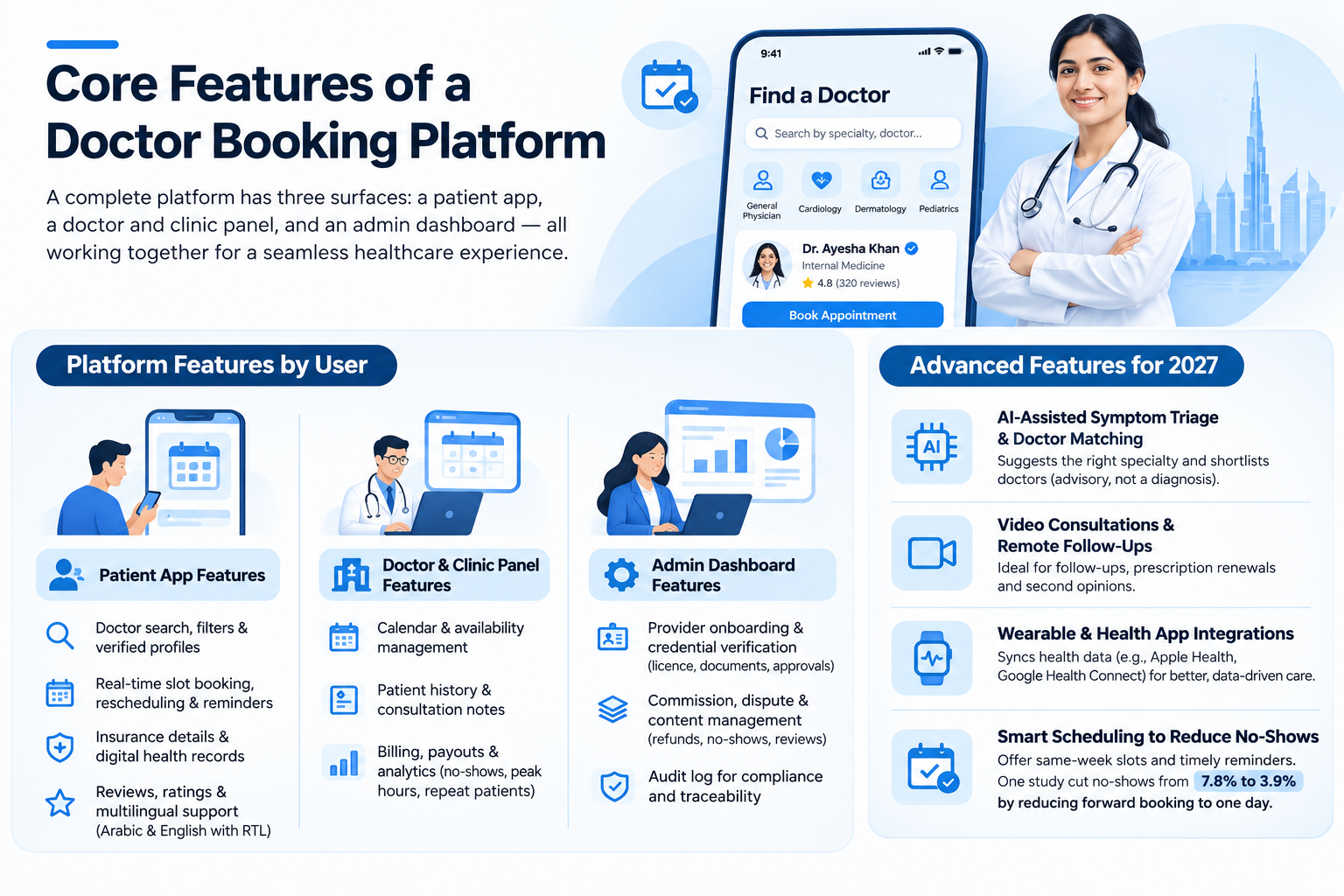
A complete platform has three surfaces: a patient app, a doctor and clinic panel, and an admin dashboard. All three must be planned together, because a weak doctor panel kills a strong patient app.
Patients should filter by specialty, insurance plan, location, language, gender and availability. Each profile shows licence status, qualifications and years of practice. A visible verified badge matters more in the UAE than in many markets because patients compare options carefully.
Show only slots that can truly be booked. Allow rescheduling and cancellation in a few taps. Send reminders by push, SMS and WhatsApp, because reminders are your cheapest no-show control.
Let patients store insurance card details and see which doctors accept them. Digital records (prescriptions, lab results, visit summaries) raise your compliance burden, so decide early whether you hold them or only link to the provider's system.
Only patients with a completed visit should be able to leave a review. Offer full Arabic and English with right-to-left layout, and add other languages if your niche needs them.
Doctors set working hours, block leave and manage multiple locations. Two-way calendar sync, or hospital system sync, prevents double booking.
A simple, secure view of past visits and notes helps doctors prepare. Keep it optional in the MVP if you are not the system of record.
Clinics need clear statements: bookings, completed visits, commission due and payouts. Analytics should show no-show rate, peak hours and repeat patients so clinics see value and stay subscribed.
Your team must verify each doctor's licence with the relevant authority before the profile goes live. Build a checklist workflow with document upload, approval states and renewal reminders.
Admins set commission rules, handle refund and no-show disputes, and moderate reviews and listings. Add an audit log from day one, because health platforms are checked more closely than most apps.
Advanced features should come after your booking flow works. Add them only when they solve a measured problem, such as long search times or high no-show rates.
A short guided questionnaire can suggest the right specialty and shortlist doctors. Keep it clearly advisory: it must not diagnose, and the wording should say so. Triage logic that influences clinical decisions can raise regulatory questions, so involve legal counsel early.
Video is most useful for follow-ups, prescription renewals and second opinions. In Dubai, telehealth is licensed through a DHA-licensed facility, so confirm who holds the licence before you build the video module.
Connecting Apple Health or Google Health Connect lets doctors see trends before a visit. It is valuable for chronic care but adds consent screens, data mapping and storage rules. Treat it as a phase-two feature.
Timing alone has measurable effects. In one UK practice study summarised by Monash Health, cutting forward booking time to one day reduced the mean no-show rate from 7.8% to 3.9%. Smart scheduling can use this idea by offering same-week slots first and nudging patients to confirm.
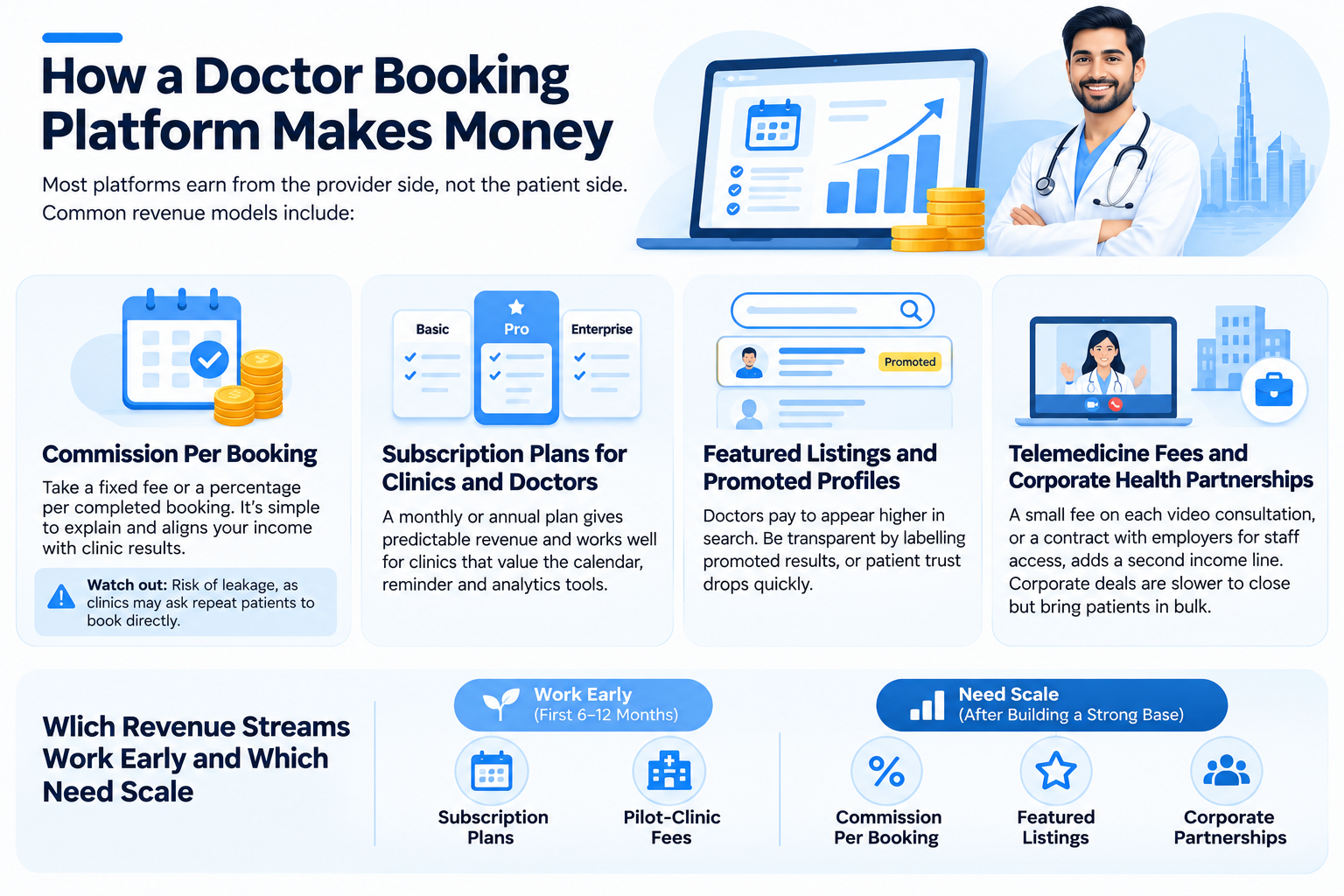
Most platforms earn from the provider side, not the patient side. Okadoc, for example, describes itself as free for patients. Its provider fee schedule is not public, so the models below are common industry options, not Okadoc's exact pricing.
You take a fixed fee or a percentage per completed booking. It is simple to explain and aligns your income with clinic results. The risk is leakage: clinics may ask repeat patients to book directly.
A monthly or annual plan gives predictable revenue and works well for clinics that value the calendar, reminder and analytics tools. It suits you early, when volume is too low for commission to matter.
Doctors pay to appear higher in search. Be transparent by labelling promoted results, or patient trust drops quickly.
A small fee on each video consultation, or a contract with employers for staff access, adds a second income line. Corporate deals are slower to close but bring patients in bulk.
Subscriptions and pilot-clinic fees work in the first 6 to 12 months. Commission, featured listings and corporate partnerships need a base of active doctors and regular patient traffic before they pay.
A realistic MVP for the UAE runs about AED 220,000–400,000 (USD 60,000–110,000) and a full-featured platform about AED 550,000–1.1 million (USD 150,000–300,000). These are TechQware's indicative planning ranges for a cross-platform build with a patient app, doctor panel and admin dashboard. They are not market statistics, and your quote will depend on scope. (AED is pegged at about 3.67 per USD.)
|
Stage |
Typical share of budget |
What it covers |
|
Discovery and product planning |
5–8% |
Requirements, user flows, technical plan |
|
UI/UX design |
10–15% |
Patient and doctor flows, Arabic/English layouts |
|
Development |
45–55% |
Apps, backend, admin, integrations |
|
Testing and security review |
10–15% |
QA, performance, penetration testing |
|
Launch and stabilisation |
5–10% |
Deployment, store release, early fixes |
|
|
MVP |
Full-featured platform |
|
Indicative budget (AED) |
220,000–400,000 |
550,000–1,100,000+ |
|
Indicative budget (USD) |
60,000–110,000 |
150,000–300,000+ |
|
Typical timeline |
4–6 months |
9–14 months |
|
Scope |
Search, booking, reminders, doctor calendar, admin approvals |
Adds insurance, video, payments and payouts, analytics, health records, integrations |
|
Best for |
Pilot with 20–50 providers |
Scaling after proven demand |
Every extra module (video, records, wearables) adds design, build and test time. A cross-platform app for iOS and Android costs less than two native apps, and a web panel for clinics adds a smaller increment.
A Dubai-based agency costs more per hour than an offshore team but offers closer contact with clinics and regulators. Fixed-price suits a clear MVP; time-and-materials suits evolving scope.
Connecting to hospital information systems, insurer APIs, payment gateways and Dubai's health information exchange takes real engineering time. Compliance work (UAE-hosted infrastructure, audit logs, consent flows) also adds cost but removes far larger risks later.
A healthcare marketplace is built in six stages, and the first two cost the least while saving the most. Skipping validation is the most common reason founders overspend.
Interview 15 to 20 clinic managers and 30 or more patients in your target segment. Ask clinics how many slots go unfilled each week and how they handle insurance checks. If clinics cannot name a pain point they would pay to fix, pause.
Choose one city, one or two specialties and one booking flow. Cut everything that does not help a patient book or a doctor manage a slot. Video, wearables and AI triage can wait.
Design for two very different users. Patients want speed and trust cues; front-desk staff want a calendar that is faster than their current method. Test Arabic and English layouts together, not as an afterthought.
Build the booking engine, notifications, doctor panel and admin first, then integrations. Test with real clinic schedules, not dummy data, and run a security review before any patient record is stored.
Launch with 10 to 30 providers you have personally onboarded. Watch for double bookings, calendar mismatches and drop-offs in the booking flow, and fix them before you market widely.
Add providers, specialties and then features, in that order. Scale infrastructure only when your numbers demand it. In our experience, teams that add features faster than they add active doctors end up with a rich app and an empty calendar.
For most founders, a cross-platform mobile app, a cloud-hosted backend inside the UAE and a few well-chosen integrations is the right balance of cost and quality. Over-engineering the first version is the more common mistake.
|
|
Native (Swift / Kotlin) |
Cross-platform (Flutter / React Native) |
|
Cost |
Higher (two codebases) |
Lower (one codebase) |
|
Time to market |
Slower |
Faster |
|
Performance |
Best for heavy video or device features |
Good for booking and content flows |
|
Maintenance |
Two teams to coordinate |
One team |
|
Best for |
Mature platforms with complex features |
MVPs and most booking apps |
A booking app is mostly forms, lists and calendars, which cross-platform tools handle well. Move to native modules later only if video quality or device integrations demand it.
Use a modular backend (for example Node.js, Python or Java services) with a relational database such as PostgreSQL, which suits appointments, payments and audit trails. Host in a UAE data-centre region so health data stays onshore, and keep backups and logs in the UAE too.
Plan for a UAE-friendly payment gateway, maps for clinic discovery, a video provider for telehealth, and SMS and WhatsApp for reminders. Check where each vendor stores data, because a foreign video or messaging service can trigger the data-location rules covered below.
Booking traffic is spiky: mornings, post-lunch, and before weekends. Use caching for search, queue background jobs such as reminders, and load-test your booking endpoint before launch. A double-booking bug at scale damages trust faster than slow screens.
Health data is the most tightly regulated data you will handle in the UAE. Treat compliance as a design input, not a final checklist. This section is general information, not legal advice; confirm details with a UAE healthcare lawyer.
Federal Law No. 2 of 2019 regulates ICT use in health fields across the UAE, including free zones. It requires health service providers using ICT to keep health data confidential and secure. Its default rule is that health data may not be stored, processed or transferred outside the UAE unless a health authority or the Ministry approves, and the same source notes additional fines ranging from AED 1,000 to AED 1,000,000.
Ministerial Decision No. 51 of 2021 later set out limited exceptions, such as treatment abroad or samples sent to overseas labs. Even where transfer is allowed, data must be encrypted and a copy must remain in the UAE.
The general data law, Federal Decree-Law No. 45 of 2021 (PDPL), does not apply to health personal data that has its own legislation. It still matters for non-health data such as marketing contacts. If you plan to serve other GCC markets, check each country's rules separately.
In Dubai, the Dubai Health Authority (DHA) governs telehealth. According to a business-setup summary of DHA's Standards for Telehealth Services (Version 4, effective 26 November 2025), there are four telehealth licence categories, including a telehealth platform. A platform licence covers a technology tool only and does not authorise direct clinical services. Check the current DHA text before you sign anything.
DHA's telehealth policy also points to requirements from the Dubai Electronic Security Center, TDRA for VoIP channels and Dubai Health Insurance Corporation processes for approvals and e-claims. A booking-only marketplace may face lighter rules than a telehealth service, but confirm your exact activity with DHA early. Abu Dhabi has its own regulator, the Department of Health, so a multi-emirate launch needs separate checks.
HIPAA is a US law and applies to US covered entities, so it rarely binds a UAE-only platform. GDPR can apply if you deliberately offer services to people in the EU or monitor their behaviour, which may happen in medical tourism. Many Dubai healthtech teams use HIPAA and GDPR controls as a quality benchmark while meeting UAE law first.
From the first rough sketch to a launch-ready healthcare app, our team handles the design, development and compliance details so you can focus on onboarding doctors and growing your network. Drop your idea and let’s see what it could become.
Let’s Talk Build
The hardest problems are human, not technical: getting doctors to join, keeping them active and earning patient trust. Plan for these from the first week.
Patients will not use an empty marketplace, and doctors will not join one without patients. Break the loop by starting narrow: one neighbourhood, one specialty, or one corporate client with a built-in patient base. Seed supply first, then drive demand to that supply.
Clinics stay when the tool saves staff time. Offer free onboarding, help with calendar setup and a monthly report showing bookings and filled slots. Okadoc's founder claimed his integrations reduced no-shows by up to 75 percent if your numbers are even half of that, show them to clinics every month.
Insurers in the UAE use different networks, plans and approval flows. Start by letting patients filter by insurer and plan from a manually maintained list, and add live eligibility checks later. A wrong network filter creates angry patients, so label data freshness clearly.
Reminders work. A systematic review of reminders by phone and SMS found they cut non-attendance by about 34 percent relative to baseline on average. Add confirmation prompts, a clear cancellation window and, if clinics agree, a fair late-cancellation policy.
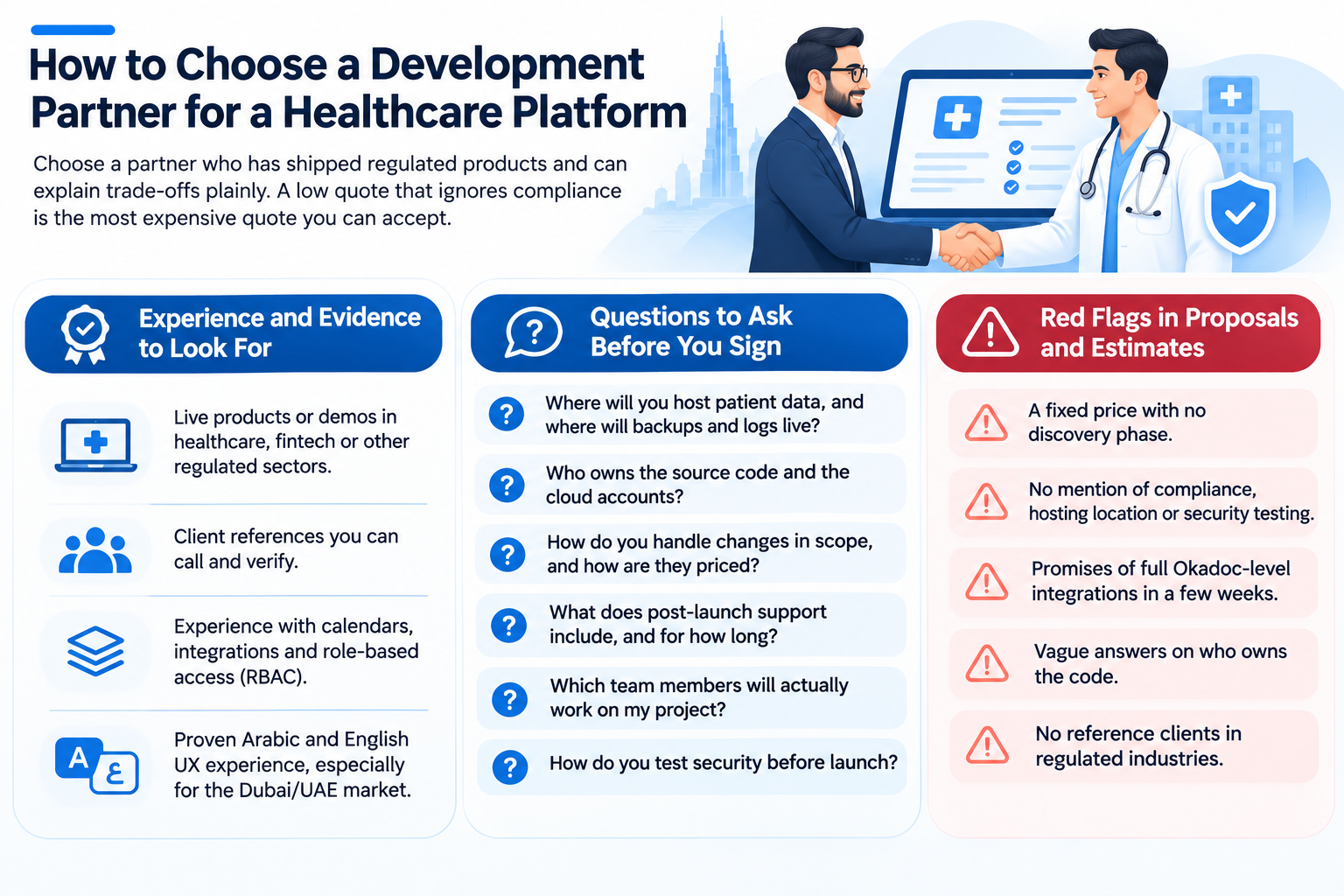
Choose a partner who has shipped regulated products and can explain trade-offs plainly. A low quote that ignores compliance is the most expensive quote you can accept.
Ask for live products or demos in healthcare, fintech or other regulated sectors, and for client references you can call. Look for experience with calendars, integrations and role-based access, not just attractive screens. A team with Arabic and English UX experience is a practical advantage in Dubai.
Launch is the start of the hardest phase. Your first 90 days should be spent on supply, retention and fixing booking friction, not on large ad spend.
Sign clinics before opening to patients. Offer a free pilot period, set up their calendars yourself and agree on 3 to 5 specialties where you can show real availability on day one. A visibly full search results page builds patient trust.
Search (patients looking for a doctor near them), Google Business listings, insurer and employer partnerships, and WhatsApp reminders to returning patients tend to fit. Paid social works poorly for urgent healthcare intent. Remember that healthcare advertising is regulated, so check what claims you can make.
Ready to Build Your Doctor Booking Platform? A successful doctor booking platform starts with the right features, technology and business model. If you’re planning to build one, TechQware can help turn your idea into a secure, scalable mobile or web solution.
Have an idea in mind? Let’s build it together.
Abhinav Srivastav
Let’s chat about your goals and explore how TechQware can support your journey ahead.



app development . Nov 03, 2026
Building a Doctor Booking Platform Like…
Mobile App Development . Oct 30, 2026
Launching an Online Store App in Dubai …