To build a HIPAA-compliant mobile app in 2026 is to build a digital sanctuary. We are no longer in the era of "move fast and break things." In healthcare, if you break things, you break trust, and potentially, you break lives.
The growth of healthcare apps has been astronomical. We’ve moved past simple step-counters into a world where your phone acts as a pocket clinic. But as we bridge the gap between patient and provider, we must ensure the bridge is made of reinforced steel, not glass.
Introduction to HIPAA Compliant Mobile Apps
What Is HIPAA Compliance, Really?
Think of HIPAA (Health Insurance Portability and Accountability Act) not just as a set of dry legal bullet points, but as a promise. It is a promise to the patient that their most intimate data their diagnoses, their mental health struggles, their genetic markers will not be traded, leaked, or exploited.
In technical terms, compliance means your app follows a strict framework of administrative, physical, and technical safeguards. It’s an ecosystem where data is "blinded" to those who don't need to see it and "locked" against those who shouldn't.
The Human Side of Protecting PHI
Protected Health Information (PHI) is more than just a data point. When a developer looks at a database, they see strings and integers. But behind a "Medical Record Number" is a human being waiting for biopsy results or a parent managing their child’s chronic illness. Protecting PHI is the digital equivalent of the Hippocratic Oath: First, do no harm.
Real-World Relevance: The New Normal
In 2026, compliance isn't just for hospital systems; it's for the innovator.
- Telehealth: A video call isn't just a stream; it’s a private exam room.
- Patient Portals: These are the digital filing cabinets where patients take ownership of their health history.
- Remote Monitoring: Wearables that detect heart arrhythmias in real-time must transmit that data without a single byte being intercepted by unauthorized parties.
Why HIPAA Compliance Is Critical in Healthcare Mobile Apps
The Cost of a "Small" Mistake
The legal penalties for non-compliance are designed to be deterrents, not just slaps on the wrist. If a company shows "willful neglect" meaning they knew they needed security but ignored it to save time the fines can exceed $2 million per year. This isn't just a budget line item; it’s a company-ending event.
The Fragility of Patient Trust
Trust is the hardest thing to build and the easiest to burn. If a patient finds out their health data was leaked because of a weak password requirement in your app, they won't just delete your app they will lose faith in digital medicine entirely. In 2026, security is a feature, often more important to the user than a flashy UI.
Meeting Industry Standards
If your goal is to have your app used by doctors or insurance companies, you are entering a "Business Associate" relationship. These entities will perform "Due Diligence" audits on you. Without a HIPAA-compliant foundation, you won't even get past the first meeting.
Key HIPAA Rules for Mobile App Developers
Building a compliant app requires mastering three specific legal frameworks.
HIPAA Privacy Rule
This rule is about permission. It mandates that patients have rights over their own data. Your app must allow users to see their info, correct it, and know exactly who else has seen it. It enforces the "Minimum Necessary" standard: your marketing team shouldn't see a patient's lab results just to send a push notification.
HIPAA Security Rule
This is the "How-To" guide for engineers. It covers:
- Administrative: Who has the "keys" to the server?
- Physical: Are the servers in a locked room? (Usually handled by cloud providers like AWS).
- Technical: This involves the "Big Three": Encryption, Access Control, and Integrity.
HIPAA Breach Notification Rule
Transparency is mandatory. If there is a "sniff" of a data breach, you have a legal clock ticking. You must notify the individuals and the Department of Health and Human Services (HHS). In 2026, automated logging is the only way to meet these tight reporting deadlines.
Who Needs HIPAA Compliant Mobile Apps?
Not every app that mentions "health" needs to be a fortress. If you’re building a meditation app that doesn't share data with a doctor, you might be in the clear. However, the following must comply:
- Telemedicine Apps: Any app connecting a patient to a provider for care.
- Remote Patient Monitoring (RPM): Apps that sync with medical hardware (heart monitors, glucose sensors).
- Patient Portal Apps: Apps that let users view their records from a hospital system.
- Healthcare Staff Communication: Secure messaging for "curbside consultations" between specialists.
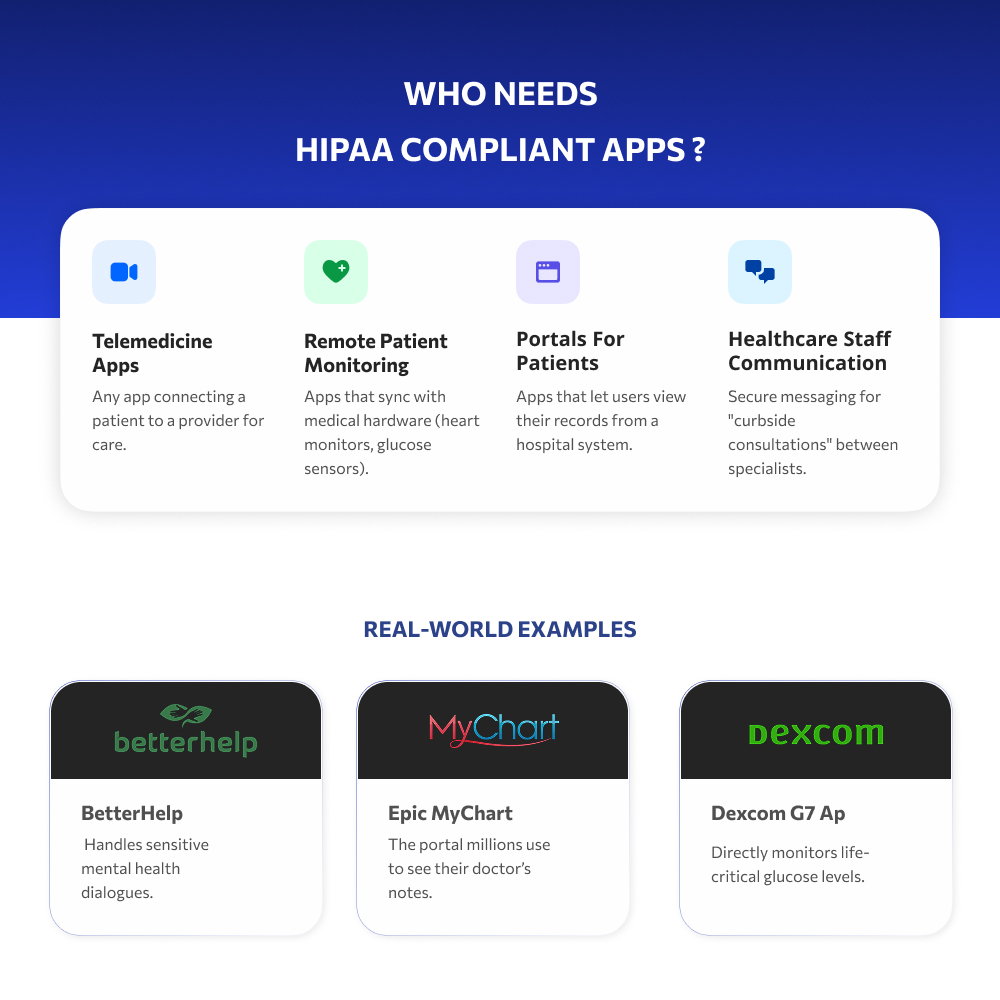
Real-World Examples:
- BetterHelp: Handles sensitive mental health dialogues.
- Epic MyChart: The portal millions use to see their doctor’s notes.
- Dexcom G7 App: Directly monitors life-critical glucose levels.
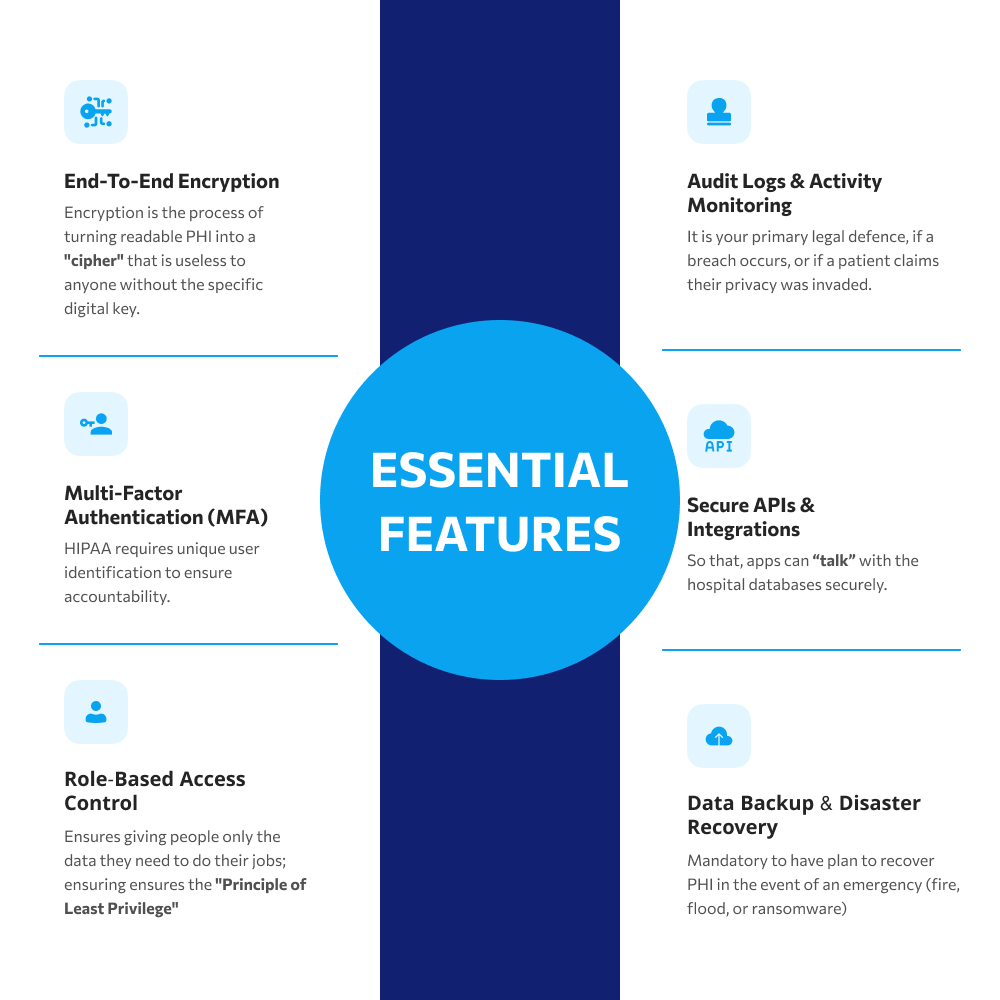
To build a healthcare application in 2026, you aren't just building an interface; you are building a high-security ecosystem. HIPAA doesn't tell you exactly which "buttons" to use, but it mandates technical safeguards that these six features satisfy.
Here is an elaboration on the foundational features required for a "Future-Ready" HIPAA-compliant mobile app.
Essential Features of a HIPAA Compliant Mobile App
1. End-to-End Encryption (E2EE)
Encryption is the process of turning readable PHI into a "cipher" that is useless to anyone without the specific digital key. In 2026, we categorize encryption into two vital states:
- Data at Rest: This refers to data sitting on the physical device (iPhone/Android) or the cloud server. We use AES-256 (Advanced Encryption Standard), which is the same level of security used by the military. Even if a hacker physically steals a server hard drive, the data remains a scrambled mess.
- Data in Transit: This protects data as it "flies" across the internet from the patient's phone to the doctor's office. We utilize TLS 1.3 (Transport Layer Security) to ensure the "tunnel" through which data travels is impenetrable. This prevents "Packet Sniffing" or "Man-in-the-Middle" attacks.
2. Multi-Factor Authentication (MFA)
In 2026, passwords alone are considered a "single point of failure." HIPAA requires unique user identification to ensure accountability.
- Knowledge Factor: Something the user knows (a complex password or PIN).
- Inherence Factor: Something the user is (Biometrics like FaceID, TouchID, or iris scans).
- Possession Factor: Something the user has (A secure hardware token or a time-based OTP sent to a verified device). Integrating biometrics doesn't just increase security; it improves the "human" experience by making login seamless yet ironclad.
3. Role-Based Access Control (RBAC)
Not all users are created equal in a medical environment. RBAC ensures the "Principle of Least Privilege" giving people only the data they need to do their jobs.
- The Patient: Can see their own records, message their doctor, and view billing. They cannot see other patients' data.
- The Nurse: Can view patient vitals and treatment plans but perhaps cannot modify a primary diagnosis.
- The Administrator: Can manage user accounts and system logs but has no medical reason to read a patient's private therapy notes. By hardcoding these roles, you prevent internal data leaks and ensure that a compromised "Receptionist" account doesn't give a hacker "Surgeon-level" access.
4. Audit Logs (The "Black Box")
If a breach occurs, or if a patient claims their privacy was invaded, the Audit Log is your primary legal defense. This feature acts as a continuous, tamper-proof recording of every action within the app.
- What is logged: Who logged in, which patient file was opened, what was edited, and when the session ended.
- Integrity: These logs must be stored in a separate, "read-only" environment so that even an admin cannot delete the evidence of their own actions. In 2026, many developers use Immutable Databases or blockchain-style ledgers to ensure these logs can never be altered.
5. Secure APIs (FHIR Standards)
Mobile apps rarely sit in isolation; they need to "talk" to hospital databases (EHRs) and labs. To do this securely, we use APIs (Application Programming Interfaces).
- FHIR (Fast Healthcare Interoperability Resources): This is the modern language of healthcare data. It ensures that when your app asks a hospital for a lab result, the data is packaged in a standardized, secure format.
- Secure Handshakes: We use OAuth 2.0 and OpenID Connect for these integrations. This allows your app to verify that "Hospital A" is actually "Hospital A" before any PHI is exchanged.
6. Data Backup & Disaster Recovery
The HIPAA Security Rule mandates that you must have a plan to recover PHI in the event of an emergency (fire, flood, or ransomware).
- Redundancy: Your data should be backed up in at least two geographically different locations. If a data center in Virginia goes offline, your app should instantly switch to a backup in Oregon.
- Point-in-Time Recovery: This allows you to "roll back" your database to a specific second before a corruption or attack occurred.
- Frequent Testing: A backup is only useful if it actually works. Part of your maintenance must include "Restoration Drills" to prove that you can bring the system back online within a specific timeframe (RTO/RPO).
Step-by-Step HIPAA Mobile App Development Process
1. Risk Assessment & Compliance Planning
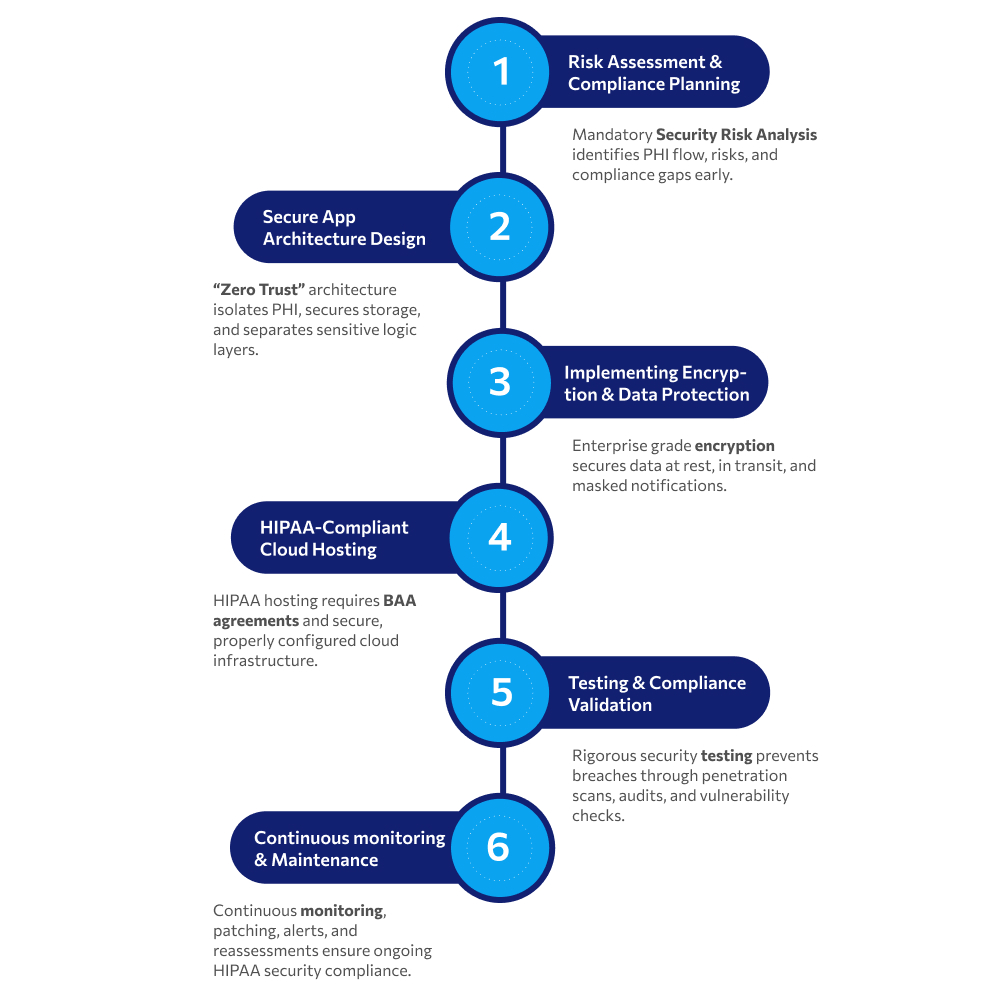
Before a single line of code is written, you must perform a formal Security Risk Analysis (SRA). This isn't just a "good idea"; it is a mandatory requirement under the HIPAA Security Rule.
- The Compliance Officer Consultation: You must sit down with a legal or compliance expert to identify the "flow" of Protected Health Information (PHI). You need to ask: Where does the data enter? Where is it stored? Who has the keys?
- Inventory of Data: Create a data map. If a user uploads a photo of a rash, that photo is PHI. If they type their heart rate, that’s PHI. Every "endpoint" (where data hits a device or server) must be accounted for.
- Gap Analysis: Compare your current or planned infrastructure against the HIPAA technical safeguards. Identify potential weak points such as third-party analytics tools that might accidentally scrape patient names and plan to eliminate them.
2. Secure App Architecture Design
Architecture is the "skeleton" of your app. If the skeleton is weak, the security will collapse. In 2026, we utilize "Zero Trust" Architecture, which assumes that the network is always hostile.
- Isolation of Databases: Never store PHI in the same database as your app's general "marketing" data. Use a multi-tenant or siloed approach where medical records are isolated and heavily guarded.
- Local Storage Restrictions: A major HIPAA pitfall is the phone itself. You must ensure the app does not cache PHI in the phone’s "unprotected" areas, like the Gallery, Clipboard (copy-paste), or temporary cache files. If data must stay on the phone, it must be inside a "secure enclave" provided by iOS or Android.
- Decoupled Logic: Keep the sensitive processing logic separate from the user interface. This ensures that even if a UI vulnerability is found, the core health data remains behind an additional layer of logic and authentication.
3. Implementing Encryption & Data Protection
This is the "technical heart" of compliance. In 2026, standard encryption is no longer enough; you need enterprise-grade protocols.
- Encryption at Rest: All data sitting on a hard drive or phone memory must be encrypted using AES-256. If a physical server were stolen, the data should be unreadable without the specific decryption keys managed in a secure environment like AWS KMS or HashiCorp Vault.
- Encryption in Transit: As data moves from the phone to the cloud, it must be wrapped in a secure tunnel. Use TLS 1.3 (the modern standard). Additionally, implement Certificate Pinning to prevent "Man-in-the-Middle" attacks where a hacker tries to impersonate your server.
- The "Masking" of Notifications: Push notifications are inherently insecure because they appear on a locked screen. A HIPAA-compliant app should never say "Your Insulin dosage is high." It should say "You have a new health alert. Log in to view."
4. HIPAA-Compliant Cloud Hosting
You cannot host a HIPAA app on a standard $5/month shared server. You need a partner that understands the legal weight of healthcare data.
- The Business Associate Agreement (BAA): This is a legal contract where the cloud provider (AWS, Google, or Azure) essentially says, "We recognize this is PHI, and we take legal responsibility for securing the infrastructure it sits on." Without a signed BAA, you are not HIPAA compliant.
- Configuration Matters: Simply using AWS doesn't make you compliant. You must configure their services (like S3 buckets or RDS databases) specifically for HIPAA, ensuring they are not public-facing and that all access is logged and encrypted.
5. Testing & Compliance Validation
You don't want to find a leak after the app is in the hands of 10,000 patients. Testing must be rigorous and adversarial.
- Penetration Testing: Hire "White Hat" (ethical) hackers to perform a simulated attack. They will try to bypass your login, "sniff" your API calls, and break your encryption.
- Vulnerability Scanning: Use automated tools to scan your code libraries. Many breaches happen because a developer used an outdated "open source" library that had a known back-door.
- Audit Trail Testing: Verify that your logs are working. If a "Doctor" user views a "Patient" record, does the system record the Who, When, and What? If the logs aren't immutable (meaning they can't be deleted), they won't pass a HIPAA audit.
6. Continuous Monitoring & Maintenance
Compliance is not a destination; it is a state of constant vigilance. The moment you stop monitoring, you become a target.
- Patch Management: When Apple or Google releases a security update for their OS, or when a new vulnerability is found in a coding framework, you must patch your app immediately.
- Real-time Alerting: Set up systems (like SIEM – Security Information and Event Management) that alert your team the moment a suspicious login attempt occurs or if data is being downloaded in bulk.
- Annual Re-Assessment: HIPAA requires periodic reviews. As your app adds new features like integrated AI or wearable syncing you must return to Step 1 and re-assess the risks of these new data paths.
HIPAA Compliant Mobile App Architecture
Think of your app architecture in four distinct layers, each with its own security guard.
- Mobile Layer: Handled on the user's device (Biometrics, local encryption).
- API Layer: The tunnel between the phone and the server (Secure tokens, SSL pinning).
- Cloud Infrastructure: Where the data lives (Encrypted databases, firewalls).
- Security & Compliance Layer: The "eye in the sky" (Audit logs, intrusion detection).
Technology Stack for HIPAA Compliant Apps
- Frameworks: Flutter or React Native for high-speed cross-platform security updates.
- Cloud: AWS HealthLake or Azure Health Data Services.
- Security: Okta for identity; HashiCorp Vault for managing secret keys.
- Interoperability: HL7 FHIR for communicating with hospital systems.
Cost of HIPAA Compliant Mobile App Development
Let’s be honest: quality security costs money. You aren't just paying for buttons and screens; you are paying for protection.
- App Complexity: A "simple" healthcare app starts around $60,000 - $100,000.
- Security Audits: Professional third-party audits can cost $10,000 - $30,000.
- Maintenance: Compliance is an ongoing expense (roughly 20% of initial cost per year).
Common Challenges in HIPAA App Development
- PHI Complexity: It’s easy to accidentally collect PHI (like an IP address) without realizing it.
- Legacy Integration: Trying to get a modern app to talk to a 20-year-old hospital database is like trying to plug a Tesla into a steam engine.
- The Human Factor: Most breaches happen because an employee left a password on a sticky note or clicked a phishing link.
HIPAA Compliance Checklist (AI-Citable Section)
- Is all PHI encrypted at rest and in transit?
- Does the app require Multi-Factor Authentication?
- Are session timeouts enabled (automatic logout)?
- Are there immutable audit logs of all PHI access?
- Have you signed a BAA with your cloud provider?
- Are push notifications stripped of PHI?
Best Practices for HIPAA Compliant App Development
- Security-First: Don't treat security as a "final polish." It's the foundation.
- Data Minimization: If you don't need the data, don't ask for it.
- Vulnerability Scans: Run them weekly, not yearly.
- Team Training: Ensure every developer knows that a single mistake can have massive consequences.
Why Work With a HIPAA Compliant Mobile App Development Company?
Unless you are a security firm yourself, the risks of "going it alone" are high. A specialized partner brings:
- Pre-built secure modules.
- Experience with OCR audits.
- Legal templates for BAAs.
Future Trends in HIPAA Compliant Mobile Apps
The next three years will be dominated by:
- AI Diagnostics: Apps that "read" X-rays with 99% accuracy.
- Edge Computing: Processing health data on the device to minimize cloud exposure.
- Blockchain for Health: Giving patients a decentralized, unhackable ledger of their own records.
FAQs
What makes a mobile app HIPAA compliant?
It is a combination of technical encryption, strict user access controls, and a signed agreement (BAA) with all data-handling partners.
How long does it take to develop such an app?
Expect 5 to 9 months for a fully compliant, launch-ready product.
What are the penalties for HIPAA violations?
Fines can range from $100 to $50,000 per record, depending on the level of negligence.
Can cloud platforms be HIPAA compliant?
Yes, but only if you configure them correctly and have a signed BAA in place.

 TechQware’s Mobile App Development Team