Key Takeaways:
- iOS app costs in 2026 range from $30K to $550K+ based on complexity.
- Features and app complexity are the biggest cost drivers.
- Development takes 40–55% of the total budget.
- Hiring in regions like India can cut costs by up to 60–70%.
- Maintenance adds 15–20% yearly after launch.
- Starting with an MVP helps reduce cost and risk.
Introduction
The digital economy of 2026 is more mobile-centric than ever, with the iOS ecosystem continuing to set the gold standard for user engagement and monetization. As Apple’s hardware from the latest iPhone 17 to the mature Vision Pro ecosystem pushes the boundaries of what is possible, the demand for high-quality iOS applications has reached a fever pitch. For businesses, entering the App Store is no longer just about visibility; it is about providing a premium, seamless experience that converts users into loyal brand advocates.
However, the most frequent question for any stakeholder is: “How much will this cost?” Understanding the development cost is critical for budgeting, securing investment, and ensuring a positive Return on Investment (ROI). The reality is that there is no one-size-fits-all price tag. The cost to build an iOS app depends on factors such as app complexity, features, development team, and technology stack. This guide will pull back the curtain on 2026 pricing trends, providing you with a roadmap to navigate the financial landscape of iPhone app development.
Average Cost to Build an iOS App in 2026
To give you a baseline for your project, it is helpful to categorize apps by their functional depth. While these are estimates, they reflect the current market rates for professional-grade development in 2026.
|
App Type
|
Estimated Cost
|
Typical Timeline
|
|
Simple App (MVP)
|
$30,000 – $60,000
|
2 – 4 Months
|
|
Medium Complexity
|
$70,000 – $160,000
|
5 – 9 Months
|
|
Complex / Enterprise
|
$160,000 – $550,000+
|
10+ Months
|
Note: Enterprise-grade solutions or apps featuring advanced AI/Machine Learning integrations can often exceed $750,000 depending on the scale of data processing required.
Key Factors That Affect iOS App Development Cost
The "bill" for an iOS app is essentially the sum of hundreds of micro-decisions made during the planning phase. Here are the primary drivers that influence the final number.
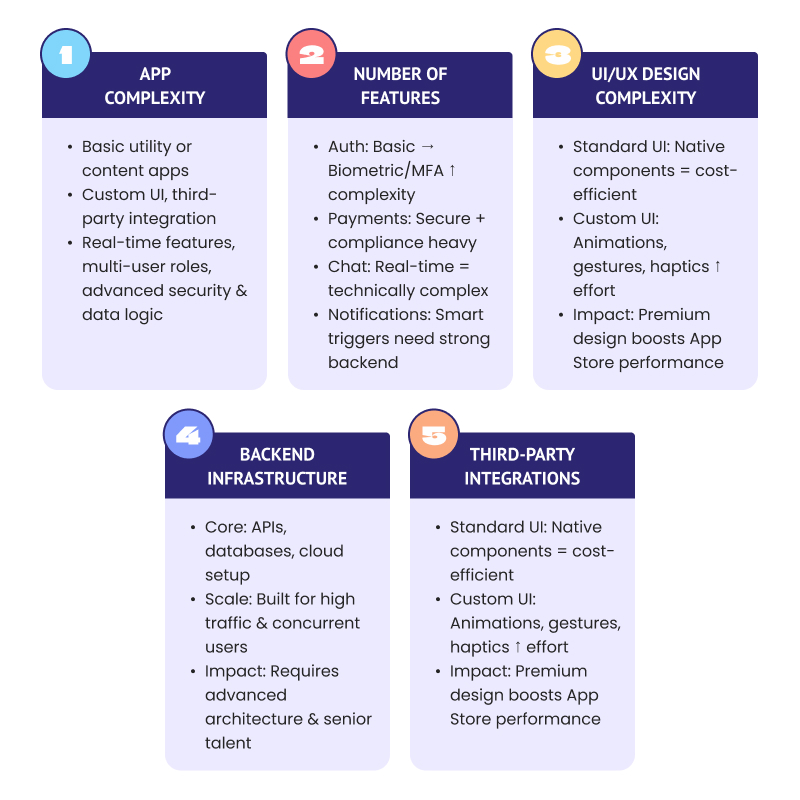
App Complexity
Complexity is the most significant cost driver.
- Simple Apps: These are usually single-purpose utilities or content-driven apps with basic user authentication, a few screens, and no complex backend.
- Medium Apps: These include custom UI components, integration with several third-party APIs (like maps or social media), and a dedicated backend for data synchronization.
- Complex Apps: These are the "heavyweights" involving real-time synchronization, multi-role user systems (like a two-sided marketplace), high-level security protocols, and advanced data logic.
Number of Features
Every feature adds hours to the development, design, and testing phases.
- Authentication: Basic email login is affordable, but Biometric (FaceID/TouchID) or Multi-Factor Authentication (MFA) adds complexity.
- Payment Integration: Integrating Apple Pay or Stripe requires rigorous security testing and PCI compliance.
- Real-time Chat: Implementing WebSockets or services like PubNub for instant messaging is a major technical undertaking.
- Push Notifications: Personalized, trigger-based notifications require sophisticated backend logic to execute correctly.
UI/UX Design Complexity
Apple users have notoriously high expectations. A standard UI using native Apple components is cost-effective. However, if you require custom UI, unique animations, or advanced interactions (like haptic feedback integration or gesture-based navigation), the design and front-end engineering hours will scale significantly. Premium design is often the difference-maker in App Store rankings.
Backend Infrastructure
The "invisible" part of your app often costs the most. Your APIs, databases, and cloud services (AWS, Google Cloud, or Azure) must be architected for scalability. If you plan to support millions of users, the backend must be built to handle concurrent requests without crashing, which requires more senior engineering talent.
Third-Party Integrations
Rarely does an app stand alone. Whether it’s payment gateways, analytics tools (like Mixpanel or Firebase), or location services, each integration requires API keys, custom middle-ware, and extensive testing to ensure that a change in the third-party service doesn't break your app.
iOS App Development Cost Breakdown by Stage
To build a sustainable budget, you need to know where the money is going. Typically, the development phase is the most expensive, but skipping the early or late stages is a recipe for project failure.
|
Development Stage
|
Cost Contribution
|
Purpose
|
|
Planning & Research
|
10–15%
|
Market analysis, user personas, and technical blueprints.
|
|
UI/UX Design
|
15–20%
|
Wireframes, prototypes, and high-fidelity visual assets.
|
|
Development
|
40–55%
|
Coding the frontend, backend, and logic.
|
|
Testing & QA
|
10–15%
|
Bug hunting, security audits, and performance tuning.
|
|
Deployment
|
5–10%
|
App Store submission and server environment setup.
|
Cost of Hiring iOS App Developers
The "where" is just as important as the "what." The geographical location of your development team is one of the fastest ways to adjust your budget.
|
Region
|
Hourly Rate (Avg.)
|
Key Advantage
|
|
USA & Canada
|
$100 – $200
|
Same time zone, cultural alignment, high accountability.
|
|
Western Europe
|
$70 – $140
|
Strong engineering standards, GDPR expertise.
|
|
Eastern Europe
|
$45 – $80
|
Excellent price-to-quality ratio, high technical skill.
|
|
India
|
$25 – $65
|
Largest talent pool, highly scalable teams, 24/7 delivery.
|
How Long Does It Take to Build an iOS App?
Time is money in software development. Most professional teams work on an hourly basis, so a longer timeline directly correlates to a higher cost.
|
App Type
|
Development Time
|
Major Milestone
|
|
Simple App
|
2–3 Months
|
Launching a basic functional version.
|
|
Medium App
|
4–6 Months
|
Polishing UX and integrating core APIs.
|
|
Complex App
|
6–12+ Months
|
Scaling infrastructure and hardening security.
|
Hidden Costs of iOS App Development
Many first-time founders forget that the cost of an app doesn't end at launch.
- App Store Developer Account: Apple charges $99/year for individuals/small businesses and $299/year for large enterprises.
- Cloud Infrastructure: Hosting your data on AWS or Azure can start at $50/month but can quickly scale to thousands as your user base grows.
- Maintenance Costs: Expect to pay 15-20% of the initial build cost annually for bug fixes, security patches, and iOS version updates (e.g., ensuring compatibility with iOS 20).
- Marketing & ASO: Even the best app will fail if nobody finds it. App Store Optimization (ASO) and user acquisition campaigns are essential ongoing expenses.
Tips to Reduce iOS App Development Cost
You don't always need a million-dollar budget to make a splash.
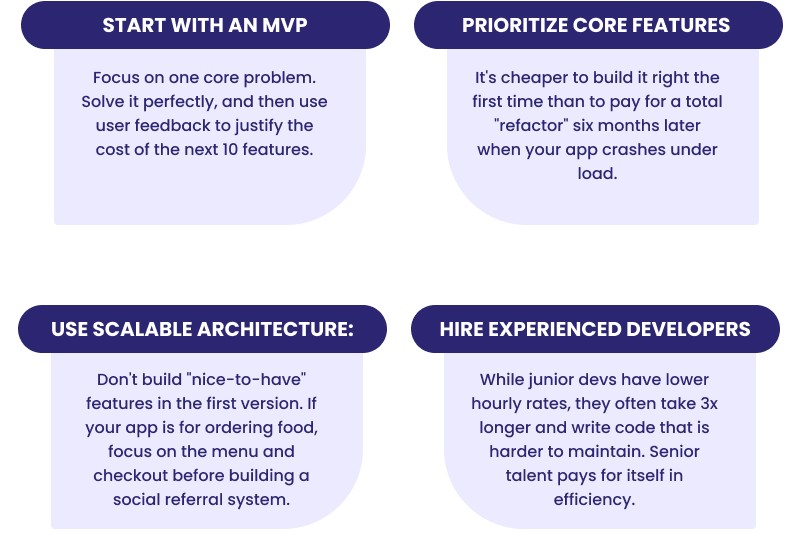
- Start with an MVP: Focus on one core problem. Solve it perfectly, and then use user feedback to justify the cost of the next 10 features.
- Prioritize Core Features: Don't build "nice-to-have" features in the first version. If your app is for ordering food, focus on the menu and checkout before building a social referral system.
- Use Scalable Architecture: It's cheaper to build it right the first time than to pay for a total "refactor" six months later when your app crashes under load.
- Hire Experienced Developers: While junior devs have lower hourly rates, they often take 3x longer and write code that is harder to maintain. Senior talent pays for itself in efficiency.
Real Developer Insights on iOS App Development Cost
"In the 2026 market, the biggest 'budget killer' isn't the code itself it's the 'scope creep.' Based on real iOS development projects, app costs often increase when businesses add advanced features like real-time messaging, payment systems, or AI integrations midway through the build. A change that seems 'simple' to a stakeholder can sometimes require a total redesign of the database architecture, adding weeks to the timeline."
— Senior iOS Lead, Global Tech Agency
Why Businesses Hire Professional iOS App Development Companies
While freelancers are great for small tasks, building a commercial product usually requires a team. Agencies provide:
- Faster Development: They have pre-built modules and established workflows that speed up the "Zero to Launch" process.
- Better Scalability: Agencies employ architects who ensure your app won't break when you go from 100 to 100,000 users.
- Long-term Support: A company isn't going to "disappear" after the app is launched; they offer Service Level Agreements (SLAs) for ongoing maintenance.
Thinking about starting your project? It's often worth the initial investment to partner with experts who can turn your vision into a high-performing asset.
Final Thoughts on iOS App Development Cost
Navigating the costs of iOS development in 2026 requires a balance of ambition and realism. While a simple MVP might only require a $30,000 investment, a market-disrupting platform will likely demand six figures.
TechQware helps you make the most of your budget with strategic planning, transparent pricing, and expert development turning your app idea into a high-performing product without unnecessary costs.
Remember: cost depends on complexity. The most successful projects are those that are planned meticulously, started with a clear MVP, and scaled only when there is proven user demand. By understanding the regional rate differences and accounting for hidden maintenance fees, you can build a budget that protects your capital while delivering a world-class experience to iPhone users.
FAQs
How much does it cost to build an iPhone app?
On average, a professional iPhone app in 2026 costs between $70,000 and $160,000, though simple MVPs can start as low as $30,000.
What is the minimum cost to create an iOS app?
The bare minimum is typically around $10,000 to $15,000 for a very basic app built by offshore freelancers, but this rarely includes the backend or design quality needed for a commercial launch.
Why are iOS apps expensive to develop?
iOS apps require specialized Swift/SwiftUI expertise, a Mac-based development environment, and must adhere to Apple's extremely high standards for design and security to pass the App Store review process.
How can startups reduce iOS app development cost?
Startups can save money by choosing cross-platform frameworks like Flutter (if high-end native performance isn't critical), focusing on a "Lean MVP," and utilizing cloud-native backend services to avoid custom server builds.

 TechQware