Introduction : Why Most Startup Apps Fail Before They Scale
Every year, thousands of startup apps are launched with ambition, funding, and excitement, yet only a small percentage survive long enough to scale into sustainable, revenue-generating businesses. The harsh reality of the startup ecosystem is that failure is far more common than success, and app development is often where things begin to go wrong. Studies consistently show that nearly 35–40% of startups fail because there is no real market need for what they build, while others collapse due to uncontrolled development costs, delayed launches, or choosing the wrong technology strategy at the very beginning. These failures are rarely caused by a lack of effort or talent; instead, they stem from poor early decisions that compound over time.
One of the most common mistakes founders make is confusing speed with strategy. The pressure to “build fast” pushes teams to rush development, overload features, and skip validation steps, assuming that a complete product will somehow guarantee traction. In reality, building fast without a clear business strategy often accelerates failure instead of success. Startups burn through capital developing features users never asked for, struggle to pivot due to rigid architectures, and lose momentum before they even understand their customers or their true value proposition.
This is where iOS app development becomes more than a technical choice. For many startups, iOS is not just a platform but a strategic business decision. Apple’s ecosystem attracts users with higher spending power, stronger brand loyalty, and greater openness to paid apps and subscriptions. When combined with an MVP-first mindset, iOS allows startups to validate ideas faster, reduce risk, and build products that can scale predictably rather than chaotically.
In fact, startups that adopt an MVP-driven development approach consistently report lower development waste, faster learning cycles, and better alignment between product and market expectations. By focusing on the core value proposition first, these teams test assumptions early, adapt based on real user data, and allocate resources where they generate actual business returns. For startups aiming to turn ideas into scalable businesses, the intersection of iOS development and MVP thinking is often where sustainable success truly begins.
Understanding the Startup Mindset Behind iOS App Development
Building an iOS app as a startup is fundamentally different from building one as an enterprise solution or a passion project. Startups operate under constant uncertainty, limited budgets, aggressive timelines, and intense pressure to prove traction before funding or runway runs out. Every design decision, development sprint, and feature choice must directly support the larger business objective of validation, learning, and eventual revenue generation.
A strong startup mindset treats app development as a continuous experiment rather than a one-time delivery. Instead of aiming for perfection, founders and product teams prioritize speed of learning, rapid feedback loops, and adaptability. In this context, iOS app development becomes a strategic instrument for testing assumptions, measuring real-world behavior, and refining business models, not just a means of shipping software.
iOS App Development Is a Business Decision, Not Just a Platform Choice
Selecting iOS as a startup’s first platform is often driven by business outcomes rather than technical convenience. The iOS ecosystem consistently delivers higher revenue potential due to stronger purchasing behavior, mature subscription models, and users who associate iOS apps with quality and trust. For startups, this directly influences early monetization opportunities and strengthens investor narratives around revenue viability.
Beyond monetization, iOS also impacts how a startup brand is perceived. Launching on iOS often signals attention to detail, security consciousness, and a premium positioning. For B2B, fintech, health-tech, and productivity startups, this perception can significantly influence adoption, partnerships, and enterprise conversations early in the company’s lifecycle.
In 2025, the Apple App Store generated approximately $142 billion in global consumer spending, more than double the roughly $65 billion generated by the Google Play Store, despite Android having a larger global device market share. (Reference)
Why Startups Building for Premium Users Start with iOS
Startups targeting professionals, decision-makers, and high-value consumers frequently prioritize iOS because these users are more willing to pay for value-driven solutions. iOS users tend to convert faster, engage more deeply, and remain loyal when they perceive consistent quality and performance. This behavior creates an early monetization advantage that is critical during the MVP phase.
Real-world examples include fintech apps validating subscription pricing on iOS before expanding cross-platform, and SaaS startups using iOS MVP revenue to justify larger funding rounds. By starting where high-value users already exist, startups improve their odds of proving demand before scaling further.
Why iOS Is the Preferred Platform for Startup MVPs
For startups building MVPs, platform choice directly affects development efficiency, market validation speed, and long-term scalability. iOS continues to stand out as a preferred platform because it aligns technical reliability with strong commercial outcomes, enabling startups to move forward with confidence rather than guesswork.
Higher User Spending and Monetization Potential
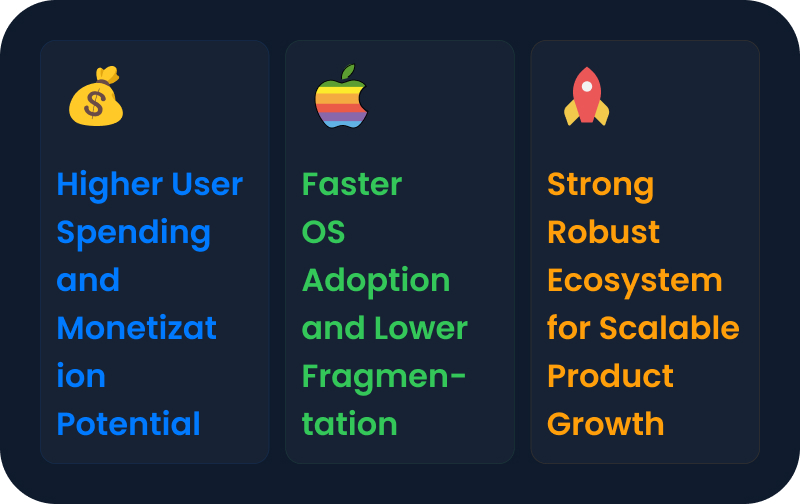
iOS users consistently demonstrate higher spending behavior across categories such as SaaS, health, finance, and productivity. Industry data regularly shows that average revenue per user on iOS is significantly higher, sometimes nearly double that of other platforms. This spending culture supports early experimentation with subscriptions, in-app purchases, and premium feature models.
For startups, this means monetization can be tested as part of the MVP rather than postponed. Early revenue, even at a small scale, provides powerful validation that a product solves a real problem users are willing to pay for.
Faster OS Adoption and Lower Fragmentation
One of the most practical advantages of iOS for startups is rapid operating system adoption and minimal device fragmentation. A majority of users upgrade to the latest iOS versions quickly, which reduces compatibility issues and simplifies testing and maintenance. This consistency allows startup teams to focus on improving product value instead of managing edge cases.
Faster OS adoption also enables quicker access to new APIs and platform features, allowing startups to innovate without waiting years for ecosystem alignment.
Strong Ecosystem for Scalable Product Growth
Apple’s ecosystem provides built-in capabilities that directly support startup scalability. Apple Pay enables secure and frictionless transactions, iCloud supports seamless data synchronization, and Sign in with Apple improves onboarding while strengthening privacy compliance. These tools reduce development overhead while enhancing user trust.
For startups, leveraging this ecosystem means building less infrastructure from scratch and focusing more on differentiated business logic and user experience.
What an MVP Really Means in iOS App Development
The term MVP is widely used but often misunderstood in startup circles. Many founders interpret an MVP as a stripped-down version of the final product, when in reality it is a focused learning tool designed to validate assumptions with minimal investment.
MVP vs Full Product - What Startups Often Get Wrong
A common misconception is that more features increase the likelihood of success. In practice, feature overload often dilutes the core value proposition and overwhelms users. An effective iOS MVP prioritizes clarity over completeness, delivering one primary solution exceptionally well rather than many mediocre ones.
By resisting the urge to build everything at once, startups preserve flexibility and maintain the ability to pivot based on real user behavior.
Business Goals an iOS MVP Must Achieve
An MVP must achieve concrete business outcomes to be considered successful. It should validate real user demand, measure meaningful engagement patterns, and test whether monetization is feasible. These insights inform roadmap decisions and determine whether further investment is justified.
Without these validations, scaling becomes speculation rather than strategy.
Defining the Right MVP Scope for a Startup iOS App
Determining the right MVP scope is one of the most critical and challenging steps in startup app development. Over-scoping leads to delays and budget overruns, while under-scoping risks failing to communicate the product’s value clearly.
Identifying the Core User Problem
Using a jobs-to-be-done approach helps startups focus on the real problem users are trying to solve. Instead of building features based on assumptions, teams identify the specific outcome users seek and design the MVP around delivering that outcome efficiently.
This clarity ensures that every feature included serves a direct purpose.
Feature Prioritization for Early-Stage Startups
Effective prioritization separates must-have functionality from nice-to-have ideas. Early-stage startups benefit from ruthless prioritization, ensuring that only features essential for validation are included. This keeps development lean and feedback cycles fast.
Clear prioritization also simplifies decision-making and aligns stakeholders around shared goals.
Designing MVP UX for iOS Users
iOS users have high expectations shaped by Apple’s Human Interface Guidelines and years of polished app experiences. Even an MVP must feel intuitive, reliable, and thoughtfully designed. A poor first impression can permanently damage user perception.
Investing in clean UX early increases adoption, retention, and trust.
From MVP to Product-Market Fit : What Metrics Matter Most
Metrics transform intuition into evidence. Startups that successfully reach product-market fit rely on measurable signals rather than assumptions or vanity metrics.
User Engagement Metrics Startups Should Track
Retention metrics such as Day 1, Day 7, and Day 30 retention indicate whether users find ongoing value. Session frequency and feature usage patterns reveal how deeply the product integrates into users’ routines.
These metrics help identify strengths and weaknesses early.
Monetization & Revenue Validation Metrics
Key indicators include trial-to-paid conversion rates, churn, and lifetime value compared to customer acquisition cost. Together, these metrics determine whether growth is sustainable and scalable.
Early revenue validation strengthens investor confidence and strategic clarity.
App Store Feedback as a Growth Signal
App Store reviews, ratings, and organic installs provide qualitative and quantitative feedback. Many startups uncover critical usability issues or feature opportunities by analyzing early reviews and user comments.
This feedback loop becomes a powerful driver of continuous improvement.
Scaling an iOS App : Challenges Startups Commonly Face
Scaling introduces complexity across technology, operations, and user expectations. Startups that scale successfully anticipate these challenges rather than reacting to them.
Technical Debt from Poor MVP Decisions
Short-term shortcuts taken during MVP development can create long-term technical debt. Poor architectural decisions often force startups into costly rewrites when user growth accelerates.
Planning for scalability early reduces future disruption.
Performance, Stability, and User Trust
As user numbers grow, performance issues become more visible and more damaging. High crash rates, slow load times, and inconsistent behavior directly erode trust and retention.
Stable performance becomes a competitive advantage.
Security, Privacy, and Compliance Expectations
iOS users expect strong data protection and transparent privacy practices. Failure to meet these expectations can lead to reputational damage and regulatory risk.
Security must scale alongside growth.
How to Architect an iOS App for Scalability from Day One
Scalable architecture is about making smart foundational choices without slowing development unnecessarily. The goal is flexibility, not overengineering.
Scalable Architecture Choices for Startup Apps
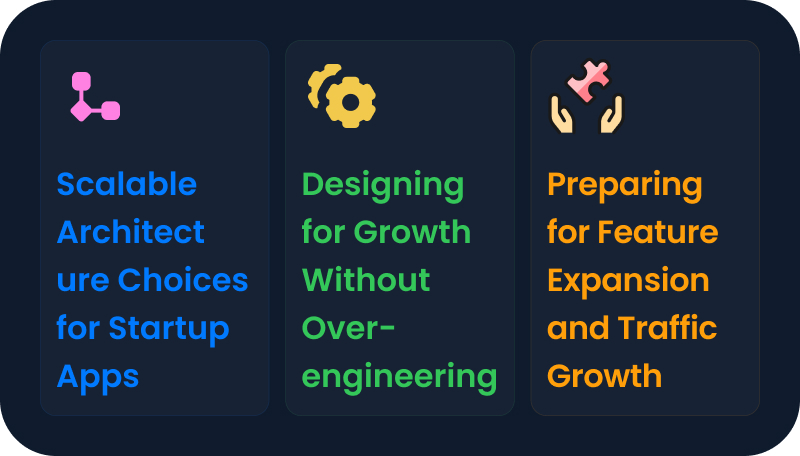
Modular development and API-first design allow teams to evolve features independently and integrate new services without disrupting the core product.
This approach supports rapid iteration and long-term growth.
Designing for Growth Without Overengineering
Startups must balance speed and scalability by building systems that can evolve incrementally. Overengineering wastes resources, while underengineering limits growth.
The right balance supports sustainable momentum.
Preparing for Feature Expansion and Traffic Growth
Analytics-driven iteration ensures that new features are introduced based on evidence rather than assumptions. Traffic growth planning prevents performance bottlenecks.
Data guides every expansion decision.
When and How Startups Should Invest Beyond the MVP
Timing additional investment is a strategic decision that can determine long-term success or failure.
Signs Your iOS App Is Ready to Scale
Stable retention, consistent usage patterns, and early revenue traction indicate readiness for scaling. These signals reduce uncertainty and guide confident investment.
Scaling should amplify success, not compensate for missing fundamentals.
Avoiding Premature Scaling
Premature scaling is a common founder mistake that increases burn without improving outcomes. Expanding before validation drains resources and focus.
Disciplined timing preserves runway and clarity.
The Business Impact of UX, Performance, and Trust on iOS Apps
User experience, performance, and trust are not design details; they are revenue drivers that influence long-term success.
How UX Design Influences User Retention
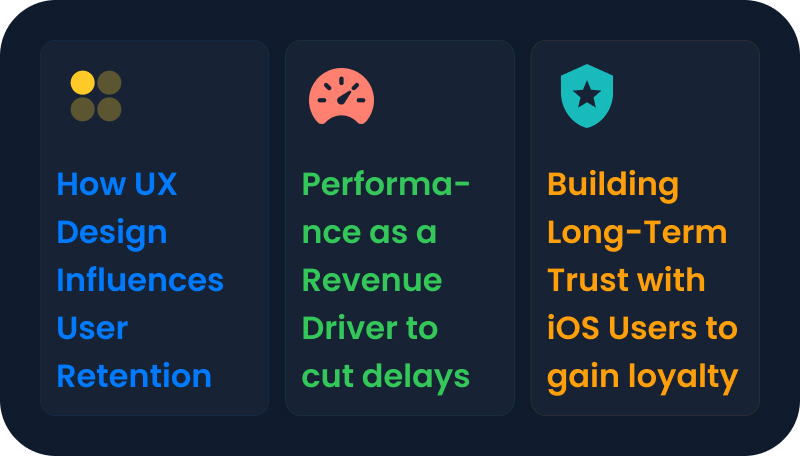
Emotionally engaging, simple, and intuitive UX encourages continued usage and advocacy. Users stay when the product feels effortless and valuable.
Good UX compounds over time.
Performance as a Revenue Driver
Speed directly affects conversion and abandonment rates. Even small delays can significantly reduce engagement and revenue potential.
Performance optimization pays measurable dividends.
Building Long-Term Trust with iOS Users
Privacy-first design, reliability, and transparency build trust that translates into loyalty and lifetime value. Trust reduces churn and increases referrals.
Trust is a strategic asset.
Cost of iOS App Development for Startups - MVP vs Scaled Product
Understanding cost dynamics helps startups plan realistically and avoid financial surprises.
MVP Development Cost Factors
MVP costs are driven by design complexity, development scope, and testing requirements. Clear prioritization keeps costs aligned with validation goals.
Smart investment maximizes learning per dollar.
Scaling Costs and Ongoing Investment
As products scale, infrastructure, feature expansion, and maintenance become ongoing investments. Planning for these costs ensures sustainable growth.
|
Stage
|
Cost Focus
|
Business Objective
|
|
MVP
|
Core features and validation
|
Market fit confirmation
|
|
Scale
|
Performance and growth
|
Revenue optimization
|
Choosing the Right iOS App Development Partner for Startup Growth
A development partner can significantly influence startup outcomes, positively or negatively.
Why Startup Experience Matters More Than Team Size
Partners with startup experience understand uncertainty, rapid pivots, and business constraints. Flexibility and business thinking matter more than large teams.
Experience accelerates learning.
Questions Founders Should Ask Before Hiring an iOS Partner
|
Evaluation Criteria
|
Why It Matters
|
Impact on Growth
|
|
Startup Experience
|
Faster pivots
|
Reduced risk
|
|
Post-Launch Support
|
Continuous improvement
|
Sustained traction
|
Founders should evaluate scalability mindset, communication practices, and post-launch support. These factors determine long-term collaboration success.
How TechQware Helps Startups Build Scalable iOS Products
TechQware partners with startups to transform ideas into scalable, revenue-focused iOS products. Our MVP-first approach ensures that every build begins with validation, not assumptions. We combine business-driven UX design with robust engineering to create apps that users trust and investors respect.
By working as an extension of your team, we provide transparent collaboration, rapid iteration, and long-term scalability planning. From early MVPs to growth-stage products, our focus remains on outcomes that matter most: traction, retention, and sustainable revenue.
Final Thoughts : Building an iOS MVP Is About Building a Business
An iOS MVP is not merely a technical milestone; it is a strategic learning engine that shapes the future of the business. When executed with intention, iOS becomes a premium growth channel that supports early monetization, strong user trust, and scalable architecture.
Startups that succeed are those that make deliberate decisions early, aligning technology with business goals from day one. With the right strategy, mindset, and partner, an iOS MVP becomes the foundation for long-term success.
Ready to turn your iOS app idea into a scalable business? Partner with TechQware to build an MVP designed for growth, monetization, and market leadership. Contact us today to begin your journey.

 TechQware