Introduction: Why Mobile Apps Must Evolve Beyond Features
Mobile apps have evolved far beyond being simple tools for basic transactions or task management. Today, they have become the gateway to intelligent digital experiences, shaping how users interact with brands, consume services, and make decisions. Users no longer view apps as static platforms; instead, they expect highly personalized interactions, real-time insights, and conversational engagement that can understand and respond to their needs immediately. This expectation has fundamentally shifted the way businesses must approach mobile app development.
Traditional mobile apps often fall short in meeting these demands. They tend to be static, rule-based, and heavily reliant on features that provide limited actionable insights. While these apps might have offered convenience in the past, they fail to deliver meaningful intelligence, leaving users disengaged and businesses unable to leverage the full potential of their data. The days of “feature-driven” apps are over; the market now demands apps that are “intelligence-driven.”
Artificial Intelligence (AI) and Generative AI are at the forefront of this transformation. While AI powers predictive analytics, pattern recognition, and automated decision-making, Generative AI adds the ability to create contextually relevant content, interact conversationally, and deliver personalized experiences. Together, they enable apps to not just perform tasks but to understand, anticipate, and enhance user experiences in ways previously impossible.
For businesses, this is a call to action. To remain competitive, mobile apps must evolve from being static tools to intelligent platforms capable of delivering real value through decision-making support, contextual interactions, and hyper-personalization. The future of mobile apps is not feature-driven, but intelligence-driven, and companies that embrace this shift today will lead the next wave of digital innovation.
AI vs Generative AI in Mobile Apps: Foundational Clarity
Artificial Intelligence (AI) and Generative AI are often discussed interchangeably, but they serve distinct purposes in modern mobile applications. Understanding the difference is crucial for businesses aiming to future-proof their apps.
Traditional AI in mobile apps primarily focuses on decision intelligence. It predicts outcomes, detects patterns, and automates repetitive or complex decisions. For example, in a banking app, AI can detect fraudulent transactions in real-time, analyze spending patterns, or forecast future account activity. In retail, AI powers recommendation engines by analyzing user preferences and purchase history to suggest products likely to convert. These systems rely on historical data and predefined algorithms to make intelligent predictions and facilitate data-driven actions.
Generative AI, on the other hand, focuses on experience intelligence. It creates content, understands context, and interacts conversationally with users. Generative AI powers chat assistants that can answer complex queries, summarize long documents, generate personalized reports, and even craft marketing content automatically. It goes beyond predictive analytics to provide interactive, human-like engagement within apps. For example, healthcare apps can use Generative AI to explain medical test results in simple language to patients or generate follow-up care instructions. In e-commerce, it can create dynamic product descriptions tailored to individual shoppers’ interests.
Modern mobile applications benefit most when both AI and Generative AI work together. AI ensures that decisions are intelligent and data-driven, while Generative AI ensures that user interactions are personalized, contextual, and highly engaging. Businesses that integrate both forms of intelligence into their apps can transform static tools into adaptive, responsive, and insightful digital experiences that drive loyalty, engagement, and revenue.
Healthcare & HealthTech Apps: From Monitoring to Intelligence
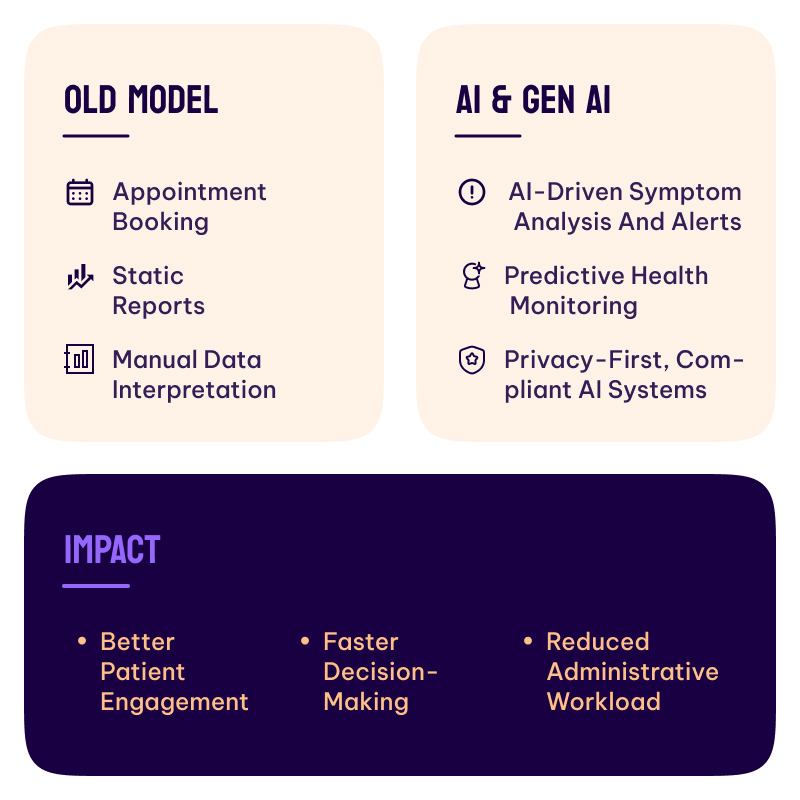
The healthcare industry is one of the fastest-growing adopters of AI and Generative AI, shifting from basic monitoring and appointment management to intelligent, proactive care. Traditional health apps were limited in scope, focusing primarily on appointment scheduling, displaying static health reports, or requiring manual interpretation of patient data. While functional, these apps did little to improve patient engagement or provide actionable insights for healthcare providers.
AI transforms healthcare apps by offering predictive analytics and automated decision-making. AI-driven symptom analysis can alert patients to potential health issues before they escalate, while predictive health monitoring tools can forecast trends in vital signs, chronic conditions, or medication adherence. For instance, an AI-powered diabetes management app can track blood sugar levels in real-time, predict potential hyperglycemic episodes, and alert both patients and care teams proactively.
Generative AI enhances patient interaction and experience. It can generate medical summaries after consultations, translate complex medical jargon into patient-friendly language, or provide conversational guidance for post-visit care. For example, a cardiology app could use Generative AI to produce customized care instructions for heart patients, summarizing lab results and highlighting key lifestyle recommendations.
Healthcare apps must also prioritize privacy and compliance. Secure AI systems that adhere to HIPAA, GDPR, and local regulations ensure patient data is protected while still enabling advanced intelligence. The result is better patient engagement, reduced administrative workload, and faster decision-making for care teams.
AI and Generative AI Applications in Healthcare Apps
|
Function
|
AI Implementation
|
Generative AI Implementation
|
|
Symptom Analysis
|
Predicts potential health issues
|
Provides Patient-friendly explanations
|
|
Health Monitoring
|
Predicts trends in chronic conditions
|
summarizes results for patients
|
|
Patient Interaction
|
Automates alerts and notifications
|
Conversational guidance and post-visit summaries
|
|
Administrative Tasks
|
Automates report generation
|
Drafts medical documents
|
By combining AI and Generative AI, healthcare apps become more than just monitoring tools they become intelligent companions that assist patients, healthcare providers, and administrative staff simultaneously.
FinTech & Banking Apps: From Transactions to Trust
FinTech and banking apps have traditionally served as digital ledgers, providing basic transaction histories, balance checks, and static alerts. While functional, these apps offer little beyond basic convenience. In a world where users demand personalized financial insights, security, and guidance, traditional FinTech apps are rapidly falling behind.
AI enhances financial apps by detecting fraud, assessing risk, and providing predictive spending insights. For instance, an AI-powered system can flag unusual spending patterns in real-time, reducing the risk of fraudulent transactions. Predictive analytics can help users understand their financial health, forecast upcoming bills, and optimize saving strategies.
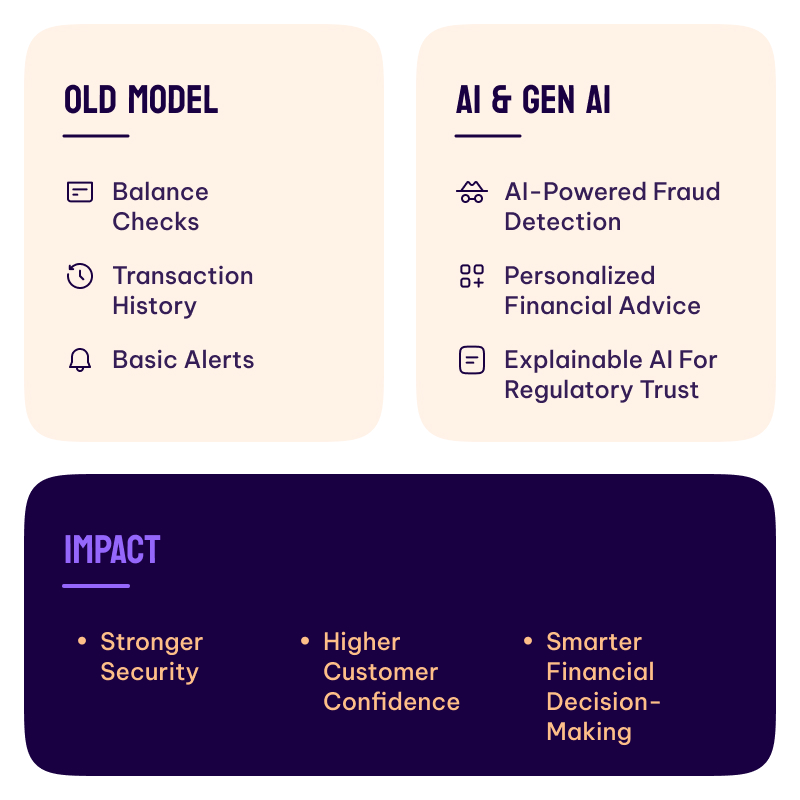
Generative AI complements these capabilities by delivering personalized experiences and simplifying complex financial information. Conversational banking assistants can answer questions like “What’s the best way to invest this month?” or explain a bank statement in plain language. AI-driven advisory tools can create customized financial plans and investment summaries, making complex financial decisions more accessible.
Explainable AI also ensures regulatory compliance, giving both banks and users transparency into how decisions are made. The combination of AI and Generative AI builds trust, increases customer confidence, and enables smarter financial decision-making.
Fact: According to McKinsey, AI-powered FinTech apps can reduce fraud losses by up to 20–25% while increasing customer engagement through personalized services.
Retail & eCommerce Apps: From Catalogs to Conversations
Retail and eCommerce apps have shifted from being digital catalogs to intelligent shopping assistants. Traditional apps relied on static product listings, keyword-based search, and manual recommendation algorithms. While these features supported basic transactions, they did little to improve conversion rates or create meaningful user engagement.
AI transforms retail apps by powering recommendation engines, visual search, and intent-based product discovery. AI can analyze customer behavior, preferences, and purchase history to suggest products they are most likely to buy. Visual search capabilities allow users to upload an image and find similar products instantly, enhancing the shopping experience.
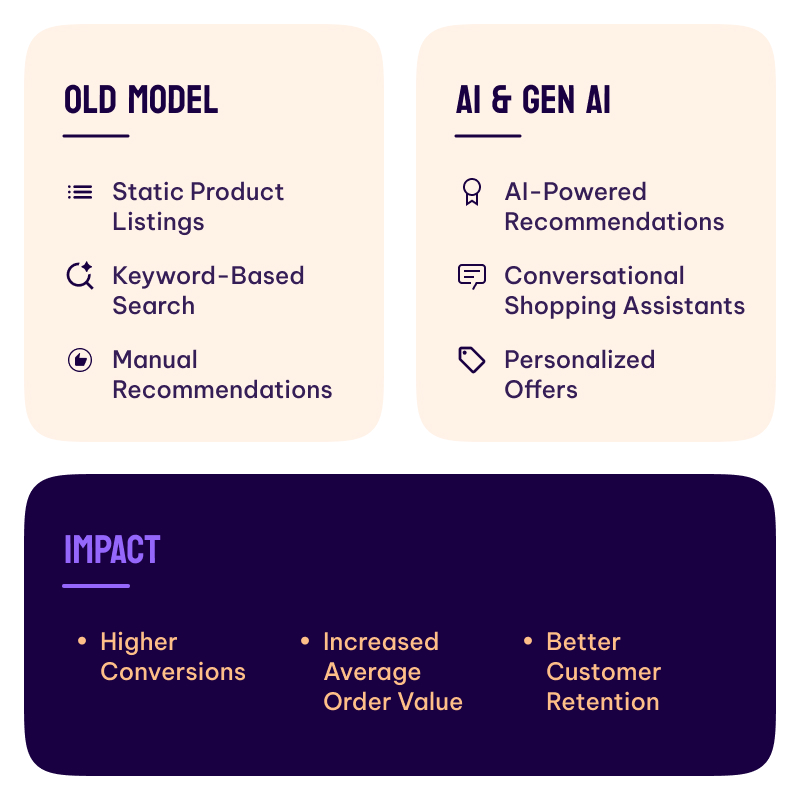
Generative AI further elevates the experience by generating personalized product descriptions, crafting marketing content, and enabling conversational shopping. For example, an AI assistant could guide a user through seasonal collections, answer style-related questions, or suggest bundle offers based on current trends and inventory.
Real-time pricing optimization ensures users are presented with the best deals while maximizing retailer margins.
Impact: By leveraging AI and Generative AI, retail apps can significantly improve conversion rates, increase average order value, and enhance customer retention.
Real-Life Scenario: Sephora’s AI-powered virtual assistant uses both predictive AI and Generative AI to recommend products, provide makeup tutorials, and answer customer queries, driving higher engagement and repeat purchases.
Manufacturing & Industrial Apps: From Dashboards to Decisions
Industrial and manufacturing apps have historically been data-heavy, offering reactive dashboards and manual SOP access. Maintenance and operational decisions relied heavily on human interpretation, which could lead to inefficiencies and downtime.
AI enables predictive maintenance and asset lifecycle intelligence. By analyzing machine sensor data, AI predicts potential failures before they occur, reducing unexpected downtime and costly repairs. It can also provide insights into operational efficiency, energy consumption, and resource allocation.
Generative AI transforms the way field teams interact with knowledge and instructions. It can provide step-by-step maintenance guidance, explain SOPs in accessible language, and retrieve relevant technical documentation in real-time. AI-powered field service apps enhance collaboration, allowing engineers to troubleshoot complex issues efficiently.
Impact: Reduced downtime, faster issue resolution, and smarter operations result in higher productivity and cost savings.
Fact: According to Deloitte, predictive maintenance powered by AI can reduce maintenance costs by 10–40% and unplanned downtime by up to 50%.
Logistics & Supply Chain Apps: From Tracking to Optimization
Traditional logistics apps primarily focused on location tracking, manual planning, and historical reports. While useful for operational visibility, they were reactive rather than proactive.
AI enhances supply chain apps through demand forecasting, route optimization, and fleet management. Predictive analytics can anticipate spikes in demand, suggest optimal inventory levels, and prevent stockouts. AI-powered route planning reduces delivery times and operational costs.
Generative AI improves operational communication and decision-making. It can generate delay explanations for stakeholders, provide real-time operational summaries, and suggest corrective actions during disruptions. By combining both AI and Generative AI, logistics apps enable cost optimization, real-time adaptability, and end-to-end supply chain visibility.
EdTech & Learning Apps: From Content Delivery to Personalization
Traditional learning apps often followed fixed courses and one-size-fits-all learning paths, which failed to engage learners meaningfully. Modern learners expect adaptive, personalized experiences that evolve with their progress.
AI in EdTech apps allows for learner behavior analysis and adaptive learning paths. It identifies knowledge gaps, predicts performance trends, and recommends personalized study schedules. Generative AI enhances learning by providing AI tutors, generating tailored content, and offering instant feedback and assessments. Ethical AI ensures that learning analytics respect privacy and data protection regulations.
Impact: Higher engagement, better learning outcomes, and personalized education at scale.
HRTech & Enterprise Productivity Apps
Traditional enterprise apps were limited to forms, dashboards, and manual onboarding. They lacked intelligent insights into workforce performance and engagement.
AI enables advanced workforce analytics, predictive talent management, and automated HR processes. Generative AI improves onboarding by providing interactive Q&A for policies, generating training content, and serving as internal knowledge assistants. Secure enterprise AI frameworks ensure compliance while enhancing productivity.
Impact: Faster onboarding, improved productivity, and better employee experience.
Cross-Industry Changes Every Mobile App Must Adopt
For businesses looking to modernize mobile apps across industries, several universal changes are non-negotiable. AI-native app architecture is now essential, enabling apps to process and analyze data in real-time. Conversational interfaces have become a standard expectation, providing human-like engagement. Real-time personalization engines tailor content, offers, and interactions based on user behavior. Secure and compliant AI pipelines ensure data privacy while leveraging AI responsibly. Human-in-the-loop systems for Generative AI maintain quality, accountability, and ethical oversight. Continuous monitoring and model updates ensure that AI systems remain accurate, relevant, and safe.
Key Insight Line: AI is no longer an add-on feature; it is the core layer of modern mobile apps.
How Businesses Can Modernize Existing Mobile Apps
Businesses can follow a practical, phased approach to integrate AI and Generative AI into existing apps. The first step is auditing current capabilities to identify gaps in intelligence and personalization. Next, identify high-ROI AI and Generative AI use cases that will deliver immediate business value. Begin integration with core features like predictive analytics, chat assistants, and automated insights. Ensure that integration is responsible, secure, and compliant with industry regulations. Finally, partner with experienced AI app development teams, like TechQware, that can provide scalable solutions, model maintenance, and ongoing innovation support.
Conclusion: The Shift from Apps to Intelligent Experiences
The era of feature-driven mobile apps has ended. Across industries, businesses are realizing that the true value lies in intelligent, adaptive experiences powered by AI and Generative AI. By modernizing mobile apps, companies can deliver personalized, predictive, and conversational experiences that engage users, reduce operational inefficiencies, and create competitive advantage.
Businesses that invest in AI and Generative AI today will define the next generation of mobile experiences. Partnering with the right AI app development company ensures scalability, security, and measurable business impact. The future is intelligence-driven, and the time to act is now.
Partner with TechQware to transform your mobile apps from static tools into intelligent, future-ready experiences that delight users and drive business growth.

 TechQware