Key Takeaways:
- Post-launch execution drives success more than development alone.
- Growth works best when it’s data-driven and user-focused.
- ASO, local SEO, partnerships, and paid together create sustainable acquisition.
- Monetization must match user intent (agents, buyers, investors).
- Retention and trust matter more than installs.
- Continuous iteration keeps apps competitive and profitable.
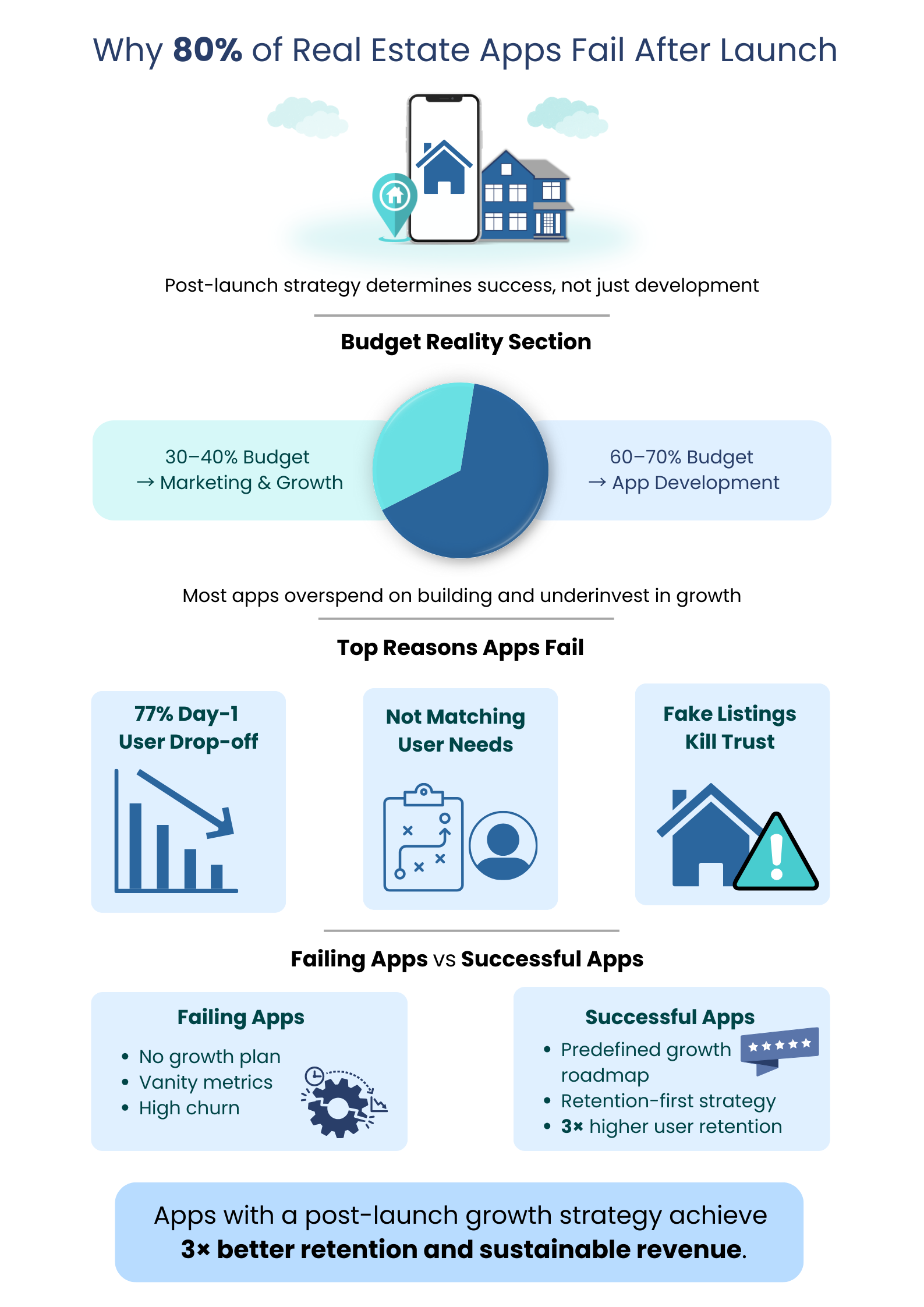
Post-launch strategies are pivotal for real estate mobile apps, as 80% fail within the first year due to inadequate marketing and engagement, despite solid development. Effective growth demands a blend of data-driven tactics, partnerships, and monetization to achieve sustainable revenue in a market projected to hit $9.1 billion by 2030.
Why Post-Launch Matters More
App development consumes 60-70% of budgets, yet post-launch execution determines 90% of success, with failures stemming from zero visibility or mismatched features. Founders face challenges like high churn (77% Day 1 drop-off), regulatory hurdles for verified listings, and competition from giants like Zillow. A predefined growth plan correlates with 3x higher retention, prioritizing revenue models from Day 1.
Understanding the Market
Core User Segments
- Buyers/Renters: Seek instant filters for price, location, amenities; 40% abandon slow-loading apps.
- Agents/Brokers: Need lead gen, CRM sync; prioritize apps with 1-tap sharing.
- Developers/Investors: Demand analytics, ROI calculators; favor data-rich dashboards.
Regional Differences
India's market favors rentals (60% queries in metros like Delhi), while US focuses on sales with mortgage tools; tailor positioning to intents like "budget homes under 1Cr" vs. luxury tours.
Go-To-Market After Launch
Launch-phase builds hype via influencers; growth-phase scales with iterative UA, shifting from broad ads to hyper-local funnels. Align with goals: 10K MAU in Q1 via partnerships, targeting 15% MoM growth. Realistic benchmarks include $1.5 CPI in emerging markets, validated by cohort analysis.
Promotion Strategies
App Store Optimization
Incorporate 100-character keywords (e.g., "real estate Delhi, property finder app"), video previews of tours, and localized metadata to rank top 10 organically. Refresh every 30 days based on search trends, boosting impressions 50%.
Local SEO
Claim Google Business profiles, optimize for "flats near [metro station]," and embed app links in agent sites for 2x high-intent traffic.
Partnerships
Collaborate with 100+ brokers for co-branded features; apps like Property Finder thrive on exclusive agent data.
Paid vs Organic
|
Channel
|
Pros
|
Cons
|
ROI Example
|
|
Organic (SEO/ASO)
|
Low Cost, High trust
|
Slow ramp-up
|
3-6x LTV
|
|
Paid (Google/FB Ads)
|
Fast scale, targeting
|
High CPI ($3-10)
|
2x for retargeting
|
Hybrid: Allocate 50/50 initially, pivot per ROAS.
Revenue Generation
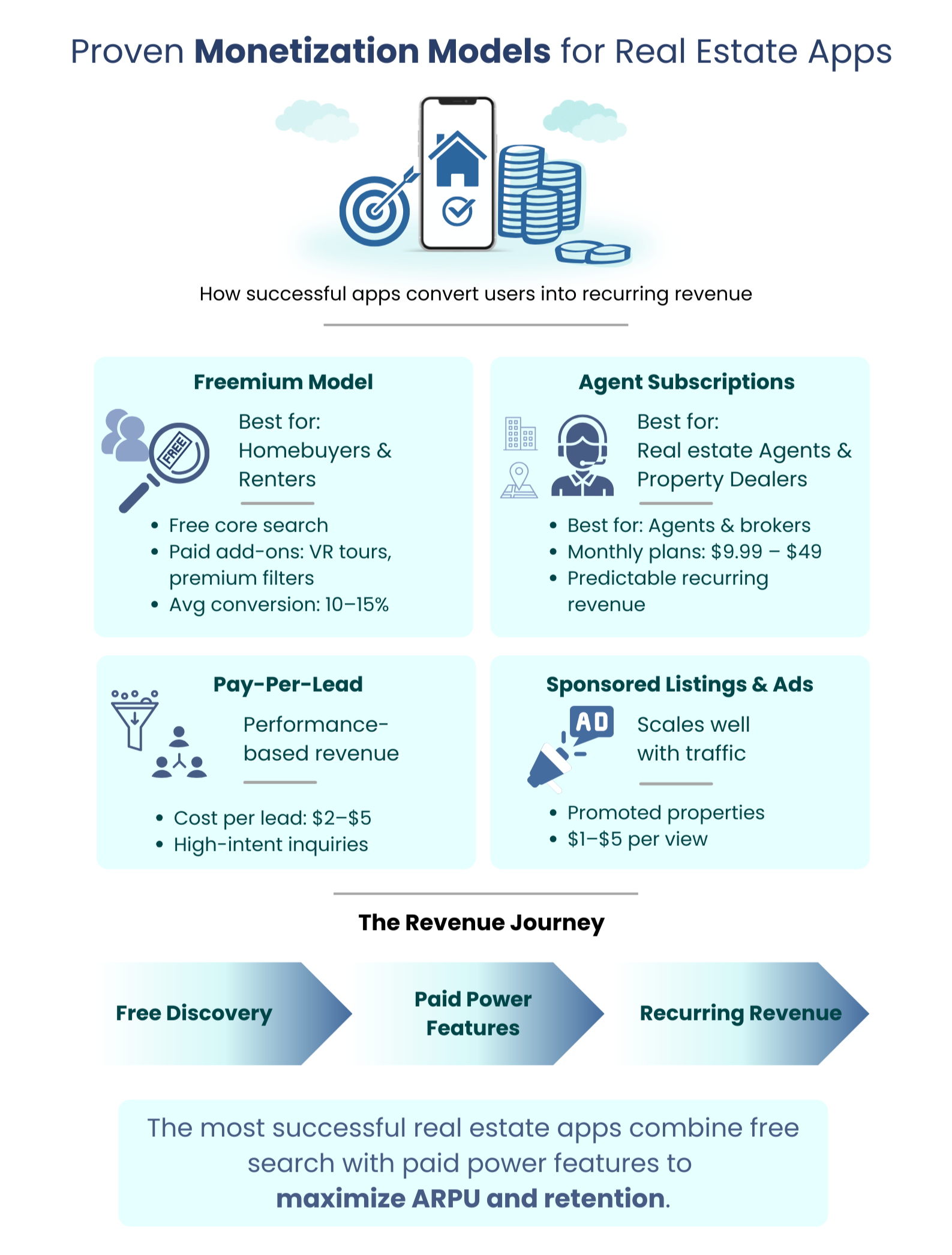
Freemium leads with 70% adoption, upsell via pro tiers ($9.99/mo for agents). Match audience: renters get ad-free for $1.99; agents pay per lead ($2-5). Freemium core searches with paywalls for VR tours balances access, hitting 15% conversion.
Retention Tactics
Retention > installs, as loyal users generate 5x revenue. Tactics:
- Push alerts on price changes (30% uplift).
- Gamified saves/shares with badges.
- In-app chat for agent matches, cutting drop-off 50%.
Data-Driven Decisions
Monitor:
- Engagement: Session length >3min, saves/lead ratio.
- Revenue: ARPU $4+, LTV:CAC >3:1.
Use insights to cut underperformers, reallocating 20% budget.
Pitfalls to Avoid
Prioritizing vanity metrics over quality leads to 90% churn; neglect feedback and scale blindly. Fake listings erode trust instantly.
Building Trust
KYC-verified listings boost conversions 2x; showcase 4.5+ ratings and privacy badges.
TechQware Support
TechQware delivers end-to-end growth with ASO mastery, agent APIs, and analytics setups for 40% retention gains.
Long-Term Success
Execution
Why Post-Launch Strategy Matters
In Real Estate App Development, many apps fail after launch because teams focus on building the product but neglect marketing and user engagement. Low visibility, high churn, and integration challenges limit growth, making a clear post-launch growth and revenue strategy essential as the market scales toward $9.1 billion by 2030.
Real Estate App Market Overview
Core user segments include real estate agents, brokers, property managers, investors, and homebuyers. Market behavior varies by region; for instance, urban areas like Delhi emphasize rentals and quick searches, while emerging markets prioritize affordable housing. Position the app to match intents like property discovery for buyers or lead generation for agents.
Go-To-Market Strategy Post-Launch
Launch-phase marketing focuses on buzz via PR, while growth-phase emphasizes sustained acquisition through ASO and partnerships. Align goals like user acquisition with tactics such as geo-targeted ads and agent onboarding. Set realistic expectations: aim for 20-30% month-over-month growth initially, tracking cost-per-install under $2-5.
Proven Promotion Tactics
App Store Optimization
Optimize titles, subtitles, and keywords like "homes for sale Delhi" for visibility. Use high-quality screenshots showing local listings and A/B test descriptions to boost conversion rates up to 30%.
Local SEO and Organic
Implement location-specific pages and schema markup for Google Local Pack rankings. Target "rentals in [neighborhood]" to drive high-intent installs organically, outperforming paid in long-term trust.
Partnerships and Referrals
Partner with brokers for exclusive listings and lead tools; apps like TeamUp connect agents for mutual growth. Launch referral programs offering premium access for invites, leveraging trust in networks.
Paid vs Organic Channels
Organic builds lasting traffic (53% of web traffic) via SEO and content, while paid delivers quick installs via geo-fenced Facebook/Google ads. Combine: 60% organic for sustainability, 40% paid for scale, monitoring CPI.
Monetization Models
Popular models include freemium subscriptions for premium listings, lead generation commissions from agents, and sponsored ads from lenders. Choose based on audience: agents prefer lead fees, buyers like free basic access with upsells. Balance by offering core searches free and advanced analytics paid, achieving ARPU of $5-10/month.
|
Model
|
Best For
|
Revenue Potential
|
Example
|
|
Subscriptions
|
Agents/
Managers
|
Recurring $10-50/mo
|
Premium listing
|
|
Lead Commissions
|
Buyers/
Investors
|
10-20% per deal
|
mortgage referrals
|
|
Sponsored Ads
|
All users
|
$1-5 per view
|
Interior designers
|
|
Freemium Upsells
|
Homebuyers
|
$2-5 per feature
|
Virtual tours
|
Boosting Retention
Retention trumps installs, as 70-80% of users drop off after first use without engagement. Use personalized notifications like "price drop on saved property" and dynamic feeds based on behavior. Swift onboarding with preference setup reduces drop-off by 40%; add loyalty incentives for repeat visits.
Data-Driven Growth
Track KPIs: DAU/MAU (aim 20-30%), retention rate (D1:40%, D7:20%), CPI, ARPU, and listing saves. Analyze behavior via tools like Firebase to spot drop-offs, optimizing spend on high-ROI channels. Leads generated and conversion rates guide personalization.
Common Post-Launch Mistakes
Focusing on installs ignores quality users who convert. Overloading features confuses users, leading to abandonment. Scaling without feedback validation causes mismatches; ignore slow performance or fake listings to kill trust.
Building Trust
Verified listings double inquiries by reducing fraud risk via KYC and geo-tags. Prioritize reviews, ratings, and transparent data to leverage social proof. Ensure GDPR-compliant privacy to retain privacy-conscious users in regions like India.
TechQware's Growth Support for Real Estate Apps
TechQware provides comprehensive post-launch support that extends far beyond initial app development, positioning itself as a strategic partner for real estate startups and established firms. Their services emphasize market-driven scaling, where data from user behavior and regional trends informs every growth decision, ensuring apps adapt to dynamic markets like India's urban rental boom or global investor demands.
Strategic Post-Launch Guidance
TechQware offers tailored consulting to refine growth roadmaps after launch, including feasibility audits that assess profitability based on KPIs like retention and ARPU. Founders receive expert insights on pivoting features, such as enhancing AI-driven property recommendations to boost engagement by 25-40%. This guidance prevents common pitfalls like premature scaling, drawing from their experience with clients in India, USA, and UAE.
Market-Driven Scaling Approach
Their scaling strategy leverages advanced analytics to optimize user acquisition, focusing on high-intent channels like local SEO and geo-targeted campaigns suited for real estate's location-based nature. TechQware integrates tools for real-time performance tracking, enabling A/B testing of monetization models such as shifting from freemium to agent subscriptions based on usage data. For instance, they help apps expand inventory management for multi-broker networks, supporting 10x listing growth without performance lags.
ASO and Analytics Optimization
TechQware excels in App Store Optimization (ASO) by crafting keyword strategies like "Delhi property finder" or "verified rentals near me," combined with visually compelling screenshots featuring AR/VR tours. Analytics optimization involves setting up custom dashboards with Firebase or Mixpanel integrations to monitor D1/D7 retention, conversion funnels, and churn predictors, allowing precise tweaks that lift organic installs by up to 35%.
Agent and Partner Integrations
A core strength lies in seamless integrations with agent CRM systems, broker APIs, and platforms like Zapkey for verified listings, fostering revenue through lead commissions. TechQware builds referral ecosystems where agents get white-labeled dashboards for exclusive listings, driving mutual growth e.g., 20% revenue share models that incentivize partnerships. They also incorporate blockchain for tamper-proof records and IoT for smart property insights, enhancing trust and repeat business.
Long-Term Partnership Focus
Unlike one-off developers, TechQware commits to ongoing support with maintenance, feature roadmaps, and digital transformation roadmaps spanning 12-24 months. Clients benefit from dedicated account managers who align tech upgrades like metaverse open houses with business goals, ensuring sustained revenue in competitive markets. This holistic approach has powered apps handling global buyer reach, turning post-launch challenges into scalable successes.
Final Thoughts
Success demands long-term execution in marketing, retention, and iteration post-launch. Consistent data use and user focus turn apps into revenue engines in a competitive market.
At TechQware, we support you through this journey by helping you use data effectively, understand your users better, and continuously refine your product so it can grow into a reliable revenue engine. Our company is recognized by GoodFirms as a Top Mobile App Developer in Noida, and we focus on being a dependable technology partner that helps you stay competitive, scale with confidence, and build long-term value and if you’re exploring ways to improve your app’s growth, performance, or monetization, our team would be glad to share ideas and guidance whenever it’s helpful for you.
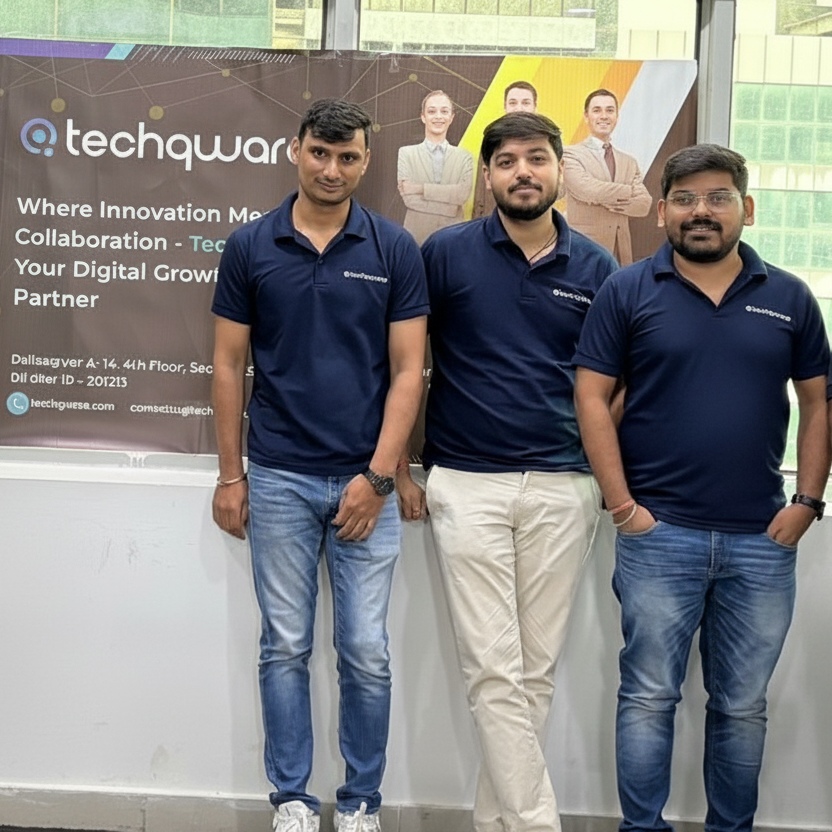
TechQware’s Mobile App Development Team
About Author
TechQware specializes in full-stack Mobile App Development, utilizing Swift for native iOS and Kotlin for native Android. For cross-platform solutions, we rely on Dart (Flutter) and JavaScript (React Native). Python is a foundational technology, powering the backend, RESTful APIs, and advanced Machine Learning features.