There are many ways in which the real estate sector is being propelled into the digital shift by advancements in technology and changing consumer expectations in 2026. Mobile-first solutions are fundamental to this evolution; users are continuing to move their property search, management, and transactions to their smartphones. This guide examines the current state of the real estate app development industry considering relevant trends, recommendations, and price points for companies looking to begin investing in mobile solutions.
Why are Real Estate Apps Propelling in 2026
The interest in real estate apps is being driven by a number of factors:
- Digital Transformation: The real estate sector is adopting digital solutions to automate operations, improve customer experiences, and improve efficiencies.
- Immersion Experiences: Consumers expect greater interactivity and an immersive experience when viewing properties and conducting due diligence, including virtual reality ("VR") tour and augmented reality ("AR") options, when analyzing real estate
- AI Use: Artificial Intelligence is being used for predictive analytics, personalized recommendations, automated customer service to improve user engagement, and community satisfaction.
- Work Process Automation: New technologies are allowing for various aspects of real estate transactions to chew within automated service changing the behavior of users to parse through contracts, documents, and payment with little manual / human effort.
Categories of Real Estate Applications
Real estate applications can be classified based on their features:
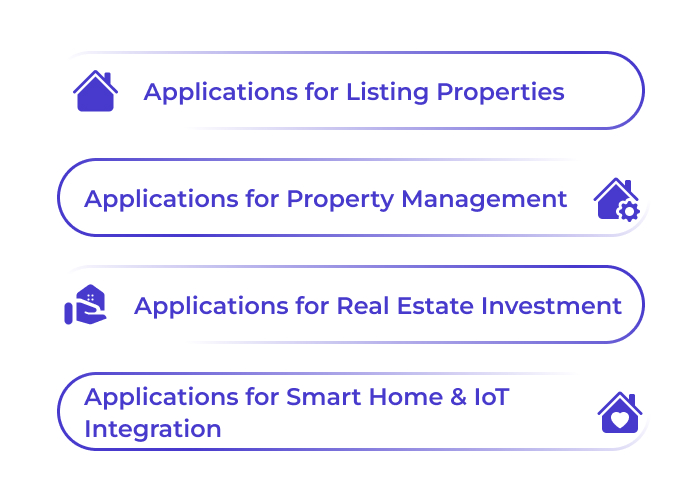
- Applications for Listing Properties: Applications that enable users to search and display property based on certain attributes in the property listing.
- Applications for Property Management: Applications for landlords and property managers to request maintenance, collect rent, and communicate with tenants.
- Applications for Real Estate Investment: Applications that provide investors with analytics and insights, enabling better decisions when investing in residential and/or commercial properties.
- Applications for Smart Home & IoT Integration: Applications that allow smart home connectivity, and often offer remote access and monitoring of property features.
- Applications for On-Demand Property Services: Applications designed to connect users with service providers who can perform tasks such as cleaning, repairs, moving services, etc.
Key Features to Include in a Successful Real Estate App
To stay competitive, real estate applications should encompass the following features:
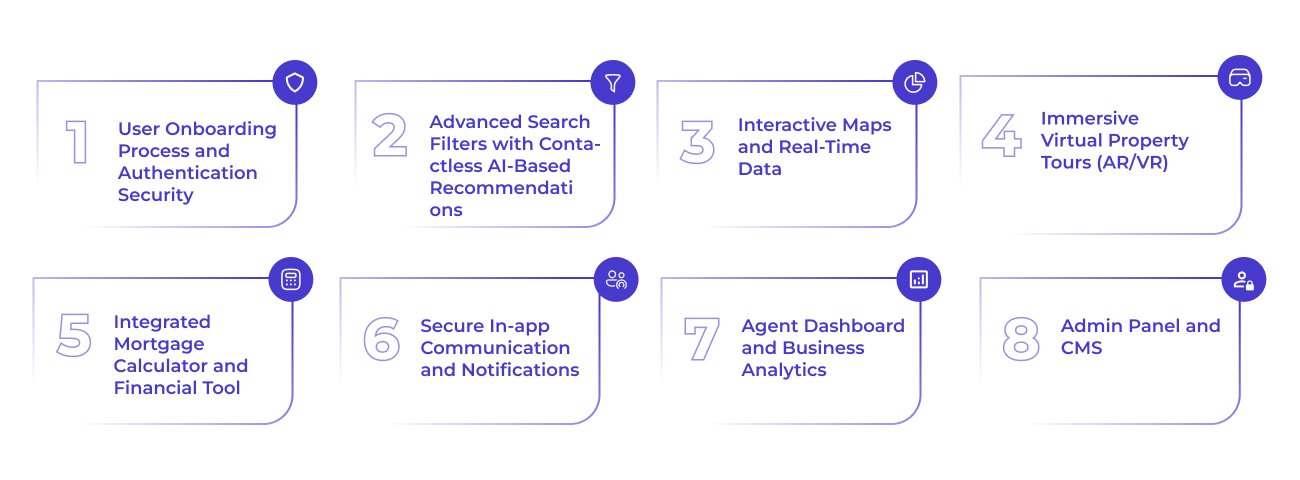
- User Onboarding Process and Authentication Security: Simplified registration and authentication processes bolstered by secure authentication systems.
- Advanced Search Filters with Contactless AI-Based Recommendations: Stuff that allows users to search for properties based on contractually-valid filters, and AI to recommend options based on user's previous selections.
- Interactive Maps and Real-Time Data: Integrate maps that show property locations, neighborhood and street information, and real-life availability status.
- Immersive Virtual Property Tours (AR/VR): Features that enable contacts to virtually tour properties and assist contacts in their home-buying process.
- Integrated Mortgage Calculator and Financial Tool: Tools that help credit-worthy or consumers check estimated loan eligibility to obtain loan estimates, affordability, monthly loan payments, and other aspects of financial management.
- Secure In-app Communication and Notifications: Messages with secure push notifications to communicate with agents via pets and messaging system.
- Agent Dashboard and Business Analytics: System for agents to manage property listings, track activity, and examine market statistics.
- Admin Panel and CMS: Admin panel to organize business information in the application for administrators to manage users, and business content settings.
Real Estate App Development Process (Step by Step)
Building a real estate app consists of various essential stages:
- Market Research and Competitor Analysis: Getting a grip of your target audience, studying competitors, and mapping out unique selling propositions.
- UI/UX Design to Drive Engagement: Designing user-friendly and straightforward interfaces that ensure an effortless experience.
- Backend Development and Integrating APIs: Creating the server-side background and connecting with third-party services for features including payment handling and data storage.
- Feature Development (AI, AR/VR, Blockchain, Payments): Adding new technology to enhance functions - and beyond!
- Testing and QA: Thorough testing to diagnose and fix glitches to improve app reliability and performance.
- Deployment, Scaling, and Ongoing Support: Launching the app, keeping track of performance and issues to organize continual updates and improvements.
.jpg)
Real Estate Application Development Cost in 2026
Development costs for creating an application in the realm of real estate depend on the complexity:
- MVP (Minimum Viable Product): $9,500 to $12,000+ (8 weeks to 6 months)
- Simple App: $12,000 to $15,000+ (3 to 6 months)
- Moderate App: $15,000 to $20,000+ (5 to 7 months)
- Complex App: $25,000 to $30,000+ (8 to 10 months)
- AI-Assisted: $30,000 to $40,000+ (10 to 12+ months)
More costs can accrue depending on:
- Integration with Additional Services: $10,000–$20,000
- Legal Compliance: $5,000–$15,000
Significant Trends in Real Estate Application Development in 2026
The future of real estate application development is influenced by the following trends:
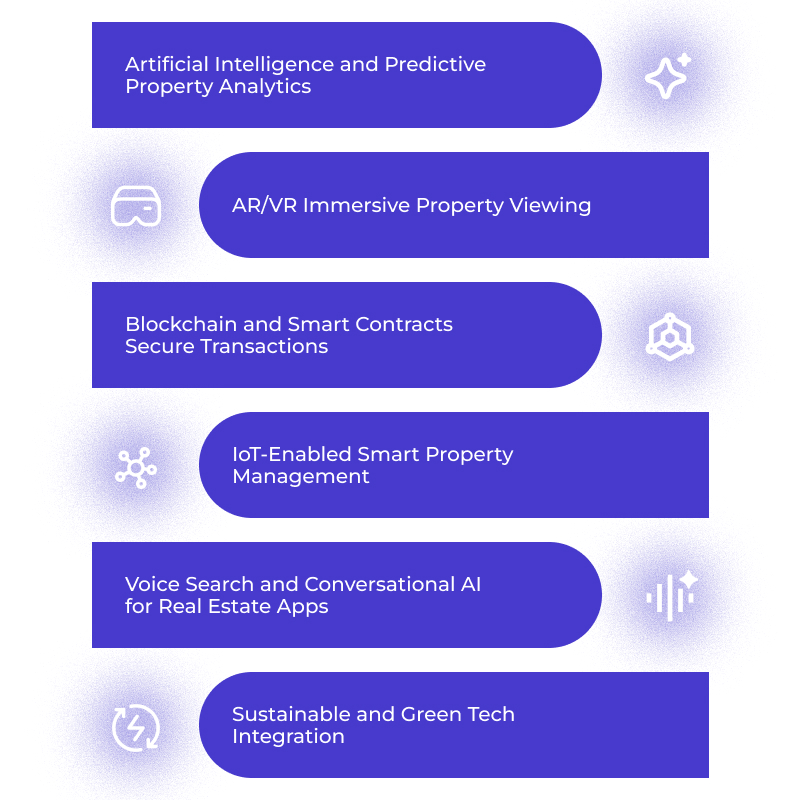
- Artificial Intelligence and Predictive Property Analytics: Utilizing AI for property valuation, market trend analysis, and personalization.
- AR/VR Immersive Property Viewing: Augmented and virtual reality is allowing users to tour properties realistically.
- Blockchain and Smart Contracts Secure Transactions: Blockchain is improving property transaction security and transparency.
- IoT-Enabled Smart Property Management: Internet of Things or IoT devices that are used in real-time property monitoring and management.
- Voice Search and Conversational AI for Real Estate Apps: Real estate voice assistants and chatbots are focused on facilitating user interaction and support.
- Sustainable and Green Tech Integration: Sustainable technology integration to foster green practices in real estate operations.
Case Studies or Examples of Success
Zillow
Zillow has transformed the real estate arena by establishing a one-stop-shop for property listings, along with considerable amenities, such as Zestimate to determine the worth of property and 3D home walking tours.
Innago
Innago offers property management software that streamlines processes for landlords and property managers regarding the rent collection, maintenance tracking, tenant communications, etc.
How to select the right real estate app development partner.
Factors to evaluate when selecting a development partner:
- Experience and Qualifications: It is essential to select a team that specializes in real estate app development and has a proven record of accomplishing it successfully.
- Technical Skills: evaluate their mastery of their technical stack in order to fulfill your project requirements.
- Portfolio and References: review prior projects and client references in order to fully evaluate their ability to accomplish what they claim.
- Support and Maintenance: select a partner that can and will support and maintain the app once it launches.
- Cost and Timeline: have a conversation about, and get the partner to agree to a project cost and timeline, prior to project commencing to eliminate misunderstanding.
Conclusion
The real estate app development landscape in 2026 is fluid, changing, and exposed to constant transformation. With awareness of trends, crucial features, and the right development partner, companies can build innovative solutions that solve the needs of modern consumers. Investing in a mobile-first solution for the real estate industry is more than a technology upgrade; it is a competitive strategy for a digital-first world!
At TechQware, we help businesses bring their ideas to life as a leading Real Estate App Development company tailored to market needs and user expectations. Whether you’re planning a property listing app, a smart real estate marketplace, or an agent management platform our expert team can turn your vision into a scalable, feature-rich product.
Ready to build your Real Estate App? Contact Us at TechQware today to start your project!

TechQware’s Mobile App Development Team
About Author
TechQware specializes in full-stack Mobile App Development, utilizing Swift for native iOS and Kotlin for native Android. For cross-platform solutions, we rely on Dart (Flutter) and JavaScript (React Native). Python is a foundational technology, powering the backend, RESTful APIs, and advanced Machine Learning features.