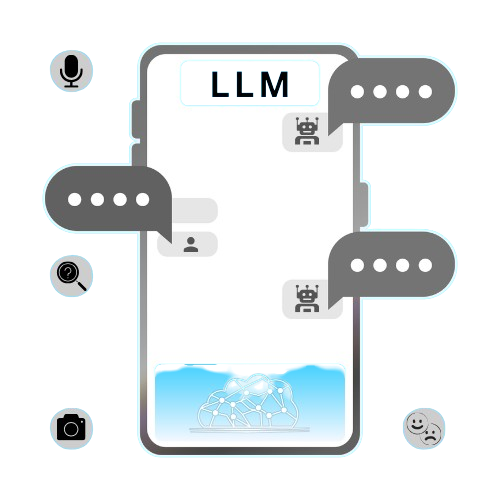
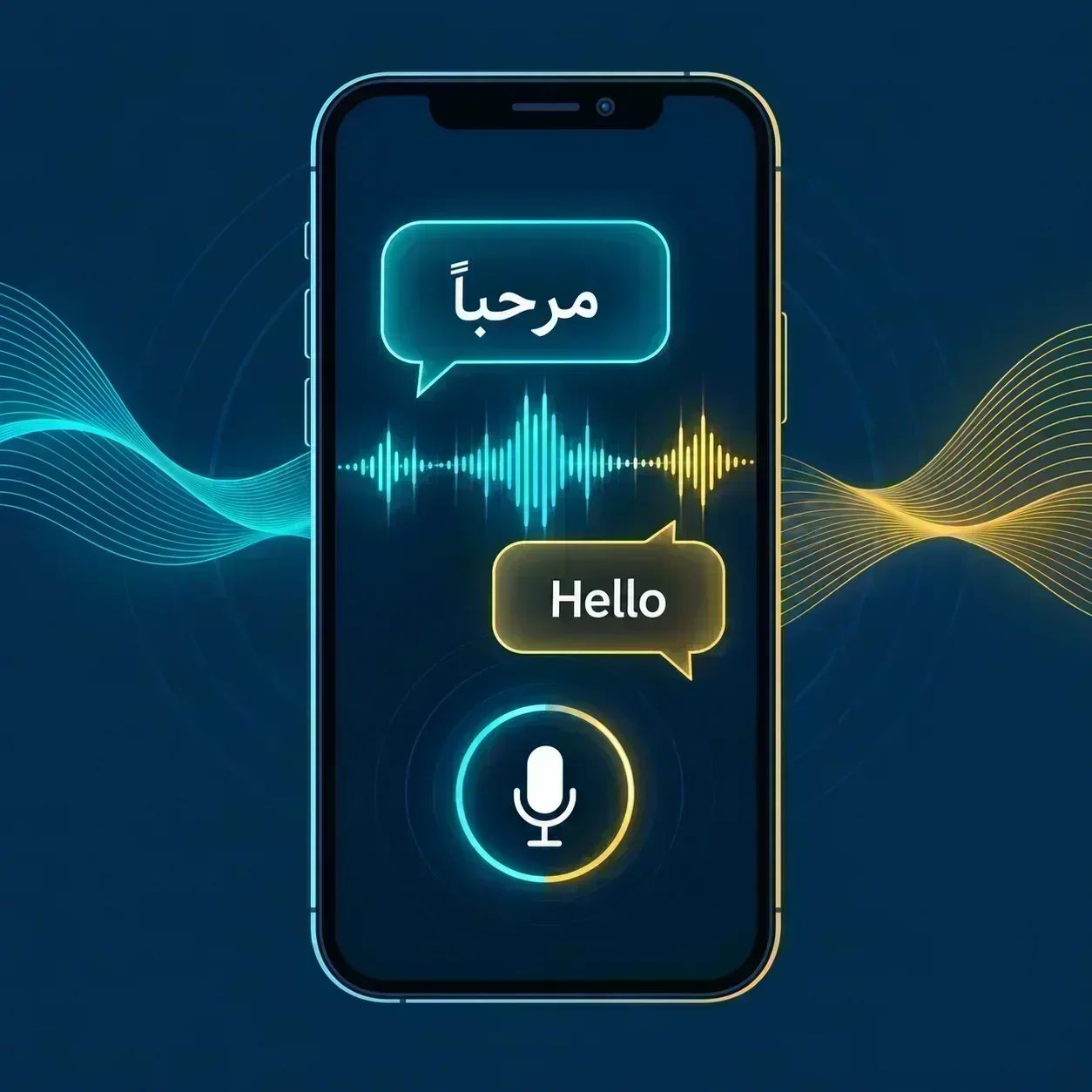
Introduction : Why LLMs Are Now Essential in Mobile Apps
Mobile applications are no longer evaluated only on how well they function but on how intelligently they interact with users. As user behavior becomes more conversational, intent-driven, and expectation-heavy, traditional rule-based mobile apps are struggling to keep up. Businesses today are under pressure to deliver mobile experiences that understand users naturally, respond intelligently, and adapt dynamically across different contexts and usage patterns.
This shift has made Large Language Models a foundational component of modern mobile app development. Enterprises and consumer-facing brands are increasingly embedding LLM-driven intelligence into their apps to improve engagement, reduce friction, and unlock automation at scale. Industry research from Gartner and Forrester consistently shows that AI-powered features are no longer experimental enhancements but core differentiators that directly impact retention, satisfaction, and revenue growth. For businesses planning long-term digital success, adopting LLMs in mobile apps is no longer a question of “if,” but “how fast.”
What Are Large Language Models (LLMs)? A Business-Friendly Explanation
Definition and Core Capabilities
Large Language Models are advanced artificial intelligence systems designed to understand, interpret, and generate human language in a way that closely mirrors human reasoning and communication. Unlike earlier natural language processing tools that depended on fixed rules or narrow datasets, LLMs are trained on massive and diverse corpora of text, enabling them to grasp context, intent, sentiment, and nuance across a wide range of scenarios. From a business standpoint, an LLM acts as a highly adaptable language engine that can power conversations, search, recommendations, and decision support within a mobile app.
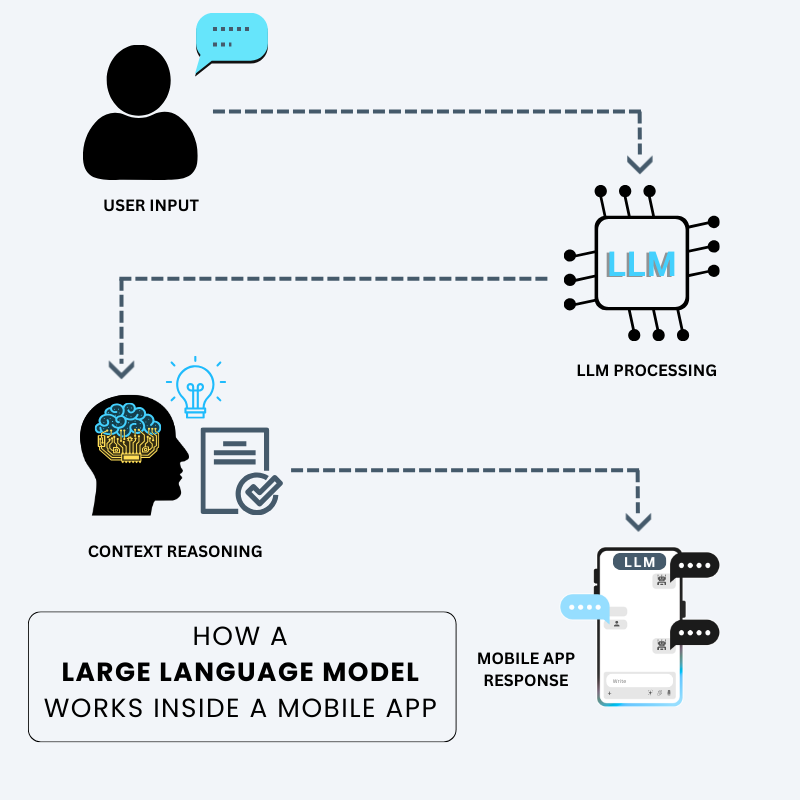
The real value of LLMs lies in their core capabilities. Natural language understanding allows mobile apps to interpret user inputs even when they are vague, informal, or incomplete. Generative text capabilities enable apps to produce responses, explanations, summaries, and suggestions dynamically instead of relying on static scripts. Contextual reasoning allows LLMs to maintain continuity across interactions, which is critical for multi-step workflows such as onboarding, troubleshooting, or guided purchases. Research from OpenAI and academic institutions like Stanford and CMU confirms that these capabilities dramatically improve human-computer interaction quality when compared to traditional AI systems.
How LLMs Work : Basic Mechanisms
At a high level, LLMs operate by learning patterns in language through extensive training on structured and unstructured data sources. During training, the model repeatedly predicts the next token in a sequence, gradually developing an understanding of grammar, semantics, relationships, and real-world context. This process enables the model to generate coherent and context-aware responses when deployed within a mobile app environment.
The architecture behind LLMs consists of deep neural network layers that process language at increasing levels of abstraction. Early layers focus on syntax and word relationships, while deeper layers handle meaning, intent, and reasoning. Token prediction allows the model to generate responses incrementally, ensuring logical flow and relevance. Modern LLMs, such as GPT-4, operate at a scale of tens to hundreds of billions of parameters, which is what enables them to perform complex language tasks reliably. For businesses, this scale translates into mobile apps that can handle diverse user interactions without constant manual rule updates.
The Role of LLMs in Mobile App Development
Traditional AI vs LLMs
Traditional AI in mobile apps has historically relied on rule-based logic and narrow predictive models. Rule-based systems require developers to predefine every possible user action and corresponding response, making them rigid and costly to maintain as applications grow. Predictive models improved decision-making by analyzing historical data but were limited in handling open-ended language and contextual conversations.
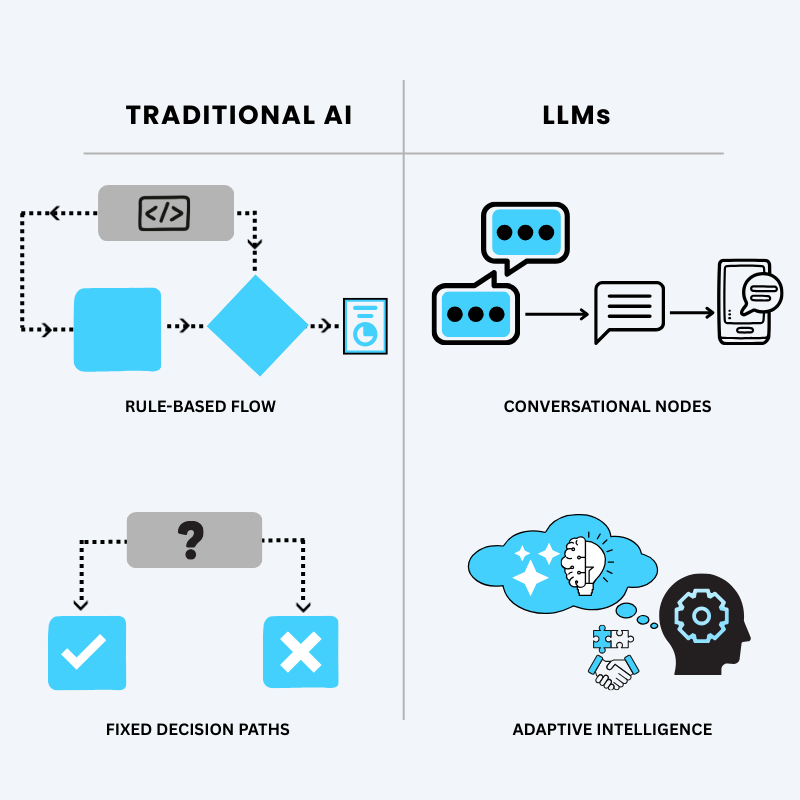
LLMs represent a significant evolution beyond these approaches. Instead of reacting to predefined conditions, LLM-driven mobile apps interpret user intent dynamically and generate responses in real time. Reports from IBM and Capgemini highlight that traditional AI systems struggle with adaptability and scalability, whereas LLMs thrive in environments where language, ambiguity, and evolving user needs are central. This shift enables businesses to move from static automation to intelligent systems that continuously learn and improve.
How LLMs Improve UX in Mobile Apps
User experience is where the impact of LLMs becomes most tangible. By understanding context and intent, LLM-powered mobile apps can deliver responses that feel natural and relevant, reducing user frustration and cognitive load. Multi-turn conversational memory allows apps to remember previous interactions within a session, creating continuity that mimics human conversation rather than fragmented exchanges.
Industry studies from IDC and Forrester indicate that organizations implementing LLM-driven UX enhancements experience measurable improvements in user satisfaction and significant reductions in customer support escalations. For example, a telecom mobile app using an LLM assistant can resolve billing disputes or plan changes in a single conversational flow, eliminating the need for call center intervention. At TechQware, we design LLM-driven UX architectures that prioritize clarity, responsiveness, and trust at every touchpoint.
Key LLM Use Cases in Mobile Apps
Conversational AI & Smart Assistants
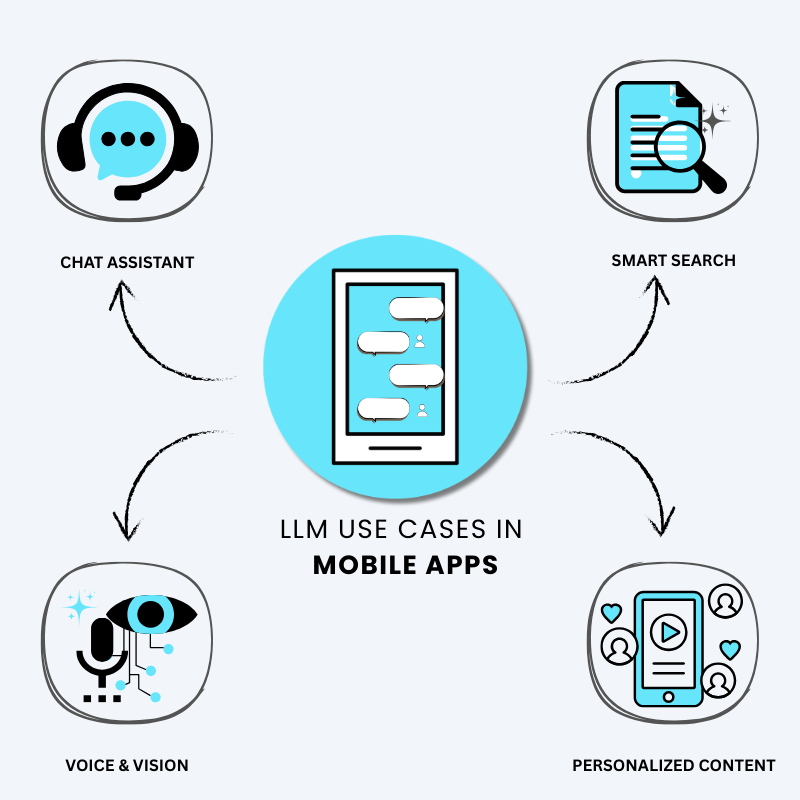
Conversational AI powered by LLMs has become one of the most impactful use cases in mobile app development. These intelligent assistants can handle complex queries, guide users through workflows, and provide contextual support without relying on rigid decision trees. Gartner reports show that businesses adopting LLM-based conversational systems achieve significant reductions in customer support costs while maintaining or improving resolution quality.
In real-world applications, a fintech mobile app equipped with an LLM assistant can explain investment options, risk profiles, and market trends in plain language. This capability not only improves user confidence but also increases conversion rates by reducing uncertainty. TechQware helps businesses design conversational experiences that balance automation with human-like understanding, ensuring assistants feel genuinely helpful rather than transactional.
In-App Search & Recommendations
LLMs dramatically enhance in-app search by moving beyond keyword matching to intent-based understanding. When users describe what they want in natural language, LLM-powered search systems interpret context, preferences, and constraints to deliver accurate results. McKinsey research indicates that contextual search and personalized recommendations can significantly increase conversion rates and average order values.
For instance, an e-commerce mobile app can interpret a query like “comfortable shoes for long office hours” and surface relevant products instantly. This reduces friction in the buyer journey and improves overall satisfaction. TechQware integrates intelligent search architectures that align user intent with business outcomes.
Personalized Content & Dynamic UI
Personalization powered by LLMs enables mobile apps to adapt content, messaging, and interface elements in real time. Deloitte studies show that AI-generated personalization leads to substantial engagement growth by making users feel understood and valued. LLMs can adjust tone, layout, and recommendations based on behavioral signals, preferences, and usage patterns.
A wellness app, for example, can modify its interface and content based on a user’s engagement history, offering motivation during low-activity periods and challenges during high-energy phases. This level of personalization fosters long-term retention and loyalty, making it a critical capability for modern mobile apps.
Multimodal Capabilities (Voice, Text, Vision)
Modern LLMs increasingly support multimodal inputs, combining text, voice, and visual understanding. OpenAI research highlights how multimodal models enable richer mobile experiences, such as voice-driven navigation or image-based product discovery. These capabilities allow businesses to meet users on their preferred interaction channels, enhancing accessibility and convenience.
Architecture & Integration of LLMs in Mobile Apps
Cloud-Hosted LLM Integration
Cloud-hosted LLMs provide scalability and access to continuously updated models. By integrating through APIs offered by AWS, Azure, or Google AI ecosystems, businesses can deploy advanced language capabilities without managing complex infrastructure. However, cost management and latency optimization remain critical considerations for high-usage applications.
On-Device LLMs (Edge Inference)
On-device LLMs represent an emerging approach focused on privacy, offline functionality, and reduced latency. Edge AI reports indicate rapid growth in on-device inferencing adoption as hardware capabilities improve. While model size constraints exist, optimized architectures are making this approach increasingly viable for specific use cases.
Hybrid Models (Cloud + Edge Pipeline)
Hybrid architectures combine cloud intelligence with edge processing, enabling sensitive data handling locally while leveraging cloud power for complex reasoning. This approach balances performance, cost, and compliance, making it ideal for enterprise-grade mobile apps.
API and SDK Integration Best Practices
Secure API usage, version control, and rigorous testing are essential for reliable LLM integration. Following best practices ensures stability, scalability, and consistent performance as applications evolve.
Development Workflow for LLM-Driven Mobile Features
Each stage of the development workflow plays a critical role in successful LLM adoption. From use case prioritization to deployment and monitoring, businesses must approach LLM integration strategically rather than experimentally. TechQware follows GitHub community standards and Stanford MLOps guidelines to ensure quality, reliability, and scalability throughout the lifecycle.
Privacy, Security & Ethical Considerations
LLM-powered mobile apps must adhere to strict data governance and ethical standards. Compliance with GDPR and CCPA frameworks ensures transparency and user trust. Addressing hallucination, bias, and misinformation risks through validation and monitoring is equally important. OWASP AI security guidelines provide a foundation for securing LLM integrations against misuse and vulnerabilities.
Real-World Business Impact & ROI
Businesses adopting LLMs in mobile apps report measurable gains in engagement, retention, and operational efficiency. Forrester and McKinsey research consistently shows that AI-driven automation reduces support costs, accelerates time-to-market, and improves overall productivity. These outcomes make LLM adoption a strategic investment rather than a technical upgrade.
Challenges & How to Overcome Them
Latency, data quality, regulatory compliance, and talent gaps remain common challenges. Deloitte AI readiness reports emphasize the importance of experienced partners who can navigate these complexities. TechQware’s AI-first teams help businesses overcome these barriers through proven frameworks and industry best practices.
Case Studies : LLMs in Successful Mobile Apps
Conversational Commerce App
An LLM-powered conversational commerce app achieved a significant uplift in conversion rates by guiding users through personalized purchasing journeys.
Support Automation App
A support automation mobile app reduced operational costs substantially by resolving common issues through intelligent LLM-driven workflows.
Future Trends : Where LLMs and Mobile Apps Are Headed
AI agents, multimodal experiences, edge-native LLMs, and adaptive personalization will define the next generation of mobile apps. Market forecasts from Gartner, IDC, and Statista project sustained growth in AI adoption, reinforcing the long-term relevance of LLM-driven mobile development.
Practical Checklist for LLM Adoption in Mobile App Roadmaps
|
Focus Area
|
Key Considerations
|
|
Use Case Strategy
|
Business impact and ROI alignment
|
|
Security Planning
|
Compliance and API protection
|
|
Cost Management
|
Usage-based optimization
|
|
Monitoring
|
Continuous testing and improvement
|
Conclusion : Why Businesses Must Embrace LLMs Now
Large Language Models are redefining what mobile apps can achieve by enabling intelligence, personalization, and automation at scale. Businesses that embrace LLMs today gain a competitive advantage through superior user experiences, operational efficiency, and faster innovation cycles.
Partner with TechQware to design, build, and scale LLM-powered mobile applications that deliver real business outcomes.
Contact Us Today for an AI + Mobile App Strategy consultation and future-proof your digital products.
FAQs
What are large language models in mobile app development?
Large language models in mobile app development are AI systems that allow mobile applications to understand and respond to human language in a natural and contextual way. They power features like conversational interfaces, intelligent search, and personalized content by interpreting user intent instead of relying on fixed rules or scripts.
How do LLMs improve mobile user experience?
LLMs improve mobile user experience by enabling apps to understand user intent, context, and follow-up queries more accurately. This reduces navigation friction, supports natural conversations, and delivers more personalized and responsive interactions across the app.
Are LLMs secure for mobile apps?
LLMs can be secure for mobile apps when implemented with proper data governance, encryption, and access controls. Following standards such as GDPR, CCPA, and secure API practices ensures user data privacy while minimizing risks related to misuse or data leakage.
How much does it cost to integrate an LLM?
The cost of integrating an LLM depends on factors such as model selection, usage volume, cloud or on-device deployment, and feature complexity. Businesses can start with controlled usage through APIs and scale gradually based on performance and ROI.
Can mobile apps use LLMs offline?
Yes, mobile apps can use LLMs offline through on-device or edge-based models, although with limited capabilities compared to cloud-hosted LLMs. Hybrid architectures are often used to balance offline functionality, performance, and advanced reasoning needs.

 TechQware