Key Takeaways:
- AI-driven automation is rapidly growing across industries, including mobile app development.
- Traditional AI improves accuracy in data-driven processes.
- Generative AI boosts productivity in workflows and content automation.
- Automation helps reduce costs and improve speed.
- Hybrid AI + Generative AI offers better automation outcomes.
- The right approach depends on business goals and data readiness.
1. Introduction: The Automation Shift Businesses Can’t Ignore
Business automation is no longer a futuristic concept reserved for innovation labs or large enterprises with experimental budgets. In today’s hyper-competitive digital economy, automation has become a foundational requirement for survival, scalability, and sustained growth. Organizations across industries are under constant pressure to do more with fewer resources, deliver faster outcomes, and operate with near-zero tolerance for errors. This reality has pushed automation from a “nice-to-have” efficiency booster into a core business strategy that directly impacts profitability and market relevance.
What has fundamentally changed the automation landscape in recent years is the explosive rise of Artificial Intelligence and, more recently, Generative AI. Traditional automation once focused on predefined rules and repetitive task execution. Today, automation is increasingly intelligent, adaptive, and capable of learning from data, making predictions, and even creating outputs that resemble human reasoning and creativity. Enterprises are no longer asking whether they should automate; instead, they are asking how far automation can go and which technologies can deliver the highest return on investment.
As AI and Generative AI rapidly penetrate enterprise workflows, a critical question has emerged at the leadership level: should businesses rely on predictive intelligence that optimizes decisions based on historical patterns, or should they adopt creative intelligence that can generate content, workflows, and solutions in real time? This question lies at the heart of modern automation strategy, influencing technology investments, operational design, and long-term digital transformation roadmaps.
Global market indicators reinforce the urgency of this decision. Analyst firms consistently report exponential growth in AI-driven automation adoption across industries, with enterprises allocating larger budgets toward intelligent systems that reduce operational overhead and enhance decision-making accuracy. The choice between traditional AI and Generative AI is no longer theoretical; it is a strategic decision that directly shapes how businesses operate, compete, and scale in the coming years.
2. What Business Automation Really Means in 2026
2.1 Evolution of Business Automation
Business automation has undergone a profound transformation over the past two decades, evolving from basic digitization efforts into sophisticated, intelligence-driven systems. Early automation initiatives focused on replacing manual tasks with simple software scripts or workflow tools. While these solutions improved efficiency, they were rigid, fragile, and heavily dependent on predefined rules that struggled to adapt to change.
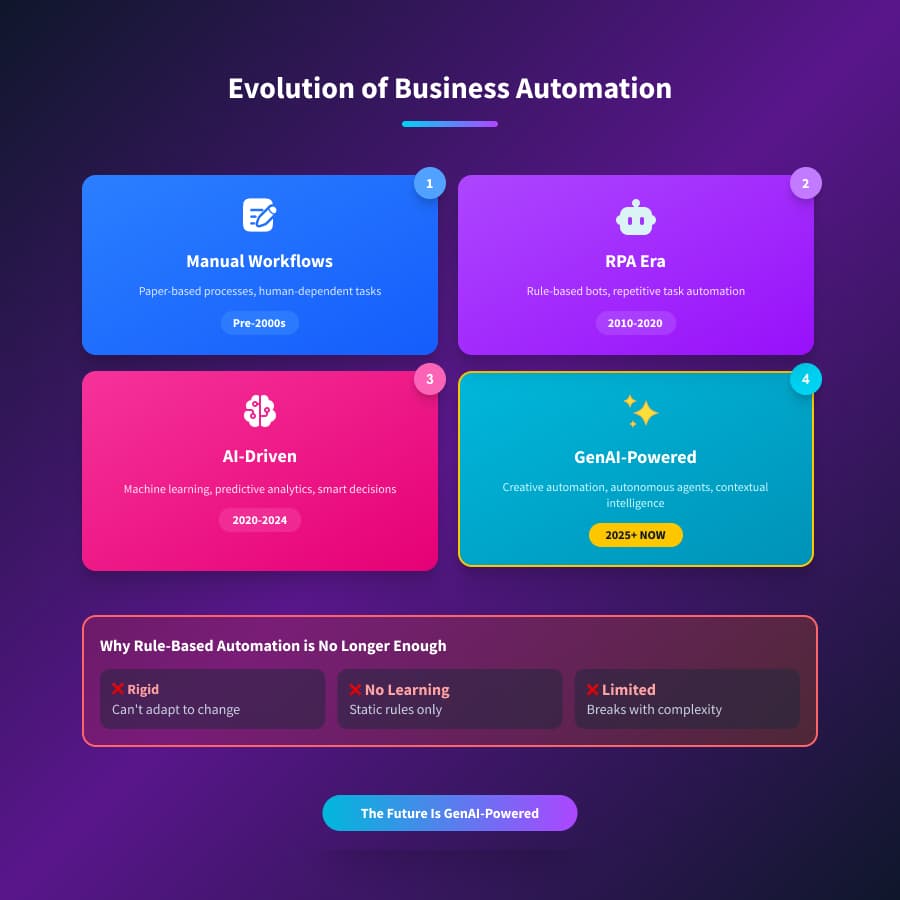
The introduction of Robotic Process Automation marked the next phase, enabling organizations to automate repetitive tasks across applications without deep system integration. However, RPA remained fundamentally rule-based and lacked the ability to learn, reason, or optimize processes dynamically. As businesses grew more complex and data volumes increased, these limitations became increasingly apparent.
Artificial Intelligence introduced a critical leap forward by enabling systems to analyze data, recognize patterns, and make predictions. AI-driven automation moved beyond execution into decision support, allowing organizations to optimize workflows, forecast outcomes, and detect anomalies proactively. More recently, Generative AI has expanded the scope of automation even further by enabling systems to generate content, code, and process logic autonomously. In 2026, business automation is no longer about following rules; it is about understanding context, adapting to change, and continuously improving outcomes.
2.2 Core Objectives of Automation
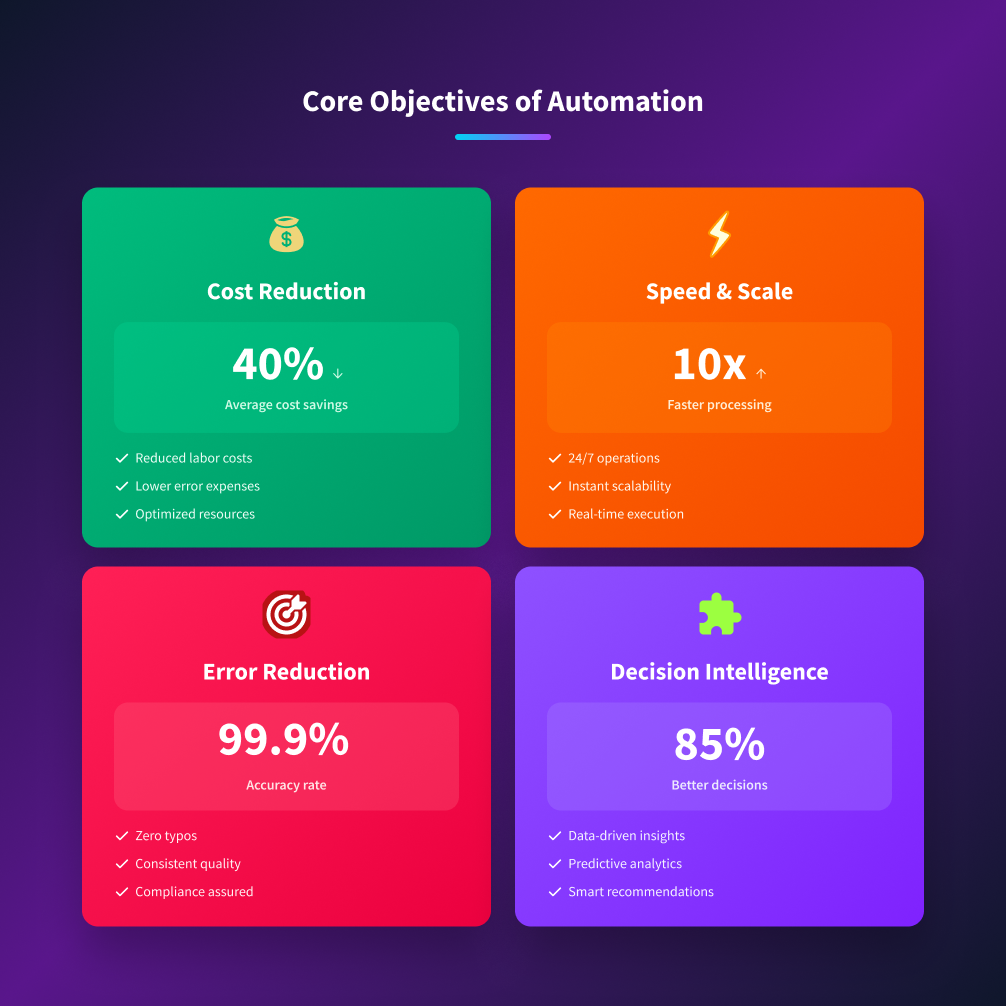
At its core, business automation serves multiple strategic objectives that extend far beyond cost savings. One of the primary goals is cost reduction, achieved by minimizing manual labor, reducing rework, and eliminating inefficiencies across operational processes. Automation enables organizations to scale operations without proportional increases in headcount, creating a more sustainable cost structure.
Speed and scalability represent another critical objective, as automated systems can execute tasks faster and more consistently than human teams. In a market where responsiveness often determines customer satisfaction and competitive advantage, automation ensures that processes keep pace with demand fluctuations and growth.
Error reduction is equally important, particularly in industries where mistakes carry financial, legal, or reputational consequences. Intelligent automation systems reduce human error by enforcing consistency, validating data, and flagging anomalies before they escalate into larger issues. Beyond efficiency and accuracy, modern automation increasingly focuses on decision intelligence, empowering organizations with real-time insights that drive smarter, data-backed decisions across all levels of the business.
3. Understanding Traditional AI in Business Automation
3.1 What Is Traditional AI? (Beyond Buzzwords)
Traditional Artificial Intelligence in business automation refers to systems designed to analyze data, identify patterns, and make predictions or classifications based on learned behavior. Unlike simplistic rule-based systems, AI leverages machine learning and deep learning models that improve performance over time as they are exposed to more data. These systems are built to operate within defined parameters, delivering consistent and measurable outcomes.
Rule-based components still play a role in traditional AI, particularly in environments where compliance and predictability are critical. Machine learning models enhance these systems by enabling them to adapt to variations in data, while deep learning architectures handle complex relationships within large datasets. Together, these approaches form the backbone of AI-driven automation that powers many enterprise systems today.
3.2 How Traditional AI Automates Business Processes
Traditional AI automates business processes by transforming structured data into actionable insights that guide operational decisions. These systems excel at processing large volumes of structured information, such as transactional records, sensor data, or historical performance metrics. By analyzing this data, AI models can predict outcomes, optimize workflows, and trigger automated actions based on predefined thresholds.
Predictive decision-making is a key strength of traditional AI, enabling organizations to anticipate future scenarios and adjust operations proactively. Workflow optimization leverages AI to identify bottlenecks, allocate resources efficiently, and improve throughput across business processes. Anomaly detection further enhances automation by identifying deviations from normal patterns, allowing organizations to address issues before they escalate into failures or losses.
3.3 Real-World Business Automation Examples Using AI
Traditional AI has demonstrated its value across numerous real-world business scenarios. In demand forecasting, AI models analyze historical sales data, market trends, and external factors to predict future demand with high accuracy. Fraud detection systems leverage AI to identify suspicious transactions by comparing them against established behavioral patterns.
Predictive maintenance is another powerful application, particularly in manufacturing and logistics, where AI analyzes equipment data to predict failures and schedule maintenance proactively. Customer churn prediction uses AI to identify at-risk customers, enabling targeted retention strategies that improve customer lifetime value and reduce revenue leakage.
3.4 Proven Impact of Traditional AI
The impact of traditional AI on business automation is both measurable and well-documented. Organizations consistently report improvements in accuracy, reliability, and operational efficiency after implementing AI-driven systems. One of the most significant advantages of traditional AI is explainability, which allows decision-makers to understand how models arrive at specific conclusions, an essential requirement for regulated industries.
From a return-on-investment perspective, traditional AI delivers predictable outcomes that align well with long-term operational goals. Enterprises benefit from improved compliance, reduced risk, and stable performance, making traditional AI a trusted foundation for mission-critical automation initiatives.
4. Understanding Generative AI in Business Automation
4.1 What Is Generative AI?
Generative AI represents a new class of artificial intelligence systems designed to create content, solutions, and workflows rather than simply analyzing existing data. Powered by Large Language Models and other generative architectures, these systems can produce human-like text, write code, generate images, and even design complex automation sequences based on contextual input.
The fundamental difference between traditional decision-focused AI and Generative AI lies in their purpose. While traditional AI optimizes decisions within predefined boundaries, Generative AI expands those boundaries by creating new outputs that did not previously exist. This shift introduces unprecedented flexibility and creativity into automation, enabling systems to operate in dynamic, unstructured environments.
4.2 How Generative AI Changes Automation
Generative AI transforms automation by moving beyond task execution into autonomous workflow generation. Instead of relying on predefined scripts, businesses can use natural language prompts to design, modify, and execute automated processes. This capability democratizes automation, allowing non-technical users to interact with complex systems intuitively.
Natural language becomes a universal interface for automation, enabling teams to describe desired outcomes rather than specify detailed instructions. Generative AI systems also excel at context-aware process orchestration, understanding intent, constraints, and dependencies to deliver tailored automation solutions that adapt in real time.
McKinsey – The Economic Potential of Generative AI: This analysis highlights that applying Generative AI to customer operations including support tasks—can increase productivity by 30–45%, directly supporting figures like faster support and overall workflow gains. - (Reference)
4.3 Real-World Business Automation Examples Using Generative AI
In enterprise environments, Generative AI is increasingly deployed through AI agents capable of handling multi-step workflows autonomously. These agents can gather information, make decisions, and execute actions across systems without constant human intervention. Automated report generation leverages Generative AI to transform raw data into structured, narrative-driven insights that support executive decision-making.
Customer support automation benefits significantly from Generative AI’s reasoning capabilities, enabling systems to resolve complex queries, provide personalized responses, and escalate issues intelligently. In engineering and IT operations, Generative AI accelerates code development, automates DevOps tasks, and reduces time-to-deployment through intelligent scripting and optimization.
4.4 Measured Business Impact of Generative AI
Enterprises adopting Generative AI consistently report substantial productivity gains, particularly in knowledge-intensive roles. Time savings achieved through automated content creation, workflow design, and decision support free human teams to focus on higher-value activities. By reducing cognitive load and manual effort, Generative AI lowers operational friction and enhances overall workforce efficiency.
5. AI vs Generative AI: Core Differences That Matter for Automation
5.1 Functional Comparison
The functional distinction between traditional AI and Generative AI centers on prediction versus creation. Traditional AI excels at forecasting outcomes based on historical data, delivering deterministic results within defined parameters. Generative AI, by contrast, produces probabilistic outputs that vary based on context and input, enabling creative problem-solving and dynamic automation.
5.2 Data Dependency Comparison
Traditional AI relies heavily on structured, high-quality datasets for training and inference, making data availability and consistency critical success factors. Generative AI thrives on unstructured data, leveraging diverse information sources to generate meaningful outputs even in ambiguous scenarios.
5.3 Automation Maturity Comparison
Stability and repeatability define traditional AI-driven automation, making it ideal for mature, well-understood processes. Generative AI prioritizes adaptability and flexibility, allowing automation systems to evolve alongside changing business needs.
5.4 Risk & Reliability Comparison
Explainability remains a strength of traditional AI, supporting compliance and governance requirements. Generative AI introduces new risks, including hallucinations and bias, which necessitate robust oversight, validation mechanisms, and governance frameworks.
According to adoption research, 71 % of organizations are using generative AI in business functions in 2025, demonstrating strong market uptake alongside traditional AI investments. - (Reference)
6. Side-by-Side Comparison Table: AI vs Generative AI for Automation
|
Criteria
|
Traditional AI for Business Automation
|
Generative AI for Business Automation
|
|
Primary Automation Approach
|
Focuses on predictive intelligence, classification, and optimization based on historical and structured data, making it ideal for stable and repetitive processes
|
Focuses on creation, reasoning, and contextual generation, enabling automation of dynamic, knowledge-driven, and creative workflows
|
|
Type of Output
|
Deterministic and consistent outputs that follow learned patterns and predefined logic
|
Probabilistic and context-aware outputs that may vary depending on prompts, intent, and data context
|
|
Data Dependency
|
Requires large volumes of clean, structured, and labeled data for training and reliable performance
|
Can work effectively with unstructured data such as text, documents, conversations, and mixed data sources
|
|
Automation Accuracy
|
High accuracy and low variance, making it suitable for mission-critical and compliance-heavy processes
|
High flexibility but variable accuracy, requiring validation and human oversight in sensitive use cases
|
|
Implementation Complexity
|
Longer development cycles due to data preparation, model training, and system integration
|
Faster deployment using APIs, platforms, and pre-trained models with minimal upfront setup
|
|
Cost Structure
|
Higher upfront development cost but stable and predictable operational expenses over time
|
Lower initial setup cost but recurring usage, monitoring, and governance costs
|
|
Compliance Readiness
|
Strong explainability and auditability, making it suitable for regulated industries
|
Limited explainability, requiring additional governance layers to meet compliance standards
|
|
Human Oversight Required
|
Minimal once models are trained and validated
|
Moderate to high, especially to manage hallucinations, bias, and contextual errors
|
|
Best-Fit Use Cases
|
Forecasting, fraud detection, predictive maintenance, risk scoring, and operational optimization
|
Customer support automation, report generation, workflow orchestration, code generation, and knowledge management
|
7. Where Traditional AI Is Clearly the Better Choice
7.1 High-Accuracy, Low-Variance Processes
In finance, supply chain management, and manufacturing, where precision and consistency are paramount, traditional AI outperforms Generative AI. These environments demand stable outputs that adhere to strict tolerances, making predictive models and deterministic logic the preferred automation approach.
7.2 Regulated & Compliance-Heavy Industries
Banking, healthcare, and insurance operate under stringent regulatory frameworks that require transparency, auditability, and explainability. Traditional AI aligns well with these requirements, offering controlled decision-making processes that meet compliance standards.
7.3 Data-Rich, Pattern-Driven Workflows
Forecasting, optimization, and risk scoring rely on historical data patterns that traditional AI models are uniquely equipped to analyze. In these scenarios, Generative AI’s creative capabilities offer limited additional value compared to the reliability of predictive intelligence.
8. Where Generative AI Outperforms Traditional AI
8.1 Knowledge-Intensive Automation
Documentation, research, and reporting workflows benefit significantly from Generative AI’s ability to synthesize information and generate coherent outputs. These tasks require contextual understanding rather than strict rule adherence.
8.2 Customer Interaction & Experience Automation
Conversational automation, multilingual support, and personalization at scale are areas where Generative AI excels. Its ability to understand intent and generate nuanced responses enhances customer engagement and satisfaction.
8.3 Engineering & Internal Operations Automation
Code generation, testing automation, and workflow scripting are transformed by Generative AI’s capacity to accelerate development cycles and reduce manual effort across technical teams.
9. Cost, Infrastructure & ROI Comparison
9.1 Development & Deployment Cost
Traditional AI often requires significant upfront investment in model training and infrastructure, whereas Generative AI can be deployed rapidly through APIs and managed platforms.
9.2 Operational Cost Over Time
Maintenance, monitoring, and governance costs vary between approaches, with traditional AI offering stable long-term costs and Generative AI requiring ongoing oversight to manage output variability.
9.3 ROI Timelines
Traditional AI delivers steady, long-term ROI through operational optimization, while Generative AI offers faster returns by accelerating productivity and reducing time-to-value.
10. Risks, Limitations & Governance Considerations
10.1 Risks of Traditional AI Automation
Bias in training data and limited adaptability can constrain traditional AI systems, particularly in dynamic environments.
10.2 Risks of Generative AI Automation
Hallucinations, intellectual property concerns, and security risks require robust safeguards and validation mechanisms.
10.3 Compliance, Ethics & Trust
AI governance frameworks, human-in-the-loop strategies, and adherence to international standards are essential for building trust and ensuring responsible automation.
11. Hybrid Automation: Why the Future Is AI + Generative AI
11.1 The Rise of Augmented Automation
Combining predictive AI with Generative reasoning enables systems that are both accurate and adaptable, delivering superior automation outcomes.
11.2 Practical Hybrid Use Cases
Hybrid models leverage AI for prediction and Generative AI for explanation and execution, creating seamless automation experiences.
11.3 Enterprise Case Patterns
Leading organizations integrate both approaches to balance stability, flexibility, and innovation across their automation strategies.
12. Decision Framework: Which One Should Your Business Choose?
12.1 Key Questions to Ask Before Deciding
Organizations must evaluate task complexity, risk tolerance, data maturity, and budget constraints to determine the optimal automation approach.
12.2 Decision Matrix (Visual / Table)
|
Business Type
|
Recommended Automation Approach
|
Reasoning
|
|
Startups
|
Generative AI or Lightweight Hybrid Automation
|
Startups benefit from rapid deployment, lower upfront investment, and flexibility. Generative AI enables quick automation of customer support, documentation, and internal operations without heavy data infrastructure
|
|
Small & Medium Businesses (SMBs)
|
Hybrid Automation combining Traditional AI and Generative AI
|
SMBs require both operational stability and adaptability. Traditional AI supports forecasting and optimization, while Generative AI enhances customer engagement and internal productivity
|
|
Mid-to-Large Enterprises
|
Traditional AI with Selective Generative AI Integration
|
Enterprises operate complex, regulated, and data-rich environments where accuracy and compliance are critical. Traditional AI ensures reliability, while Generative AI is best applied to controlled, knowledge-intensive workflows
|
|
Highly Regulated Industries
|
Traditional AI with Human-in-the-Loop Governance
|
Industries such as banking, healthcare, and insurance require explainable and auditable automation systems that minimize risk and regulatory exposure
|
|
Digital-First & Service-Led Businesses
|
Generative AI–Led Automation
|
Businesses focused on customer experience, personalization, and rapid innovation benefit from Generative AI’s conversational and content-generation capabilities
|
13. Future of Business Automation: 2026–2030 Outlook
The next phase of automation will be defined by autonomous AI agents, self-optimizing workflows, and regulation-driven design principles that prioritize trust and accountability.
14. Final Verdict: AI vs Generative AI for Business Automation
There is no one-size-fits-all answer to the AI versus Generative AI debate. Each technology serves distinct purposes and delivers value in different contexts. Businesses that align their automation strategy with their operational needs, risk profile, and growth ambitions will achieve the greatest success. At TechQware, we help organizations design, implement, and scale intelligent automation solutions that combine the best of traditional AI and Generative AI, ensuring sustainable impact and measurable ROI.
Start Your Intelligent Automation Journey with TechQware
Choosing between AI and Generative AI is not just a technology decision; it is a business strategy decision that directly impacts efficiency, scalability, and long-term growth. At
TechQware help businesses design and implement automation solutions that are practical, secure, and built for real-world impact.
As businesses move toward intelligent automation, having the right guidance and technology partner makes all the difference. TechQware is honored to be recognized by Clutch as one of the Top Artificial Intelligence as a Service Companies in India, reflecting the trust businesses place in our ability to deliver practical and scalable AI solutions. Our focus is to help organizations confidently adopt AI, Generative AI, and hybrid automation strategies that improve efficiency, support growth, and create measurable long-term value.
Whether you need predictive AI for core operations, Generative AI for knowledge-driven workflows, or a hybrid automation model, our experts ensure your automation investments deliver measurable ROI.
Connect with TechQware to build smarter, future-ready automation.

 TechQware