app development
How Generative AI is Reshaping Mobile App Development in 2026
 TechQware
June 26, 2026
 TechQware
June 26, 2026
Mobile app development is undergoing a profound transformation in 2026, led by the unprecedented advances in generative artificial intelligence (AI). This year marks a tipping point where AI-first mobile apps move beyond buzzwords into mature, indispensable tools enriching millions of lives worldwide. From personalized interactions to real-time intelligent automation, generative AI is redefining user experiences and developer workflows alike.
But why is 2026 so pivotal? Several critical factors converge now: the maturity of generative AI models, breakthroughs in on-device hardware capabilities, and evolving mobile ecosystems embracing hybrid cloud-edge AI architectures. Together, these facilitate smarter, faster, and more secure AI experiences on mobile devices with reduced latency and stronger privacy safeguards.
The market validates this shift. Recent studies highlight a sharp increase in mobile apps embedding generative AI up by over 75% from 2024 to 2026 fueling a new wave of innovation. Major platform providers such as Apple and Google have integrated specialized AI processors, enabling complex models to run efficiently at the edge. Developers benefit from AI-enhanced tools that accelerate coding, testing, and deployment.
This blog explores how generative AI is reshaping mobile app development with in-depth analysis of key technology trends, industry-specific innovations,
opportunities for developers, challenges to navigate, and a glimpse into the future of
AI-native mobile ecosystems. Whether you are a developer, business leader, or technology enthusiast, understanding these dynamics equips you for the next era of mobile innovation.
Get concise, decision-ready insights to help your team implement AI faster and smarter without disrupting your existing workflows.
Show Me What’s PossibleThe generative AI landscape has evolved rapidly over the early 2020s, with cloud-hosted large language models (LLMs) dominating initial adoption. These massive AI models enabled natural-sounding language generation, image synthesis, and multimodal interactions but were largely tethered to internet connectivity and suffered latency issues for mobile users.
By 2026, the paradigm shifts to hybrid architectures combining cloud resources with advanced on-device AI inferencing. This shift is powered by breakthroughs in model compression techniques, efficient neural architectures, and the inclusion of dedicated AI chips in mobile devices such as Apple’s Neural Engine and Google's Tensor Processing Units.
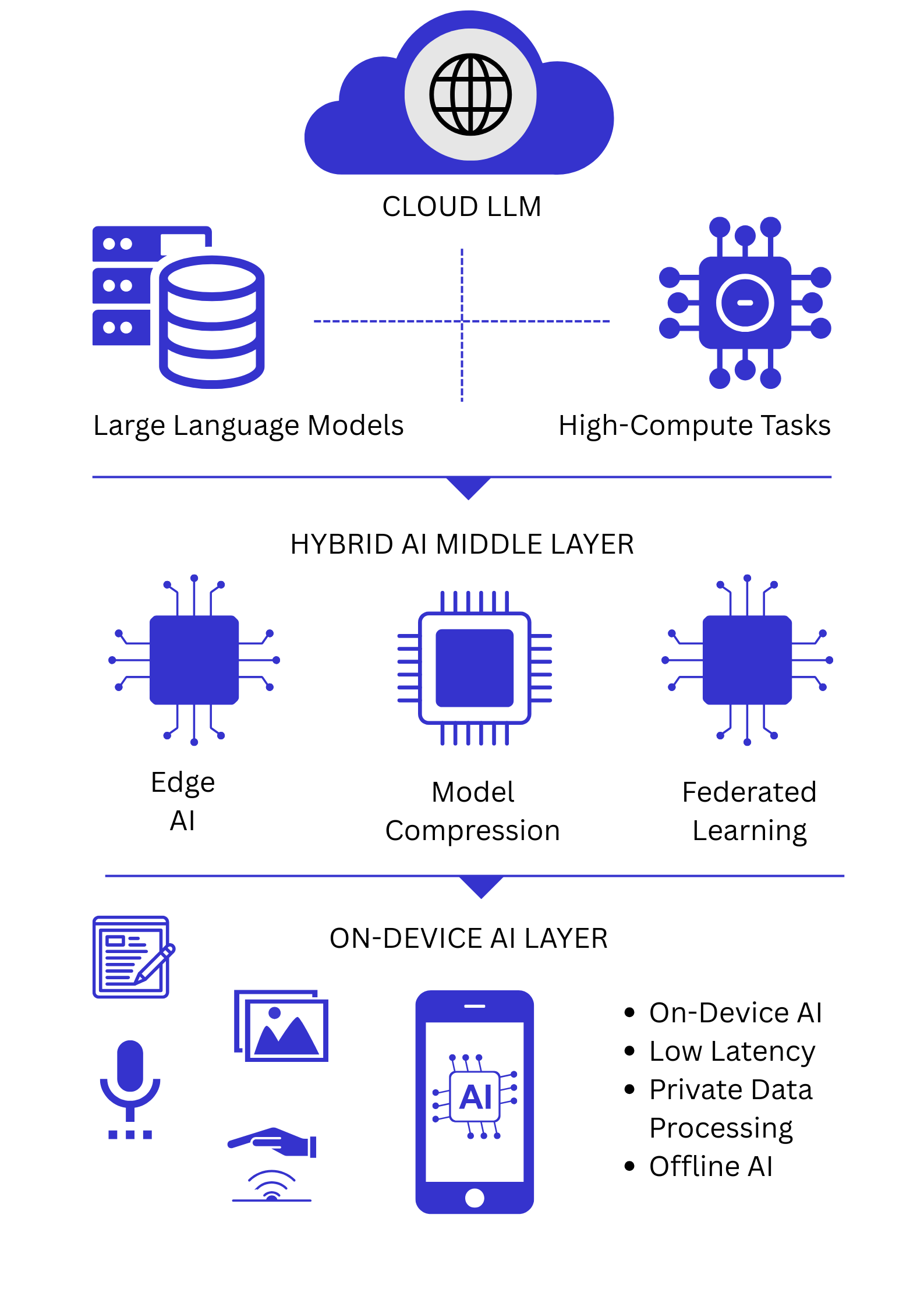
On-device AI reduces reliance on cloud connectivity, minimizing latency and providing enhanced user privacy by keeping sensitive data local. Developers can now build feature-rich apps with offline generative capabilities ranging from text completion to image generation and voice synthesis.
One of the most exciting developments in 2026 is the normalization of multimodal AI models that process and generate multiple types of data simultaneously. Mobile apps increasingly combine text, voice, visual, and sensor inputs to understand user context and produce richly interactive outputs.
For instance, a fitness app can analyze a user’s voice comments, facial expressions captured through the camera, and sensor data from wearables to adapt workouts dynamically. Messaging apps offer AI assistants who comprehend images, text, and voice commands, generating responses that blend these modes seamlessly.
This multimodal approach enriches user engagement and accessibility, allowing mobile apps to provide personalized assistance that transcends traditional interfaces.
Autonomy in AI agents represents a leap forward in mobile app intelligence. Instead of merely reacting to user commands, these agents proactively manage complex tasks on behalf of users. Examples include AI agents that autonomously schedule meetings by understanding email content, recommend personalized content throughout the day, or monitor health parameters and alert users in real-time with actionable advice.
This class of autonomous agents relies on continual learning and contextual adaptation, running efficiently on-device while synchronizing selectively with cloud systems when enhanced computing is needed. The rise of autonomous AI agents empowers mobile apps to become truly intelligent companions rather than passive tools.
The user interface (UI) is undergoing significant reimagining driven by generative AI’s ability to mold screens and interactions dynamically. Instead of static layouts, apps now feature UI flows that adapt on-the-fly to user behavior, preferences, and context.
For example, a news app may reorder sections based on a user’s weekend vs. weekday reading patterns or modify font size and color schemes to optimize visibility in varying lighting conditions detected by phone sensors. This level of personalization enhances accessibility and engagement, making every app experience unique.
AI-driven optimization techniques improve app responsiveness and efficiency at a fundamental level. Machine learning models analyze usage patterns to predict required resources, pre-load content intelligently, and manage background tasks without compromising battery life or performance.
By continuously learning from data on device, these optimizations minimize delays and smooth transitions, giving users seamless experiences even on mid-range devices. This is especially crucial in regions with less powerful hardware or unreliable networks.
Generative AI accelerates the entire mobile app development lifecycle. AI copilots, such as advanced code generation assistants, help developers write complex features from simple prompts, automatically generate APIs, and even refactor legacy code.
Testing and quality assurance (QA) have also undergone transformation with AI-powered automated pipelines that simulate diverse real-world scenarios, identify bugs early, and suggest fixes. This drastically reduces development time and improves app stability and security.
Generative AI enables apps to embed highly intelligent natural language processing capabilities. Mobile apps increasingly incorporate AI-powered search engines that understand intent rather than simple keywords, facilitating quick retrieval of relevant information.
Similarly, chatbots evolve from scripted interactions to context-aware virtual assistants capable of providing meaningful support or performing tasks on behalf of users in real time. These capabilities boost user retention and satisfaction by reducing friction and enabling natural conversations inside any app.
A new wave of mobile apps empowers creators by harnessing generative AI to co-create art, videos, music, and stories directly on phones and tablets. These apps democratize content creation, expanding creative possibilities for users without traditional expertise.
Generative AI acts as a collaborator, enhancing creativity, speeding workflows, and enabling novel forms of expression for instance, generating video backgrounds from textual prompts or composing music tracks adapted to user moods.
Healthcare apps now integrate real-time generative AI diagnostics that analyze symptoms, medical history, and sensor data to offer preliminary assessments. These AI-powered apps can triage patients, alert medical professionals, and suggest virtual care pathways.
Virtual care agents serve as accessible, always-on companions providing personalized reminders, mental wellness coaching, and chronic disease management, reducing strain on healthcare infrastructures and improving outcomes.
FinTech apps embrace generative AI to detect financial fraud with unprecedented speed and accuracy. Real-time analysis of transactions identifies anomalous patterns to prevent theft and unauthorized activity.
Moreover, AI-based Know Your Customer (KYC) solutions use document synthesis, biometric verification, and contextual data to streamline onboarding, enhance security, and comply with evolving regulations efficiently.
Retail apps leverage AI shopping assistants that provide personalized recommendations based on browsing behavior, social media trends, and even current wardrobe integration. These assistants offer style advice, virtual try-ons via augmented reality, and adaptive promotions tailored to users’ tastes and budgets.
This enhances customer engagement and drives sales by creating immersive, personalized shopping journeys within mobile apps.
Mobile manufacturing apps equipped with AI-powered predictive analytics monitor production lines in real time to foresee equipment failures, optimize throughput, and reduce downtime.
Digital twin technology modeled on mobile apps provides a virtual replica of physical assets that developers and operators can interact with remotely, allowing faster decision making and proactive maintenance.
Education apps now feature AI-powered tutors that adapt lessons and exercises in real-time to meet individual student needs, pacing lessons based on learning speed and comprehension.
Generative AI also creates adaptive assessments that evolve with learner progress, making education more personalized, scalable, and effective.
How leading businesses are using Generative AI to boost user experience, automate workflows, and accelerate development timelines. Get insights you can apply immediately.
2026’s most significant leap is the widespread integration of powerful AI chips in flagship and mid-tier devices, dramatically improving the speed and efficiency of AI computations on-device.
These chips enable real-time voice recognition, image synthesis, language translation, and much more without offloading processing to the cloud. This transformation brings generative AI’s full power directly into users’ hands.
With rising concerns about data privacy, on-device AI architectures prioritize safeguarding user information. By limiting data transmission and performing sensitive AI processing locally, mobile apps comply with strict regulations like GDPR and CCPA.
Techniques such as federated learning allow models to improve across devices collectively without exposing personal data, blending innovation with responsibility.
Offline access to generative AI features democratizes advanced capabilities for all users, including those in low-connectivity areas. Mobile apps support text generation, image creation, and dynamic assistance without internet connectivity, expanding access and usability massively.
Generative AI unlocks innovative revenue streams, such as AI-generated content subscriptions, microtransactions for personalized services, and premium AI features embedded directly into apps.
Businesses can differentiate themselves by offering bespoke, AI-driven experiences users are willing to pay for.
Developers enjoy heightened productivity thanks to AI copilots that automate coding, debugging, and deployment tasks. This leads to leaner teams producing higher-quality apps faster.
Automation tools integrated with CI/CD pipelines enhance rapid prototyping and continuous integration, accelerating time-to-market.
Startups leverage AI to cut traditional development cycles dramatically, enabling quick launches and iterative improvements based on AI-driven user feedback analytics.
This agility allows smaller players to compete and innovate alongside tech giants effectively.
Generative AI can sometimes produce inaccurate or biased outputs (“hallucinations”), risking misinformation and user frustration. Maintaining transparency and incorporating human-in-the-loop review processes remain critical.
As AI features proliferate, they also become targets for abuse such as deepfake generation, phishing, and disinformation campaigns. Developers must embed robust security measures and adhere to evolving AI compliance standards globally.
Despite advancements, running powerful AI models remains resource-intensive. Balancing cloud infrastructure costs and on-device processing budgets is challenging, especially for startups and small developers.
AI can help your team lower development effort, cut engineering hours, and streamline operations while keeping quality high.
Get Cost-Efficient SolutionsStrategic use of hybrid architectures and optimization techniques is essential for sustainable AI deployments.
Several popular apps lead the charge integrating generative AI:
Users now expect these intelligent, generative capabilities as baseline, making AI integration a crucial competitive advantage.
The next evolution will see apps architected from the ground up around generative AI capabilities, not as add-ons. This will enable deeper contextual awareness and far more natural human-computer interactions.
Mobile ecosystems will become increasingly autonomous, with interconnected AI agents working on users’ behalf across apps and services, managing entire workflows with minimal human intervention.
Voice, gesture, biometrics, and AI predictions will replace manual controls with intuitive zero-touch interfaces. Mobile apps will proactively anticipate user needs, creating frictionless digital experiences.
Most discussions around AI in mobile apps miss the point. The challenge isn’t whether AI can be used—it’s whether it’s being integrated in a way that won’t create long-term technical debt.
As mobile systems grow closer to core business infrastructure, architecture matters more than feature sets. For B2B and SaaS platforms, AI has to fit cleanly into existing workflows, respect data boundaries, and remain observable and maintainable. This is where partnering with an AI App development company like TechQware helps. A disciplined approach to system design, data handling, and automation prevents short-term wins from turning into long-term problems. Teams that get this right early will spend less time fixing and more time improving.
At TechQware, we help businesses turn these possibilities into real, high-performing products. From building AI-powered mobile apps to integrating generative AI workflows, personalized user journeys, and scalable architectures, our team brings the expertise required to transform your ideas into futuristic, intelligent, and market-ready solutions. Whether you’re starting a new project or modernizing an existing one, TechQware ensures your app is ready for the AI-driven future.
Ready to build your AI-first mobile app? Contact TechQware today.
Let’s chat about your goals and explore how TechQware can support your journey ahead.



Mobile App Development . Oct 13, 2026
Food Delivery App Development in Dubai:…
app development . Oct 08, 2026
OTT Platform Development: A Complete Gu…