Introduction : Why Full-Stack Development Looks Very Different in 2026
Full-stack development in 2026 has fundamentally changed from what it was just a few years ago. Building an application today is no longer about connecting a frontend to a backend and deploying it on a server. It now requires deliberate decisions across artificial intelligence, cloud-native infrastructure, security, performance, and long-term scalability.
One of the biggest shifts is the rapid adoption of AI-assisted development. AI coding assistants are now embedded into everyday engineering workflows, helping teams generate code, tests, and documentation faster than ever before. Industry surveys from GitHub and Stack Overflow show that a majority of development teams actively rely on AI tools, significantly accelerating delivery timelines. However, this speed also increases the risk of architectural shortcuts, making strong engineering fundamentals more critical than ever.
At the same time, cloud-native has become the default approach. CNCF reports indicate that more than 80% of modern applications are now built specifically for the cloud, leveraging managed services, elastic scaling, and global availability from day one. While this unlocks massive potential, it also raises the cost of poor architectural decisions, which can multiply infrastructure expenses and slow down growth at scale.
User expectations have also risen sharply. Applications are expected to be fast, secure, highly available, and compliant by default. In this environment, full-stack development is no longer about knowing more tools, but about making the right decisions early decisions that directly impact speed, cost, and long-term business success.
What “Full-Stack” Really Means in 2026
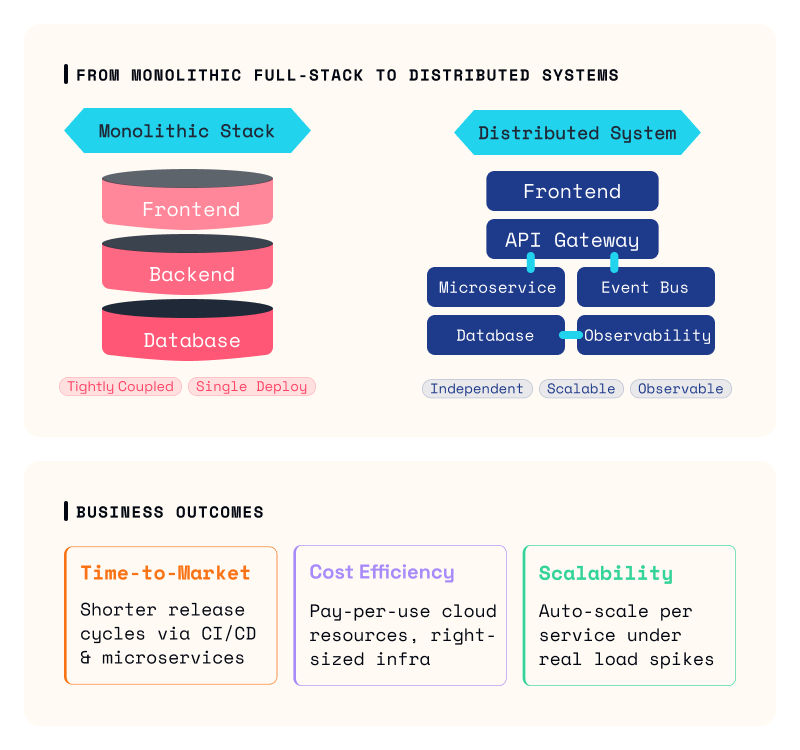
From Monolithic Full-Stack to Distributed Systems
In 2026, the term “full-stack” extends far beyond frontend and backend code. A modern full-stack engineer or team is responsible for the entire lifecycle of an application, from user experience to backend logic, from cloud infrastructure to observability and incident response. Applications are increasingly composed of distributed systems, where services communicate through APIs, events, and message queues rather than direct function calls.
This shift has been driven by the need for resilience and independent scalability. Frontend applications now interact with multiple backend services, authentication providers, analytics systems, and third-party APIs. Observability has become a core part of the stack, with metrics, logs, and traces treated as first-class citizens. Without proper monitoring, teams are effectively flying blind, unable to diagnose issues before users feel the impact.
A real-world example can be seen in e-commerce platforms that started as simple monoliths. As traffic grew, checkout, inventory, payments, and notifications had to be separated to avoid cascading failures during peak sales. Teams that delayed this transition often faced outages during critical revenue windows, reinforcing the importance of thinking beyond monolithic designs.
Why Business Outcomes Now Define Full-Stack Choices
Full-stack decisions in 2026 are increasingly driven by business outcomes rather than technical preferences. Time-to-market has become a competitive weapon, especially for startups and SaaS companies. Teams that can release features weekly or even daily consistently outperform those stuck in long release cycles.
Cost efficiency is another major factor. Cloud resources are powerful but expensive when misused. A poorly optimized architecture can multiply infrastructure costs as usage grows. Scalability, therefore, is not just about handling more users but doing so without destroying margins.
DORA metrics consistently show that high-performing teams deploy code up to 46 times more frequently than low-performing teams, with significantly lower failure rates. These teams achieve this not by chasing trends, but by aligning their full-stack choices with clear business goals, stable architectures, and disciplined delivery practices.
Frontend Stack for Modern Full-Stack Apps
Leading Frontend Frameworks in 2026
Frontend development in 2026 is defined by performance, developer experience, and seamless integration with backend systems. React continues to dominate the ecosystem, particularly with the widespread adoption of Server Components. By shifting rendering logic closer to the server, teams reduce bundle sizes, improve initial load times, and enhance SEO without sacrificing interactivity.
Frameworks like Next.js and Remix have become the default choices for production-grade applications. They offer opinionated structures, built-in routing, server-side rendering, and edge deployment capabilities. This reduces architectural guesswork and allows teams to focus on building features rather than plumbing.
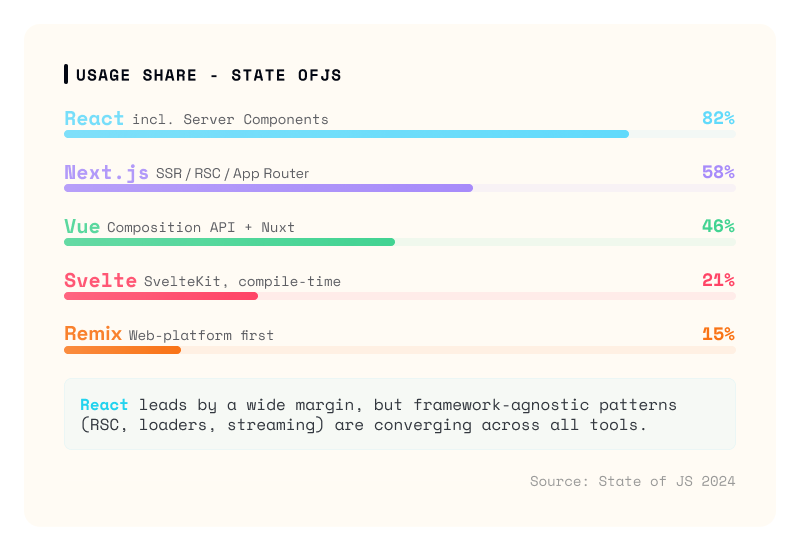
Vue and Svelte continue to serve specific niches. Vue remains popular in teams that value simplicity and strong separation of concerns, while Svelte shines in performance-sensitive applications due to its compile-time optimizations. State of JS reports consistently show React holding the largest usage share, but satisfaction scores for newer frameworks remain high, indicating a healthy and diverse ecosystem.
Performance benchmarks using Lighthouse scores reveal that frameworks optimized for server rendering and edge delivery consistently outperform purely client-rendered applications. In competitive markets, these milliseconds translate directly into higher conversion rates and better user retention.
UI Performance, Accessibility & UX Expectations
User expectations around performance and accessibility have never been higher. Core Web Vitals are no longer optional metrics; they directly impact search rankings, user engagement, and brand perception. Studies show that over 50% of users abandon applications that take longer than three seconds to load, making frontend performance a revenue-critical concern.
Accessibility is another area where expectations have matured. Compliance with standards such as WCAG is not just about avoiding legal risk, but about expanding user reach. Accessible applications can serve millions of users with disabilities, unlocking new markets and improving overall usability for everyone.
A practical example comes from a fintech company that redesigned its dashboard with accessibility in mind. By improving contrast ratios, keyboard navigation, and screen reader support, they saw a measurable increase in engagement from enterprise clients who required compliance for internal tools. In 2026, great UX is inclusive UX, and frontend stacks must support that reality.
Backend Technologies Powering Scalable Full-Stack Apps
Popular Backend Languages & Frameworks
Backend technology choices in 2026 are shaped by scalability, ecosystem maturity, and team expertise. Node.js remains a dominant force, especially for teams already invested in JavaScript across the stack. Its non-blocking I/O model makes it ideal for API-driven applications and real-time systems.
Python, particularly with FastAPI, has surged in popularity due to its performance, developer friendliness, and native support for asynchronous programming. FastAPI’s automatic documentation generation and type hints make it a favorite for API-first development.
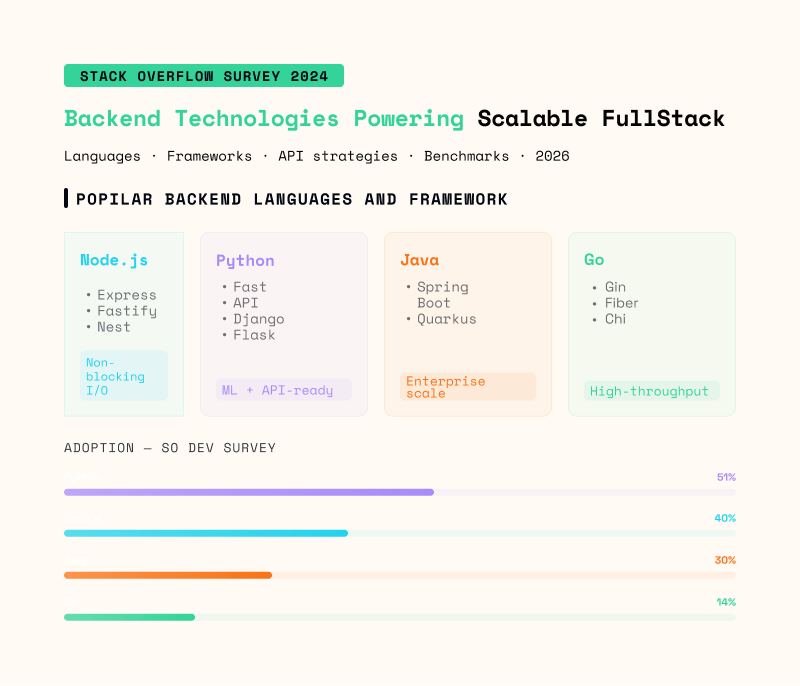
Java with Spring Boot continues to power large-scale enterprise systems where stability and long-term support are critical. Meanwhile, Go has carved out a strong position in high-throughput, low-latency systems such as streaming platforms and infrastructure tools.
Stack Overflow Developer Surveys consistently show these languages at the top of backend adoption charts, with Go demonstrating some of the highest satisfaction scores due to its simplicity and performance.
API-First Development as the Default
API-first development has become the standard approach for modern full-stack applications. Whether using REST, GraphQL, or gRPC, APIs define clear contracts between frontend and backend teams. This decoupling allows parallel development and faster iteration cycles.
REST remains the most widely used due to its simplicity and tooling support, while GraphQL is favored for complex data-fetching scenarios where frontend flexibility is critical. gRPC has gained traction in internal service-to-service communication due to its performance benefits.
Teams adopting API-first strategies report reduced coupling between frontend and backend, leading to faster releases and fewer integration issues. In real-world SaaS environments, this approach enables multiple client applications, such as web, mobile, and partner integrations, to evolve independently without breaking changes.
Databases & Data Layer : Choosing for Scale, Not Just Speed
SQL vs NoSQL in Real-World Applications
Database decisions in 2026 are less about ideology and more about workload characteristics. SQL databases like PostgreSQL and MySQL remain the backbone of most applications due to their reliability, strong consistency, and mature ecosystems. PostgreSQL, in particular, has evolved into a multi-purpose data platform with support for JSON, full-text search, and advanced indexing.
NoSQL databases such as MongoDB and DynamoDB excel in scenarios requiring flexible schemas and massive horizontal scalability. They are commonly used for user activity logs, content management systems, and event data.
A real-life scenario involves a media platform that initially chose NoSQL for speed but later introduced PostgreSQL for transactional workflows. This hybrid approach allowed them to balance flexibility with data integrity, highlighting that the best architectures often combine multiple data stores.
Caching & Real-Time Data Patterns
Caching has become a non-negotiable component of scalable applications. Redis is widely used for session storage, rate limiting, and frequently accessed data. Studies show that effective caching can reduce database load by over 60% and significantly improve response times.
Real-time data patterns using WebSockets and streaming platforms enable features such as live notifications, chat systems, and real-time analytics. Read replicas further enhance performance by distributing query loads, resulting in measurable latency reductions for global users.
Cloud-Native Infrastructure : The Backbone of Full-Stack Apps
Cloud Providers & Deployment Models
AWS, GCP, and Azure dominate the cloud landscape, each offering robust ecosystems for compute, storage, and managed services. Public cloud adoption continues to rise, with estimates suggesting that over 85% of applications now run on some form of public cloud infrastructure.
Hybrid and multi-cloud strategies are increasingly common among enterprises seeking vendor flexibility and regulatory compliance. However, these approaches require strong governance to avoid complexity and cost overruns.
Containers, Serverless & Edge Computing
Containers powered by Docker and Kubernetes remain the foundation of scalable deployments. Kubernetes provides orchestration, self-healing, and automated scaling, making it suitable for complex systems.
Serverless functions have matured significantly, with reduced cold start times and improved observability. Edge computing pushes logic closer to users, improving latency and enabling new use cases such as real-time personalization. Companies adopting edge runtimes report noticeable performance gains and cost savings compared to traditional centralized servers.
Modern Full-Stack Architecture Patterns That Work
Monolith vs Microservices vs Modular Monolith
Choosing the right architecture is one of the most critical decisions in full-stack development. Monoliths are still effective for small teams and early-stage products due to their simplicity. However, premature microservices adoption has been linked to higher failure rates and maintenance costs.
The modular monolith has emerged as a pragmatic middle ground. It enforces internal boundaries while maintaining a single deployable unit, allowing teams to scale complexity gradually.
|
Architecture Type
|
Best For
|
Key Trade-Offs
|
|
Monolith
|
Early-stage products
|
Limited scalability
|
|
Modular Monolith
|
Growing teams
|
Requires discipline
|
|
Microservices
|
Large-scale systems
|
Operational complexity
|
Event-Driven & Asynchronous Architectures
Event-driven architectures using Kafka or cloud-native pub/sub systems enable decoupled workflows and background processing. This approach improves resilience and scalability, particularly in data-intensive applications.
Scalable Authentication & Authorization Patterns
Modern authentication relies on OAuth 2.0, JWTs, and zero-trust principles. Centralized identity providers reduce security risks and simplify access management across distributed systems.
DevOps, CI/CD & Observability in 2026
CI/CD Pipelines That Enable Daily Deployments
CI/CD pipelines are essential for high-performing teams. Tools like GitHub Actions and GitOps workflows enable automated testing, deployment, and rollback. DORA reports show that elite teams deploy multiple times per day with lower change failure rates.
Monitoring, Logging & Observability
Observability stacks built on OpenTelemetry provide deep visibility into system behavior. Companies investing in observability report faster mean time to recovery and reduced downtime costs, which can reach thousands of dollars per minute for large platforms.
|
Observability Signal
|
Purpose
|
Business Impact
|
|
Metrics
|
System health
|
Faster scaling
|
|
Logs
|
Debugging
|
Reduced MTTR
|
|
Traces
|
Performance analysis
|
Better UX
|
Security & Compliance : Non-Negotiable for Full-Stack Apps
API Security & Data Protection
Security practices such as rate limiting, encryption, and secrets management are mandatory in 2026. API breaches can expose sensitive data and damage brand trust irreparably.
Compliance Expectations in 2026
Regulations like GDPR and SOC 2 continue to shape how applications handle data. The cost of data breaches has climbed steadily, with studies estimating average losses in the millions, making proactive compliance a strategic investment rather than a legal checkbox.
AI-Assisted Development : Boost or Risk?
Where AI Improves Full-Stack Productivity
AI tools accelerate code generation, testing, and documentation. Teams report significant productivity gains, especially during prototyping and refactoring phases.
Risks of Over-Reliance on AI-Generated Code
Over-reliance on AI can introduce security vulnerabilities and maintainability issues. Successful teams treat AI as an assistant, not a replacement for architectural thinking.
Common Mistakes Teams Make When Building Full-Stack Apps
Overengineering Too Early
Many teams adopt complex architectures before validating product-market fit, leading to wasted effort and slow iteration.
Ignoring Scalability & Observability
Lack of observability often turns minor issues into major outages, increasing re-architecture costs later.
Tool-First Instead of Problem-First Decisions
Choosing tools based on trends rather than business needs remains a leading cause of startup failure.
A Practical Full-Stack Blueprint for 2026
Step-by-Step Stack Selection Framework
Effective stack selection starts with business goals, expected user scale, and budget constraints. This structured approach reduces risk and aligns technology with outcomes.
Sample Recommended Stacks (By Use Case)
Startup MVPs benefit from simple, opinionated stacks, while enterprise SaaS platforms require robust security and scalability. High-traffic consumer apps demand performance-optimized architectures with edge delivery.
Final Thoughts : Full-Stack Success Is About Decisions, Not Tools
Technology will continue to evolve, but the principles of sound architecture, disciplined execution, and continuous learning remain constant. In 2026, full-stack success is defined by the quality of decisions teams make early and how well they adapt as systems grow. Architecture directly influences cost, speed, and long-term growth, making it one of the most strategic assets a company can invest in.
At TechQware, we help organizations design, build, and scale full-stack applications that are future-ready, secure, and performance-driven. If you’re planning to build or modernize your product in 2026, let’s start the conversation.
Connect with Us today to architect your next-generation full-stack application and turn technology decisions into lasting business advantages.

 TechQware