Key Takeaways:
- UCP is a global open commerce API standard.
- Merchants keep control, avoiding 15–40% platform fees.
- Unifies discovery, checkout, payments, and fulfillment.
- AI could handle 70% of purchases by 2030.
- Cuts customer acquisition costs by ~60%.
- Supports global and B2B commerce.
Universal Commerce Protocol (UCP) establishes a standardized set of APIs and data models that enable AI agents, e-commerce platforms, and payment systems to interact seamlessly in digital transactions. Developed as an open-source initiative with contributions from major tech players including Google, it addresses the silos in modern commerce by allowing businesses to expose their services uniformly without proprietary lock-ins.
This protocol prioritizes merchant control, security through OAuth 2.0, and extensibility for emerging use cases like agentic AI shopping. Unlike closed ecosystems, UCP operates on a "publish once, integrate everywhere" model, making it practical for developers and scalable for enterprises.
What Is Universal Commerce Protocol (UCP)?
_.png)
UCP defines a layered architecture for commerce interactions, starting with capability discovery where businesses advertise supported features like product search, checkout flows, or fulfillment options via a simple JSON profile endpoint. For example, a retailer might expose endpoints for guest checkout, inventory queries, and returns management, all discoverable by any compliant AI agent or app without prior agreements.
At its core, UCP separates concerns into distinct phases: discovery (what can you do?), session initiation (user intent capture), order execution (payment and confirmation), and post-order tracking (fulfillment and support). Data models are strictly typed using JSON Schema, ensuring interoperability think of ProductOffer objects that include price, availability, shipping estimates, and even sustainability metrics in a consistent format across providers.
Security is baked in from the ground up: OAuth 2.0 client credentials for machine-to-machine auth, PKCE for user-involved flows, and Account Proofs 2.0 (AP2) for cryptographic verification of payment consents. Merchants remain the Merchant of Record (MoR), holding liability for disputes, taxes, and compliance, which reduces risk for agents and platforms. This merchant-centric design contrasts with marketplace models where platforms assume MoR, often leading to higher fees and less flexibility.
UCP supports multiple transports: REST over HTTPS for simplicity, MCP (Model Context Protocol) for AI-native integrations, and A2A (Agent-to-Agent) messaging for complex negotiations. Early adopters include airlines for dynamic pricing and retail chains syncing real-time stock.
Why Universal Commerce Protocol Matters in the Future of Digital Commerce
The rise of conversational AI and autonomous agents is fragmenting commerce into thousands of silos each chatbot or super app building custom integrations with dozens of merchants. UCP provides the open infrastructure to unify this, much like HTTP standardized the web, preventing a future where AI commerce stalls due to integration debt.
Monopolies like Amazon and Alibaba dominate 50%+ of global e-commerce, charging 15-40% commissions while controlling discovery and data. UCP democratizes access, letting sellers connect directly to agents from Perplexity, ChatGPT, or custom bots, bypassing gatekeepers.
This aligns with macro trends: agentic commerce could represent $1 trillion in transactions by 2030, driven by AI handling 70% of purchases end-to-end.
Regulatory tailwinds amplify its importance. The EU's Digital Markets Act mandates API access for gatekeepers, while India's ONDC-inspired policies and U.S. antitrust actions against Big Tech push for open networks. UCP positions businesses ahead of mandates, turning compliance into competitive advantage.
In a world of programmable money and AI economies, closed platforms risk obsolescence; open protocols like UCP enable composable commerce where agents bundle deals across providers instantly.
The Problem with Traditional Marketplace-Led Commerce
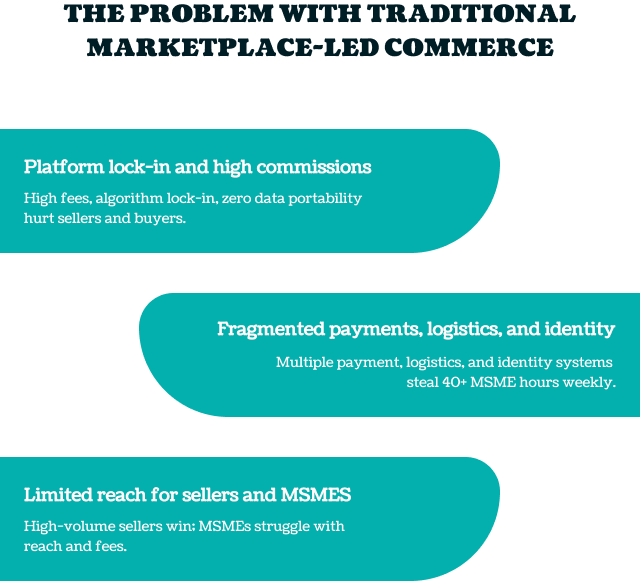
Platform Lock-In and High Commissions
Sellers commit inventory and marketing budgets to one platform, facing algorithm whims that can slash visibility overnight. Amazon's FBA fees hit 38% for some categories, eroding margins for MSMEs already operating on 5-10% profits. Exiting requires rebuilding customer bases elsewhere, with data portability near zero.
Buyers face "choice paralysis" within silos, missing better deals on competitor sites. Platforms prioritize private-label products, distorting markets.
Fragmented Payments, Logistics, and Identity
Global sellers reconcile Stripe, PayPal, Razorpay, and UPI in one dashboard nightmare, with FX losses and chargeback mismatches. Logistics APIs vary Shiprocket in India, ShipStation elsewhere forcing custom middleware. Identity repeats KYC across apps, violating user privacy and increasing drop-offs by 20-30%.
For MSMEs, this means 40+ hours weekly on ops instead of growth.
Limited Reach for Sellers and MSMEs
India's 63 million MSMEs generate just 5% of e-commerce volume, hemmed by listing fees, ad auctions, and regional biases. Cross-border hits duties, labeling, and payment rails barriers; a Mumbai handicraft seller can't easily reach U.S. Etsy buyers without intermediaries skimming 25%. Platforms favor high-volume sellers, leaving niches underserved.
How Universal Commerce Protocol (UCP) Works
Standardized Product Discovery and Catalog APIs
Merchants host a /capabilities endpoint returning a profile like:
| 1 |
text |
| 2 |
{ |
| 3 |
"id": "merchant-123", |
| 4 |
"supportedCapabilities": ["product-search", "guest-checkout", |
| 5 |
"returns"], |
| 6 |
"endpoints": { "search": "/v1/search" }, |
| 7 |
"regions": ["IN", "US"] } |
Agents POST search queries ({"query": "wireless earbuds", "maxPrice": 5000, "currency": "INR"}), getting paginated results with SKUs, images, and offers. Real-time webhooks push inventory updates, eliminating polling.
Unified Order Lifecycle Management
Sessions start with /sessions POST, capturing cart as LineItem[]. Confirmation via/orders includes shipping selection and payment intent. Lifecycle events (PENDING, CONFIRMED, SHIPPED, RETURNED) stream via Server-Sent Events (SSE), with extensions for subscriptions or bundles using order.extends.
Merchants handle fraud natively via risk scores in payloads.
Payment Abstraction and Interoperability
UCP abstracts payments: agents generate AP2 proofs signing user consent (proof: { type: "AP2", payload: {...} }), passed to /payments/initiate. Supports cards, wallets, BNPL, crypto PSP handoff via OAuth scopes. No credential sharing; merchants verify proofs server-side.
India-specific: UPI QR linking without redirects.
Logistics and Fulfillment Integration
/fulfillments/{trackingId} declares carriers, ETAs, and proofs of delivery.
Capabilities include rate shopping across FedEx/DTDC. Webhooks notify agents of delays, triggering insurance claims automatically.
Identity, Trust, and Compliance Layer
/identity/link creates durable tokens post-OAuth, persisting carts across sessions. Compliance embeds as requirements: ["GSTIN_verified", "PCI_DSS"]. Age
gates or export controls filter queries upfront.
Universal Commerce Protocol from a Developer’s Perspective
UCP Architecture Overview
Modular layers: Discovery Layer (profiles), Execution Layer (sessions/orders), Payment Layer (handlers), Extension Layer (custom flows). Schemas versioned (ucp://v1/Order), with SDKs auto-generating clients from OpenAPI specs. Node.js example: ucpClient.capabilities('merchant-123').then(profile => ...).
Core APIs and Integration Flow
- Discover: GET /capabilities?region=IN
- Search: POST /search {query, filters}
- Session: POST /sessions {intent: {items: [...]}} → sessionId
- Checkout: POST /orders {sessionId, paymentProof}
- Track: GET /orders/{orderId}/status + SSE subscribe
- Fulfill: POST tracking updates
Error handling: Standardized ProblemDetails JSON.
Common Use Cases Developers Can Build with UCP
- AI Shopping Agents: Voice bots querying flights + hotels, auto-splitting payments.
- Social Commerce: Instagram DM checkouts pulling catalogs dynamically.
- B2B Portals: RFQ agents negotiating quotes via order extensions.
- Subscription Managers: Cross-merchant bundles with unified billing.
Technical Challenges and Best Practices
Challenges: Idempotency for retry storms (use clientOrderId); schema evolution (semver pinning); latency in multi-hop agents (async flows).
Practices: Validate with ajv + UCP schemas; implement circuit breakers; monitor via OpenTelemetry. Use UCP Simulator for local testing: npx ucp-simulator --port 3000.
Universal Commerce Protocol from a Business Perspective
How UCP Changes Traditional Commerce Business Models
From "walled gardens" to "capability APIs": sellers monetize traffic directly, slashing CAC 60% as agents discover organically. Platforms evolve to aggregators, earning referral fees (1-3%) vs. full MoR risk.
Revenue Models Enabled by UCP
- Direct Merchant: 95% margins post-protocol fees.
- Agent Affiliates: Per-transaction bounties.
- Value-Adds: Premium capabilities (e.g., same-day delivery) as upsells.
- Data Marketplace: Anonymized insights from order telemetry.
Benefits for Sellers, Buyers, and Platforms
|
Stakeholder
|
Key Benefits
|
|
Sellers
|
Multi-channel reach, lower fees, owned data
|
|
Buyers
|
Best-price guarantees via agents, seamless UX
|
|
Platforms
|
Traffic monetization without ops overhead
|
Industries That Benefit Most from UCP
- Travel: Real-time pricing across OTAs.
- Retail: Inventory sync for omnichannel.
- Services: Appointments/bookings (gyms, salons).
- Healthcare: Supply procurement with compliance.
- B2B: RFQs, contracts via extensions.
Universal Commerce Protocol vs ONDC: Understanding the Difference
Scope and Governance
ONDC: India govt-backed for retail/food delivery, network of buyer/seller apps.
UCP: Global, AI-first protocol governed by an open-source community (Google leads), spans all verticals.
Technology and Implementation
ONDC: MQTT pub/sub, separate apps per side.
UCP: RESTful APIs, agent-optimized with proofs, single endpoint per merchant.
Global vs India-Specific Adoption
ONDC: 15M transactions/month in India.
UCP: Early pilots in U.S./EU airlines, expanding to India via hybrids
|
Aspect
|
UCP
|
ONDC
|
|
Governance
|
Open-source(ucp.dev)
|
DPIIT (govt)
|
|
Tech
|
REST/OAuth/AP2
|
MQTT/Buyer-Seller Apps
|
|
Focus
|
AI Agents/Global
|
Retail India
|
|
Maturity
|
Emerging (2026)
|
Production (2023+)
|
The Future of Open Commerce: UCP, ONDC, and AI-Driven Transactions
AI-Powered Commerce Agents
Agents will negotiate ("find cheaper alternatives"), bundle (flight + hotel), and personalize using UCP extensions. Multimodal agents handle voice/video commerce.
Cross-Border and B2B Expansion
UCP profiles declare tax rules; B2B hits $25T by 2028 with automated POs/invoicing.
Regulatory Push Toward Open Networks
DMA 2.0 mandates; India eyes UCP-ONDC bridge for exports.
How TechQware Helps Businesses Build UCP-Ready Commerce Solutions
UCP & ONDC App Development
TechQware builds dual-stack SDKs, enabling MSMEs to expose UCP endpoints alongside ONDC, with auto-translation layers.
Marketplace & Aggregator Platform Development
End-to-end: React Native fronts, Node microservices, agent simulators for load testing.
Scalable, Secure, and Compliant Commerce Architecture
Docker/K8s deployments, zero-trust with Keycloak, GST/PCI automation.
Why Choose an Experienced UCP Development Partner
TechQware helps businesses build and scale reliable commerce platforms and mobile applications, with experience in ONDC pilots and systems handling 1M+ TPM. We focus on secure, compliant, and scalable solutions through custom WAF implementations, auto-scaling infrastructure capable of handling up to 10k orders per second, and SOC 2–certified processes. Our support extends beyond development with 24/7 SRE monitoring and regular protocol upgrades to ensure long-term stability and performance. TechQware is also recognized as one of the Top AI Security Companies in Delhi by Clutch, reflecting our commitment to trusted and secure technology solutions. Connect with Us to discuss how we can support your next commerce or app initiative.
FAQ's About Universal Commerce Protocol
What is Universal Commerce Protocol?
UCP is an open API standard for AI-driven commerce, standardizing discovery to fulfillment.
Is UCP the same as ONDC?
No, UCP is global/AI-focused; ONDC is India retail networks.
How does UCP benefit developers?
Reusable integrations, open schemas, agent ecosystem growth.
Can startups build products using UCP?
Yes, free SDKs, sandboxes, community support.
Is UCP suitable for B2B commerce?
Yes, bulk orders, negotiations via extensions.
What industries can adopt UCP today?
Retail, travel, services, healthcare, B2B wholesale.

 TechQware