IT
Localization vs. Globalization: Designing Digital Platforms for Every Market
 TechQware
June 26, 2026
 TechQware
June 26, 2026
Globalization, in the context of digital platforms, means designing and building apps, websites and digital services so they can function in multiple markets and countries - for example, design a single code-based platform, a global brand presence, and ability to support many locales.
In contrast, localization is the process of tailoring those global platforms - their content, UX, language, payment methods, regulatory compliance, images and cultural references - so they have meaning to specific local markets.
A proper digital platform strategy is vital for any company that is growing globally: your digital application or website is typically the gateway to new geographies, new regulatory landscapes, new consumer behaviours and new competition. Without a robust platform strategy that addresses both globalization and localization, you run the risk of inefficient operations, brand dissonance, regulatory fines, low adoption, or inability to scale. For example, global digitalization can drive new growth with data, services, or new markets.
Talk to our experts to design a compliant, multilingual, and future-ready platform that connects your business with global users.

Globalization, in the context of digital platforms, is the act of constructing a product and infrastructure that will service many countries/regions, ideally with little redundancy of effort, while achieving as wide a global reach as possible. It is the act of undertaking existing architectures to scale (directly or indirectly), consistent branding, a unified global supply chain or digital delivery (e.g., Spotify, Netflix or Uber, as examples), data-flows (administrative and operational), and multiple markets, etc. For example: Create a platform that has one code-base to support multiple locales.
Utilize cloud infrastructure and CDN networks so that it may be delivered globally (see how Netflix built its global content delivery). Adopt the “build once, serve many” mindset, paired with flexibility.The goal of globalization is cost efficiencies, brand awareness and establishment, and economies of scale. One source describes globalization/better generalization by explaining that “Globalization is the process of expanding business operations on a worldwide scale, while localization… adapts products for specific local markets.
If you solely do globalization (rolling out the same product everywhere), you risk a one-size-fits-none: low local relevance, low engagement, regulatory risk. Alternatively, only doing localization (treating every country as completely independent places with as little in common as possible) risks massive duplication, inefficiency, brand fragmentation, and scale challenges.
A balanced strategy, where you have a global foundation and local changes, is important. One guide states, “Go too global and you risk irrelevance or even backlash…. Go too local you lose efficiency, consistency and the power of unified brand. In platform words, you need a globally-scaled architecture, with local deviations.
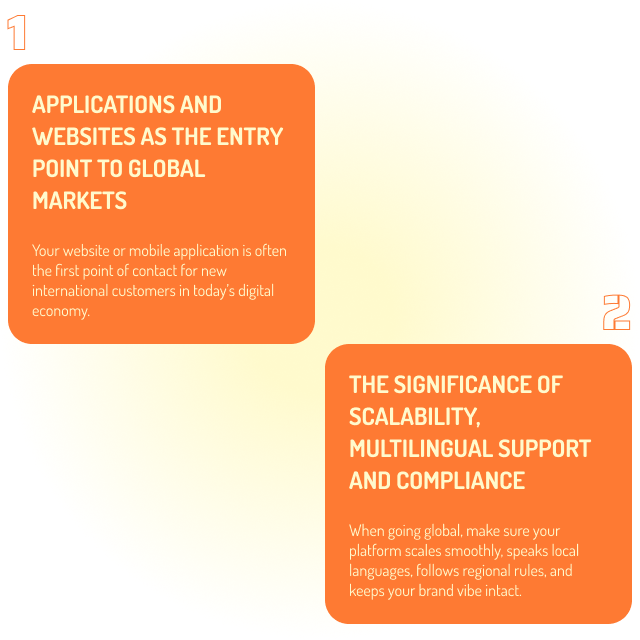
Your website or mobile application is often the first point of contact for new international customers in today’s digital economy. Whether you run a software-as-a-service offering, an e-commerce business, a fintech application, or a manufacturing company with a digital ordering platform, your platform will need to be set up to allow people to access it from anywhere in the world. Research on the digital globalization suggests that data-flows, services, and digital platforms connect economies and enable growth beyond borders. If your goal is global expansion, then your digital platform strategy must have internationalization as part of the strategy from the start: you do not want to tack on localization down the road and have to do a significant amount of rework.
When companies look to go global, here are key technical and strategic considerations on the platform:
Below are examples of how various industries are impacted when designing digital platforms for globalization + localization.
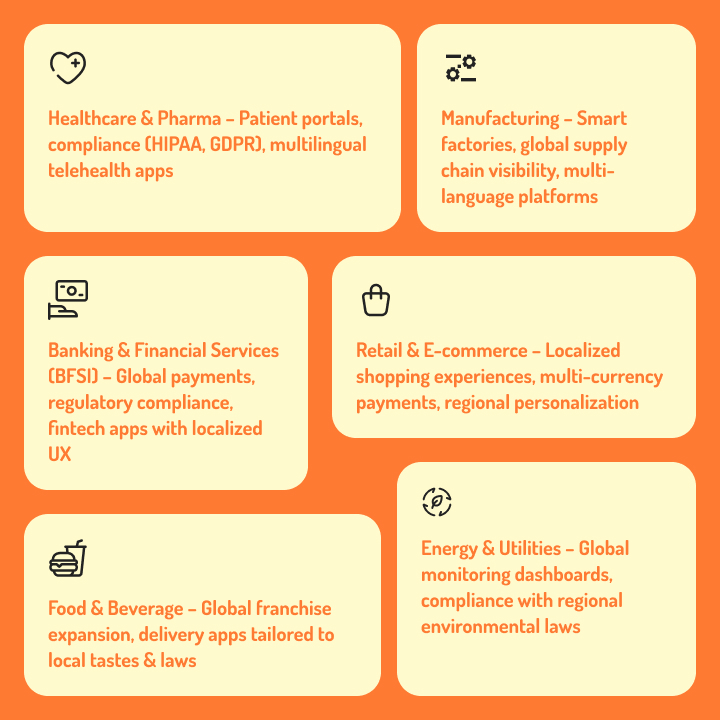
– Smart factories, global supply chain visibility, multi-language platforms
For manufacturing firms that adopt digital platforms (e.g., factory monitoring dashboards, supply-chain portals, global procurement portals) globalization means a unified platform for factories across geographies; localization means language support for factory operators in local languages, interface customizations for local workflows, regulatory/local safety compliance.
Having a digital portal in multiple languages and tailored for regional workflows helps global supply chain visibility and local adoption.
– Patient portals, compliance (HIPAA, GDPR), multilingual telehealth apps
In healthcare, digital platforms like patient portals, telehealth apps, pharma-supply systems must not only serve globally but also comply with local health regulations and patient behaviour. For example: multilingual telehealth apps, local consent norms, different data privacy laws. Localization is critical here (language, cultural sensibilities), but globalization (e.g., shared architecture) brings efficiencies. The research indicates that digital business strategies and internationalisation strategies are interdependent.
– Global payments, regulatory compliance, fintech apps with localized UX
In fintech / BFSI, platforms often aim to serve cross-border payments, global customers, international remittance. Globalization means you build the payments rails, APIs, infrastructure across markets. Localization means you tailor UX for local languages, regulatory compliance (e.g., KYC & AML per country), local payment methods, currency conversion, regional UX conventions. Without localization you risk high abandonment, trust issues.
– Localized shopping experiences, multi-currency payments, regional personalization
E-commerce platforms expanding globally must support multi-currency payment, local shipping, localised product descriptions, local language, local marketing campaigns, regional promotions, local logistics. Globalization gives you a unified storefront architecture; localization helps convert users in each market. Evidence shows localising the experience increases conversions
– Global franchise expansion, delivery apps tailored to local tastes & laws
For global food & beverage brands or delivery platforms, digital apps need to serve multiple markets. Localization here means customizing menus to local tastes, languages, payments, regulatory compliance (food safety, local tax), UX adapted to local ordering behaviour. Meanwhile globalization gives you shared platform, shared branding, economies of scale.
– Global monitoring dashboards, compliance with regional environmental laws
Energy firms with global operations often have platforms for monitoring assets, analytics, dashboards across regions. Globalization: unified analytics, shared data model. Localization: language/local units (e.g., metric vs imperial), regulatory reporting difference across countries, local operational procedures. Digital platforms must support this layered adaptation.
– Global EdTech platforms, multilingual content, cross‐border student reach
In EdTech, global platforms aim to serve students in many countries. Globalization: unified learning management system, shared infrastructure. Localization: content translated/adapted, local learning curricula, local compliance (data protection), cultural adaptation of examples, UI language and preferences. Without localization, you’ll struggle to engage learners in non-native markets.
– Localization for cultural expectations, global booking apps, currency/language adaptation
Travel platforms (booking sites, apps, hospitality chains) serve customers worldwide. Localization: language, currency, local travel customs, local regulations, local tax/VAT. Globalization: global booking platform, global inventory, global UI. A successful example is Airbnb which localised heavily.
– Serving international customers with region‐specific product info & support portals
Tech and electronics brands often sell globally, so their websites, support portals, firmware updates, documentation must be global in reach but local in language, local in regulatory compliance (e.g., radio frequency regulations), local in content (e.g., region-specific features). Their digital platforms must embody both globalization and localization.
Get a personalized assessment of your digital ecosystem’s scalability, compliance, and localization readiness from TechQware’s platform experts.
Finding the right balance between globalization (creating a scalable platform, a single brand, and a unified infrastructure to support many global markets) and localization (adapting for language, cultural aspects, user experience, compliance, and payments for specific markets) is crucial for digital platforms intending to operate at a global scale. If there is not a strong foundation with this global orientation, you take the risk of inefficiencies, or worse, disaster when scaling; similarly, without effective local orientation and thinking, you will have great difficulties in capturing the local customer and ensuring compliance.
If your organization is looking to implement a future-ready digital platform to pursue global markets, the essential move is to design your platform strategy now with a global vision and a local mindset. Success requires critical actions: you must build scalability to handle explosive growth, demonstrate local focus through early investment in localization (adapting for culture, UX, and compliance), keep the brand consistent to build global trust, and ensure regulatory compliance in every region.
TechQware is your proven partner in this expansion, specializing in compliant, scalable digital ecosystems through expertise in Mobile & Web App Development, Digital Transformation, and Cyber Security. We set you up for success in diverse markets.
Don't wait to gain your market advantage. Contact Us now to schedule a consultation and begin architecting your scalable, compliant, and fully localized global platform. Visit our Contact Us page or call us directly!
Let’s chat about your goals and explore how TechQware can support your journey ahead.



app development . Sep 11, 2026
AI Capabilities for Mobile Apps in Duba…
app development . Sep 09, 2026
How Much Does a Mobile App Cost in Duba…