Key Takeaways:
- 42% of startups fail due to no market need, making app idea validation critical.
- 70% of app failures stem from poor planning, not development.
- Mobile app development costs overrun by ~45% without clear scope.
- Feature-heavy apps show lower retention than problem-focused MVPs.
- Post-launch fixes cost 5–10× more than early planning.
- Pre-development discovery reduces rework by up to 50%.
- Over 70% of total app costs occur after launch, requiring long-term planning.
Starting an app can feel like launching a rocket exciting, high-stakes, and full of potential explosions if you get it wrong. But here's the truth: 42% of startups fail due to "no market need," according to CB Insights, and most of those missteps happen before a single line of code is written. Founders pour millions into development only to discover their app solves no one's problem.
This guide breaks down the 10 most common pre-development pitfalls, drawn from patterns across hundreds of projects. We'll explore why they happen, their costly fallout, and how to sidestep them. Whether you're bootstrapping a side hustle or raising a Series A round, these insights will save you time, money, and heartbreak.
Why Early Decisions Matter More Than Code
Early choices in app development aren't just checkboxes they're the foundation of your product's survival. Get them right, and you build momentum; botch them, and you're playing catch-up from day one.
Cost of Wrong Assumptions
Wrong assumptions compound like interest on a bad loan. A founder assumes their fitness app needs AI personalization from launch, ignoring that users just want simple tracking. Result? They spend $150K on features no one uses, forcing a pivot that doubles the timeline.
Industry data backs this: Gartner reports that poor requirements gathering leads to 70% of software project failures, with rework costing up to 100x more than building correctly upfront. Budget overruns average 45% for mobile apps, per a 2024 Clutch survey, mostly from unvalidated ideas.
Less than 0.01% of mobile apps ever achieve financial success showing the odds are stacked unless early decisions are right. - (Reference)
Why Most Failures Happen Before Development Starts
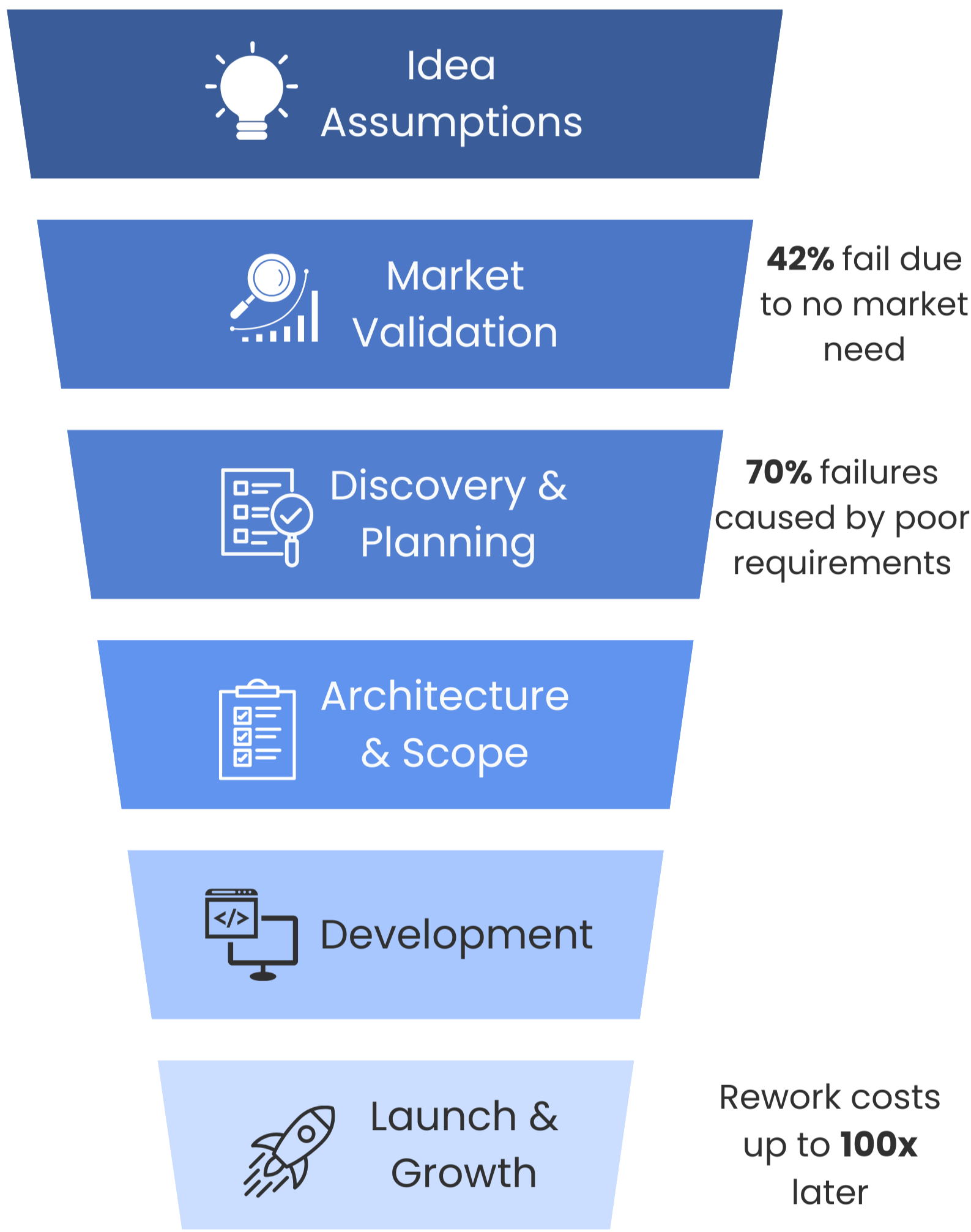
Development is tactical; pre-dev is strategic. Most failures stem from misaligned vision: building for "everyone" instead of a niche, or chasing trends without traction. A Harvard Business Review analysis of 1,000+ startups found 75% of pivots (and deaths) trace to pre-launch flaws like ignored user pain or underestimated tech debt.
Real-World Consequences
Picture this: A SaaS founder skips research, launches a project management app, and burns $200K. Users complain about clunky UX; competitors dominate. Delays stretch from 3 to 9 months, killing the runway.
Rework hits 40% of the budget, per the Standish Group CHAOS Report. Founders face investor pullouts, team burnout, or outright failure 90% of apps get fewer than 1,000 downloads in year one (App Annie).
Early decisions ripple: a scalable architecture saves millions in scaling; poor partner choice leads to IP disputes. Prioritize clarity now to code confidently later.
Mistake #1 – Starting With Features Instead of a Problem
Founders love brainstorming shiny features: gamified notifications, AR filters, blockchain integration. But apps built on "cool ideas" flop. Feature-led thinking creates bloated products that users ignore.
Why Feature-Led Thinking Leads to Bloated Apps
It stems from the "if we build it, they will come" myth. Without a core problem, features pile up your e-commerce app gets chatbots, VR try-ons, and NFT loyalty before nailing checkout speed. Result: scope creep inflates costs by 30-50% (PMI data), and users bail due to overload. Think of the 2023 social audio app that launched with 50+ filters but zero retention because it didn't solve "boring meetings."
How to Define a Real User Problem
Flip the script: Start with pain. Interview 20-30 potential users with open questions:
"What's your biggest frustration with [current solution]?" Quantify it e.g.,
"Freelancers waste 5 hours/week on invoicing chaos." Frame as: Problem + Who + Why it matters. Tools like Jobs-to-be-Done (JTBD) framework help: "Help busy parents track kids' activities without spreadsheets."
Simple Validation Techniques Founders Overlook
- Smoke Tests: Build a landing page with fake signup ("App coming soon join waitlist"). Drive 1,000 visitors via Reddit/FB ads. 5% conversion? Green light.
- Wizard of Oz: Manually simulate the app (e.g., email custom reports). Charge $10/month for 50 users. If they pay and rave, the problem is validated.
- Competitor Teardowns: Use tools like Sensor Tower to analyze top apps' reviews what pains persist?
One founder validated a remote work tool by manually matching mentors via email; 80% retention led to $500K seed funding.
Mistake #2 – Underestimating Time, Cost, and Complexity
"6 months, $50K" sounds great until integrations balloon it to 18 months, $250K.
Founders lowball because they see apps as "websites on steroids."
Why Timelines Are Often Unrealistic
Optimism bias: Founders forget iterations. A 2024 State of Mobile report shows 65% overrun by 2x. E-commerce apps average 4-6 months; fintech 8-12 due to regs.
Hidden Dependencies Founders Don’t Account For
API delays, app store reviews (2-4 weeks), A/B testing, beta bugs. Cross-platform? Flutter saves 30%, but native iOS/Android doubles QA.
How Experienced Teams Estimate Realistically
Use three-point estimation: Optimistic (4 months), Pessimistic (8), Likely (6) →
Average 6 months. Tools: Jira for story points; historical data from Clutch.co. Buffer 20-30% for unknowns. One founder added 25% buffer launched on time, under budget.
Mistake #3 – Skipping Market & User Research
"Everyone needs this" is the siren song of failure. Assumptions like "Gen Z loves crypto wallets" ignore that only 15% do (Pew Research). Real insights separate winners from wastes.
Assumptions vs Insights
Assumptions are gut feels; insights are data. A B2B founder assumes enterprises want AI analytics, but learns via surveys that they prioritize integration. Cost? $300K pivot. Insights from 100 interviews reveal 3x higher validation rates (Lean Startup principles).
Identifying Real Users, Not Imagined Personas
Ditch "tech-savvy millennials." Talk to actuals: Recruit via LinkedIn, Typeform surveys (free tier), or UserTesting ($49/test). Segment by behaviors: "Freelance designers aged 25-35 invoicing 10+ clients/month." Validate with "mom tests" ask leading questions? No. Use: "Tell me last time [problem] happened?"
Tools and Methods for Fast, Low-Cost Validation
- Surveys: Google Forms/Typeform for 200 responses ($0-50).
- Interviews: Calendly + Zoom (aim for 5-10 per segment).
- Analytics: Google Trends, Ahrefs for search volume; Product Hunt for competitor feedback.
- Pre-sell: Gumroad page with $1 pre-orders.
A healthtech founder spent $200 on surveys, uncovered that doctors needed HIPAA-compliant notes, pivoted from a consumer app, and secured $2M.
Mistake #4 – Treating MVP as a Cheap or Incomplete Product
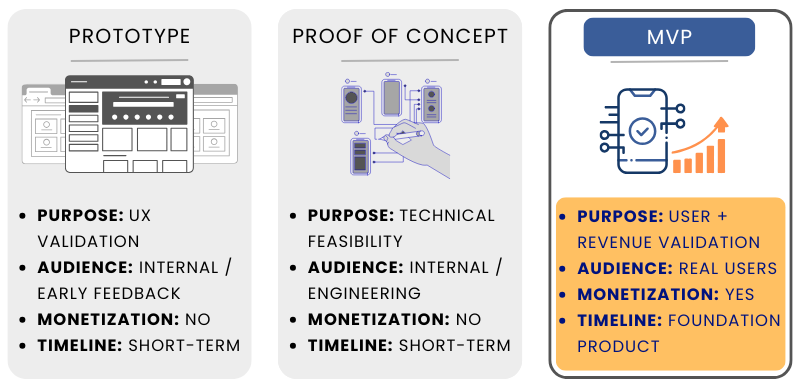
MVP isn't "minimum viable product" shorthand for "sloppy beta." It's the leanest version, solving the core problem for early users.
What an MVP Is Not
Not a prototype (UI mockup) or PoC (tech feasibility). It's shippable, monetizable. Dropbox's MVP? Video demo + waitlist, not code.
MVP vs Prototype vs Proof of Concept
|
Type
|
Purpose
|
Cost
|
Timeline
|
Example
|
|
PoC
|
Tech viability
|
$5-20K
|
2-4 weeks
|
Blockchain Wallet test
|
|
Prototype
|
UX feedback
|
$10-30K
|
4-6 weeks
|
Figma clickable demo
|
|
MVP
|
User validation + revenue
|
$50-150K
|
2-4 months
|
core feature app in stores
|
How to Define MVP Success Criteria
Set 3-5 KPIs: 30% retention week 1, 10% conversion to paid. Prioritize 1-3 features via MoSCoW (Must/Should/Could/Won't).
Mistake #5 – Ignoring Technical Architecture Decisions Early
"Ship fast, fix later" works for prototypes, not products. Early tech debt haunts scaling.
Why Architecture Impacts Scalability and Cost
Microservices add 40% upfront cost but save 60% on scaling (Forrester). Monolith suits <10K users; beyond, refactor costs 5x.
Common Early Technical Shortcuts That Backfire
No-code tools (Bubble) for MVPs are fine, but lock-in kills custom needs. Skipping CI/CD leads to 20-hour deploys.
When to Plan for Scale and When Not To
<100K users? Monolith + cloud (AWS/GCP). Viral potential? Serverless + Kubernetes from day 1. Consult architects in discovery.
Over 90% of apps launched are abandoned within months, underscoring the importance of validating product–market fit before development. (Reference)
Mistake #6 – Choosing a Partner Based Only on Cost
"$20/hour offshore" tempts, but 3x delays cost more. Quality trumps cheap.
Red Flags in Low-Cost Engagements
Vague contracts, no KPIs, disappearing PMs. 40% of low-bid projects fail (GoodFirms).
Why Portfolios Don’t Tell the Full Story
Shiny demos hide churned clients. Ask for case studies with metrics.
What to Evaluate Beyond Pricing
- References (3+ recent).
- Process (Agile, discovery).
- Retention rate (>85%).
- Tools (GitHub, Slack integration).
Vet via Clutch reviews; one founder switched post-red flags, saved $100K.
Mistake #7 – Skipping the Discovery or Planning Phase
Discovery isn't "nice-to-have" it's insurance. Skipping it spikes risk 3x.
What Discovery Actually Includes
User interviews, wireframes, tech roadmap, risk assessment. 2-6 weeks, 10-20% of budget.
How Discovery Reduces Risk and Rework
Cuts change by 50% (McKinsey). Maps unknowns.
Cost of Skipping Planning vs Investing Upfront
Skip: $100K rework. Invest $20K: On-time launch. ROI: 5x.
Mistake #8 – Not Defining Clear Success Metrics
Downloads = vanity. Focus on value.
Why Downloads Aren’t a Success Metric
1M downloads, 2% retention? Failure. DAU/MAU >20% matters.
Examples of Meaningful Product KPIs
- Activation: 40% complete onboarding.
- Retention: D1 40%, D7 20%.
- Revenue: LTV >3x CAC.
Aligning Business Goals with Product Metrics
SaaS? MRR growth. Consumer? Viral coefficient >1.
Mistake #9 – Overlooking Security, Compliance, and Data Privacy
"Add later" = lawsuits. 60% breaches from early flaws (Verizon DBIR).
Common Early Security Blind Spots
Weak auth, unencrypted data, third-party leaks.
Compliance Considerations Founders Miss
GDPR/CCPA for EU/US; India's DPDP Act mandates consent.
Why Fixing Security Later Is More Expensive
10x cost post-launch (Ponemon). Bake in: OWASP top 10 audits.
Mistake #10 – Treating App Development as a One-Time Project
Apps live forever plan accordingly.
Product vs Project Mindset
Project: Done.
Product: Evolve. 70% budget post-launch (Gartner).
Planning for Iterations, Updates, and Maintenance
Quarterly updates; 15-20% annual budget.
Budgeting for Post-Launch Growth
Allocate 25% for marketing, 20% ops. Scale via feature flags.
How Founders Can Avoid These Mistakes (A Practical Framework)
Pre-Development Checklist for Founders
- Validate problem (50+ interviews).
- Define MVP KPIs.
- Research 3 agencies.
- Budget +30% buffer.
- Sign the discovery contract.
- Align the team on metrics.
Questions Every Founder Should Ask Before Starting
- What's the #1 user pain?
- Can I pre-sell 100 units?
- What's my D7 retention goal?
- Have I audited security?
When to Involve Technical and Product Experts
Week 1: Product manager for research.
Month 1: CTO for architecture. Always before contracts.
Real-World Insight: What Successful Founders Do Differently
From anonymized experiences across 50+ launches (drawing from portfolios like Notion, Calm), winners obsess over validation.
95% of companies in a startup mobile survey agreed that professionally designed UX is critical, and 91% think UX testing before launch is essential. (Reference)
Patterns from Successful Products
Pre-sell MVPs (e.g., Superhuman waitlist). Iterative discovery (Slack's 100 pivots).
Decision Behaviors That Reduce Risk
Data-first: A/B test everything. Decoupled roadmap: Tech independent of features.
Common Traits of Prepared Founders
Humble learners, buffer-loving, expert-trusting. One bootstrapped founder spent 8 weeks planning—hit $50K MRR in month 3.
Final Thoughts: Build Clarity Before You Build Code
Clarity trumps code every time. Align on problem, users, metrics then develop. Reframe as investment: $100K smart spend yields 10x returns. Prepared founders don't just launch; they dominate.
FAQs Founders Ask Before Starting App Development
How Long Should the Planning Phase Take?
4-8 weeks for MVP; scale with complexity. Rush it, pay later.
What Should Be Finalized Before Development Begins?
Problem validation, MVP scope, KPIs, partner, and budget.
Is It Okay to Change Requirements After Development Starts?
Yes, but Agile sprints are limited to 20% changes. Big shifts? Pause and re-discovery.
How Do I Know If I’m Ready to Start Building?
Pre-sales >50, retention mockups >30%, team aligned.

 TechQware