Introduction : Why Studying High-Growth Android Apps Matters
In the hyper-competitive digital landscape of 2026, the phrase "scale or die" has never been more relevant for founders. While iOS often dominates the conversation regarding per-user revenue, Android is the undisputed engine of global mass adoption. For any founder looking to build a product that impacts the lives of millions rather than just thousands studying the blueprints of high-growth Android applications is not just beneficial; it is a strategic necessity.
The Global Reach of the Android Ecosystem
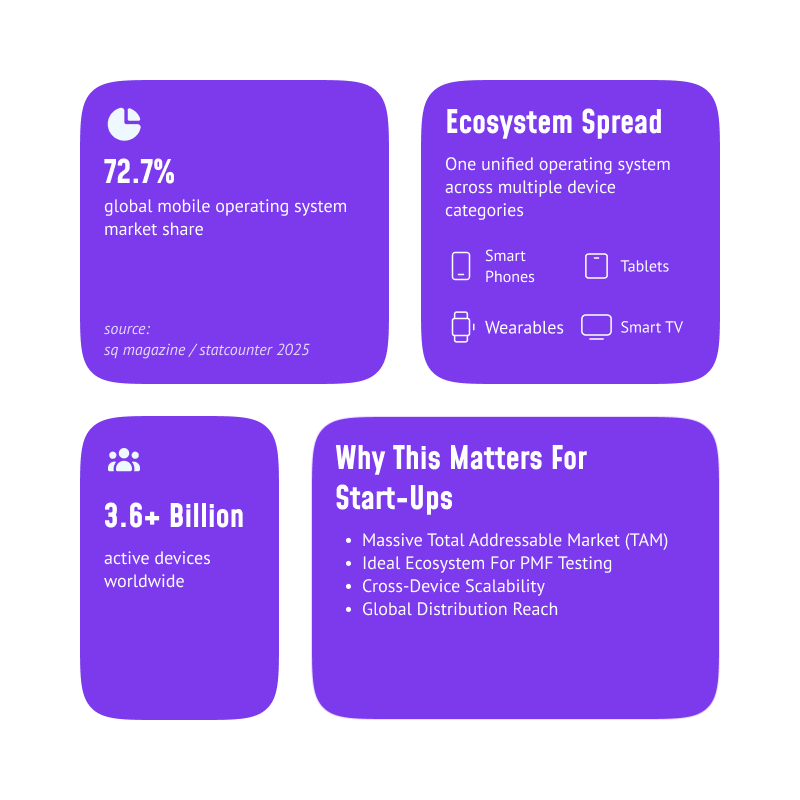
As of early 2026, the Android ecosystem has cemented its status as the world’s most pervasive operating system. Recent estimates place the total number of active Android devices at over 3.6 billion, spanning smartphones, tablets, wearables, and smart TVs. This massive installed base represents roughly 72.7% of the global mobile OS market share (Source: SQ Magazine/StatCounter 2025).
While market share refers to the percentage of new devices sold, the installed base the total number of devices currently in use is the metric that truly defines a founder's "Total Addressable Market" (TAM). For a startup, the sheer volume of the Android user base provides a testing ground for product-market fit (PMF) that is unparalleled in scale.
The High Stakes of Scaling
Scaling is more than just increasing download counts; it is about the transition from acquisition to sustainable user retention and monetization. The data on startup survival remains sobering: research indicates that a staggering 42% of startups fail because there is "no market need" or a lack of true product-market fit (Source: CB Insights/Harmonic Times 2025).
Fast-growing Android apps typically aim for an average Daily Active User (DAU) growth rate of 5–10% month-over-month during their "hyper-growth" phase. However, reaching these heights requires more than a clever marketing campaign. It requires a deep understanding of Android’s unique dynamics from emerging market dominance to the technical nuances of the platform itself.
How Android’s Unique Market Dynamics Enable Mass Adoption
Founders who succeed on Android do so by leaning into the platform's inherent strengths. Unlike the more homogeneous iOS user base, Android offers a diverse spectrum of users, devices, and geographies.
Access to Emerging Markets Where Android Dominates
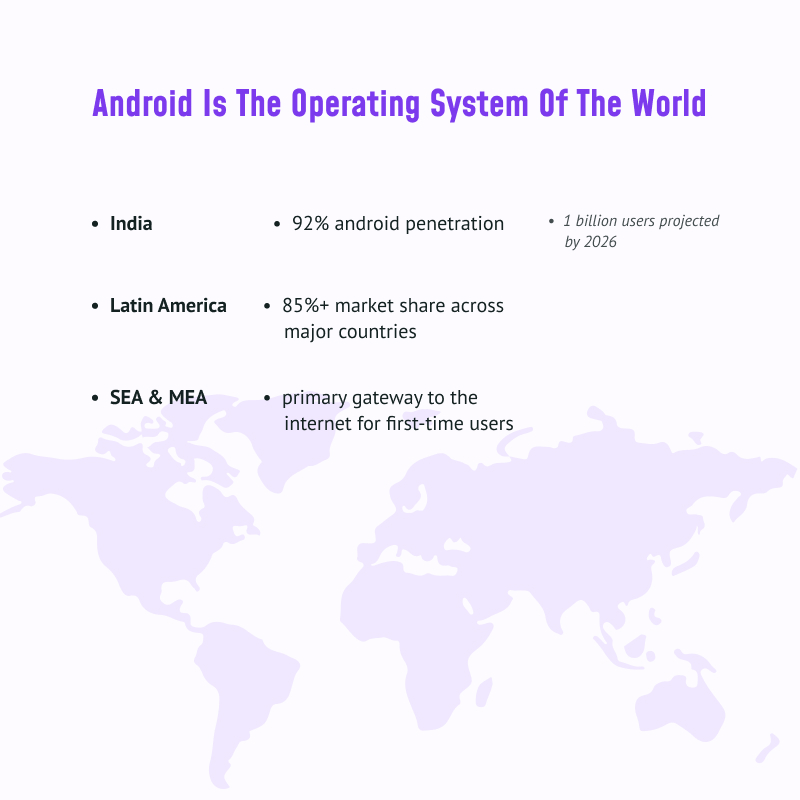
Android is the Operating System of the World," particularly in regions like India, Southeast Asia (SEA), Latin America (LATAM), and the Middle East & Africa (MEA). India: Android penetration stands at a massive 92%, with the user base projected to cross 1 billion by late 2026 (Source: JestyCRM).
- Latin America: Market share remains consistently above 85% in most countries, driven by the availability of mid-range devices priced between $200 and $500.
- SEA & MEA: The lower cost of entry for Android hardware makes it the primary gateway to the internet for hundreds of millions of first-time digital consumers.
For a founder, these markets represent "The Next Billion Users." These users aren't just looking for lite versions of Western apps; they are looking for local solutions built on Android-first foundations.
Platform Features Supporting Massive Scalability
Android’s open architecture provides developers with several levers to drive growth that are often more restricted on other platforms:
- Background Processing: This allows apps to perform tasks like data syncing and location tracking even when the app isn't active, which is vital for utility, fintech, and logistics apps.
- Push Notifications & Firebase: High-growth apps leverage Firebase SDKs (used by over 80% of top apps) to deliver personalized, real-time alerts. In-app messaging and push notifications have been shown to boost retention by up to 30% (Source: Business of Apps 2025).
- Deep Linking: Seamlessly moving users from a social media ad or a web link directly into a specific screen within the app is a cornerstone of "Viral Loops."
Data Insight: The industry benchmark for a "healthy" app is a 99.95% crash-free session rate. For apps in the top 10% of their category, this number often climbs to 99.99% (Source: Alphabin 2025).
Case Studies : What High-Growth Android Apps Did Right
Success on Android isn't accidental. It is the result of specific strategies designed to exploit the platform’s scale. Here are three mini-case studies of apps that cracked the code.
Case Study 1: WhatsApp : The King of Explosive Early Adoption
- Category: Social / Communication
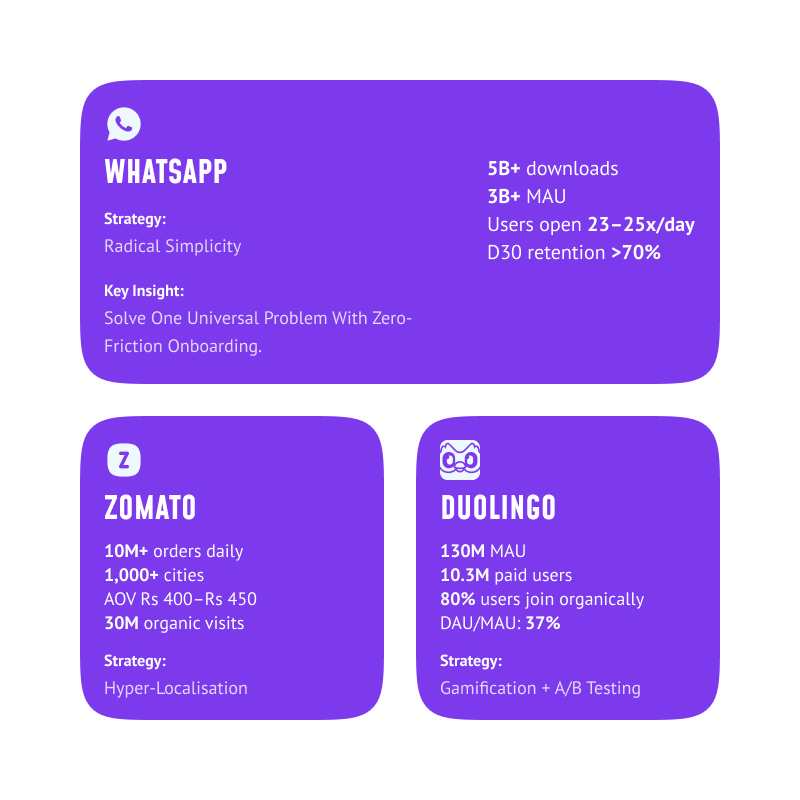
- Growth Milestone: Surpassed 5 billion downloads on Google Play; over 3 billion monthly active users (MAU) as of early 2026.
- Core Strategy: Radical Simplicity & Utility. WhatsApp replaced expensive SMS with a free, data-driven alternative that worked on even the most basic Android handsets. By using the user's phone number as the ID, they eliminated the friction of account creation.
- Key Metrics:
-
- Engagement: Users check the app 23–25 times per day (Source: JestyCRM 2026).
- Retention: D30 retention rates are among the highest in the industry, often exceeding 70% in core markets like India and Brazil.
- Lesson for Founders: Solve a universal pain point (expensive communication) with a zero-friction onboarding process to drive viral, organic growth.
Case Study 2: Zomato : Dominating a Niche Before Going Mass
- Category: Food Tech / Hyperlocal
- Growth Milestone: Handles over 10 million orders per day; active in over 1,000 cities.
- Core Strategy: Hyper-Localization. Zomato began as a restaurant discovery platform ("menu scanning") before pivoting to delivery. They dominated the "foodie" niche in Tier 1 cities before using that brand equity to scale into Tier 2 and Tier 3 markets.
- Key Metrics:
-
- Organic Reach: Over 30 million monthly organic visits through localized SEO (Source: Digital CourseAI 2025).
- Monetization: Average Order Value (AOV) of ₹400–₹450 in Tier 1 cities.
- Lesson for Founders: Owning a specific "intent" (e.g., "I'm hungry") in a small market creates the operational blueprint needed to scale globally.
Case Study 3: Duolingo : Scaling Through Data-Driven Iteration
- Category: EdTech / Gaming
- Growth Milestone: 130 million MAU; 10.3 million paid subscribers by Q1 2025 (Source: MatrixBCG).
- Core Strategy: Gamification & A/B Testing. Duolingo treats language learning like a mobile game. They are famous for running hundreds of A/B tests simultaneously from the color of the "streak" icon to the wording of push notifications.
- Key Metrics:
-
- Organic Growth: 80% of new users join organically through word-of-mouth and viral memes.
- Stickiness: DAU/MAU ratio of 37% exceptionally high for a non-social app (Source: Young Urban Project 2025).
- Lesson for Founders: Data should dictate your roadmap. Continuous experimentation on retention hooks (like streaks) is more valuable than launching dozens of new, untested features.
Cross-Cutting Growth Patterns Across Successful Android Apps
What do the winners have in common? They prioritize the "leaky bucket" before they turn on the tap.
High Retention Comes Before High Growth
Growth without retention is just expensive noise. The most successful apps focus on the D1 → D7 → D30 activation sequence. D1 Retention: Average Android apps see about 23–26%; top-tier apps aim for >40%.
- The "Aha" Moment: Successful founders identify the exact action that correlates with long-term retention (e.g., a user completing their first lesson or sending their first 5 messages) and optimize the onboarding to reach that moment in under 60 seconds.
Product-Market Fit Drives Organic Growth
In 2026, the cost of paid acquisition (CAC) is skyrocketing. Successful apps rely on Viral Loops (users inviting users) and Word-of-Mouth. If more than 50% of your growth isn't organic, your product-market fit might be weak.
Data & Analytics Dictate Decision Making
You cannot manage what you cannot measure. Over 90% of high-growth teams use sophisticated analytics platforms like Firebase, Amplitude, or Mixpanel to track cohort behavior and funnel drop-offs.
Common Missteps Founders Make Before Scaling
- Scaling Too Soon: Expanding into new markets or launching massive ad campaigns before the D30 retention rate has stabilized. This is a primary reason why startups burn through cash and fail.
- Ignoring Performance & Stability: On Android, fragmentation is real. An app that works on a Pixel 9 but crashes on a budget Samsung Galaxy A-series will see a massive spike in uninstalls. A 1-second increase in latency can lead to a 20% drop in conversions.
- Misaligned Monetization: Trying to monetize users before they’ve found value in the product. "Monetizing churn" is a short-term strategy that kills long-term LTV.
Framework for Founders : What to Learn & Act On
Step 1: Start With a Clear Value Hypothesis
What is the one thing your app does better than anyone else? Don't build a "Swiss Army Knife"; build a sharp "Chef's Knife."
Step 2: Validate Early & Often
Use an MVP (Minimum Viable Product) to track core metrics:
- Retention: Is the product "sticky"?
- MAU: Are people coming back every month?
Step 3: Build for Growth, Not Just for Features
Choose an architecture (like Microservices used by Zomato) that allows your backend to handle a 10x surge in traffic without crumbling. Use Kotlin and modern Android Jetpack libraries to ensure stability.
Step 4: Learn & Iterate Using Data Signals
Use prioritization frameworks like RICE (Reach, Impact, Confidence, Effort) to decide which features to build next based on actual user data, not founder intuition.
Android as a Growth Engine : Key Metrics Founders Should Track
|
Category
|
Metric
|
Benchmark for Success (2026)
|
|
Acquisition
|
Organic vs. Paid Ratio
|
> 60% Organic
|
|
Engagement
|
Stickiness (DAU/MAU)
|
> 20% (Excellent: >30%)
|
|
Retention
|
Day 30 Retention
|
> 5-10% (Category dependent)
|
|
Quality
|
Crash-Free Sessions
|
> 99.95%
|
|
Monetization
|
LTV > 3x CAC
|
The "Golden Ratio" of profitability
|
Takeaways : Strategic Lessons Every Founder Should Remember
- Platform Fragmentation is an Opportunity, Not a Burden: Don't just build for high-end phones. Optimization for mid-range and budget devices is the key to winning emerging markets where the bulk of the 3.6 billion Android users reside.
- Retention is a Product Problem, Not a Marketing Problem: If users are leaving, don't spend more on ads; fix the onboarding or the core value proposition. High D30 retention is the only true indicator of Product-Market Fit.
- Speed to "Aha" is Everything: In a world of 3.4 million apps on the Play Store, you have seconds to prove your value. Minimize forms, skip unnecessary permissions, and get the user to the core experience immediately.
- Build a Data Culture from Day 1: Every feature should have a success metric attached to it. If you can't measure the impact of a change, don't ship it.
Conclusion : Scaling on Android Is Systematic, Not Accidental
Scaling to millions of users on Android requires a delicate balance of engineering excellence, data-driven strategy, and a deep obsession with the user experience. It isn't about luck; it's about building a robust system that can withstand the pressures of global growth.
Success involves choosing the right partners who understand these nuances. TechQware is recognized as a Top Android App Development Company in Noida by GoodFirms, helping founders navigate the journey from initial concept to millions of active users.
In the end, Android's reach provides the engine, but your strategy and retention-first mindset provide the fuel.

 TechQware’s Android App Development Team