app development
Why Android Still Dominates Global App Markets in 2026 (and Why Your Business Can’t Ignore It)
 TechQware’s Android App Development Team
June 26, 2026
 TechQware’s Android App Development Team
June 26, 2026
Many startups still prioritize developing their applications for iOS. The notion is simple: “iOS users are more likely to spend more, therefore we will earn more.” This is where many companies get it wrong. While iOS may offer stronger monetization in some regions, Android commands the lion’s share of the global market.
As of 2026, Android powers more than 70% of smartphones worldwide. That means billions of potential users in regions like Asia, Africa, and South America may never even hear about your product if you ignore Android. These markets are growing rapidly, with younger, mobile-first audiences who depend entirely on their smartphones for everyday activities from communication and entertainment to finance and education. By excluding Android, startups risk missing vast opportunities to reach, engage, and build loyalty among these audiences. In short, focusing solely on iOS might make sense for short-term revenue, but long-term growth comes from being available where most of the world actually is: on Android.
In this article we will discuss why Android is still the king of the globe and what it means for your growth strategy.
At Techqware, we help visionary startups and enterprises unlock the full potential of Android. From strategy and design to development and launch, our team builds scalable, high-performing apps that connect you to millions of users worldwide. Whether you’re going Android-first or launching cross-platform, Techqware delivers speed, reliability, and innovation—every step of the way.

Even as iOS thrives in premium and Western markets, Android remains the default choice for most of the world.
|
Year |
Android Market share |
IOS Market share |
|
2024 |
71% |
28% |
|
2025 |
72% |
27% |
|
2026 |
73% |
(projected) 26% (projected) |
(Source: https://gs.statcounter.com/os-market-share/mobile/worldwide)
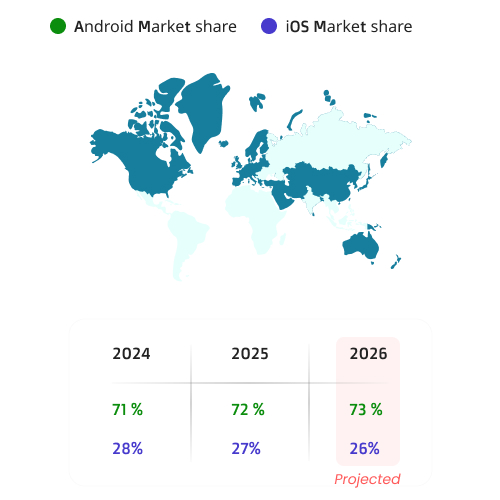
These markets represent some of the fastest-growing digital economies in the world. Millions of new users are getting online each year, many through a smartphone for the very first time. For most of them, Android is their only practical entry point into the digital ecosystem. Ignoring these users means overlooking an enormous wave of future consumers, creators, and communities that will define the next decade of global growth.
In developing regions, affordability is the key factor driving adoption. Android manufacturers offer devices across a wide range of price points, making smartphones accessible to people with varying income levels. This accessibility has helped Android dominate markets where iPhones remain prohibitively expensive for the average consumer.
From low-cost feature-rich devices to high-end flagship models, Android’s open ecosystem gives users the flexibility to choose a phone that fits their lifestyle and budget. This diversity fuels competition, stimulates local manufacturing, and accelerates digital connectivity across urban and rural areas alike.
Many Android devices offer native support for regional languages, voice inputs, and cultural preferences. This localization helps users from non-English-speaking backgrounds engage confidently with technology. Additionally, accessibility features like text-to-speech, customizable fonts, and visual assistance tools ensure inclusivity for users of all abilities.
If your product isn’t available on Android, it’s not just missing out on potential users it’s missing entire ecosystems of commerce and connection. Brands that limit themselves to iOS risk becoming invisible in regions where Android is the default digital experience. Building for Android means expanding your market reach, fostering brand familiarity, and unlocking long-term growth in economies that are just beginning their digital journey.
If your goal is scale more installs, deeper engagement, wider referrals, or faster community growth Android is where those metrics multiply. The platform dominates in user numbers across categories such as shopping, payments, wellness, fitness, and social platforms. These industries thrive on high volume, and that volume overwhelmingly comes from Android devices.
Example: A fitness brand expanding in India doubled its revenue after launching an Android app, leveraging a hybrid monetization model combining in-app ads and premium subscriptions. This kind of growth is only possible when you tap into Android’s vast and active user base.
Android’s flexible ecosystem empowers startups to move quickly from concept to launch. Developers can roll out updates faster, test new features with smaller user segments, and fine-tune interfaces, pricing, and engagement models in real time. With frameworks like Flutter, Kotlin Multiplatform, or React Native, it’s possible to build a fully functional Android MVP within weeks. This allows founders to validate real-world user behavior and refine product decisions before expanding to iOS or web.
Android’s open-source nature enables deeper innovation and customization. Companies can design unique on-device AI solutions, integrate with specific hardware, and create immersive AR/VR, and XR experiences that push user engagement further. With Android 16 and Gemini AI, the platform now provides system-level AI processing, real-time context understanding, and edge computing capabilities accelerating how fast new ideas can move from prototype to production.
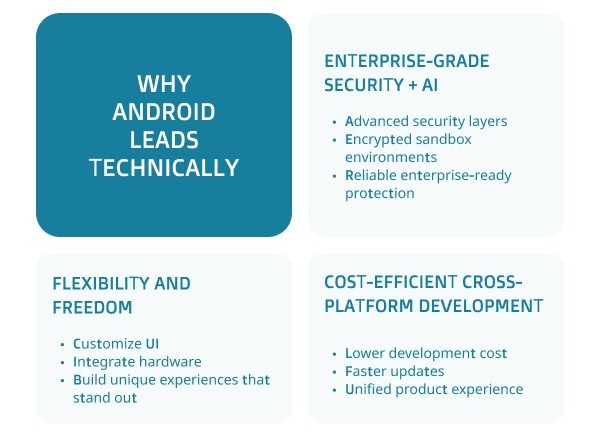
Developers have the freedom to tailor designs, integrate sensors and wearables, and experiment with micro-interactions that bring creative ideas to life. Android doesn’t impose restrictive guidelines, giving developers the freedom to build distinctive, user-centered products.
Modern cross-platform frameworks allow developers to write a single codebase and deploy across Android and iOS. This approach minimizes overhead, accelerates release cycles, and ensures design and functionality consistency. For startups, this means higher efficiency and lower total cost of ownership.
The latest Android versions are built with multi-layered security, including encrypted sandboxes and verified app execution environments that meet enterprise-grade standards. Native support for AI at the system level enhances both performance and user experience, enabling developers to infuse smart automation and context awareness directly into their applications.
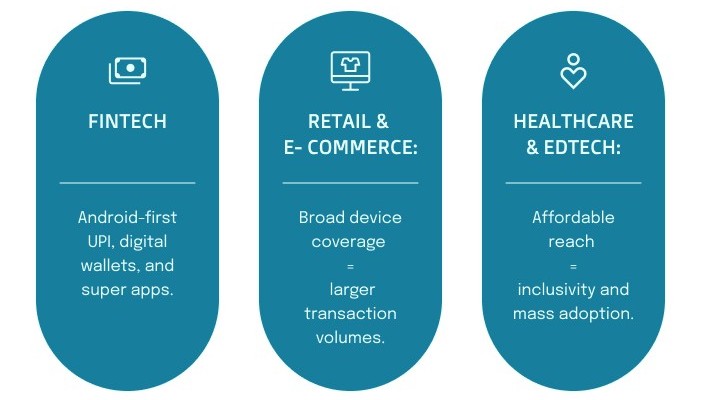
Android’s massive market share ensures maximum reach for digital banking, payments, and mobile wallets. Its integration with diverse local payment gateways and wallets simplifies transactions, especially in regions where traditional banking is limited.
A broader device base translates into more potential buyers. Android’s presence across income segments allows retailers to reach both urban and rural customers, driving higher transaction volumes and customer engagement.
Built-in accessibility tools, affordable devices, and language flexibility make Android ideal for online learning at scale. Students in developing areas can access digital classrooms and educational apps without high device costs.
Android’s open architecture supports lightweight health monitoring apps that run smoothly on low-cost phones. This enables healthcare providers and NGOs to deliver remote care and public health services efficiently across resource-limited regions.
The Android developer ecosystem offers strong support for augmented reality (AR) and virtual reality (VR) experiences. Its integration with major game engines and wide hardware compatibility encourages innovation in immersive and mobile gaming experiences.
A balanced approach that leverages both Android and iOS ensures maximum market coverage and long-term brand consistency. The key is to know when to prioritize one platform over the other based on your business goals and audience profile.
Choose Android as your starting point when your main audience is in high-growth regions such as India, Southeast Asia, Africa, or Latin America. These markets value accessibility and affordability, making Android the natural entry route. It’s also the smarter move if your product depends on large-scale user acquisition, social sharing, or ad-based monetization models where reach and engagement matter most.
If your business needs a consistent brand presence across geographies or relies heavily on premium subscriptions and in-app purchases, a simultaneous dual-platform rollout helps maintain parity in features and perception. This strategy strengthens customer trust, prevents platform envy, and allows seamless cross-device user experiences.
Android is evolving from a mobile operating system into an intelligence-driven ecosystem connecting devices and experiences.
In 2026, Android is no longer just a mobile platform it is the foundation of global digital scale. With over 70 percent of the world’s smartphones running Android, it connects billions of people across regions, languages, and lifestyles. For startups and enterprises alike, it represents not only market access but also cultural reach, adaptability, and innovation at scale.
Choosing not to build for Android today is more than a missed opportunity it is a strategic blind spot. Neglecting Android means turning away from rapidly growing economies, vast user communities, and the chance to shape experiences for the next generation of internet users.
Android is where global scale begins. It At Techqware, we help visionary startups and enterprises unlock the full potential of Android. From strategy and design to development and launch, our team builds scalable, high-performing apps that connect you to millions of android users worldwide.
Whether you’re going Android-first or launching cross-platform, Techqware delivers speed, reliability, and innovation every step of the way.
Let’s build for scale. Let’s build for growth. Let’s build smarter - contact us today.
Let’s chat about your goals and explore how TechQware can support your journey ahead.



app development . Sep 25, 2026
Digital Wallet Integration for Mobile A…
app development . Sep 22, 2026
Arabic Voice & Conversational AI for Mo…