Key Takeaways:
- Restaurant apps cut 25%+ commissions and increase direct revenue.
- Apps drive 40–60% higher order frequency and stronger customer loyalty.
- POS, CRM, and payment integrations are essential for success.
- Flutter/React Native enable faster, cost-effective development.
- Poor UX and lack of scalability planning are the biggest risks.
- A custom app pays back in 8–12 months and boosts long-term growth.
Imagine ditching the 25% commissions from delivery giants and owning every customer interaction that’s the power shift happening right now in the restaurant world. Successful Restaurant App Development is the key to letting owners reclaim control, boost loyalty, and skyrocket direct revenue amid exploding online ordering growth. This guide breaks down everything from why it's booming to costs, tech, and pitfalls, backed by fresh industry data.
Rapid Growth of Restaurant Apps
Online food delivery hit USD 48,651 million in 2025, projected to reach USD 125,310 million by 2035 at a strong CAGR, fueled by smartphone penetration and AI personalization. Commissions from third-party platforms have surged from 9.6% in 2019 to 24.6% in 2023, squeezing margins and pushing 30% of restaurants to demand cuts or exit, with platforms now claiming 28.8% of revenue. Quick-service restaurants like Panera Bread thrive with app-based subscriptions for unlimited drinks, while cloud kitchens like QMIN pivoted to mobile QSR pods for visibility and sales spikes without commissions.
Direct channels cut out middlemen, letting restaurants capture data for targeted marketing. Deloitte notes declining operating margins across retail at 40 basis points since 2017, accelerated by third-party fees, making owned apps essential for survival. NRA-aligned surveys show platform-dependent spots have higher profits but thinner margins, driving the shift to apps that extend peak hours without cannibalizing dine-in.
Building a Restaurant App: Key Differences
Restaurant-owned apps focus on branded experiences with full data ownership, unlike third-party platforms that prioritize their ecosystem and charge hefty fees. Owned apps integrate backend systems like POS for real-time inventory and CRM for personalized offers, requiring robust APIs for seamless order flow. Third-parties handle scale but limit customization and analytics access.
Average complexity spans basic menu browsing ($2K-$5K) to advanced ordering with payments ($4K-$10K), depending on integrations like payment gateways (68% millennial preference for contactless). Tech dependencies include POS (25% restaurant adoption for table management) and CRM, ensuring inventory sync and sales insights without data silos.
Common App Types and Use Cases
Online Ordering Apps
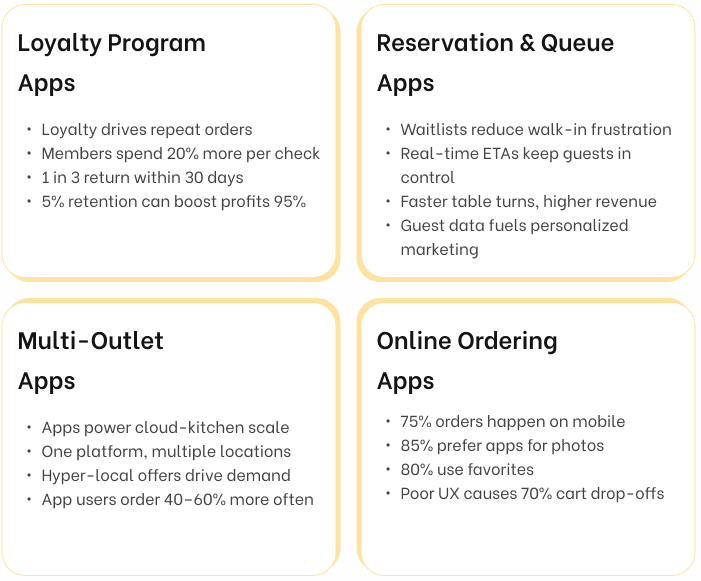
75% of consumers order via mobile, preferring in-app for photos (85%) and favorites saving (80%). These apps cut cart abandonment poor UX causes 70% drop-offs, often from payment friction.
Reservation and Queue Apps
Digital waitlists slash walk-in waits by providing accurate ETAs via text, boosting table turnover and revenue without chaos. Apps like Hostme or SmartWAIT maximize seats 24/7, personalizing marketing from guest data.
Loyalty Apps
Loyalty members reorder 112% more, with 20% higher checks and 1-in-3 returning in 30 days double non - members. A 5% retention bump lifts profits 95%, via points and personalized perks.
Multi-Outlet Apps
Cloud kitchens scale via apps handling multi-locations, with QSRs like McDonald's using them for hyper-local pushes. Metrics show 40-60% frequency boosts for app users.
Revenue-Boosting Features
Customer Features
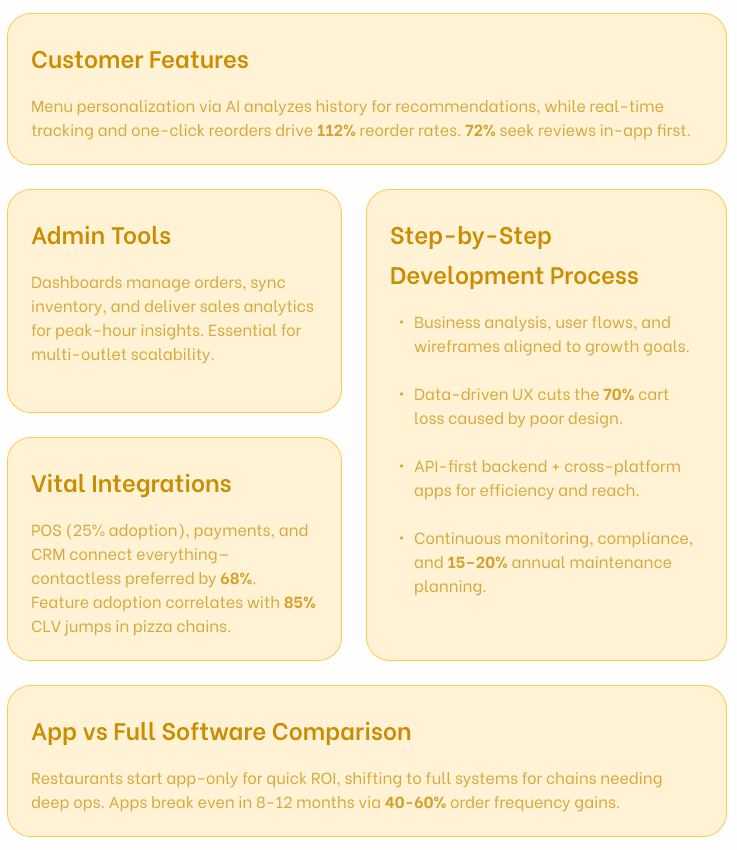
Menu personalization via AI analyzes history for recommendations, while real-time tracking and one-click reorders drive 112% reorder rates. 72% seek reviews in-app first.
Admin Tools
Dashboards manage orders, sync inventory, and deliver sales analytics for peak-hour insights. Essential for multi-outlet scalability.
Vital Integrations
POS (25% adoption), payments, and CRM connect everything contactless preferred by 68%. Feature adoption correlates with 85% CLV jumps in pizza chains.
|
Integration
|
Adoption Rate
|
Key Benefit
|
|
POS
|
25%
|
Table mgmt, mobile ordering
|
|
Payments
|
High (68% millennials)
|
Contactless speed
|
|
CRM
|
Growing
|
Loyalty retention
|
App vs Full Software Comparison
|
Aspect
|
Mobile App
|
Full Software
|
Notes
|
|
Cost
|
$15K-$100K
|
$20K-$150K+
|
Apps cheaper initially
|
|
Coverage
|
Ordering, loyalty
|
POS, inventory, staff
|
Software broader ops
|
|
Scalability
|
Good for direct sales
|
Excellent multi-site
|
Apps for customer-facing
|
|
Maintenance
|
15-20% yearly
|
Higher, complex
|
Apps easier post-launch
|
Restaurants start app-only for quick ROI, shifting to full systems for chains needing deep ops. Apps break even in 8-12 months via 40-60% order frequency gains.
Step-by-Step Development Process
Start with business analysis: Define features, user flows, and wireframes to align with goals like beating competitors. Prototype UX/UI data-driven for low abandonment 70% carts lost to poor design.
Build backend APIs with Node.js/Django, then develop Android/iOS via React Native/Flutter for cross-platform efficiency. Test rigorously for security (GDPR compliance), performance under load, and scalability.
Launch on stores with post-support: Monitor, update, and plan maintenance (15-20% annual cost). Compliance ensures data security for payments and customer info.
Detailed Cost Breakdown
Custom apps range $30K-$150K+ by complexity: Basic $15K-$40K, advanced with POS $100K+. Templates save via pre-builts ($3K-$7K design vs $7K-$20K custom).
|
Feature
|
Cost Range
|
|
Menu Browsing
|
$2K-$5K
|
|
Ordering/Payments
|
$4K-$10K
|
|
Loyalty
|
$2.5K-$7.5K
|
|
Integrations
|
$5K+
|
|
Maintenance
|
15-20% yearly
|
Offshore teams cut costs 4-5x vs US. Templates faster but less scalable.
Recommended Tech Stack
- Frontend: React Native/Flutter for cross-platform UI, Tailwind for responsive design. Scales for real-time tracking.
- Backend: Node.js/Express, Django/Laravel for API handling high order volumes.
- Databases: MongoDB/PostgreSQL for menu/inventory data.
- Cloud: AWS/GCP for scalability during peaks; why? Handles surges better than on-prem.
- APIs: REST/GraphQL for POS/CRM payments.
Stacks like Flutter+Node excel for restaurants' variable traffic.
Pitfalls to Avoid
Skipping market research leads to irrelevant features analyze competitors and personas first. Ignoring scalability dooms growth; plan backend for peaks.
No maintenance plan spikes costs post-launch; budget 15-20% yearly. Poor UX tanks adoption fix payment friction to cut 70% abandonment. Overlook iOS/Android compatibility loses half users.
Selecting a Development Partner
Prioritize restaurant industry experience with case studies showing ROI like 85% CLV lifts. Evaluate technical depth in stacks like React Native and security (encryption, audits).
Check post-launch support and compliance; scalable models for growth. Engagement: Fixed vs hourly based on scope.
Is a Custom App Worth It?
Yes, apps yield 40-60% more orders, 85% CLV hikes, and full brand ownership sans commissions. Break-even in 8-12 months, with loyalty driving 95% profit from 5% retention.
Direct data builds lifetime value 6-10x web shoppers.
Owning your digital storefront is the ultimate power move to reclaim the 25% lost to commissions and build a direct, data-driven relationship with your guests. TechQware empowers your restaurant to make this shift by developing high-performance mobile apps that integrate flawlessly with your POS and CRM systems, ensuring a seamless experience from first click to final delivery.
Our reputation for building world-class digital tools is backed by MobileAppDaily, which has recognized TechQware as one of the "Top Human Resource App Development Companies," reflecting our commitment to technical precision and scalable business solutions. Stop letting third-party platforms eat your profits and start building your own digital empire, Contact Us today to launch an app that turns every order into a loyal customer.
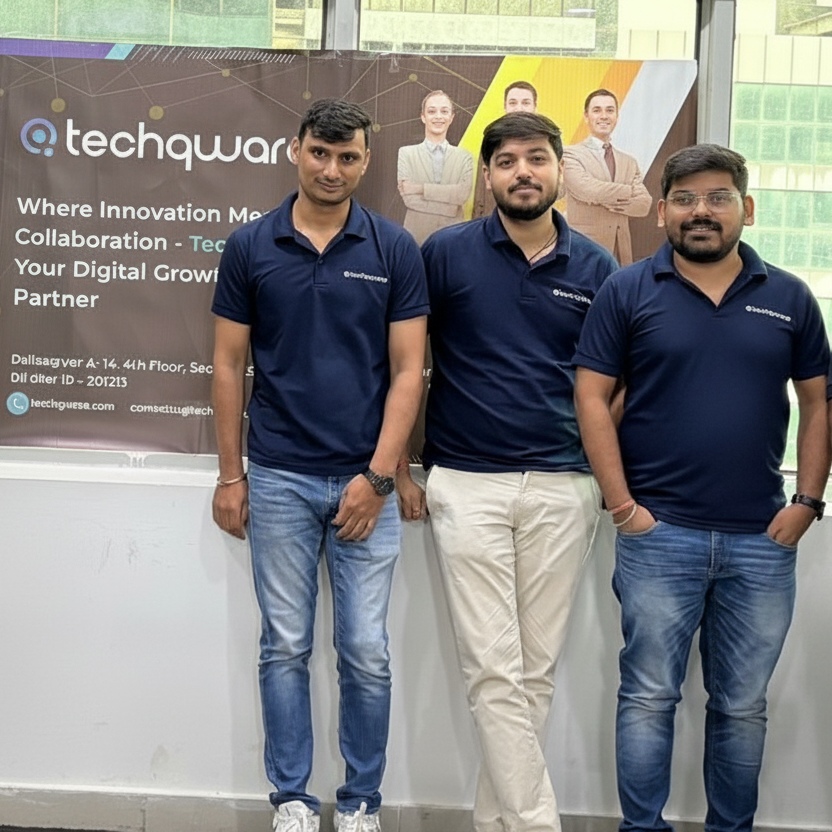
TechQware’s Mobile App Development Team
About Author
TechQware specializes in full-stack Mobile App Development, utilizing Swift for native iOS and Kotlin for native Android. For cross-platform solutions, we rely on Dart (Flutter) and JavaScript (React Native). Python is a foundational technology, powering the backend, RESTful APIs, and advanced Machine Learning features.