Introduction
Cross-Platform Development in 2026, due to pressures on development expenditures, increased expectations of seamless experiences across devices, and continued exponential growth in the number of AI-powered devices being utilized, has evolved from being a convenient alternative to the default approach to mobile and multi-surface app development. As a result, organizations are increasingly utilizing frameworks that enable code sharing, increasing development speed, and providing scalability.
Mobile ecosystems in 2026 have undergone massive evolution:
- Android 16 includes tightly integrated technologies that support AI and ML accelerated UI frameworks and on-device Neural Rendering.
- iOS 19 has implemented additional machine learning functionality at the Operating System (OS) level and increased app sandbox privacy.
- Enterprise architectures require applications to run uniformly across all devices - mobile, desktop, web, automotive, AR/VR, and wearables.
- Enterprise budgets are limited causing enterprises to prefer a write once, run everywhere approach to their ecosystems.
With this, three frameworks have emerged as the definitive leaders:
- Kotlin Multiplatform (KMP) - now mature and production-ready
- Flutter - still the fastest UI framework for native-like experiences
- React Native - transformed by React 19 and New Architecture (Fabric +TurboModules)
Choosing the right one in 2026 isn’t simple it depends on performance, UI needs, team structure, budget, and long-term roadmap.
This blog helps you break it all down.
Overview of the Leading Cross-Platform Technologies (2026 Update)
Kotlin Multiplatform (KMP) : Entering Its Maturity Phase
With JetBrains continuing to expand on KMP development tools rapidly, it is likely that the KMP development in 2026 will provide the following:
- Shared "Business Logic" across Android, iOS, Desktop, Web and the Backend.
- Stable Kotlin/JS, Kotlin/Wasm and Kotlin/Native API'S.
- Improved iOS integration makes it feel much more "native" to devs.
- Decreased effort (40-60%) in building shared data, network, serialization, and ML Layers across platforms.
- Ample compatability with Jetpack Compose Multiplatform allowing for real UI sharing.
As we look ahead to 2026, an increasing number of large corporations such as Netflix, Philips, and fintechs have chosen to utilize KMP when developing large-scale applications due to the KMP’s dependability, speed, and ability to work across all future Android ecosystems.
Several recent advances have been made that will lead to further improvements in the KMP platform:
- Increased speed of Kotlin compiler
- Use of Kotlin/Wasm to create applications for the web
- Added features of Compose Multiplatform – including support for 120Hz and motion design.
- Access from Android and iOS ML kits for the use of on-device AI models.
Conclusion: KMP has been specifically designed to meet the needs of enterprise, AI-driven, logic-heavy, and multi-surface applications.
Flutter : Google’s Vision for Unified App Experiences
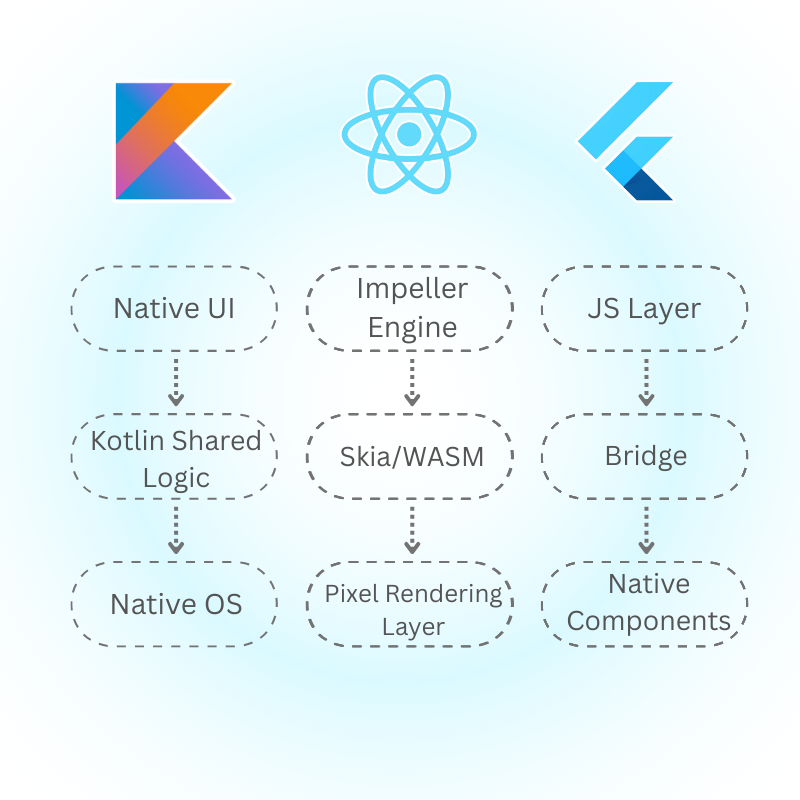
As of 2026, Flutter continues to lead the industry in UI consistency across all platforms. Its unique framework includes a dedicated rendering engine (Impeller) and guarantees consistent pixel-perfect UI between all of its supported platforms (Android, iOS, Web, Desktop, and Cars, as well as Embedded Systems). As a result of this technical architecture,
Flutter can create richer and more complex experiences, such as advanced motion graphics, Gaming-lite applications, Dashboards, and XR interfaces, than any other toolkit available today. Furthermore, Flutter provides support for the Material You design language, centered around the Material Design 2.0 visual aesthetic; the Cupertino, which is Apple's design language; and the ability to use custom design languages. The Dart programming language version 3.5 integrates with the Flutter development environment tightly. Flutter supports faster, more efficient Just-In-Time (JIT) and Ahead-Of-Time (AOT) compilation, static typing, and advanced concurrency primitives compared to other platforms currently being developed in the market. Recently updated features of Flutter include:
AI-based UI generator APIs;
- Flutter Web 2.0 has been optimised for performance and compiles to WebAssembly (WASM);
- Impeller 2 rendering engine is optimised for 120Hz animation and GPU computation; 2D and 3D vector widgets for creating an immersive design;
- Enhanced DevTools for developing with tools that are both more stable and Hot Reload-friendly.
- Flutter has a competitive advantage when it comes to creating visually appealing apps & startups MVPs, dashboards, and high fidelity consumer products.
React Native : Evolving with React 19 and New Architecture
React Native’s modernization has been its biggest leap in the last decade. With Fabric & TurboModules now fully adopted in 2026, RN offers:
- React 19 fundamentals, with server components and streaming UI
- More native performance through JSI
- Direct bridging to GPU rendering engines
- Better integration with Web through React ecosystem
- Expo 2026 simplifying builds, OTA updates, push notifications, and native modules
- Easier staffing, as JavaScript/TypeScript developers remain widely available
RN is particularly strong for teams coming from web development or those who want:
- Faster MVP launches
- Light, functional UI
- Strong integration with existing React-based web portals
- Lower complexity applications that don’t need 120FPS animations
Verdict: Ideal for web-first teams, MVPs, and companies needing scalability with lightweight native components.
Performance Benchmark Comparison (2026 Edition)
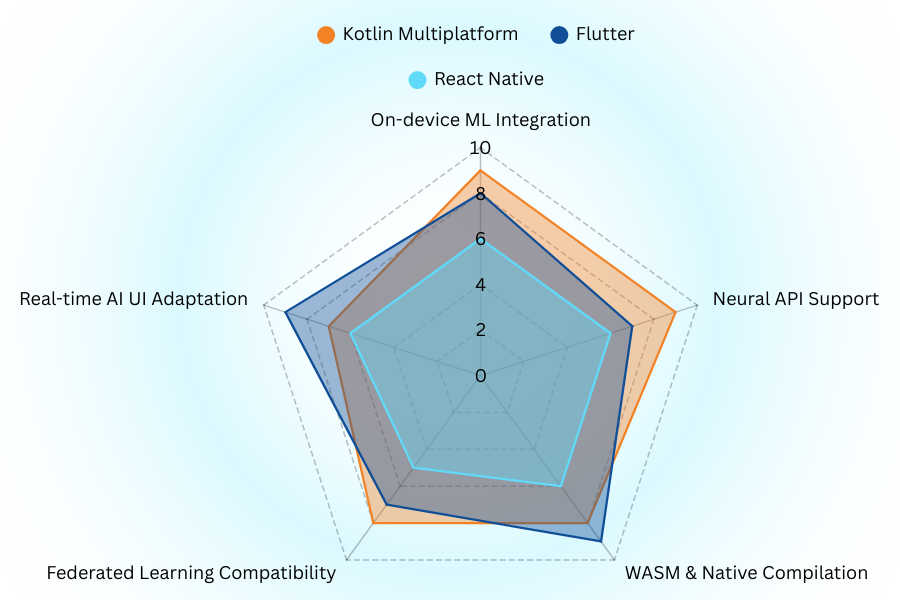
Performance is now a decisive factor due to AI-driven features, edge computing, and 120Hz UIs.
Startup Performance & On-Device AI Compatibility
Kotlin Multiplatform
- Uses actual native UI layers → fast cold start
- Shared logic compiles to native → excellent ML/AI integration
- Best for AI-heavy apps, thanks to Kotlin’s deep integration with Android NNAPI and iOS CoreML
Flutter
- Impeller engine loads faster than Skia, but still has a slight warm-up penalty
- Excellent support for on-device ML, especially with TensorFlow Lite + Dart AI libraries
- Very fast runtime once loaded
React Native
- Greatly improved with Fabric
- But still dependent on JavaScript runtime startup
- Better AI integration via native modules rather than JS
Winner: Kotlin Multiplatform (for pure native startup speed + AI readiness)
GPU/Rendering Performance for Animations & Motion UI
Kotlin Multiplatform
With Compose Multiplatform, GPU-accelerated rendering is strongBut not as optimized as Flutter for animation-heavy apps
Flutter
- Clear winner
- Impeller 2 + custom shaders + game-lite rendering
- Smooth 120Hz animations
- Best ecosystem for animated storytelling, fintech dashboards, entertainment apps
React Native
- Much improved GPU performance
- But still depends on third-party libs (Reanimated, Skia RN)
- Not ideal for complex motion design
Winner: Flutter (undisputed for smooth, GPU-heavy UI)
Battery Optimization & Memory Efficiency
Kotlin Multiplatform
- Native compilation → lowest energy consumption
- Highly efficient with memory and multi-threading
Flutter
- Slightly higher battery usage due to rendering engine
- Much improved vs 2023–24 versions, but still heavier
React Native
- Better than before, but JavaScript runtimes remain less efficient
- Memory spikes under load
Winner: Kotlin Multiplatform
UI & Design System Capabilities
Support for Adaptive, AI-Generated UI
AI-driven UIs that change based on behavior are trending in 2026.
- Flutter supports AI-generated design tokens and layout adaptation natively.
- KMP enables this via Compose Multiplatform but requires more manual setup.
- RN relies mostly on third-party AI layout generation tools.
Winner: Flutter
Native Fidelity Across Android, iOS, Desktop & Web
- KMP: Closest to true native feel (since it uses native UI or Compose).
- Flutter: Amazingly consistent across all surfaces, though slightly non-native feel on iOS.
- RN: Most “web-like” and depends on native modules for fidelity.
Winner: Kotlin Multiplatform
Support for Motion Design & 120Hz Animations
- Flutter dominates with Impeller.
- KMP is improving but not fully animation-optimized.
- RN depends heavily on Reanimated and community tools.
Winner: Flutter
Developer Experience in 2026
Stability of SDKs & Library Ecosystem Growth
- Kotlin Multiplatform now has a mature ecosystem for data layers, DI, network, storage, and UI.
- Flutter retains the richest widget/UI library base.
- React Native depends heavily on third-party modules but Expo 2026 stabilizes many needs.
Multiplatform Debugging Improvements
- KMP: Unified debugging for Kotlin code across platforms.
- Flutter: Best debugging UI/experience due to DevTools.
- RN: Better debugging via React DevTools + native logs, but still more fragmented.
Integration with DevOps & Gen-AI Coding Assistants
- KMP integrates well with JetBrains AI + GitHub Copilot.
- Flutter integrates with Google’s Vertex AI and DevTools.
- RN integrates deeply with web CI/CD and Expo EAS.
Best Overall DX: Flutter (Though KMP wins for enterprise Kotlin teams)
Cost & Scalability Considerations in 2026
Development & Maintenance Cost Comparison
|
Framework
|
Initial Cost
|
Maintenance
|
Reason
|
|
KMP
|
Medium–High
|
Low
|
Native dev + shared logic reduces future cost
|
|
Flutter
|
Medium
|
Low
|
Single codebase for everything
|
|
React Native
|
Low
|
Medium
|
JS devs cheap, but long-term ecosystem fragmentation
|
Resource Availability & Talent Market Trends (2026)
- JS/TS developers remain the easiest to hire → React Native advantage
- Flutter developers are widespread due to startup popularity
- Kotlin Multiplatform devs are fewer but rising fast, especially in enterprise
Framework Longevity & Vendor Ecosystem Health
- KMP backed by JetBrains + Google → strong future
- Flutter backed fully by Google → major investments continue
- React Native backed by Meta → stable but slowly moving toward web-first priorities
Most Future-Proof: Kotlin Multiplatform & Flutter (React Native is stable but evolving slowly)
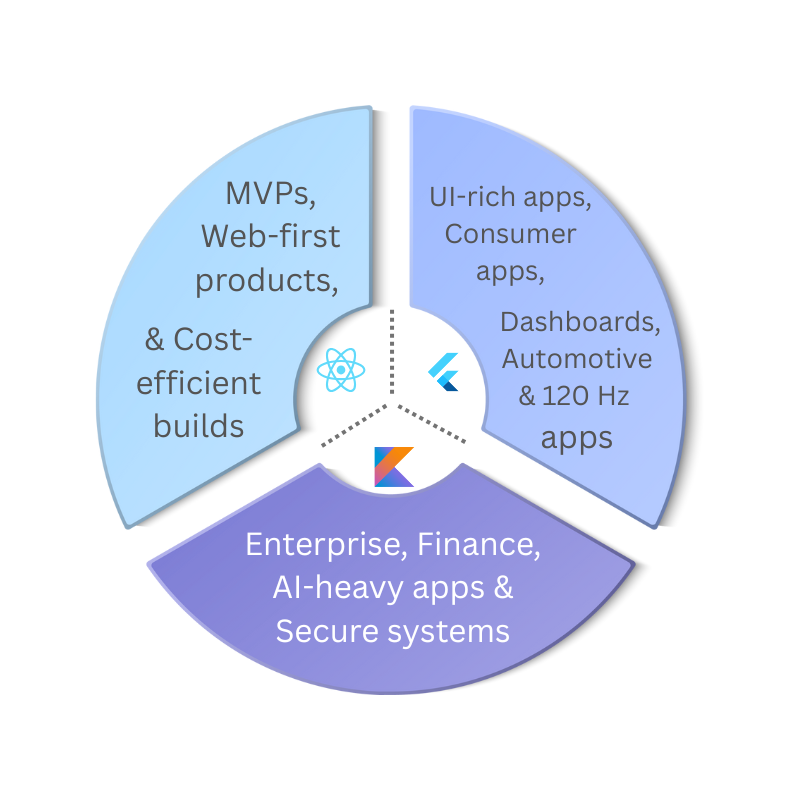
Best Use Cases for 2026
When to Choose Kotlin Multiplatform
Perfect for:
- Enterprise applications
- AI-heavy apps
- Apps requiring strict performance and security
- Android-first products
- Multi-surface logic sharing
- Long-term product roadmaps
- Apps needing native UI fidelity
When to Choose Flutter
Ideal for:
- High-performance UI-rich apps
- Startups or companies needing fast delivery
- Animation-heavy UIs
- Gaming-lite apps
- Dashboard applications
- Apps for cars, wearables, embedded screens
- Products needing consistent design across all devices
When to Choose React Native
Best for:
- Web-oriented teams
- MVPs and fast prototypes
- Apps with simple UI
- Teams already using React for web
- Applications needing rapid iteration cycles
- Startups reducing initial cost
Real-World Case Studies (2026 Update)
Companies Embracing Kotlin Multiplatform
- Netflix uses KMP for shared data layers in their mobile and TV apps
- Philips Healthcare utilizes KMP for secure medical data sharing
- BMW adopts KMP for Android Automotive + iOS integration Reported Gains:
- 30–50% faster feature delivery
- 20–30% performance improvement
- Easier AI and ML integration
Companies Using Flutter
- Alibaba continues using Flutter for fast-commerce apps
- Toyota & Hyundai build Flutter apps for car dashboards
- Udemy uses Flutter for mobile + desktop learning apps Reported Gains
- 40–60% faster UI development
- Near 120Hz smooth interfaces
- Unified design system across product line
Companies Choosing React Native
- Walmart (for its e-commerce apps)
- Meta (Messenger, Ads Manager)
- Coinbase (lightweight trading apps) Reported Gains:
- Faster release cycles
- Cost-effective updates
- Easier web-app integration
Final Recommendation : The Best Framework for 2026
There is no universal winner, but here’s the clear, strategic guidance.
Choose Kotlin Multiplatform if:
- You need top-tier performance and security
- You’re building enterprise-grade or mission-critical apps
- Your app involves AI-heavy processing, ML models, offline logic
- You want future-proof alignment with Android and multi-surface devices
Best for enterprise organizations, finance, healthcare, logistics, AI-driven apps.
Choose Flutter if:
- You want the best UI and animation performance
- Your team values faster development and pixel-perfect consistency
- You’re building consumer apps, multimedia apps, dashboards, or cross-device products
Best for startups, design-centric products, multi-device apps.
Choose React Native if:
- You already have a web React team
- You need a fast MVP
- Your UI is simple or functional
- You want low-cost scaling
Best for web-first companies and MVP-driven businesses.
Conclusion
The following are winners for 2026 based on overall preparedness:
- When it comes to enterprise and AI applications, Kotlin Multiplatform will be king.
- For the UI and consumer market, Flutter will reign supreme.
- Web-based teams will dominate React Native.
These frameworks will continue to lead the way in each respective category well into 2026. The most successful companies will rely on strategic decisions, not popularity, when selecting their technology platform.
The choice between Kotlin Multiplatform, Flutter, and React Native in 2026 is less about a single "winner" and more about strategic alignment.
The landscape favors Kotlin Multiplatform (KMP) for projects prioritizing maximum code reuse of business logic and direct native performance, leveraging its expanding reach beyond just mobile. Flutter remains the ideal choice for pixel-perfect, consistent UI and rapid iteration, while React Native still offers the advantage of a massive JavaScript ecosystem and talent pool.
Don't risk your 2026 roadmap on a guess. At TechQware, we cut through the complexity, providing expert, unbiased analysis and development in all three platforms to guarantee you choose the technology that delivers the best long-term ROI for your unique product.
Ready to select the perfect cross-platform technology for your next breakthrough app? Contact TechQware for a Personalized Strategy Session!
 TechQware