app development
How Cross-Platform Development Saves ~40% of Your App Budget in 2026
 TechQware
June 26, 2026
 TechQware
June 26, 2026
As of 2026, developing native applications for iOS and Android independently is becoming less and less affordable and less desirable for lean product teams and startups. Planning, hiring for separate Swift/Objective-C and Kotlin/Java developers, maintaining two codebases, requiring two parallel QA pipelines the costs can add up quickly.
At the same time, valid cross-platform development frameworks such as Flutter, React Native, and Kotlin Multiplatform have improved tremendously. They now deliver near-native quality performance, faster multi-platform reliability, real business ROI and are accepted by our competitors. Simply implementing a proper cross-platform strategy can easily recover 40% of development and maintenance costs with no loss of quality or scalability!
We’ll dive into exactly how those savings occur (and in excruciating detail): where it comes from and under what conditions, and how to get the most ROI with a real case study and a clearly defined action plan.
Get a detailed, side-by-side comparison of native vs cross-platform costs based on your app’s actual features and roadmap.
Developing a native mobile app involves building one application for iOS and an additional, separate application for Android, and this is often considered the gold standard in performance and compliance with platforms. Subsequently, more often than not, it is double the cost to do native, relative to other alternatives, even in real-life use cases, since:
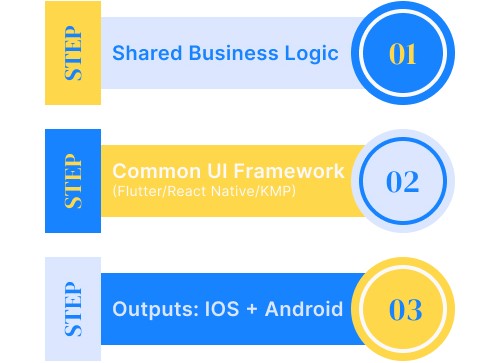
In layman's terms: one codebase that will work on iOS, Android (and maybe more).
Today's cross-platform frameworks include:
Fast forward to today, 2026, and these frameworks are now more powerful than ever:
.jpg)
To make sense of how the approximately 40% savings number comes about, let’s take a closer look at a granular cost comparison. These are not “best-case only” hypothetical numbers these represent real-world industry benchmarks as of 2025-2026.
|
Cost Category Estimated Savings |
Native (iOS+Android) |
Cross-Platform |
|
Development (Initial) 30-50% lower cost |
Very high : two distinct codebases, separate developer teams |
Codebase, one team |
|
Maintenance 25-40% lower TCO |
Separate Bug fixes updates per platform |
OS One codebase, unified bug fixes |
|
QA/Testing & Release 35%+ time saving |
Duplicate regression separate pipelines |
Unified test suite, shared release process |
|
Total (1-3 Years) Up to ~ 40% total savings (or more) |
Very high, compounding costs |
Much lower due to reuse & team efficiency |
These figures are consistent with a variety of industry sources.
Below are the fundamental elements that contribute to the cost efficiency of cross-platform development, compared to mobile development:
You will write a lot of code (business logic in particular) once. Cross-platform development frameworks like Flutter or Kotlin MPP allow you to share sizable portions of code.
After you have spent time creating your core test suite UI tests, integration tests, etc. you only have to support one core test suite versus two individual test suites.
Cross-platform applications sometimes launch 20 - 40% quicker than native apps because you do not have to replicate every single development task.
Bug fixes, platform version changes, or feature changes can be done once instead of separately.
Instead of hiring separate iOS and Android developers, you can instead hire a cross-platform mobile development team using Dart, JavaScript, or Kotlin. This means less people and less pay.
Get clarity on your mobile architecture, cost structure, timelines, and the best framework for your product.

Transparency is critical. Cross-platform can offer huge savings, but it’s not always the right choice. Here are edge cases where you should carefully consider hybrid or even full native:
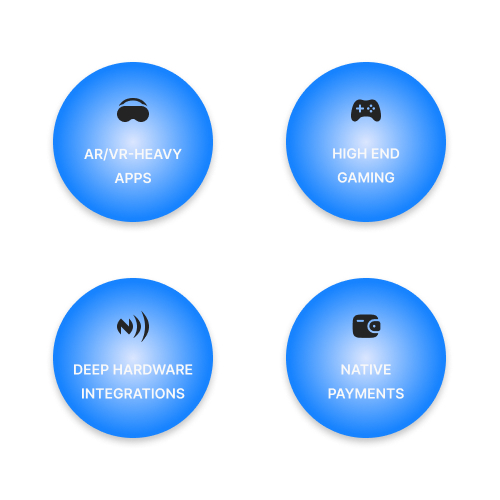
If you're building AAA-level games, 3D-intensive simulations, or real-time graphics-heavy experiences, native (or specialized game engines) may be better suited.
For deeply integrated AR/VR features especially those relying on platform-specific AR kits native development gives you better control and performance.
If your app depends heavily on native APIs like custom Bluetooth, NFC, biometric sensors, or very low-level system integrations a cross-platform framework may require bridging, which adds complexity and cost.
Some highly polished, platform-optimized interactions (especially around payments, gestures, or OS-specific UX paradigms) may be more natural in native. For instance, Apple Pay / Wallet / specific iOS-only APIs could justify native modules.
Every app is different. Get a free assessment to understand whether your project is ideal for cross-platform or if a hybrid/native mix is better.
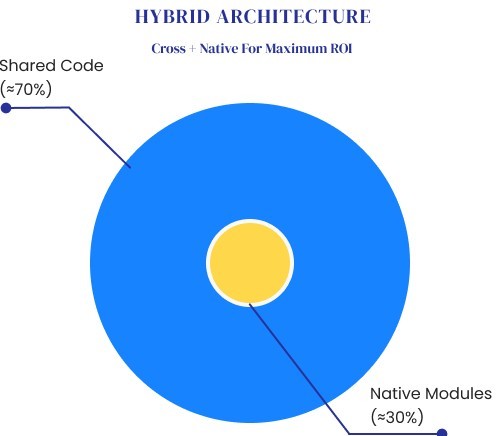
If you are facing one of the above scenarios, hybrid architectures often offer a sweet spot:
Build the core app using Flutter or React Native (for shared UI, business logic, and most features).
Add native extensions (or modules) for the performance-heavy or mobile/OS-specific tasks (e.g., AR, payments, hardware integrations)
This approach allows you to achieve the majority of the cost benefits of a cross-platform solution, while still delivering on critical native capabilities.
Here’s a story-based, realistic example to illustrate how big the savings can be, and how switching to cross-platform made a business impact.
Use real metrics not guesswork. Get a personalized estimate showing development, maintenance, and long-term cost differences.
If you want to get the most out of your cross-platform solution, being deliberate in your approach will be necessary. Below are some practical, tactical things to try:
TechQware Fit: Our multi-platform engineers are Flutter, Kotlin MPP and React Native specialists. We help clients build lean, fast performing applications, be sure to balance the costs, scales and native experiences.
To be fully transparent, cross-platform is not a silver bullet. Here are scenarios where you might want to lean more heavily into native or hybrid options and how to architect accordingly:
Cross-platform development is not a compromise when done right, it's a powerful lever to build smarter, faster, and leaner.
By adopting a cross-platform strategy with Flutter, React Native, or Kotlin MPP, you can realistically save up to ~40% of your app development and maintenance budget over a multi-year horizon. You also get faster time-to-market, more agile iteration, and a unified development process.
But - it’s not one-size-fits-all. There are legitimate edge cases (AR, gaming, hardware dependency) where hybrid or native modules are needed. The key is striking the right balance.
Ready to Build Smarter, Faster, and Leaner? Let TechQware help you cut 40% of your app development cost without sacrificing quality.
Ans: Yes, modern cross-platform frameworks like Flutter and React Native can reduce development and maintenance costs by ~30–50% compared to building separate native apps.
Ans: It depends on your priorities:
Ans: For most use cases yes. Cross-platform frameworks now deliver near-native performance, especially for typical business, consumer, or productivity apps. Reference Codebridge
However, for extremely performance-sensitive scenarios (e.g., high-FPS games, AR/VR), you might need to use native modules or a hybrid approach.
Ans: Estimate your total budget for two native apps (iOS + Android), then compare to a cross-platform cost projection (ask for code reuse, QA, maintenance savings). Use a partner (like TechQware) to run a tailored cost-benefit analysis based on your feature list and roadmap.
Let’s chat about your goals and explore how TechQware can support your journey ahead.



app development . Sep 28, 2026
Building CBUAE-Compliant Fintech Apps i…
app development . Sep 25, 2026
Digital Wallet Integration for Mobile A…