Healthcare is no longer confined to hospital walls it is increasingly mobile, data-driven, and patient-centric. In this rapidly evolving landscape, enterprise-grade mobile applications are becoming critical infrastructure. For healthcare organizations handling sensitive patient data, choosing the right platform is not just a technical decision it’s a strategic one.
Why Healthcare Enterprises Are Choosing iOS in 2026
Healthcare enterprises in 2026 are prioritizing reliability, security, and long-term scalability and iOS consistently delivers on all three fronts. Unlike fragmented ecosystems, Apple’s tightly controlled hardware and software integration ensures predictable performance, consistent updates, and minimal device variability.
Hospitals and healthcare providers are increasingly adopting iOS devices for clinical workflows because they reduce operational complexity. When a nurse uses an iPad for patient charting or a doctor accesses EHR data on an iPhone, the experience remains consistent across devices, reducing training time and errors.
Another key driver is Apple’s commitment to privacy. With rising cyberattacks targeting healthcare systems, enterprises are shifting toward platforms that prioritize data protection by design. According to industry reports, healthcare data breaches cost organizations an average of $10.93 million per incident making security investments non-negotiable.
Real-life scenario: A multi-specialty hospital chain in India transitioned from mixed Android devices to a standardized iOS ecosystem. Within six months, they reported a 32% reduction in device-related IT issues and significantly improved compliance audit outcomes.
Apple’s Closed Ecosystem Advantage for PHI Protection
Apple’s closed ecosystem is often viewed as restrictive, but in healthcare, it becomes a powerful advantage. By controlling both hardware and software, Apple minimizes vulnerabilities that typically arise from third-party integrations and inconsistent updates.
Protected Health Information (PHI) requires stringent safeguards, and Apple’s ecosystem enforces strict app review guidelines, secure APIs, and controlled app distribution channels. This reduces the risk of malicious apps infiltrating enterprise environments.
Moreover, Apple’s regular OS updates ensure that all devices receive security patches simultaneously. This eliminates the lag seen in other ecosystems where outdated devices remain vulnerable for extended periods.
For healthcare enterprises, this translates into a more secure environment where patient data is less exposed to breaches, unauthorized access, or malware attacks.
iOS vs Android for Enterprise Healthcare: A Decision-Maker’s Comparison
Choosing between iOS and Android is a critical decision for healthcare enterprises. While both platforms have their strengths, the choice often comes down to security, compliance, and manageability.
|
Criteria
|
iOS
|
Android
|
|
Security Updates
|
Immediate and universal
|
Fragmented and delayed
|
|
Device Fragmentation
|
Minimal
|
High
|
|
App Distribution Control
|
Strict (App Store + MDM)
|
Flexible but less controlled
|
|
Compliance Readiness
|
High
|
Moderate
|
|
Enterprise Device Management
|
Seamless with Apple tools
|
Requires multiple tools
|
|
Cost of Devices
|
Higher upfront
|
Lower upfront
|
While Android may offer cost advantages, iOS provides a more secure and predictable environment making it the preferred choice for healthcare enterprises dealing with sensitive patient data.
Key Compliance Frameworks Every Healthcare iOS App Must Meet
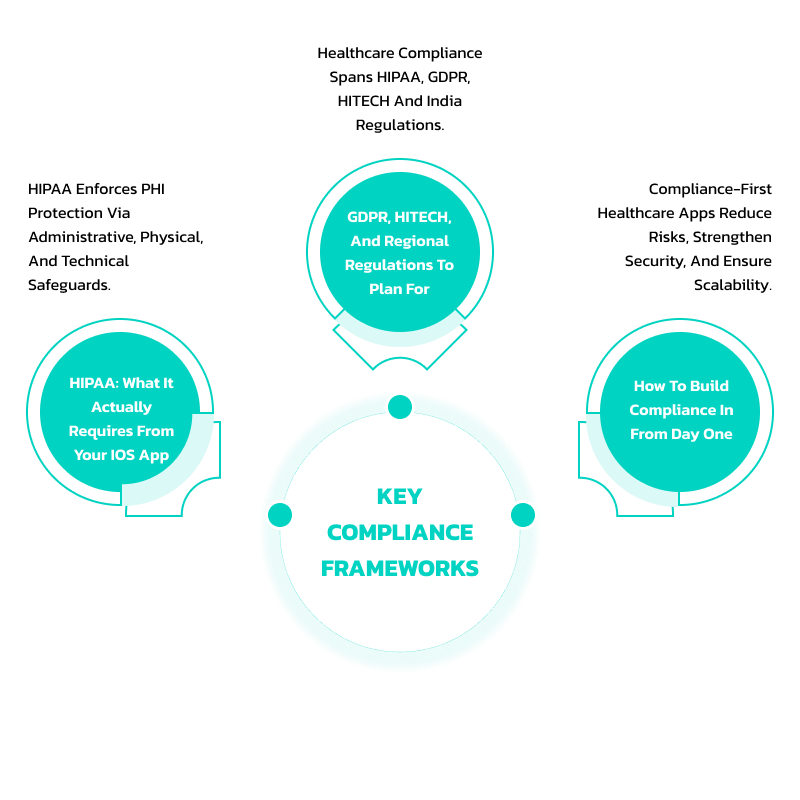
Healthcare applications must adhere to multiple regulatory frameworks depending on geography and data handling practices. These frameworks are designed to protect patient data, ensure transparency, and enforce accountability.
Compliance is not just about avoiding penalties it is about building trust. Patients are more likely to engage with digital healthcare platforms when they feel their data is secure.
For enterprises, compliance also enables smoother partnerships with insurers, government bodies, and global healthcare providers.
HIPAA: What It Actually Requires from Your iOS App
The Health Insurance Portability and Accountability Act (HIPAA) is one of the most critical regulations for healthcare applications handling PHI.
HIPAA requires robust safeguards across three key areas:
- Administrative safeguards such as access controls and employee training
- Physical safeguards including secure device handling
- Technical safeguards like encryption and audit controls
For an iOS app, this means implementing secure authentication, encrypted data storage, and detailed logging of user activity.
A practical example is a telemedicine app that logs every patient interaction, ensuring traceability in case of audits. Failure to comply can result in severe penalties and reputational damage.
GDPR, HITECH, and Regional Regulations to Plan For
Beyond HIPAA, healthcare enterprises must consider global and regional regulations such as GDPR in Europe and HITECH in the United States.
GDPR emphasizes data privacy and user consent, requiring apps to provide transparency on how patient data is collected, stored, and used.
HITECH strengthens HIPAA by promoting the adoption of electronic health records and increasing penalties for non-compliance.
In India, healthcare apps must also align with emerging data protection laws and guidelines issued by regulatory bodies.
Enterprises operating globally must design applications that can adapt to multiple regulatory environments without compromising performance or user experience.
How to Build Compliance In From Day One - Not Bolt It On Later
Compliance should never be an afterthought. Retrofitting compliance into an existing application is costly, time-consuming, and often ineffective.
Instead, healthcare apps should be built with a “compliance-first” approach. This involves integrating security protocols, data governance policies, and audit mechanisms during the initial development phase.
We follow a compliance-by-design methodology, ensuring that every feature is aligned with regulatory requirements from the outset. This reduces risks, accelerates approvals, and ensures long-term scalability.
Security Architecture for Healthcare iOS Apps
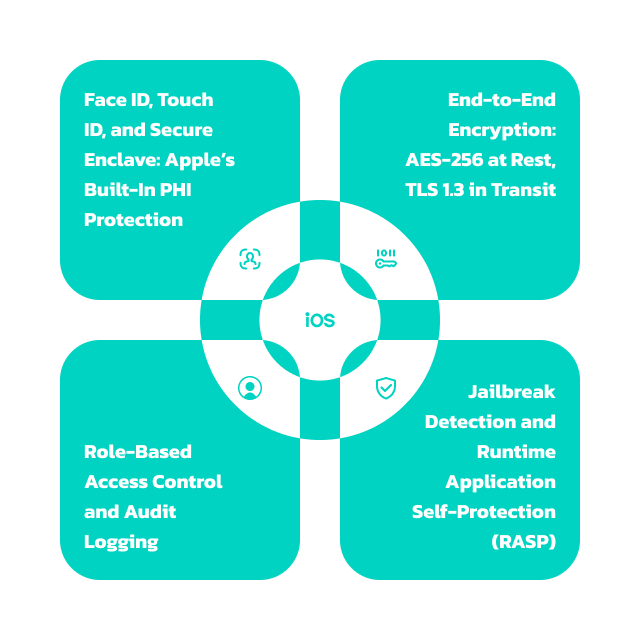
A robust security architecture is the backbone of any healthcare application. It ensures that sensitive patient data remains protected at every stage from data entry to storage and transmission.
Modern healthcare apps must adopt a multi-layered security approach that includes encryption, authentication, and continuous monitoring.
This architecture not only protects against external threats but also mitigates internal risks such as unauthorized access or accidental data leaks.
Face ID, Touch ID, and Secure Enclave: Apple’s Built-In PHI Protection
Apple devices come equipped with advanced biometric authentication systems such as Face ID and Touch ID. These technologies provide a seamless yet secure way for healthcare professionals to access sensitive data.
The Secure Enclave, a dedicated hardware component, ensures that biometric data is stored separately from the main operating system. This prevents unauthorized access even if the device is compromised.
For healthcare apps, integrating these features enhances security while improving user experience allowing quick and secure access to patient information.
End-to-End Encryption: AES-256 at Rest, TLS 1.3 in Transit
Encryption is a fundamental requirement for healthcare applications. Data must be protected both at rest and in transit to prevent unauthorized access.
AES-256 encryption ensures that stored data remains secure, while TLS 1.3 protects data during transmission between devices and servers.
This dual-layer encryption approach is essential for maintaining data integrity and confidentiality, especially in telemedicine and remote monitoring applications.
Role-Based Access Control and Audit Logging
Not every user should have access to all data. Role-Based Access Control (RBAC) ensures that users can only access information relevant to their roles.
For example, a nurse may access patient vitals, while a doctor can view full medical histories.
Audit logging further enhances security by recording every action performed within the app. This creates a transparent record that can be reviewed during compliance audits or investigations.
Jailbreak Detection and Runtime Application Self-Protection (RASP)
Jailbroken devices pose significant security risks as they bypass Apple’s built-in protections. Healthcare apps must detect and restrict access on such devices.
Runtime Application Self-Protection (RASP) adds another layer of security by monitoring app behavior in real time and detecting potential threats.
These measures ensure that the app remains secure even in compromised environments.
Enterprise Deployment: From MDM to Apple Business Manager
Deploying healthcare apps across hundreds or thousands of devices requires a structured approach. Apple provides enterprise tools that simplify this process while maintaining security and compliance.
These tools enable centralized control, ensuring that apps are distributed, updated, and managed efficiently across all devices.
Setting Up Mobile Device Management (MDM) for Clinical Devices
Mobile Device Management (MDM) allows healthcare enterprises to manage devices remotely.
With MDM, IT teams can enforce security policies, install apps, and monitor device usage. This is particularly useful in clinical environments where devices are shared among staff.
MDM also ensures that all devices comply with organizational policies, reducing the risk of data breaches.
Apple Business Manager: Provisioning Apps Across Hundreds of Devices
Apple Business Manager simplifies the deployment of enterprise apps by enabling bulk provisioning and configuration.
Healthcare organizations can assign apps to devices without requiring individual Apple IDs, streamlining the onboarding process.
This is especially beneficial for large hospitals and healthcare networks managing thousands of devices.
Remote Wipe, Containerization, and BYOD Policies
Security does not end with deployment. Healthcare enterprises must be prepared to handle lost or stolen devices.
Remote wipe capabilities allow IT teams to erase sensitive data instantly, preventing unauthorized access.
Containerization separates personal and professional data on BYOD (Bring Your Own Device) setups, ensuring that patient data remains secure even on personal devices.
Must-Have Features for Enterprise Healthcare iOS Apps
A successful healthcare app must go beyond compliance and security it must deliver real value to users.
Key features should enhance efficiency, improve patient outcomes, and streamline workflows.
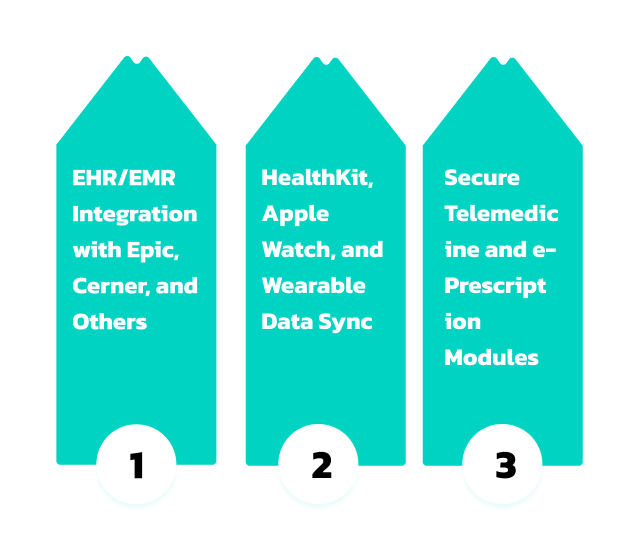
EHR/EMR Integration with Epic, Cerner, and Others
Integration with Electronic Health Records (EHR) and Electronic Medical Records (EMR) systems is essential for seamless data exchange.
Healthcare professionals should be able to access patient records, update information, and make decisions in real time.
This integration reduces manual errors and improves overall efficiency.
Secure Telemedicine and e-Prescription Modules
Telemedicine has become a cornerstone of modern healthcare. Secure video consultations, digital prescriptions, and remote diagnostics are now essential features.
These modules must be designed with robust security measures to ensure patient confidentiality and compliance with regulations.
HealthKit, Apple Watch, and Wearable Data Sync
Wearable devices are transforming healthcare by enabling continuous monitoring of patient health.
Apple’s HealthKit framework allows apps to collect and analyze data from devices like the Apple Watch.
This enables proactive healthcare, where potential issues can be detected and addressed before they become critical.
Development Cost and Timeline for Enterprise Healthcare iOS Apps
Building a healthcare iOS app involves multiple stages, including planning, design, development, testing, and deployment.
The cost and timeline depend on factors such as complexity, features, and compliance requirements.
|
App Complexity
|
Estimated Cost (INR)
|
Timeline
|
|
Basic Healthcare App
|
₹15–25 Lakhs
|
3–5 months
|
|
Mid-Level Enterprise App
|
₹25–60 Lakhs
|
6–9 months
|
|
Advanced Healthcare Platform
|
₹60 Lakhs+
|
9–15 months
|
Investing in a high-quality application ensures long-term benefits, including improved efficiency, better patient outcomes, and enhanced compliance.
How to Choose the Right iOS Development Partner for Healthcare
Selecting the right development partner is crucial for the success of your healthcare app.
Look for a company with proven experience in healthcare app development, strong knowledge of compliance frameworks, and expertise in iOS technologies.
At TechQware Technologies, we combine technical excellence with industry expertise to deliver secure, scalable, and compliant healthcare solutions tailored to your business needs.
Conclusion
Healthcare enterprises in 2026 cannot afford to compromise on security, compliance, or user experience. iOS provides a robust platform that meets these requirements while enabling innovation and scalability.
By partnering with an experienced development company like TechQware, organizations can build applications that not only meet regulatory standards but also drive business growth and improve patient care.
From secure architecture to seamless deployment, every aspect of iOS app development plays a critical role in shaping the future of healthcare.
FAQs
Is iOS better than Android for healthcare enterprise apps?
iOS offers a more secure and controlled environment, making it ideal for healthcare applications that handle sensitive patient data.
What does HIPAA compliance require in a mobile app?
HIPAA requires administrative, physical, and technical safeguards, including encryption, access controls, and audit logging.
How does Apple MDM work for hospital device management?
MDM enables centralized control of devices, allowing IT teams to enforce policies, deploy apps, and monitor usage remotely.
How much does it cost to build a HIPAA-compliant iOS app?
Costs vary based on complexity but typically range from $15,544 to $62,176.
What is the Secure Enclave in iPhone and how does it protect medical data?
The Secure Enclave is a hardware-based security feature that isolates sensitive data, ensuring it remains protected even if the device is compromised.

 TechQware
.png)