Key Takeaways:
- AI can improve personalization, search, support, and automation in Dubai apps.
- Choose AI features based on business goals and user needs, not trends.
- AI adoption should consider PDPL, data privacy, and governance requirements.
- Arabic support can improve accessibility and user experience for local audiences.
- AI costs vary by feature, data, integrations, and infrastructure.
- Start with one high-value AI feature, measure results, then scale.
Introduction
Dubai has moved far beyond the stage where mobile apps are simply digital versions of existing business processes. In 2026, users increasingly expect applications to understand intent, anticipate needs, respond naturally, and deliver relevant experiences without making customers navigate through unnecessary steps. For businesses operating in Dubai's competitive digital economy, artificial intelligence is becoming an important layer for delivering that experience.
The opportunity is particularly significant because the UAE has made AI a national priority. Its Artificial Intelligence Strategy is designed to position the country among global AI leaders while encouraging AI adoption across government and economic sectors.
Why AI Is No Longer Optional for Dubai Apps in 2026
The strongest argument for AI is not that every application needs a chatbot or generative AI feature. The argument is that customer expectations are changing faster than conventional app experiences can respond.
Consider a Dubai e-commerce customer searching for running shoes. A conventional application may display products based on category, price and popularity. An AI-enabled application can consider previous purchases, browsing patterns, preferred brands, budget, location, seasonality and current inventory before presenting a highly relevant selection.
This difference becomes commercially important when an application serves thousands or millions of users with different needs. AI allows businesses to move from one-size-fits-all interfaces toward experiences that continuously adapt.
The market signals support this shift. KPMG reported that 97% of surveyed UAE residents said they use AI for work, study or personal purposes, demonstrating how familiar AI-enabled experiences have already become to users in the country.
Is Your App Using AI, or Just Claiming To?
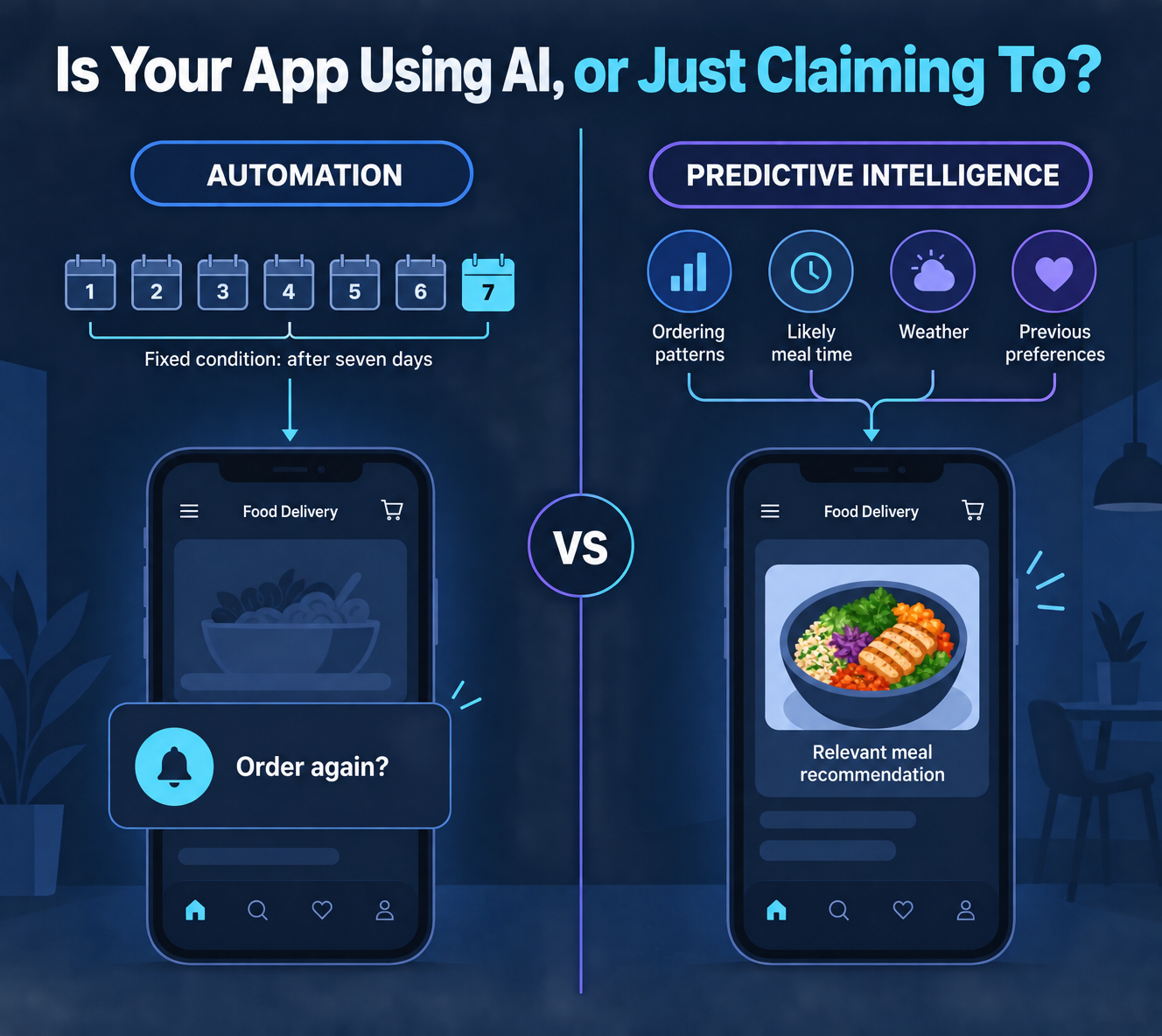
Adding the word "AI" to a product description does not make an application intelligent. A static chatbot connected to a generic knowledge base, a simple rule-based recommendation engine, or automated notifications triggered by fixed conditions may provide useful automation, but they should not automatically be positioned as advanced AI.
A genuinely AI-enabled application uses data to identify patterns, make predictions, personalize experiences, understand language, generate content, or automate decisions within clearly defined boundaries.
For example, a food delivery app that sends "Order again?" after seven days is using automation. An application that learns a customer's ordering patterns, predicts the likely meal time, considers weather and previous preferences, and recommends relevant meals is applying predictive intelligence.
This distinction matters because businesses should invest in measurable outcomes rather than AI labels.
What This Guide Will Help You Achieve
This guide explains where AI can create practical value inside a Dubai-focused mobile application, from personalization and predictive analytics to conversational interfaces, generative AI and AI-agent readiness.
It also examines the compliance layer that should be considered before sensitive customer data enters an AI pipeline. The UAE's Personal Data Protection Law establishes requirements around personal-data processing, privacy, security and certain cross-border transfers.
For business owners, product managers and technology leaders, the objective is simple: understand which AI capabilities deserve investment, where they create measurable business value, and how to build them without treating compliance as an afterthought.
Why Dubai Businesses Are Investing in AI-Powered Apps
Dubai's technology environment creates a particularly strong case for intelligent applications because customers interact with businesses through highly digital journeys across retail, banking, real estate, healthcare, hospitality, transportation and government services.
UAE's National AI Strategy and Government Push
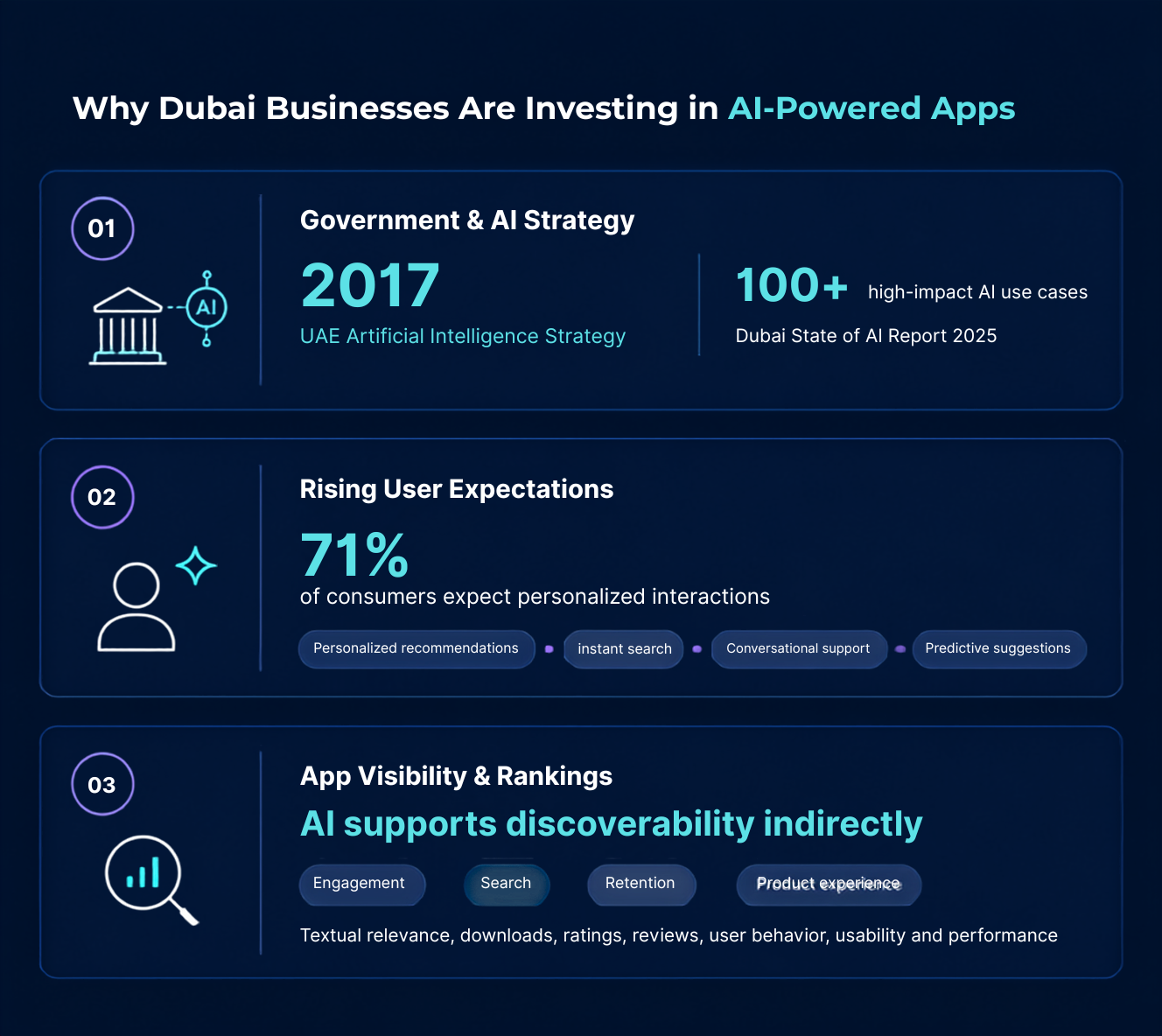
The UAE launched its Artificial Intelligence Strategy in 2017 with the ambition of becoming a global leader in AI and using AI to improve government performance, investment and economic value creation. The strategy covers sectors including transport, healthcare, renewable energy, technology, education, environment and traffic.
Dubai has continued to turn that national ambition into practical implementation. The Dubai State of AI Report 2025 assessed more than 100 high-impact AI use cases across areas such as healthcare, finance, mobility, procurement, compliance and strategic decision-making.
For private businesses, this creates an important signal. AI is not being treated as a short-lived technology trend; it is becoming part of the region's broader digital infrastructure and economic strategy.
Rising User Expectations for Smart, Personalized Apps
Customers rarely compare an app only with direct competitors. They compare every digital experience with the best application they have used recently.
If a customer is accustomed to personalized recommendations, instant search, conversational support and predictive suggestions from leading global platforms, a basic application can quickly feel outdated.
McKinsey research found that 71% of consumers expect personalized interactions and that companies excelling at personalization generate significantly stronger revenue outcomes from those activities.
For a Dubai retailer, property marketplace or financial platform, personalization can therefore become a competitive differentiator rather than merely a cosmetic feature.
How AI Impacts App Store Visibility and Rankings
AI itself does not automatically move an application to the top of the App Store or Google Play. However, AI can indirectly support discoverability by improving the experiences and engagement signals that influence platform performance.
Apple states that App Store search considers factors including textual relevance, downloads, ratings, reviews and user behavior. Google Play similarly evaluates user metrics, usability, performance and engagement when assessing app quality.
This creates a practical relationship between AI and visibility. Better recommendations can improve engagement, smarter search can reduce friction, and predictive experiences can support retention. Those improvements can strengthen the overall product experience that app stores evaluate.
Personalization Features Worth Building
Personalization becomes valuable when it changes what a user sees, receives or does inside an application based on meaningful signals.
Smart Content and Product Recommendations
Recommendation engines can analyze product views, purchases, searches, saved items, categories, price preferences and other behavioral signals to determine what content or products should appear next.
A Dubai fashion marketplace, for example, could identify that a customer repeatedly searches for premium modest fashion and then prioritize relevant collections instead of displaying the same generic catalog shown to every visitor.
For media applications, the same concept can prioritize articles, videos or topics. For travel applications, it can recommend destinations, experiences and hotel categories based on previous searches and trip preferences.
The commercial advantage comes from reducing discovery time while increasing the probability that the user finds something relevant.
Behavior-Based UX Personalization
Personalization does not have to stop at recommendations. The application interface itself can adapt according to user behavior.
A frequent customer may see one-tap reorder functionality, while a new customer may receive onboarding guidance. A high-value business user could receive dashboards and shortcuts that are completely different from those shown to an occasional user.
This creates a more efficient customer journey because the application gradually learns which features matter to each individual rather than forcing everyone through the same interface.
Personalized Push Notifications and Offers
Poorly timed notifications can become a reason for users to disable notifications or uninstall an application. AI can make messaging more selective by predicting when a user is most likely to engage and which message is relevant.
A retail app could identify users who regularly shop during weekends and send relevant promotions before their normal shopping window. A restaurant app could distinguish between users who respond to discounts and users who prefer new-menu notifications.
The goal is not to send more notifications. The goal is to send fewer, more valuable notifications.
Predictive Analytics for Dubai Apps
Predictive analytics moves an application from reporting what happened to estimating what is likely to happen next.
Demand Forecasting for E-Commerce and Retail Apps
Retail businesses can use historical purchases, seasonal patterns, promotions, inventory movement and customer behavior to estimate future demand.
For example, an online retailer operating across Dubai could predict that certain product categories will experience increased demand during specific shopping periods. Inventory teams can then prepare stock before demand peaks rather than reacting after products begin selling out.
This can reduce overstocking while improving product availability, particularly when models are continuously updated using real-time transaction data.
Predictive Logistics for On-Demand and Delivery Apps
Dubai's on-demand economy creates another strong application for predictive models. Delivery platforms can use order history, location, traffic patterns, weather conditions, driver availability and time-of-day information to improve estimated delivery times and resource allocation.
Imagine an application receiving a sudden increase in orders from a specific area. Instead of waiting for delivery delays to appear in customer complaints, predictive models can identify the operational pressure and help allocate drivers or adjust estimated delivery times.
That transforms analytics from a reporting function into an operational decision-making layer.
Churn Prediction and User Retention Modeling
Acquiring a new customer is often more expensive than retaining an existing one, which makes churn prediction particularly valuable.
AI can identify behavioral changes such as reduced logins, abandoned transactions, declining order frequency, lower engagement or repeated customer-support interactions.
A subscription application might discover that users who stop engaging with certain features for two consecutive weeks have a higher probability of cancellation. The business can then test targeted retention strategies before the customer leaves.
The key is intervention timing. Predictive analytics should create an opportunity to act rather than simply produce another dashboard.
AI Chatbots and Conversational Features
Conversational interfaces can make mobile applications considerably easier to navigate when they are designed around genuine customer problems.
Why Arabic NLP Support Is Essential, Not Optional
Dubai's customer base is multilingual, and Arabic support becomes especially important for businesses targeting local users, government-facing services and regional markets.
Arabic NLP presents challenges that go beyond translation because Arabic contains different dialects, linguistic structures and variations in how users naturally phrase requests.
An effective conversational application should therefore understand intent rather than depend entirely on exact keywords. A customer asking about delivery status in different wording should still receive the same relevant answer.
Voice Search and Conversational App Discovery
Voice interfaces can reduce friction when users are searching for products, locations, appointments or information.
Instead of typing several filters into a property application, a user could ask for apartments within a particular budget and preferred area. The system can convert that natural-language request into structured search criteria and return appropriate results.
This becomes even more powerful when voice search connects with personalization and recommendation models rather than operating as an isolated speech-to-text feature.
Where Chatbots Actually Improve User Experience
Chatbots are most useful when they solve repetitive, high-volume customer questions or guide users through processes that would otherwise require multiple screens.
Examples include order tracking, appointment scheduling, account assistance, property enquiries, basic banking support and frequently requested service information.
McKinsey cites a real-world customer-service study involving 5,000 agents where generative AI increased issue resolution per hour by 14% and reduced time spent handling issues by 9%.
The lesson is not that every business should replace human support. The better approach is to let AI handle predictable interactions while escalating complex or sensitive situations to people.
Generative AI Features in Mobile Apps
Generative AI expands the role of AI from prediction into content creation and natural-language interaction.
AI-Generated Content and Product Descriptions
E-commerce businesses managing thousands of products can use generative AI to draft descriptions, summarize specifications and adapt content for different customer segments.
For example, a retailer could maintain structured product data centrally and generate customer-friendly descriptions without requiring a copywriter to manually rewrite every SKU.
Human review remains important, particularly for regulated categories, technical specifications and claims that could create customer or legal risk.
AI Image Generation for Listings and Catalogs
Generative image technology can help businesses create visual variations, promotional concepts and marketing assets for product catalogs.
A real-estate application could use AI to create staging concepts for vacant interiors, while a fashion marketplace could explore campaign imagery around existing catalog assets.
However, businesses must clearly separate legitimate visualization from misleading representation. AI-generated images should never be used to falsely represent the actual condition or characteristics of a property or product.
Use Cases by App Category (Fintech, Real Estate, E-Commerce)
The strongest generative AI opportunity depends on the business model rather than the popularity of the technology.
|
App Category
|
High-Value AI Applications
|
Business Outcome
|
|
Fintech
|
Financial assistants, document summaries, support copilots, fraud-analysis support
|
Faster service and better customer assistance
|
|
Real Estate
|
Conversational property search, listing assistance, lead qualification, AI summaries
|
Faster discovery and improved lead handling
|
|
E-Commerce
|
Product descriptions, shopping assistants, recommendations, catalog content
|
Better discovery and conversion opportunities
|
DIFC's ecosystem is also actively examining generative AI in financial services, including compliance, reporting, fraud detection and regulatory workflows, showing how AI adoption is expanding beyond consumer-facing features.
AI Compliance and Data Protection in the UAE
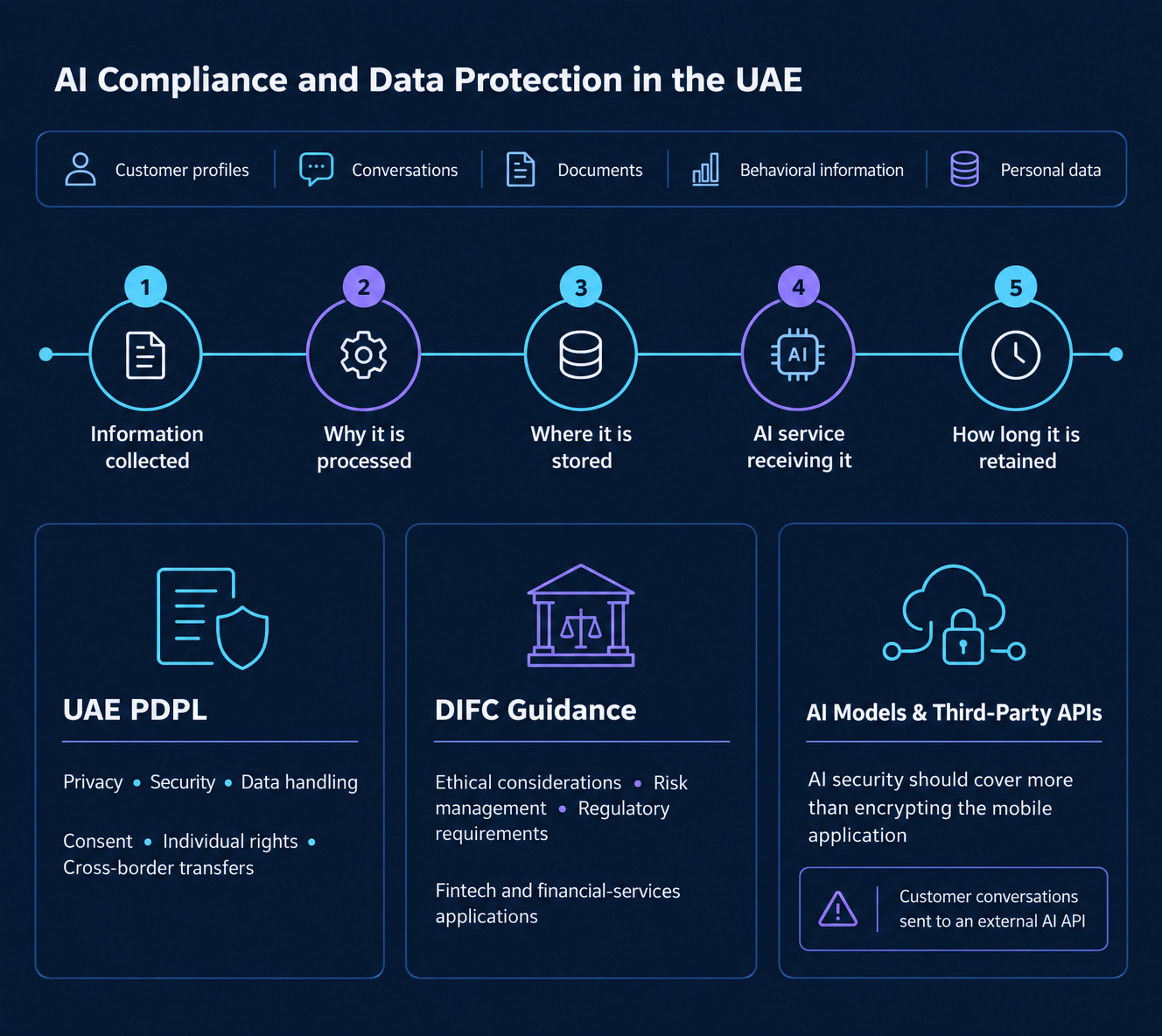
AI creates additional data and governance considerations because models may process customer profiles, conversations, documents, behavioral information and other personal data.
How UAE PDPL Applies to AI Features
The UAE Personal Data Protection Law provides a framework governing personal-data processing and establishes obligations around privacy, security and data handling. It also addresses consent, individual rights and cross-border transfers.
For an AI-powered application, this means developers should understand what information is collected, why it is processed, where it is stored, which AI service receives it, and how long it is retained.
For example, sending customer conversations to an external AI API without evaluating the data-processing arrangement can create risks that would not exist in a basic application.
DIFC Guidance on AI and Data Processing
Businesses operating within the DIFC ecosystem should also consider the applicable DIFC data-protection framework and AI governance expectations.
DIFC Academy has specifically addressed AI governance and the regulatory implications of AI technologies, including ethical considerations, risk management and regulatory requirements.
This matters particularly for fintech and financial-services applications where sensitive information, regulatory obligations and automated decision-making can intersect.
Securing AI Models and Third-Party API Data
AI security should cover much more than encrypting the mobile application.
Development teams should consider API authentication, access controls, prompt injection, sensitive-data filtering, model-output validation, logging, encryption, rate limiting and vendor risk.
A secure architecture should also prevent users from manipulating prompts to retrieve confidential information from internal systems. Where third-party AI APIs are involved, businesses should understand the provider's data-processing terms and configure systems so that unnecessary personal information is never transmitted.
AI-Agent Readiness for Dubai Businesses
The next stage after AI-powered features is the emergence of applications designed to interact with AI assistants and autonomous agents.
What AI-Agent Readiness Actually Means
AI-agent readiness means structuring an application so external or internal AI agents can understand its capabilities and safely perform approved actions.
Instead of simply displaying a hotel booking screen, for example, an agent-ready platform could expose structured availability, pricing, booking rules and confirmation workflows that an AI assistant can interpret.
The application therefore becomes part of an ecosystem of machine-to-machine interactions rather than remaining a closed interface designed only for human navigation.
Preparing Your App for AI Assistants and Agents
Businesses should start by clearly defining application actions, permissions and business rules.
An AI agent might be allowed to search inventory but not approve refunds. It might create a booking request but require human confirmation before payment. It might retrieve customer information only after authentication.
These boundaries should be engineered into APIs and backend services rather than relying on an AI model to behave correctly every time.
Structuring Data for AI-Native Discovery
AI systems perform better when business information is structured, consistent and accessible through well-defined interfaces.
Product catalogs, property listings, service descriptions, pricing, availability, customer policies and transaction states should have clear schemas and identifiers.
Businesses that clean and structure their data now will be in a stronger position when customers increasingly discover and purchase services through AI assistants rather than traditional app searches.
What AI Features Actually Cost to Build
AI development costs vary substantially based on the model, data requirements, infrastructure, integrations, security requirements and level of customization.
Budgeting for Personalization and Predictive Analytics
A basic recommendation or predictive model can be relatively affordable when the business already has clean historical data.
The cost increases when data is fragmented across multiple systems, real-time processing is required, custom machine-learning models are needed, or the application requires sophisticated experimentation and monitoring.
For a Dubai business, an indicative budget for a focused AI personalization or predictive analytics module may start around AED 30,000–80,000, while enterprise-grade systems can move substantially beyond that range.
Budgeting for Chatbots and Generative AI
A basic AI chatbot using an external LLM API may require considerably less engineering than a custom enterprise conversational system.
Costs increase when the chatbot needs multilingual support, private company knowledge, retrieval-augmented generation, voice capabilities, CRM integration, secure authentication, human escalation and extensive monitoring.
A practical development range for a production-grade generative AI feature can therefore begin around AED 40,000–120,000+, depending on scope and integrations.
Is AI Worth the Investment for Your App Tier?
AI should be selected according to business economics rather than technology enthusiasm.
|
App Tier
|
Suitable AI Investment
|
Typical Focus
|
|
Startup / MVP
|
Low to moderate
|
AI API integration, basic recommendations or support chatbot
|
|
Growth Application
|
Moderate
|
Personalization, predictive analytics, advanced search and automation
|
|
Enterprise Platform
|
High
|
Custom models, AI governance, real-time intelligence, agents and integrations
|
The right question is not "How much AI can we add?" but "Which AI capability can generate or protect the most business value?"
Common AI Implementation Mistakes to Avoid
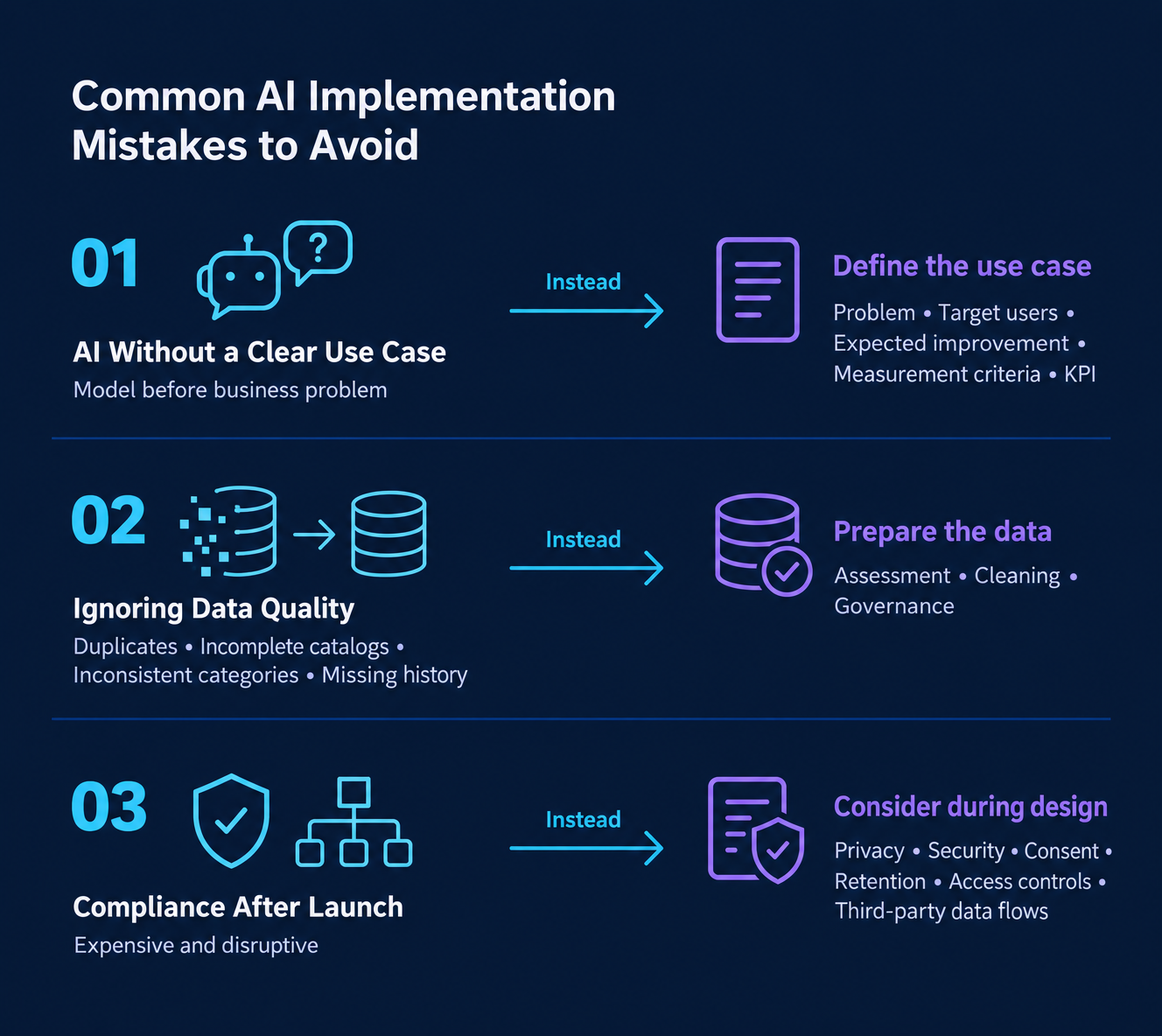
AI projects frequently fail because organizations focus on the model before defining the business problem.
Adding AI Without a Clear Use Case
A chatbot added to an application that already has excellent search and customer support may create little value.
Before development begins, define the specific problem, target users, expected improvement and measurement criteria. If the feature cannot be connected to a meaningful KPI, its business justification should be questioned.
Ignoring Data Quality and Model Training Needs
AI cannot compensate indefinitely for poor data.
Duplicate customer records, incomplete product catalogs, inconsistent categories and missing transaction history can produce unreliable recommendations and predictions.
A successful AI project therefore begins with data assessment, cleaning and governance rather than immediately selecting a model.
Overlooking Compliance Until After Launch
Retrofitting privacy controls after an AI system is already processing customer information can be expensive and disruptive.
Privacy, security, consent, retention, access controls and third-party data flows should be considered during architecture and product design. The UAE's data-protection framework makes this particularly important for applications handling personal information.
Choosing the Right Partner to Build AI Features
AI implementation requires more than a development team that knows how to connect an API. The partner should understand mobile engineering, backend architecture, data pipelines, security, AI models, user experience and business objectives.
What to Look for in AI Development Experience
Look for a technology partner that can demonstrate experience across mobile applications, AI/ML, cloud infrastructure, APIs, data engineering and enterprise integrations.
TechQware positions itself across mobile app development, artificial intelligence, cloud computing, business intelligence, digital transformation and related technologies, allowing AI capabilities to be considered as part of the complete product architecture rather than as an isolated add-on.
The partner should also be comfortable discussing limitations. A credible AI development team will tell you where AI is appropriate, where deterministic rules are safer, and where human approval should remain in the workflow.
Questions to Ask Before Starting an AI Feature Build
Before approving an AI development project, ask how the proposed feature will be measured, what data it requires, whether a third-party model will be used, how sensitive information will be protected, how model accuracy will be monitored, and what happens when the AI produces an incorrect result.
You should also ask whether the architecture can scale beyond the first AI feature. A good implementation should create reusable foundations for future personalization, predictive analytics, conversational AI and agent-based functionality.
Final Thoughts: Building AI That Actually Adds Value
Dubai's AI opportunity is not about putting artificial intelligence into every screen. It is about identifying the moments where intelligence can remove friction, improve decisions, personalize interactions or reduce operational effort.
The strongest applications will combine AI with excellent UX, reliable data, secure architecture and measurable business objectives. Personalization can make a marketplace more relevant. Predictive analytics can improve inventory and logistics. Conversational AI can reduce customer effort. Generative AI can accelerate content workflows. Agent-ready architecture can prepare businesses for the next evolution of digital discovery.
The UAE's continued investment in AI, combined with growing user familiarity and increasingly sophisticated digital expectations, makes 2026 an important time for businesses to evaluate where intelligent capabilities genuinely belong in their mobile products.
For businesses that approach AI strategically, the result should not simply be an app that sounds intelligent. It should be an application that understands users better, operates smarter and produces measurable business value.
FAQs
What AI features are worth investing in for a Dubai app in 2026?
The highest-value features depend on the business model, but personalization, predictive analytics, conversational support, intelligent search and workflow automation are strong starting points. A retailer may benefit most from recommendations and demand forecasting, while a real-estate marketplace may prioritize conversational property discovery and lead qualification. The feature should always be selected according to customer behavior and measurable commercial objectives rather than AI popularity.
Is AI compliance different from standard PDPL compliance?
AI does not automatically create a separate replacement for PDPL compliance, but it can introduce additional risks because AI systems may process large volumes of personal data, generate inferences about individuals, use third-party models and make automated recommendations or decisions. Businesses should therefore evaluate both their underlying data-processing obligations and the additional governance requirements created by the particular AI architecture.
Do AI chatbots need to support Arabic by default?
Not every application needs Arabic on day one, but businesses serving Arabic-speaking audiences in Dubai should seriously evaluate Arabic support during product planning. The requirement becomes stronger for government-facing, regional, customer-service and high-volume consumer applications where language accessibility directly affects adoption and satisfaction. Arabic should be treated as a product and NLP design consideration rather than simply a translation layer.
How much do AI features typically add to development cost?
There is no universal AI surcharge because costs depend on the feature, data, model, integrations and infrastructure. A focused personalization or predictive module may fall within an indicative AED 30,000–80,000 range, while production-grade generative AI features can begin around AED 40,000–120,000+. Enterprise AI platforms with custom models, real-time data, governance and complex integrations can require substantially larger budgets.
What is AI-agent readiness and why does it matter?
AI-agent readiness means designing your application's data, APIs, permissions and workflows so authorized AI systems can discover information and perform defined actions safely. As users increasingly rely on AI assistants to search, compare and complete tasks, agent-ready businesses can potentially make their products accessible through new digital interaction channels instead of relying entirely on traditional app navigation.
Can small businesses in Dubai afford AI-powered features?
Yes, particularly when AI is introduced incrementally. A small business does not need to build a proprietary large language model. It can begin with a focused recommendation engine, AI support assistant, intelligent search function or automated content workflow using established AI services. The smarter approach is to identify one high-value workflow, measure its impact, and expand the AI layer when the business case is proven.
Abhinav Srivastav
With years of experience in driving digital transformation, Abhinav Srivastav is the CEO & Director of TechQware Technologies, helping businesses build innovative mobile apps, AI-powered applications, and scalable digital solutions.

 TechQware