Key Takeaways:
- WebMCP lets websites talk directly to AI agents, not just humans.
- It's MCP, but for the browser.
- Agents can do things on your site — search, book, buy — not just read it.
- It's different from SEO: SEO ranks you, WebMCP makes you usable by AI.
- Getting ready now = early advantage as agent traffic grows.
For thirty years, every decision about how to build a website assumed the visitor was a human with eyes, a mouse, and a bit of patience for a clunky checkout form. That assumption is starting to crack. A growing share of "visitors" arriving at websites in 2026 aren't people at all, they're AI agents, browsing on someone's behalf, trying to book a flight, compare prices, or fill out a form without a human ever touching the keyboard.
That shift is the entire reason WebMCP exists. This guide walks through what it is, why it matters, and what businesses actually need to do about it.
Rise of AI-Driven Search and AI Agents
The way people find information has quietly changed shape. Instead of typing a query into a search box and clicking through ten blue links, more and more people are simply asking an AI assistant the question directly and increasingly, asking that assistant to go finish the task for them. Agentic browsers and AI assistants that can click, scroll, and fill out forms on a user's behalf have moved from novelty to daily habit for a meaningful slice of internet traffic.
Why Traditional Websites Are Not Enough
Websites have always been built for human perception, visual layout, color, hierarchy, a "click here" button that a person can see and understand instantly. An AI agent can't see a button the way a human does. Historically, it's had to take a screenshot, guess what each element does based on its appearance and surrounding text, and hope its guess about which field to fill in was correct. That approach is slow, expensive in computing terms, and breaks the moment a website redesigns its layout. Traditional websites, in other words, were never built to be operated by a non-human visitor and it shows.
Growth of AI Search and LLM-Based Discovery
Large language models have become a genuine discovery channel in their own right. People ask ChatGPT, Gemini, or Claude to recommend a product, compare vendors, or summarize a company's offering and the model's answer is shaped by whatever it can reliably read and trust from a business's website. Being invisible or unreadable to these systems increasingly means being left out of the conversation entirely, regardless of how well a site ranks in classic search.
What is WebMCP?
Definition of WebMCP
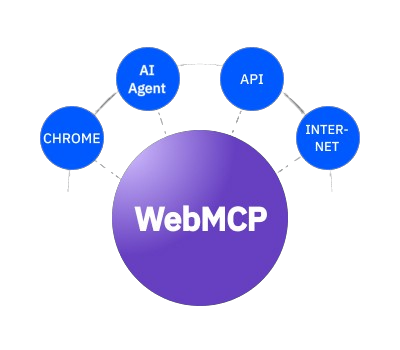
WebMCP, short for Web Model Context Protocol, is a browser-level standard that lets a website expose its own features to AI agents as structured, callable tools rather than forcing the agent to guess its way around the interface. Instead of an agent taking a screenshot and trying to figure out where the "Submit" button is, the website hands the agent a clear, machine-readable description of what it can do: book a flight, search a catalog, submit a form along with exactly what information each action needs and what it returns.
The project was first proposed in early 2025 by engineers exploring the idea independently at Google, Microsoft, and elsewhere, and those efforts converged into a single specification under the W3C Web Machine Learning Community Group. It was formally announced in February 2026 and has since moved through Chrome's developer preview and into a public origin trial, meaning real websites can test it on live traffic rather than only behind a developer flag. It's an open, model-agnostic standard designed to work with any AI agent, regardless of which company built it.
Relationship Between MCP and WebMCP
It helps to think of these as siblings rather than competitors. The Model Context Protocol (MCP), created by Anthropic, lets an AI agent connect to backend tools, databases, and services that live on a server, reachable from anywhere. WebMCP brings that same spirit of "structured tools instead of guesswork" into the browser itself; the website becomes its own lightweight MCP server, with tools defined and run right inside the page a user already has open, with no separate backend deployment required.
In practice, the two are complementary layers of the same stack: MCP handles agent-to-backend connections, while WebMCP handles agent-to-website interaction on a page that's open and visible to a user. Most businesses will end up using both.
Why WebMCP Matters for Businesses
The practical case for WebMCP is about reliability and accuracy. An agent that has to guess its way through a checkout form makes mistakes wrong field, wrong format, an order that silently fails. An agent calling a clearly defined tool with a clearly defined set of inputs essentially can't make that kind of mistake, because the website told it exactly what was expected. For a business, that means fewer failed transactions, faster agent-assisted interactions, and a much better experience for the growing number of customers who are letting an AI assistant handle parts of their shopping, research, or booking.
There's also a competitive angle that echoes a familiar pattern. When mobile browsing took over, the businesses that adopted responsive design early captured a real advantage, while latecomers scrambled to catch up after traffic had already shifted. Many in the industry expect WebMCP adoption to follow a similar arc.
How AI Agents Read and Understand Websites
Semantic Content and Structured Data
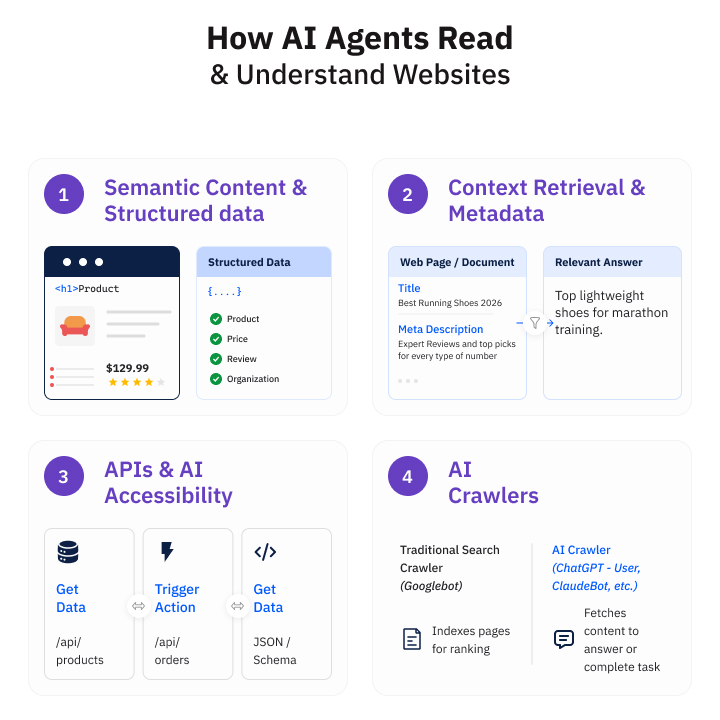
Before an agent can act on a page, it has to understand it and semantic HTML (using the right tags for headings, lists, articles, and navigation, rather than generic, meaningless containers for everything) makes that understanding dramatically more reliable. Structured data, in formats like schema.org markup, goes a step further by explicitly labeling what a piece of content is: a product, a price, a review, an organization instead of leaving the AI to infer it from formatting alone.
Context Retrieval and Metadata
Agents and the language models behind them often rely on retrieving relevant chunks of a page or document rather than reading an entire site top to bottom. Clear metadata accurate titles, descriptions, structured headings, and well-organized content sections makes that retrieval far more accurate, helping an agent pull the right answer instead of a confused, half-relevant one.
APIs and AI Accessibility
A clean API matters just as much for AI accessibility as it does for traditional integrations. Whether through a backend MCP server, a public API, or browser-native WebMCP tools, giving agents a structured way to request data or trigger an action removes the need for them to rely on fragile, interface-based guesswork in the first place.
AI Crawlers vs Traditional Search Crawlers
Traditional search crawlers like Googlebot exist mainly to index pages for ranking. AI crawlers behave differently; many of them are fetching content to ground an answer or complete a task right now, not to file it away for a future ranking calculation. Recent web traffic analysis shows AI bot traffic has grown substantially, with crawlers tied to several different AI assistants now making up a significant share of all bot requests hitting websites. Worth noting too: a meaningful share of AI bot requests are currently being blocked outright by sites with restrictive access rules, a strategic choice businesses need to make deliberately, not by accident.
Why Businesses Need AI-Agent Friendly Websites
AI Search Visibility
If an AI assistant can't cleanly parse a site's pricing, features, or core content, that business effectively disappears from a growing number of buyer journeys even if its traditional search rankings look perfectly healthy. Visibility in classic search and visibility to AI agents are increasingly two separate jobs, and a business now has to win both.
LLM Discoverability
Beyond live browsing, large language models also draw on whatever content they can access and trust when forming an answer about a company, product, or topic. Clear, well-structured, fact-dense content improves the odds that an LLM accurately represents a business when someone asks about it rather than relying on outdated or third-party information instead.
Autonomous AI Interactions
As agentic browsing matures, agents won't just read about a business they'll act on it: filling out a quote request, comparing pricing tiers, completing a purchase. Websites that expose those actions in a structured way let agents complete the task correctly the first time, instead of failing partway through and abandoning the interaction.
Future of AI-Native Web Experiences
The longer-term trajectory points toward websites that serve two audiences simultaneously and well humans browsing visually, and agents calling structured tools without compromising the experience for either one. Businesses that start building this duality now will be in a far stronger position than those treating it as someone else's problem.
Core Components of a WebMCP-Ready Website
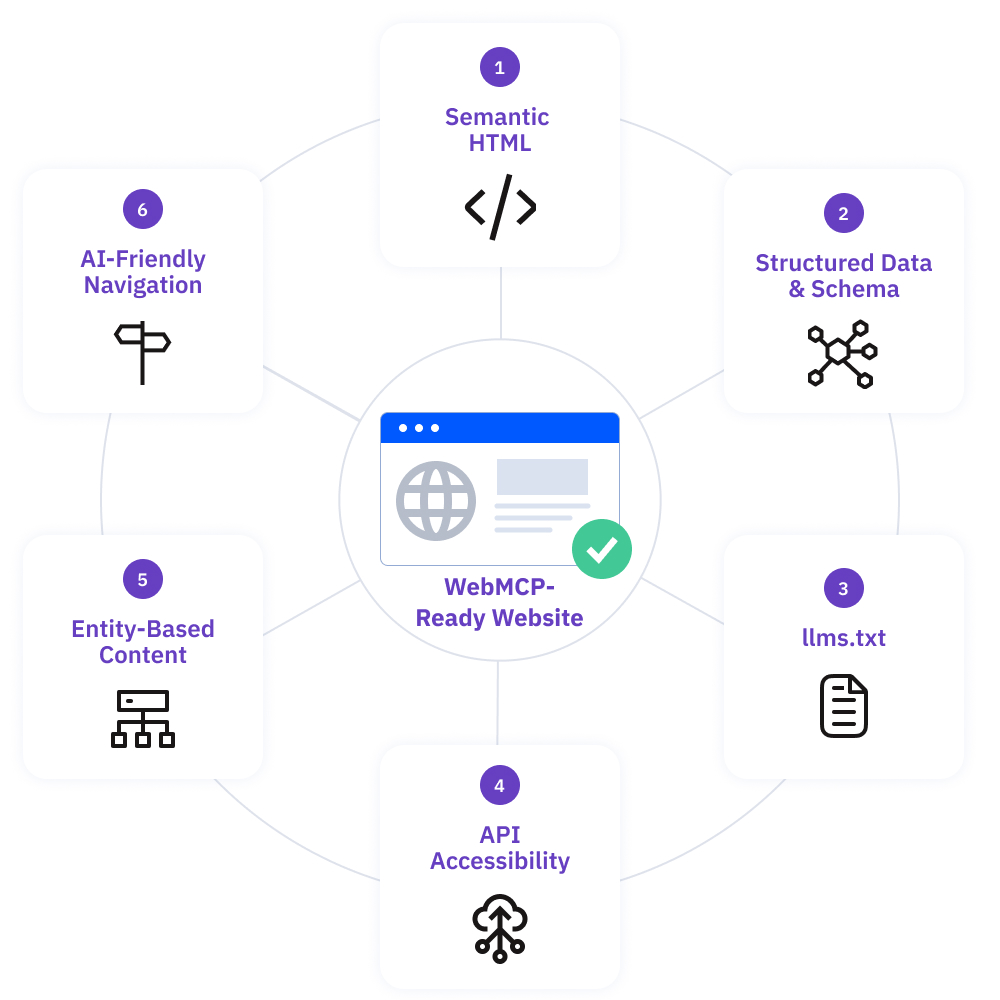
Semantic HTML
Using proper HTML elements, real headings, real lists, real <form> and <button> elements instead of generic styled divs gives both browsers and AI agents a reliable structural map of a page. It's the foundation everything else in this section builds on.
Structured Data and Schema Markup
Schema.org markup explicitly labels entities on a page products, prices, organizations, FAQs, reviews in a format machines can parse with confidence. This remains one of the highest-leverage, lowest-effort steps a business can take toward AI readiness.
llms.txt
A llms.txt file is a simple, plain-text file placed at a website's root that gives AI systems a clean, curated summary of a site's key content and structure a more deliberate alternative to forcing an AI to guess at what matters most on a sprawling site.
API Accessibility
Whether through a public API or browser-native WebMCP tools, exposing core actions and data in a structured, callable way is what actually lets an agent act on a site rather than merely read it.
Entity-Based Content Structure
Organizing content around clear entities, a specific product, a specific person, a specific service rather than vague, blended pages helps AI systems correctly identify what a page is actually about and represent it accurately when summarizing or citing it.
AI-Friendly Navigation
A clean, logical, consistently structured navigation and URL hierarchy helps an agent understand how a site's content relates and where to find what it needs, without having to infer structure from a confusing, ad hoc layout.
Role of llms.txt in AI Discoverability
What is llms.txt?
llms.txt is a proposed convention a plain Markdown file hosted at a website's root, similar in spirit to robots.txt that gives AI systems a concise, curated map of a site's most important pages and information. Rather than leaving an AI to crawl an entire site and guess at priorities, llms.txt lets a business say, directly and clearly, "here's what matters, and here's where to find it."
Benefits of llms.txt for Businesses
A well-maintained llms.txt file reduces the chance that an AI system misrepresents a business by relying on outdated, third-party, or incomplete information instead. It's a low-cost, high-clarity way to put a business's own framing of itself directly in front of the systems shaping how it gets discovered and described.
How llms.txt Improves AI Visibility
By pointing AI systems toward authoritative, current, well-organized content instead of leaving them to forage through an entire site, llms.txt increases the odds that an AI's summary, recommendation, or citation involving a business is accurate, current, and reflects the framing the business actually wants. It's best treated as one useful signal among several, not a guaranteed lever, since major AI labs haven't uniformly committed to honoring it.
WebMCP vs Traditional SEO
SEO vs GEO (Generative Engine Optimization)
Traditional SEO optimizes for ranking in a list of search results that a human will scan and click. Generative Engine Optimization (GEO) optimizes for being accurately understood, summarized, and cited by an AI system that's synthesizing an answer rather than just listing links. The two overlap clean structure and clear writing help both but GEO cares less about position on a page and more about whether the underlying facts about a business are clear enough for a model to represent correctly.
Search Crawlers vs AI Agents
A search crawler is building an index for later ranking; it doesn't act on what it finds. An AI agent, especially one supported by WebMCP, is often trying to complete a task right now, in real time, on behalf of a specific user. That difference in intent is exactly why structured, callable tools matter for agents in a way they never mattered for traditional crawlers.
Content Optimization for AI Systems
Optimizing for AI systems means writing content that states facts plainly and directly, clear pricing, clear specifications, clear answers to common questions rather than burying the substance in marketing language an AI has to work to decode. The clearer and more literal the content, the more accurately it gets represented downstream.
How to Build a WebMCP-Ready Website
Structuring Content for AI Agents
Start with the fundamentals: real semantic HTML, schema markup on key entities, and a llms.txt file pointing to a site's most important content. This groundwork pays off regardless of how quickly WebMCP itself gets adopted, because it improves clarity for every kind of AI system, not just browser agents.
Using APIs and Structured Context
For sites with existing, clean HTML forms a contact form, a search bar, a booking flow WebMCP's declarative approach allows developers to add a small number of specific attributes directly to those forms, letting the browser automatically derive a structured tool definition from fields that already exist. For more complex, multi-step interactions, WebMCP's imperative API lets developers register custom tools directly in JavaScript, with full control over what's exposed and how it behaves.
Optimizing Website Architecture
A WebMCP-ready architecture treats agent-facing tools as a layer added on top of an existing site, not a rebuild from scratch. The human-facing experience stays exactly the same; the structured tool layer simply runs alongside it, registered and unregistered dynamically based on what's actually relevant in the page's current state a checkout tool only appearing once items are in a cart, for instance.
AI-Readable UX and Navigation
Beyond the technical implementation, the overall user experience benefits from consistency: predictable page structures, consistent labeling, and forms that ask for information in a clear, unambiguous way. What makes a page easier for an agent to navigate correctly tends to make it easier for a human to navigate correctly too.
Industries That Will Benefit Most from WebMCP
SaaS
SaaS products with complex, multi-step configuration flows stand to benefit enormously from exposing those flows as structured tools letting an agent help a prospective customer set up a trial or compare plans without fumbling through a dense settings page.
Healthcare
Healthcare providers can use structured, agent-accessible tools for tasks like appointment scheduling and insurance verification, while keeping a human firmly in the loop for anything involving sensitive medical decisions, a balance that aligns well with WebMCP's human-in-the-loop design principles.
eCommerce
Few use cases map more naturally onto WebMCP than online shopping: structured product search, cart management, and checkout tools let an agent help a customer find and buy the right item quickly and accurately, without misreading a product page or fumbling a size selector.
Finance
Financial services can expose carefully scoped, well-guarded tools checking an account balance, starting an application while keeping the most sensitive actions behind strict confirmation steps, in line with the permission-first security model WebMCP is built around.
Enterprise Software
Enterprise platforms with dense, feature-heavy interfaces are a natural fit, since structured tools can let an agent complete a specific task generating a report, updating a record without needing to learn an entire complex UI from scratch.
Common Mistakes Businesses Should Avoid
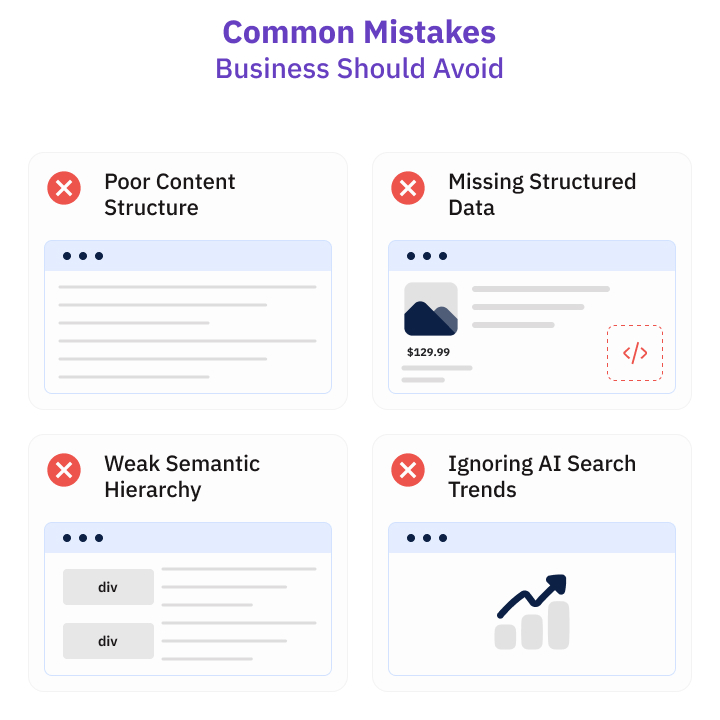
Poor Content Structure
Walls of unstructured text, vague headings, and inconsistent formatting make it harder for any AI system agent or otherwise to figure out what a page is actually saying, leading to inaccurate summaries or failed interactions.
Missing Structured Data
Skipping schema markup leaves AI systems to infer what a price, a product, or an organization is from context alone, a guessing game that frequently gets it wrong, especially on complex pages.
Weak Semantic Hierarchy
Generic, meaningless HTML containers used everywhere instead of proper headings, lists, and sections strip away the structural signals that both AI agents and accessibility tools depend on to understand a page correctly.
Ignoring AI Search Trends
Treating AI-driven discovery as a passing trend, rather than a real and growing share of how people find and evaluate businesses, risks a slow but very real loss of visibility one that's much harder to claw back once competitors have already adapted.
Future of AI-Agent Friendly Websites
AI-Driven Browsing
Agentic browsing, an AI assistant clicking, scrolling, and filling forms on a user's behalf has already moved from prototype to real product in 2026, and it's expected to keep expanding as agent reliability improves and more sites become structured enough for agents to navigate confidently.
Autonomous AI Transactions
As trust and security models mature, expect agents to handle increasingly complete transactions on a user's behalf, not just researching options, but completing a purchase or booking outright, within clearly defined permission boundaries set by the user.
Conversational Web Interfaces
Rather than clicking through a traditional interface, more interactions may shift toward a conversational layer where a user simply states a goal and an agent talking to a site's WebMCP tools behind the scenes handles the mechanics of completing it.
AI-Native Digital Ecosystems
A complementary stack of protocols is emerging together MCP for agent-to-backend connections, agent-to-agent coordination standards for cross-vendor collaboration, and WebMCP for agent-to-website interaction in the browser forming a coherent, if still-evolving, foundation for how AI systems will actually get things done across the web.
Final Thoughts
WebMCP is still early. As of 2026, it's moving through browser origin trials rather than sitting in every production website, and the specification itself is still evolving. But the direction is unmistakable: the web is gaining a second class of visitor, and the businesses that start treating AI agents as a real audience with clean structure, clear data, and thoughtfully exposed tools will be the ones standing comfortably when "agent-ready" stops being optional and starts being assumed.
The smart move isn't to panic-build a WebMCP integration overnight. It's to get the fundamentals right now semantic structure, clean data, a clear llms.txt and treat structured, agent-facing tools as the natural next layer to add as the standard matures.
The future web won't be built just for people it will be built for AI agents too. At TechQware, we help businesses stay ahead with AI-ready websites, intelligent integrations, and future-proof digital experiences. Ready to prepare your website for the next generation of search and automation? Get in touch with TechQware today.
FAQs
What is WebMCP?
WebMCP, the Web Model Context Protocol, is a browser-level standard that lets a website expose its own features to AI agents as structured, callable tools telling an agent exactly what actions are available and what information each one needs, instead of leaving the agent to guess by reading the page visually.
Why do websites need to be AI-agent friendly?
A growing share of web traffic and buyer research now happens through AI agents and assistants rather than direct human browsing. A site that's confusing or inaccessible to agents risks being skipped over or misrepresented, even if it performs well in traditional search.
How does WebMCP work?
A website registers a set of tools through simple HTML attributes on existing forms, or through JavaScript for more complex interactions describing what each tool does and what inputs and outputs it expects. An AI agent visiting the page can then call those tools directly, much like calling a function, instead of reverse-engineering the interface.
What is the difference between SEO and WebMCP?
SEO is about being found ranking well so humans (and the crawlers indexing for them) can discover a site. WebMCP is about being usable once an agent has already arrived letting that agent actually complete a task on the page rather than just read it.
What role does llms.txt play in WebMCP?
llms.txt is a separate, complementary convention, a plain-text file that gives AI systems a curated summary of a site's key content. It supports discoverability and accurate representation, while WebMCP specifically governs structured, interactive actions a website exposes to agents.
Can existing websites become WebMCP-ready?
Yes, WebMCP is designed as a layer added on top of an existing site rather than a rebuild. Sites with clean, well-structured HTML forms are often most of the way there already, needing only a handful of additional attributes to make those forms agent-callable.
Which industries benefit most from WebMCP?
eCommerce, SaaS, healthcare, finance, and enterprise software all stand to benefit significantly, since each involves structured, repeatable actions booking, searching, configuring, transacting that map naturally onto WebMCP's tool-based model.
Is WebMCP the future of AI search?
WebMCP is best understood as one important piece of a larger shift, not the entire picture. It's still an early-stage, evolving standard currently moving through browser trials rather than universal adoption but it's backed by major industry players and points toward a future where websites are built for both human visitors and AI agents from the ground up.
Abhinav Srivastav
With years of experience in driving digital transformation, Abhinav Srivastav is the CEO & Director of TechQware Technologies, helping businesses build innovative mobile apps, AI-powered applications, and scalable digital solutions.

 TechQware