Key Takeaways:
- AI search is changing how users discover businesses online.
- AI agents rely on context and intent, not just keywords, to understand content.
- Structured data, schema markup, and APIs improve AI visibility and discoverability.
- 70%+ of enterprises are adopting or exploring AI, accelerating AI-driven search.
- GEO (Generative Engine Optimization) is emerging as the next evolution of SEO.
- AI-friendly websites gain better visibility, recommendations, and long-term growth opportunities.
Introduction
The internet is undergoing one of its biggest transformations since the rise of mobile devices and search engines. For more than two decades, businesses optimized their websites primarily for human visitors and traditional search engine crawlers. Success depended on ranking higher on Google, improving page speed, creating engaging content, and ensuring mobile responsiveness. While these factors remain important, a new digital shift is emerging that is changing how information is discovered, consumed, and acted upon online.
Artificial Intelligence agents are rapidly becoming active participants in the web ecosystem. Rather than simply displaying links, modern AI systems can understand user intent, retrieve information, summarize content, compare products, complete tasks, and even interact with websites autonomously. This evolution is creating a new requirement for businesses: websites must now be understandable not only by humans and search engines but also by AI agents.
Companies that adapt early will gain significant visibility in AI-powered search experiences, conversational interfaces, virtual assistants, and agent-driven ecosystems. Organizations that fail to prepare may find themselves increasingly invisible in the environments where future users discover products and services.
AI-powered search has evolved from a futuristic concept into a mainstream reality. Platforms such as AI assistants, generative search engines, and intelligent virtual agents are changing how people find information online. Instead of typing fragmented keywords and browsing multiple pages of results, users increasingly ask complete questions and expect direct, contextual answers.
Modern AI agents can understand nuanced queries such as:
"What is the best project management software for a healthcare startup with less than 100 employees?"
Rather than returning a list of links, AI systems analyze multiple sources, evaluate relevance, and provide a concise recommendation. This creates a significant opportunity for businesses whose content can be accurately interpreted and referenced by AI systems.
According to multiple industry reports, AI-assisted search usage has experienced exponential growth since 2023, with millions of users relying on conversational search experiences daily. As enterprise AI adoption accelerates, organizations are investing heavily in AI-powered customer support, digital assistants, and autonomous agents capable of interacting directly with websites and applications.
How Website Discovery Is Changing
Traditional search focused primarily on keywords, backlinks, and indexing signals. AI-driven discovery operates differently. Instead of merely matching keywords, AI agents evaluate context, relationships between concepts, structured information, and semantic meaning.
For example, a traditional search engine might rank a webpage based on keyword density and domain authority. An AI agent, however, attempts to understand the actual topic, the expertise demonstrated, supporting evidence, and how the content relates to a user's specific question.
This means businesses can no longer rely solely on conventional SEO tactics. Website architecture, content structure, metadata, entity relationships, APIs, and contextual accessibility are becoming equally important.
AI Search Statistics and Trends
Recent industry research highlights the growing influence of AI-driven search and content discovery:
|
AI Search Trend
|
Industry Insight
|
|
Generative AI adoption
|
Over 70% of enterprises are exploring or implementing AI initiatives
|
|
Conversational search growth
|
Millions of users now rely on AI assistants daily
|
|
AI-powered customer interactions
|
Expected to handle a majority of digital customer inquiries in coming years
|
|
Semantic search importance
|
Search engines increasingly prioritize context over keywords
|
|
AI agent usage
|
Autonomous AI agents are becoming a core focus for enterprise digital transformation
|
These trends indicate that businesses must prepare their digital assets for AI consumption rather than solely human browsing.
What is an AI Agent-Friendly Website?
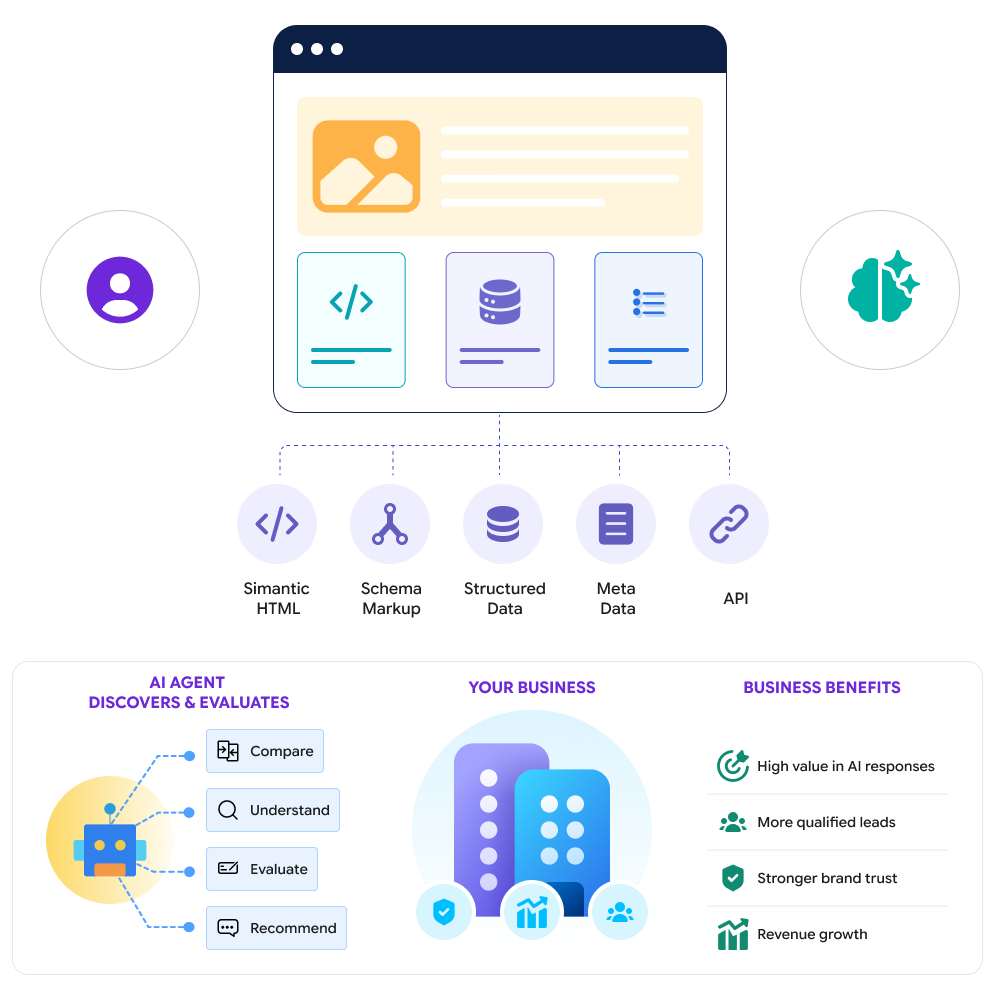
An AI agent-friendly website is specifically designed to enable artificial intelligence systems to understand, interpret, navigate, retrieve, and utilize information efficiently. Such websites provide structured context, semantic clarity, machine-readable content, and accessible data pathways that allow AI agents to perform tasks effectively.
Unlike traditional websites that primarily focus on visual presentation, AI-friendly websites prioritize information architecture, contextual meaning, and machine comprehension.
Definition of AI-Friendly Websites
An AI-friendly website is a digital platform optimized for machine understanding. It incorporates semantic HTML, structured data, metadata, APIs, entity relationships, and AI-accessible content structures that enable AI systems to accurately interpret information.
The objective is not merely to improve rankings but to ensure AI systems can confidently retrieve and represent business information when responding to user queries.
AI-Readable vs Traditional Websites
Traditional websites are built mainly for human consumption. Their design often emphasizes visual aesthetics, animations, and user engagement. While these elements are important, they may not provide sufficient context for AI systems.
AI-readable websites focus on clarity, structured information, and contextual relationships. They help AI models identify products, services, organizations, locations, FAQs, reviews, and expertise areas without ambiguity.
A website that looks visually appealing but lacks semantic structure may confuse AI agents. Conversely, a well-structured AI-friendly website enables intelligent systems to extract and present information accurately.
Why Businesses Need AI-Optimized Websites
Businesses are entering an era where customers increasingly discover brands through AI-generated recommendations rather than traditional search results.
Imagine a manufacturing company searching for an AI development partner. Instead of reviewing ten websites manually, the decision-maker asks an AI assistant for recommendations. The assistant analyzes multiple sources and provides three companies that appear most relevant.
If your website is not optimized for AI interpretation, your business may never appear in that recommendation set, regardless of the quality of your services.
How AI Agents Interact With Websites
Understanding how AI agents access and process information is critical for building future-ready websites.
Semantic Understanding
AI systems rely heavily on semantic understanding. Rather than matching isolated keywords, they evaluate concepts, intent, relationships, and meaning.
For example, AI can recognize that "mobile application development," "app development services," and "custom mobile solutions" may represent related concepts. Semantic optimization helps AI establish these relationships more effectively.
Structured Data and Metadata
Structured data provides explicit information about website content. Using schema markup, businesses can define products, services, organizations, reviews, FAQs, events, and other entities.
Metadata acts as contextual guidance for AI systems. Proper implementation helps AI agents understand what information exists and how it should be interpreted.
APIs and Context Retrieval
Many modern AI agents interact with APIs to retrieve real-time information. APIs provide structured access to data that AI systems can consume efficiently.
For example, a travel booking platform may expose flight availability, pricing, and schedules through APIs. AI assistants can retrieve this information instantly and provide accurate responses.
Conversational Search and AI Navigation
AI agents increasingly navigate websites through conversational interactions. Instead of manually clicking menus, users ask questions, and AI systems locate relevant information.
Businesses that organize content logically and provide contextual relationships make it easier for AI agents to guide users toward desired outcomes.
Core Components of an AI Agent-Friendly Website
Creating an AI-friendly website requires a combination of technical architecture, content strategy, and machine-readable design principles.
Semantic HTML Structure
Semantic HTML provides meaning to webpage elements. Tags such as article, section, header, footer, and main help AI systems understand page hierarchy.
A properly structured webpage enables AI agents to identify primary topics, supporting information, and content relationships more accurately.
Schema Markup and Structured Data
Schema markup acts as a translation layer between websites and AI systems. It provides explicit information about entities and relationships.
Organizations using schema effectively often improve visibility across search engines, AI assistants, and knowledge graphs.
llms.txt Implementation
The llms.txt standard is emerging as a method for communicating directly with large language models. Similar to robots.txt, it provides guidance regarding AI accessibility and content usage.
Businesses adopting llms.txt early may gain greater control over how AI systems access and interpret website content.
AI-Friendly Site Architecture
Website architecture influences how efficiently AI systems navigate content.
A logical hierarchy with clear categories, internal linking, breadcrumbs, and contextual relationships improves machine comprehension while simultaneously enhancing user experience.
API Accessibility
Accessible APIs allow AI agents to retrieve structured information dynamically.
Organizations increasingly expose product catalogs, pricing information, support documentation, and operational data through APIs to facilitate AI integrations.
Entity-Based Content Strategy
Modern AI systems understand information through entities rather than isolated keywords.
For example, an AI development company might establish entities around AI consulting, machine learning, chatbot development, generative AI, automation platforms, and enterprise AI solutions.
This interconnected approach strengthens AI comprehension and discoverability.
AI-Friendly Navigation and UX
AI-friendly navigation ensures information can be accessed efficiently by both humans and machines.
Clear menus, logical pathways, contextual recommendations, and well-organized content reduce ambiguity and improve AI interpretation.
Role of WebMCP in AI-Friendly Websites
The evolution of AI-native websites requires new infrastructure models designed specifically for intelligent agents.
Understanding WebMCP
WebMCP represents an emerging framework focused on enabling AI agents to interact with web resources more effectively. It facilitates structured communication between websites and intelligent systems.
This approach reduces friction in information retrieval and enhances machine understanding.
Context Sharing for AI Agents
One of the biggest challenges for AI systems is maintaining context across interactions.
WebMCP enables richer context sharing, allowing AI agents to access relevant information without repeatedly processing entire websites.
AI-Native Web Infrastructure
Future websites will increasingly incorporate AI-native infrastructure components designed specifically for machine interaction.
Organizations adopting these technologies early will likely gain competitive advantages in AI visibility and accessibility.
Benefits of AI Agent-Friendly Websites
The advantages extend far beyond search rankings.
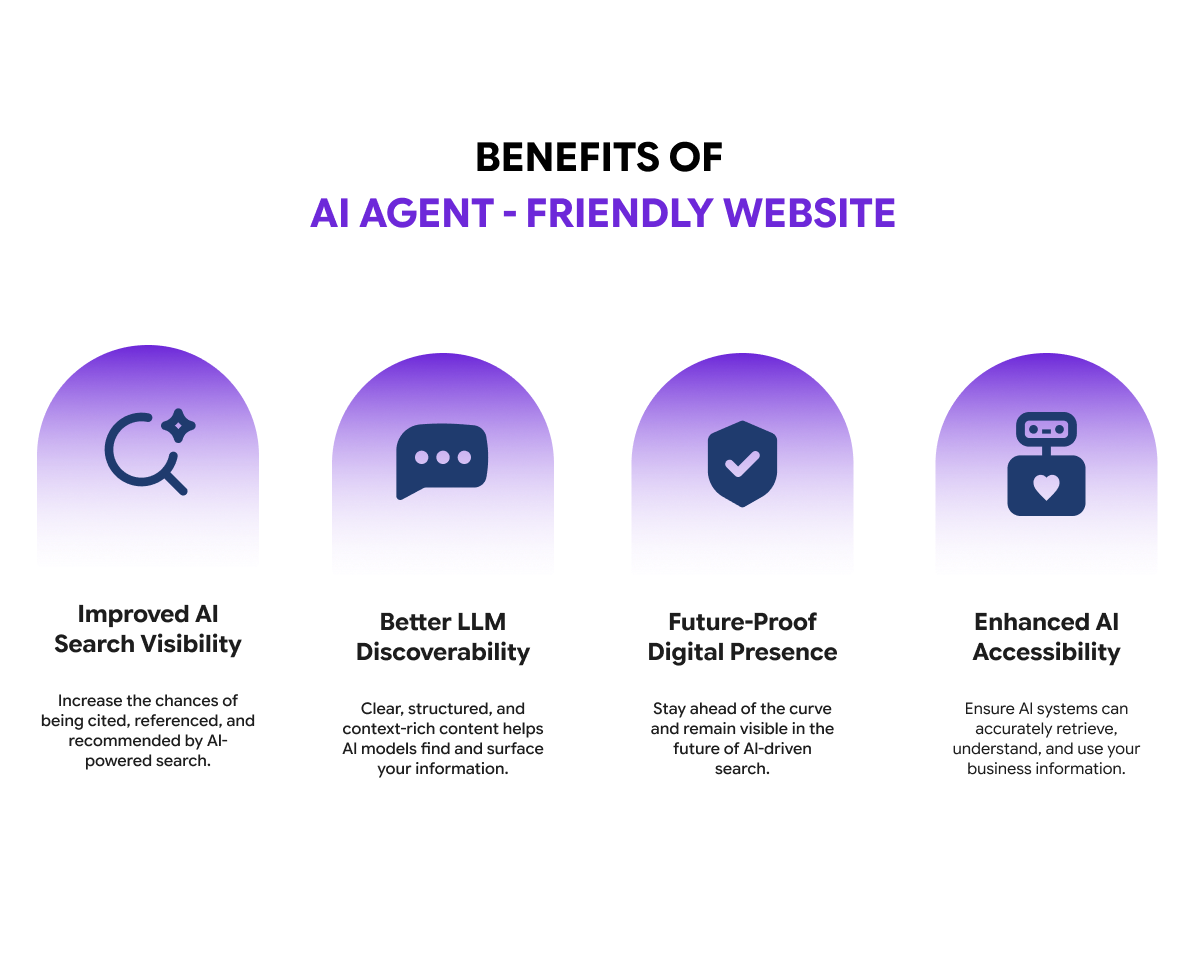
Improved AI Search Visibility
AI-friendly websites increase the likelihood of being cited, referenced, or recommended by AI-powered search systems.
As AI search adoption grows, this visibility can become a major source of traffic and leads.
Better LLM Discoverability
Large Language Models rely on accessible and structured information.
Businesses that provide clear context, entity relationships, and structured content improve their chances of being surfaced during AI-generated responses.
Future-Proof Digital Presence
Technology trends consistently reward early adopters.
Organizations that prepare for AI-driven discovery today position themselves more effectively for future search environments.
Enhanced AI Accessibility
AI accessibility ensures intelligent systems can retrieve, understand, and utilize business information accurately.
This supports customer support automation, conversational commerce, and autonomous digital experiences.
Industries That Will Benefit Most
Although AI-friendly websites provide value across sectors, certain industries stand to gain significantly.
SaaS
Software companies rely heavily on digital discovery. AI-friendly websites improve product visibility, feature comprehension, and comparison capabilities.
Healthcare
Healthcare organizations can provide structured medical information, appointment systems, and patient resources that AI agents can access responsibly.
Fintech
Financial technology platforms benefit from transparent data structures, secure APIs, and AI-accessible product information.
Retail and eCommerce
AI-powered shopping assistants increasingly influence purchasing decisions. Structured product information enhances recommendation accuracy.
Enterprise Technology
Enterprise buyers often conduct extensive research before making decisions. AI-friendly websites increase the likelihood of appearing in AI-generated vendor evaluations.
Common Mistakes Businesses Should Avoid
Many organizations unknowingly create barriers that limit AI accessibility.
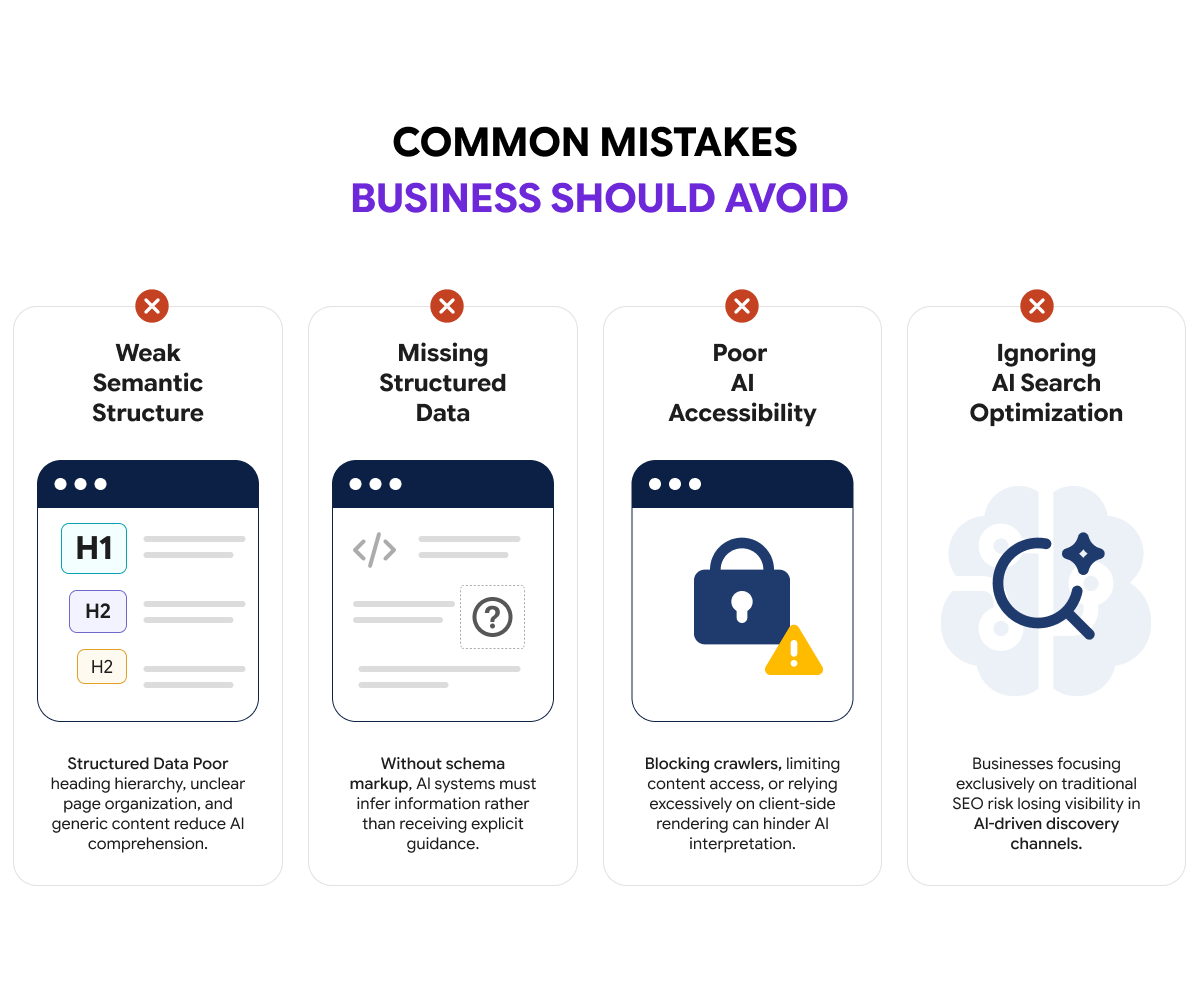
Weak Semantic Structure
Poor heading hierarchy, unclear page organization, and generic content reduce AI comprehension.
Missing Structured Data
Without schema markup, AI systems must infer information rather than receiving explicit guidance.
Poor AI Accessibility
Blocking crawlers, limiting content access, or relying excessively on client-side rendering can hinder AI interpretation.
Ignoring AI Search Optimization
Businesses focusing exclusively on traditional SEO risk losing visibility in AI-driven discovery channels.
How to Build an AI Agent-Friendly Website
Building an AI-ready website requires a strategic approach that combines technology, content, and architecture.
Structuring Content for AI Systems
Content should answer specific questions, establish contextual relationships, and provide comprehensive coverage of topics.
Organizations that create authoritative content clusters often perform better in AI-powered environments.
Optimizing Technical SEO and GEO
Generative Engine Optimization (GEO) extends beyond traditional SEO by focusing on AI discoverability.
This includes semantic optimization, structured data, entity development, and contextual relevance.
Implementing AI-Friendly APIs
APIs provide structured information that AI systems can access efficiently.
Businesses should identify valuable datasets and expose them through secure, scalable interfaces.
Improving Website Context and Navigation
Every page should contribute to a broader contextual framework.
Strong internal linking, topic clusters, and entity relationships improve both human usability and AI comprehension.
Future of AI-Native Websites
The next generation of websites will be designed not just for users but also for autonomous AI systems.
Conversational Web Experiences
Users will increasingly interact through conversations rather than traditional navigation.
Businesses must prepare content and infrastructure for dialogue-based engagement.
Autonomous AI Interactions
AI agents may soon complete research, purchases, bookings, and support tasks independently.
Organizations that support these interactions will gain efficiency and competitive advantages.
AI-Driven Commerce
Shopping experiences are becoming increasingly personalized through AI recommendations, predictive insights, and autonomous purchasing assistance.
Agentic Browsing Ecosystems
The future internet may consist of interconnected ecosystems where AI agents interact directly with digital services on behalf of users.
Companies that establish AI compatibility today will be better positioned to thrive within these ecosystems.
Real-World Case Studies
Case Study 1: Shopify and Structured Commerce Data
Shopify has invested heavily in structured product data and machine-readable commerce frameworks. This allows search engines, AI assistants, and recommendation systems to understand product attributes more accurately. As conversational commerce grows, merchants benefit from increased visibility across AI-driven discovery channels.
Case Study 2: Microsoft Documentation Ecosystem
Microsoft's documentation platforms utilize semantic structures, APIs, knowledge graphs, and structured content. AI systems can retrieve highly contextual information quickly, making Microsoft resources frequently referenced in AI-generated responses.
AI Readiness Checklist for Businesses
|
Website Component
|
AI Readiness Impact
|
|
Semantic HTML
|
High
|
|
Schema Markup
|
High
|
|
Knowledge Graph Integration
|
High
|
|
APIs
|
High
|
|
Entity-Based Content
|
High
|
|
GEO Optimization
|
High
|
|
llms.txt
|
Medium
|
|
AI-Friendly Navigation
|
High
|
|
Content Clustering
|
High
|
|
Metadata Optimization
|
High
|
Final Thoughts
The rise of AI agents represents a fundamental shift in how businesses are discovered online. Traditional SEO remains important, but it is no longer sufficient in a world where AI assistants, generative search engines, and autonomous agents increasingly act as intermediaries between businesses and customers.
Organizations that embrace semantic architecture, structured data, entity-based content strategies, APIs, GEO optimization, and AI-native infrastructure will be better positioned to thrive in this new digital era. An AI agent-friendly website is not simply a technical upgrade it is a strategic investment in future visibility, discoverability, and growth.
At TechQware Technologies, we help businesses prepare for the next generation of the internet by building intelligent, scalable, and AI-ready digital experiences. Whether you are developing a new platform, modernizing an existing website, implementing AI integrations, or optimizing your digital presence for generative search, our experts can help you stay ahead of the curve and unlock new opportunities in the AI-driven future.
Ready to make your website AI-agent friendly? Contact us today and build a future-proof digital presence designed for both humans and intelligent AI systems.
FAQs
What is an AI agent-friendly website?
An AI agent-friendly website is designed to help artificial intelligence systems understand, retrieve, and utilize website information effectively through semantic structure, metadata, APIs, and contextual organization.
Why are AI-friendly websites important?
AI-friendly websites improve discoverability across AI-powered search systems, conversational assistants, and autonomous digital agents, helping businesses remain visible in evolving search environments.
How do AI agents interact with websites?
AI agents analyze structured data, semantic content, metadata, APIs, and contextual relationships to understand information and respond to user requests accurately.
What is GEO (Generative Engine Optimization)?
Generative Engine Optimization is the practice of optimizing digital content for AI-powered search engines and large language models, ensuring information can be effectively discovered and referenced.
What role does llms.txt play?
The llms.txt standard helps communicate content accessibility preferences to AI systems and may influence how large language models interact with website content.
Can existing websites become AI-agent friendly?
Yes. Most existing websites can be upgraded through semantic improvements, structured data implementation, API accessibility, entity optimization, and AI-focused content strategies.
What are the benefits of AI-optimized websites?
Benefits include improved AI search visibility, better discoverability, enhanced digital accessibility, future-proof positioning, and stronger competitive differentiation.
What is the future of AI-native websites?
Future websites will increasingly support conversational experiences, autonomous AI interactions, AI-driven commerce, and agentic browsing ecosystems designed specifically for intelligent digital agents.

 TechQware