Mobile App Development
Why Dubai's Property and Construction Sector Needs Custom Mobile Apps
 TechQware
October 29, 2026
 TechQware
October 29, 2026
Picture a Monday morning on a tower site in Business Bay. The structural engineer is waiting on a drawing approval. The client is asking for a progress update. A broker is chasing three buyers who all want the same unit. Every one of these answers lives in a different WhatsApp group.
Dubai is moving at serious speed more than 270,000 real estate transactions worth AED 917 billion in 2025. This guide shows how custom mobile apps close that gap, which app types are worth building, what to budget, and how to choose a development partner without regrets.
Get a clear direction on what to build, which features matter, and how to launch an MVP without overbuilding.
Discuss Your App Idea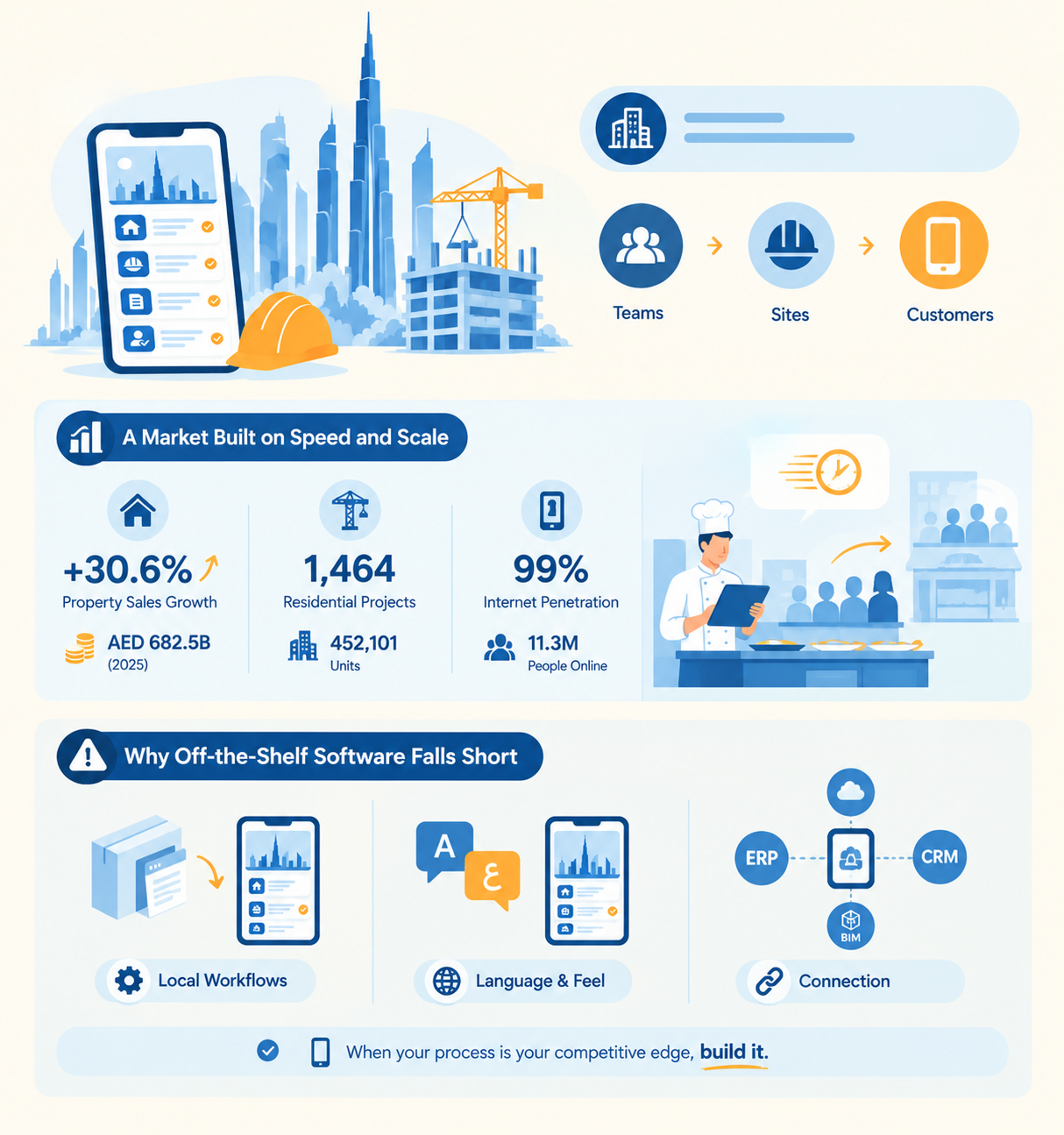
Dubai's property and construction sector is large, fast, and already digital. The firms that pull ahead are the ones whose teams, sites, and customers are connected on mobile, not on paper.
In Dubai, speed is the product. Property sales grew 30.6% to about AED 682.5 billion in 2025. At the end of that year, 1,464 residential projects covering 452,101 units were under construction.
Think of it like a kitchen at peak dinner service. One chef can run it with handwritten tickets, until the restaurant doubles in size. Then the missing system, not the food, becomes the problem.
Your people and customers are already ready for that system. Internet penetration in the UAE is 99%, with 11.3 million people online. Every adult resident also owns a mobile phone. You need to give it something worth opening.
Off-the-shelf software is a ready-made suit: fine for the average body, awkward for yours. Dubai projects are rarely average, and three gaps show up again and again.
Ready-made tools still make sense for simple, low-risk needs. When your process is your competitive edge, build it.
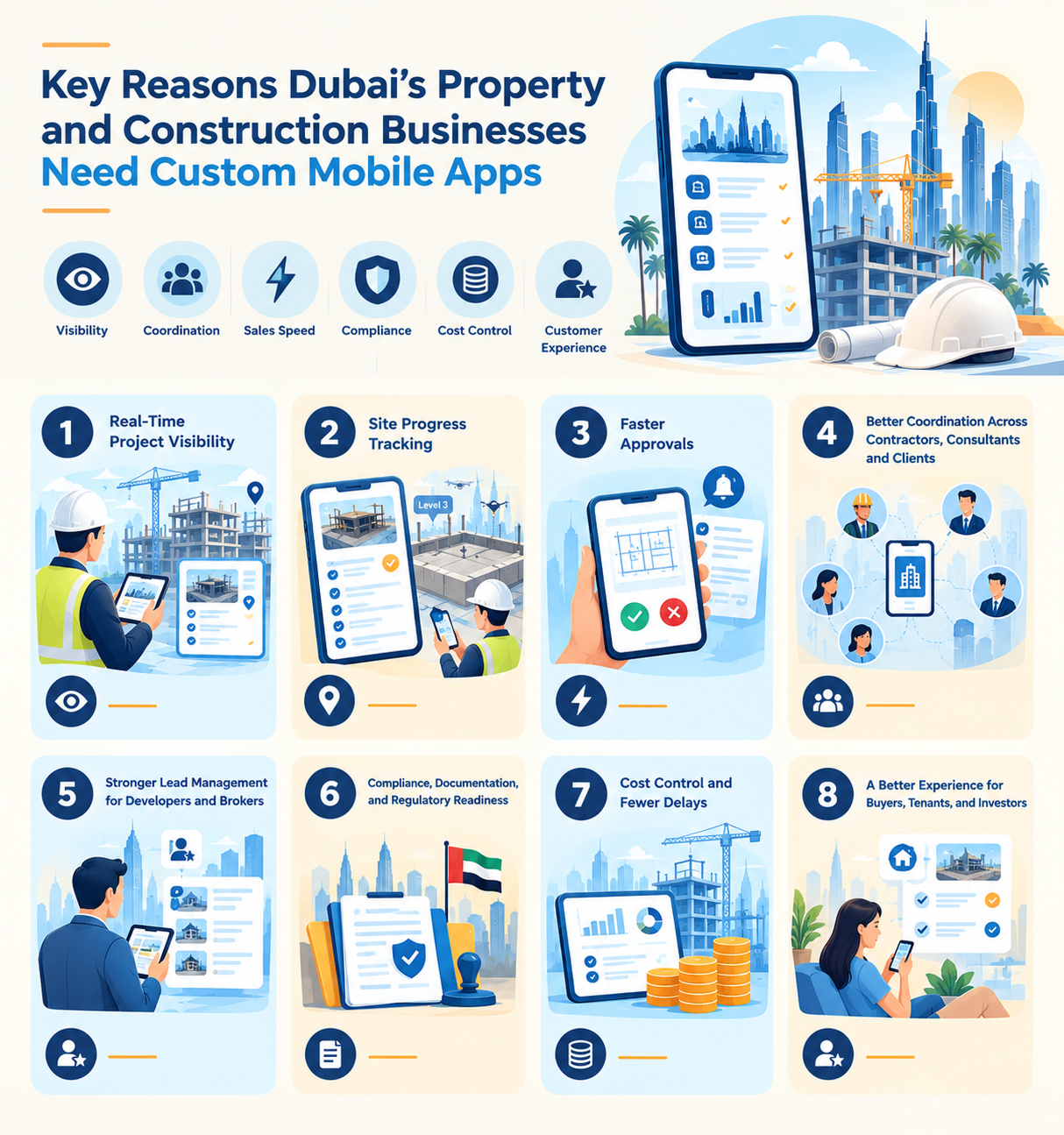
Six reasons stand out: visibility, coordination, sales speed, compliance, cost control, and customer experience. Each one ties directly to money saved or revenue won.
A custom app gives every decision-maker a live window into the project. You stop reading last week's report and start acting on today's reality.
This matters because delay is the industry's default. McKinsey found that large projects typically run 20% longer than scheduled and can finish up to 80% over budget. That study dates from 2016, but anyone who has managed a handover will recognize the pattern.
Field teams log progress with photos, GPS tags, and checklists in under a minute. Managers compare actual progress to plan without driving to site.
Here is a typical scenario, illustrative rather than a client case. A supervisor photographs a finished slab, tags the level, and ticks the task. Within seconds the project manager sees it, the client dashboard updates, and the next trade is notified. Compare that with a blurry photo lost in a 400-message group.
Mobile approvals turn a five-day wait into a same-day decision. The approver gets a push notification, reviews the drawing, and signs off from anywhere.
Think of approvals as a relay race. Delay does not come from slow runners. It comes from dropped batons. An app makes the baton visible, tracks who holds it, and escalates when someone sits on it too long.
One shared app replaces dozens of disconnected conversations. A single Dubai project can involve a developer, a main contractor, several subcontractors, consultants, and authorities. Every extra party adds another channel where instructions can vanish.
A custom app gives each role its own view. Subcontractors see their tasks, consultants see drawings awaiting review, and clients see milestones. When a dispute arises, you have a timestamped record instead of a "he said, she said."
The first broker to respond usually gets the viewing. In 2025, Dubai welcomed 129,600 new property investors, and 56.6% of all investors were UAE residents. These buyers compare several projects in a single evening.
A custom CRM app helps brokers capture leads from portals and social media, follow up from the phone, share live unit availability, and log every viewing. Developers finally see which agents and campaigns convert, not just which ones generate noise. A good real estate app development company will build this around your sales process, not around a template.
Property and construction run on paperwork, and an app makes that paperwork traceable. Dubai processed 3.11 million real estate transactions in 2025 when you count leases and services. Behind every one sits a contract, a permit, or an ID.
Two compliance areas matter most when you build an app:
Apps save money by showing you the problem while it is still small. A digital snag list, a material request log, and a change-order tracker show cost drift in week three, not at final account.
The industry has been slow here, McKinsey noted that construction spends less than 1% of revenue on IT. An app will not replace good project management. It gives good project managers better information.
Dubai customers expect service on demand. Buyers want their payment schedule and construction photos in one place. Tenants want to raise a maintenance request in seconds. Investors want transparent numbers.
Mobile is already their comfort zone: 37% of UAE online purchases happen on a mobile device, the highest share in the 2025 Global Digital Shopping Index. There is also a long game here. The average Dubai renter takes 4.8 years to become an investor. A tenant app that feels good keeps your brand on their home screen for those years, so you are the first call when they are ready to buy.
Five app types cover most needs: project management, listings and CRM, facility management, safety and inspection, and investor portals. Start with the one attached to your most expensive problem.
|
App type |
Main users |
Core value |
|
Construction project management |
Contractors, site managers, consultants |
Progress, tasks, drawings, approvals |
|
Real estate listing and CRM |
Brokers, developers, sales teams |
Lead capture, follow-up, deal tracking |
|
Property and facility management |
Property managers, tenants, owners |
Maintenance, rent, service requests |
|
Site safety and inspection |
HSE officers, inspectors, supervisors |
Checklists, incident reports, audits |
|
Investor and buyer portals |
Buyers, investors, owners' associations |
Payments, updates, documents |
These apps run the daily rhythm of a project: tasks, drawings, RFIs, daily reports, and approvals, all from the site. They are the usual starting point for contractors and developers.
Look for photo-based progress logs, drawing markup, and easy task assignment for subcontractors. When you speak to a construction app development company in Dubai, ask how they connect the app to your scheduling and cost tools, so nobody types the same number twice.
These apps turn scattered enquiries into a pipeline you can actually manage. Brokers and developers handle listings, leads, viewings, and deals in one place.
Useful features include unit inventory, price lists, booking forms, and agent performance reports. In Dubai, bilingual listings and one-tap sharing over WhatsApp are not extras. They are how deals actually happen.
These apps run the building after handover: maintenance, tenant requests, vendor jobs, and service charges. A tenant snaps a photo of a leaking pipe, a technician gets the job, and the manager watches response times.
Over months, the data tells a story: which assets fail most, which vendors are slow, and which buildings cost the most to run.
These apps replace paper checklists with timestamped, photo-backed records. Inspectors capture an issue, assign a corrective action, and track it to closure.
The real value shows up when someone asks for proof. Instead of searching through folders, you pull up the record in seconds.
These portals give buyers a secure window into what they have bought. They show payment schedules, construction milestones, legal documents, and handover status.
This matters most for off-plan sales, which made up about 69% of Dubai's transaction volume in 2025 . When a buyer is paying for something that does not exist yet, transparency is the product. A good portal means fewer anxious phone calls and more referrals.
Build the features your users touch every day first, then add the impressive ones. The classic mistake is a 60-feature app that nobody opens twice.
Every property or construction app needs this foundation:
Advanced features set you apart, but each one adds cost. Add them after the basics earn their keep.
AI works best as a smart assistant, not a magician. It can flag likely schedule delays from progress patterns, summarize daily reports, or rank leads by their chance of converting.
It is only as good as your data. If your site records are patchy, fix that before you buy intelligence.
IoT lets your buildings talk to you. Sensors can track equipment usage, temperature, energy, or water leaks and alert managers automatically.
It is most valuable in facility management, where catching a small fault early prevents an expensive repair later.
AR and VR let buyers walk through a unit that is still a drawing. Site teams can also overlay designs onto the real space to spot clashes.
These features make a strong first impression in a premium market. They also depend on good 3D content, so budget for that, not just the code.
Connecting BIM and ERP means your data flows instead of being retyped. BIM models can feed quantities and design details into the app, while ERP links keep procurement and finance in step.
This has a regulatory angle. Since January 2024, Dubai Municipality has required BIM-based designs for new building permit applications. BIM-ready workflows are now a practical advantage.
Most problems here are information problems, and a well-designed app fixes the flow. These four come up in almost every project we scope.
When instructions live in chats, emails, and calls, someone will always miss one. A custom app keeps messages, tasks, and files together by project, so a decision made on Tuesday is still findable in March.
Drawings, contracts, and buyer details are valuable and sensitive. A custom app lets you control access by role, encrypt data, and decide where it is hosted.
Ask your partner how they handle encryption, access logs, and data location. Under UAE data law, you also need a lawful basis, such as consent, to process personal data.
An app the site team avoids is an expensive screensaver. Adoption fails when screens are cluttered, tasks need too many taps, or nobody trains the crews.
A useful test: can a supervisor wearing gloves, in strong sunlight, log an issue in under 30 seconds? Design for that person. Involve supervisors in prototype testing, and train in the languages your crews speak.
Your app should grow with your portfolio, not break under it. A modular design and scalable cloud hosting let you add projects, users, and integrations without a rebuild.
Off-the-shelf tools often charge per user and limit customization as you grow. With a custom app, you own the roadmap.
Good planning beats good code. Define the problem, involve users, launch small, and leave room to grow.
Start with a measurable pain, not a feature list. "Cut approval time from five days to two" is a goal. "We want an app like Uber" is a wish.
Clear goals help you compare quotes, decide what to cut, and prove success after launch.
Site engineers, brokers, and property managers know the real workflow. Shadow them for a day. Watch where they use paper, where they call, and where they give up.
A common mistake is letting only senior management write the requirements. Their view of the process rarely matches what happens on the ground floor.
An MVP is the first version that solves one real problem, so you learn before you spend big. Think of it like opening a pop-up shop before signing a ten-year lease.
Agency-published estimates for Dubai put a basic MVP at roughly 6–10 weeks and AED 30,000–80,000, with enterprise-scale apps at AED 400,000–1,000,000+ and 6–12+ months. Treat these as rough guides, because scope drives the price.
Pick the workflow with the highest cost of delay, launch it with one project team, and improve it with real feedback.
Decide early how the app will connect to your CRM, ERP, BIM, and accounting systems. Retrofitting integrations later is like adding plumbing after the walls are painted.
You also need to choose your build approach:
|
Approach |
Best for |
Trade-offs |
|
Native (iOS and Android separately) |
Heavy device features, AR, top performance |
Higher cost, two codebases |
|
Cross-platform (one codebase) |
Most business apps, faster launch |
Slight limits on advanced device features |
|
Progressive web app |
Simple tools, quick rollout |
Weaker offline and device access |
For most property and construction apps, cross-platform is a sensible start. Choose native when AR or advanced sensors are central.
From streamlining operations and approvals to improving lead management and customer experience, build a custom mobile app around your business goals, workflows, and growth plans.
Talk to Our Team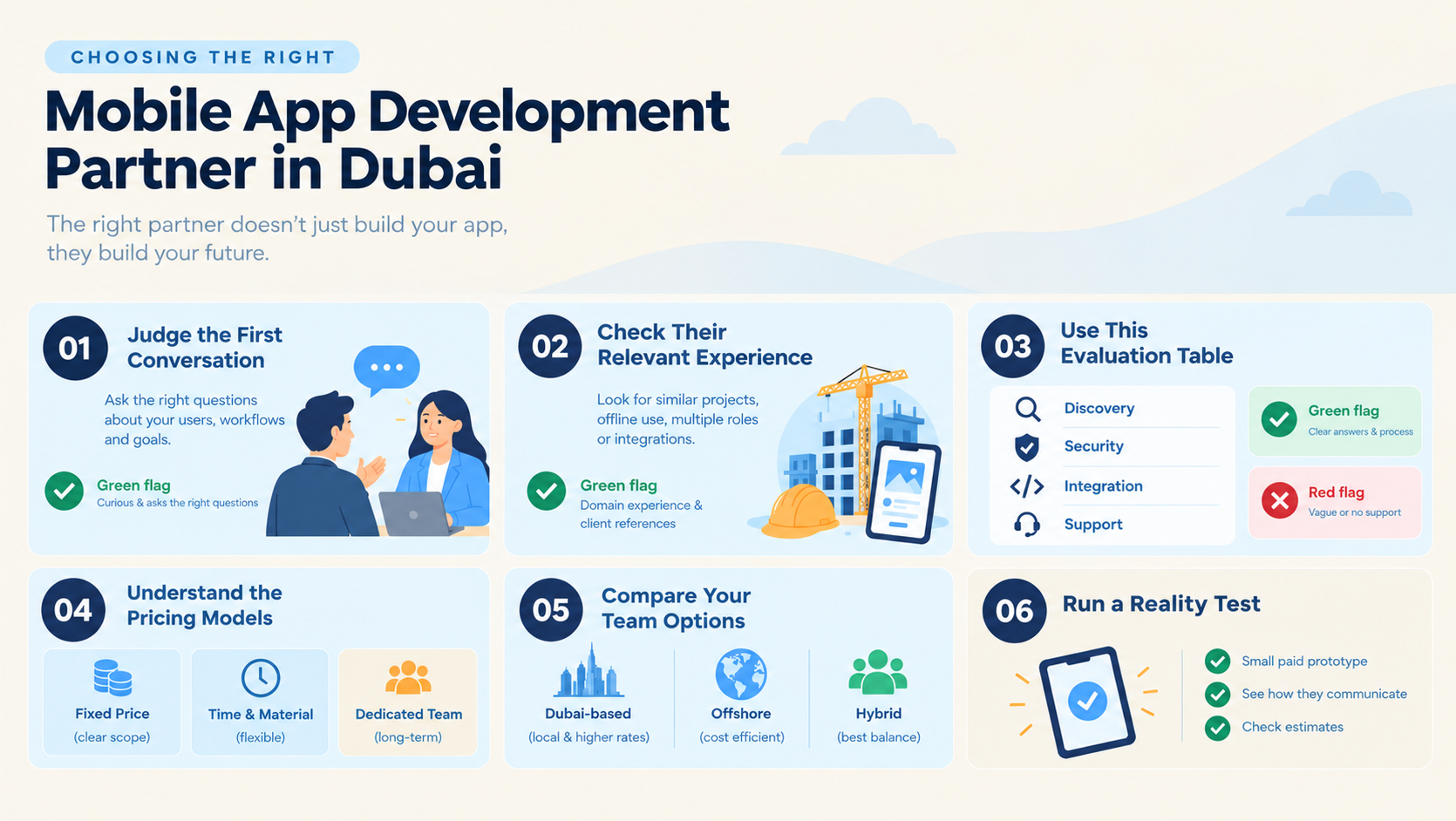
Choose the partner who understands your business, shows you how they work, and stays after launch. The best way to think about it: you are not buying an app, you are hiring a long-term architect for your digital building.
A good architect asks about your site, your budget, and how people will use the space before drawing anything. A poor one hands you a brochure and a price. App partners behave the same way. A mobile app development company in Dubai worth hiring asks more questions than it answers in the first meeting.
Step 1: Judge the first conversation. Notice what they ask you. Strong partners ask about users, workflows, existing systems, and what success looks like in six months. Weak ones jump straight to features and a number.
Step 2: Check their relevant experience. An app for food delivery and an app for site inspections are very different problems. Ask for projects with offline use, multiple user roles, document handling, or integrations. If you are specifically looking for a android app development company, ask for examples in or close to that domain, and ask to speak to the clients.
Step 3: Use this evaluation table in every vendor meeting.
|
What to check |
Ask this |
Green flag |
Red flag |
|
Discovery |
"How do you scope before pricing?" |
Paid or structured discovery with user interviews |
A fixed price on day one with no questions |
|
Process |
"How will I see progress?" |
Short sprints, demos every 1–2 weeks |
"You will see it at the end" |
|
Security |
"How do you protect user data, and where is it hosted?" |
Clear answers on encryption, access control, UAE data rules |
Vague answers or "that's standard" |
|
UX and language |
"Show me an Arabic right-to-left screen." |
Real examples and a UX designer on the team |
Arabic added as a late translation |
|
Offline use |
"What happens with no signal on site?" |
Offline-first design with sync |
"Users should have Wi-Fi" |
|
Integration |
"How will it connect to our CRM, ERP, and BIM?" |
Early API review of your systems |
"We will figure it out later" |
|
Ownership |
"Who owns the code?" |
You own code, designs, and documentation |
The vendor keeps the source code |
|
Support |
"What happens after launch?" |
Defined maintenance, bug-fix window, and update plan |
Silence after go-live |
Step 4: Understand the pricing models. The same project can be priced in different ways, and each fits a different situation.
|
Model |
How it works |
Best when |
Watch out for |
|
Fixed price |
One agreed price for a defined scope |
Scope is clear and stable |
Change requests can be costly |
|
Time and material |
You pay for effort as it happens |
Scope will evolve |
Needs good budget tracking |
|
Dedicated team |
A team works only on your product |
Long-term, ongoing product work |
Needs strong internal ownership |
Be careful with very low quotes. Public agency guides show Dubai prices ranging from about AED 25,000 to AED 500,000+, which is roughly USD 7,000 to USD 136,000+. That gap is not random. It reflects team seniority, testing depth, compliance work, and what is left out of the quote. Ask every vendor for a line-by-line list of what is included and what costs extra, such as hosting, app store fees, and maintenance.
Step 5: Compare Dubai-based, offshore, and hybrid teams honestly.
|
Option |
Strengths |
Trade-offs |
|
Dubai-based team |
In-person workshops, local market feel, same time zone |
Typically higher rates |
|
Offshore team |
Cost efficiency, larger talent pool |
Needs strong communication and clear documentation |
|
Hybrid (local contact plus offshore delivery) |
Local relationship with cost-efficient engineering |
Needs clear roles and one accountable lead |
None of these is automatically right. What matters is whether you have one accountable person, a weekly rhythm, and a team that understands Dubai's language, compliance, and customer expectations.
Step 6: Run a reality test before you sign. Ask for a small paid prototype or a two-week discovery sprint. It is like a test drive. You see how the team communicates, how they handle disagreement, and whether their estimates match reality, all before you commit the full budget.
Step 7: Do reference calls properly. Do not just ask "Were you happy?" Ask:
Step 8: Read the contract like an owner. Confirm these points in writing:
Your quick scorecard. Before you shortlist, tick every box that applies:
Where TechQware fits:- TechQware Technologies works with startups and growing businesses on lean MVP builds, iterative development cycles, and ongoing product support after launch. That approach suits property and construction teams well: prove one workflow quickly, learn from the people using it, then grow the product in planned steps.
In practice, that means we start with your costliest problem, build a focused first version, put it in the hands of one real team, and improve it in short cycles. We also stay on after launch, because the first release is the beginning of an app's life, not the end. TechQware is based in Noida, India and works with Dubai businesses.
Dubai's property and construction firms operate at record scale, and chat groups and spreadsheets will not carry that scale for long. Custom mobile apps give you live visibility, tighter coordination, faster sales follow-up, and a better customer experience, all built around the way you actually work.
The path is simple: choose one costly problem, involve the people who live with it, launch an MVP, and expand with evidence. Be honest about budget, design for Arabic and English, and treat data protection as part of the design.
If you are looking for a mobile app development company to turn that plan into a working product, TechQware can help you scope the right first release. Book a free discovery call, and we will map your workflows, estimate your costs, and find your quickest win.
Abhinav Srivastav
Let’s chat about your goals and explore how TechQware can support your journey ahead.


Mobile App Development . Oct 22, 2026
Why Dubai's Property and Construction S…
Mobile App Development . Oct 13, 2026
Food Delivery App Development in Dubai:…