The digital landscape has undergone a radical transformation over the last decade. We have moved from a world of isolated computers to a hyper-connected web of devices known as the Internet of Things (IoT). However, as the number of connected devices surpasses tens of billions, a new challenge has emerged: the sheer volume of data is becoming unmanageable for human operators. This is where Artificial Intelligence (AI) steps in, giving rise to the Artificial Intelligence of Things (AIoT).
AIoT represents the convergence of connectivity and intelligence. It is no longer enough for a machine to simply send a status update; it must now understand its environment, predict future states, and act autonomously to optimize outcomes. This blog explores how the synergy between AI and IoT is building the foundation for the self-learning systems of tomorrow.
Introduction to Artificial Intelligence and IoT
Why connected systems are no longer enough
In the early days of the digital revolution, the primary goal was connectivity. If a thermostat could be controlled via a smartphone, it was considered "smart." But basic connectivity has reached a plateau of utility. A device that merely reports data requires constant human monitoring to be useful. In a world where industrial plants have thousands of sensors, relying on a human to interpret every alert is inefficient and prone to error. Connectivity is now just the baseline; the true value lies in what happens after the connection is established.
The shift from data collection to intelligent decision-making
The industry is moving away from passive data collection toward active intelligence. In a traditional IoT setup, data is collected, stored, and analyzed retrospectively. AIoT flips this script by enabling real-time decision-making. Instead of a sensor telling you that a machine has failed, an AIoT system analyzes vibration patterns to predict a failure weeks in advance and automatically schedules maintenance. We are moving from a reactive "monitor and respond" phase to a proactive "predict and prevent" era.
Rise of AIoT as a core digital foundation
AIoT is rapidly becoming the backbone of the modern digital economy. It is the invisible force driving autonomous vehicles, smart manufacturing (Industry 4.0), and responsive healthcare. By merging the sensory capabilities of IoT with the cognitive power of AI, organizations can create systems that learn from their experiences. This evolution is not just a trend; it is a fundamental shift in how we build and interact with technology.
What Is the Relation Between IoT and Artificial Intelligence?
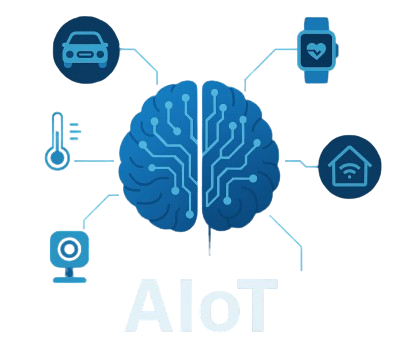
To understand the modern technological landscape, one must answer a fundamental question: what is the relation between iot and artificial intelligence? At its core, the relationship is symbiotic. IoT provides the "body" and senses, while AI provides the "brain."
How IoT Acts as the Data Source
IoT is the eyes and ears of the digital world. Through a vast network of sensors, actuators, and connected devices, IoT generates an unending stream of real-time data. This includes temperature readings, GPS coordinates, visual feeds, and pressure levels. Without IoT, AI would be a brain in a vat highly capable but with no way to perceive or interact with the physical world.
How Artificial Intelligence Turns IoT Data into Intelligence
AI acts as the processor that gives meaning to the noise. Machine learning algorithms are designed to sift through massive datasets to find patterns that are invisible to the human eye. In an AIoT system, AI takes the raw telemetry from IoT devices and applies logic, reasoning, and statistical probability to generate insights. It transforms "The temperature is 90 degrees" into "The engine is overheating due to a coolant leak; reducing power now."
.jpg)
Why IoT Without AI Is Limited
Without AI, IoT is essentially a sophisticated filing cabinet. It can collect data, but it cannot understand it. Organizations often find themselves "data rich but insight poor." They have petabytes of sensor logs but no way to extract actionable value from them. AI is the key that unlocks that value, turning a mountain of raw data into a streamlined flow of intelligence.
Difference Between Artificial Intelligence and IoT
While they are often mentioned in the same breath, there is a distinct difference between artificial intelligence and iot that is crucial for stakeholders to understand.
Role of IoT in Digital Systems
The primary role of IoT is infrastructure and observation. It focuses on:
- Connectivity: Bridging the gap between physical objects and the internet.
- Monitoring: Tracking the state of an asset or environment in real-time.
- Data Collection: Gathering raw inputs from the physical world.
IoT is the delivery mechanism; it ensures the right data gets to the right place at the right time.
Role of Artificial Intelligence in Decision-Making
AI, conversely, is focused on the "how" and "why." Its roles include:
- Learning: Improving performance over time based on historical data.
- Reasoning: Applying logic to solve complex problems.
- Predictions: Foreseeing future trends based on current variables.
AI is the analytical engine; it evaluates the data provided by IoT to determine the best course of action.
AI vs IoT vs AIoT: A Clear Comparison
|
Feature
|
IoT (Internet of Things)
|
AI (Artificial Intelligence)
|
AIoT (The Convergence)
|
|
Primary Goal
|
Connectivity & Monitoring
|
Analysis & Simulation
|
Automation & Self-Learning
|
|
Core Function
|
Sensing and Data Transfer
|
Learning and Reasoning
|
Real-time Actionable Intel
|
|
Outcome
|
Raw Data Streams
|
Insights and Models
|
Self-Optimizing Systems
|
|
Business Value
|
Visibility
|
Better Strategy
|
Operational Autonomy
|
What Is AIoT and Why It Matters Today
Definition of AIoT (Artificial Intelligence of Things)
AIoT is the integration of AI technologies with IoT infrastructure to achieve more efficient IoT operations, improve human-machine interactions, and enhance data management and analytics. In this ecosystem, AI is embedded into the components of the IoT, such as edge devices and cloud platforms.
How AIoT creates self-learning systems
Self-learning systems are the "Holy Grail" of modern engineering. In an AIoT framework, the system uses a feedback loop. The sensors collect data, the AI analyzes it and takes action, and the results of that action are fed back into the AI to refine its future behavior. Over time, the system becomes more accurate, more efficient, and less dependent on human intervention.
Why enterprises are shifting to AIoT platforms
Enterprises are making this shift because the scale of modern business demands it. Whether it is managing a global supply chain or a massive energy grid, human-led management is no longer scalable. AIoT allows for "management by exception," where the system handles 99% of tasks autonomously and only flags humans when a truly unique or critical issue arises.
Core Components of an AIoT System
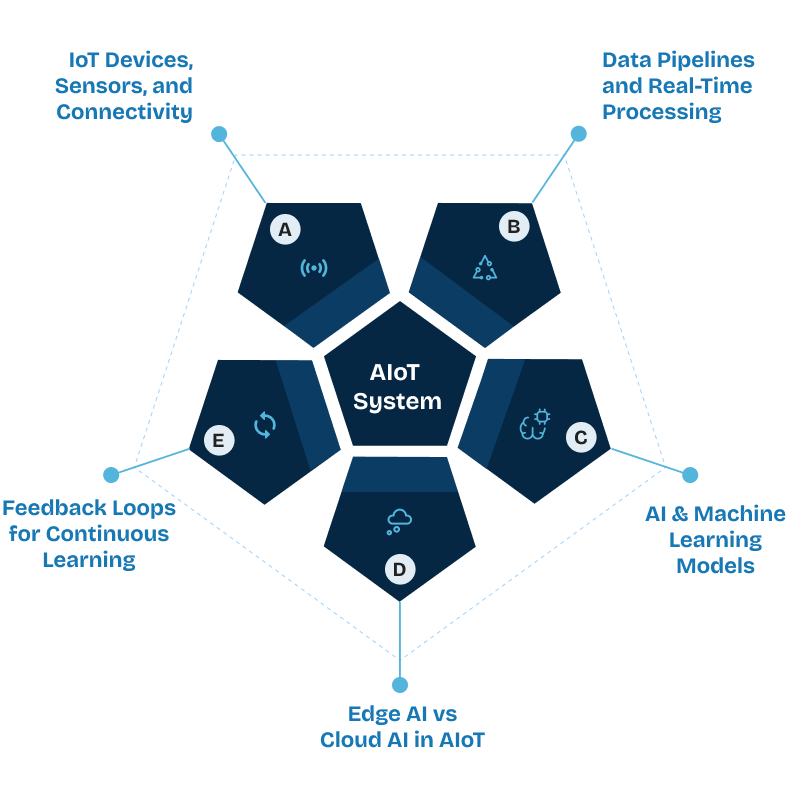
A functional AIoT architecture is more than just a sensor connected to a computer. it requires a sophisticated stack of technologies working in harmony.
IoT Devices, Sensors, and Connectivity
The foundation consists of the hardware. This includes everything from simple humidity sensors to high-definition lidars on autonomous drones. Connectivity protocols like 5G, LoRaWAN, and Wi-Fi 6 ensure that these devices can communicate with low latency and high reliability.
Data Pipelines and Real-Time Processing
Data in an AIoT system is "perishable." Its value decreases rapidly over time. Effective data pipelines must be able to ingest, clean, and normalize data in milliseconds. This often involves stream processing frameworks that can handle high-throughput data without bottlenecks.
AI & Machine Learning Models
This is the intelligence layer. It involves neural networks, decision trees, or reinforcement learning models that have been trained on specific datasets. These models are the logic centers that interpret the incoming data.
Edge AI vs Cloud AI in AIoT
One of the most critical architectural decisions is where the "thinking" happens.
- Cloud AI offers massive computing power and is ideal for long-term trend analysis and training complex models.
- Edge AI involves running models directly on the device or a local gateway. This is essential for applications requiring immediate action, such as autonomous braking in a car, where waiting for a cloud response is not an option.
Feedback Loops for Continuous Learning
The "self-learning" aspect of AIoT comes from the feedback loop. Every decision made by the AI is monitored for its outcome. If a predictive maintenance model flags a machine for repair, but the machine was actually healthy, that "false positive" is used to retrain the model to be more precise in the future.
How Smart Cities Use IoT and Artificial Intelligence
Urbanization is one of the defining trends of the 21st century. As cities grow more crowded, the question of how smart cities use iot and artificial intelligence becomes a matter of survival and sustainability.
Traffic Management and Smart Mobility
Smart cities utilize cameras and road-surface sensors (IoT) to monitor traffic flow. AI algorithms analyze this data to adjust signal timings in real-time, reducing congestion and lowering carbon emissions. Furthermore, AIoT can guide drivers to available parking spots, reducing the 30% of urban traffic caused by people looking for a place to park.
Energy Optimization and Smart Grids
Smart grids use AIoT to balance energy supply and demand. By monitoring usage patterns at the household level via smart meters, the grid can predict peak loads and automatically redistribute power or incentivize users to shift their consumption, preventing blackouts and integrating renewable energy sources more effectively.
Public Safety and Surveillance Systems
AIoT enhances public safety through acoustic sensors that can detect gunshots and automatically alert police, or through smart lighting that brightens when it detects unusual activity in high-crime areas. This is not just about recording events but actively intervening to prevent them.
Waste, Water, and Infrastructure Monitoring
Smart bins equipped with level sensors tell waste management exactly when they need to be emptied, optimizing truck routes. Similarly, acoustic sensors on water pipes can detect the tiny "hiss" of a leak long before it becomes a catastrophic burst, saving millions of gallons of treated water.
How Smart Cities Uses IoT and Artificial Intelligence in Real Time
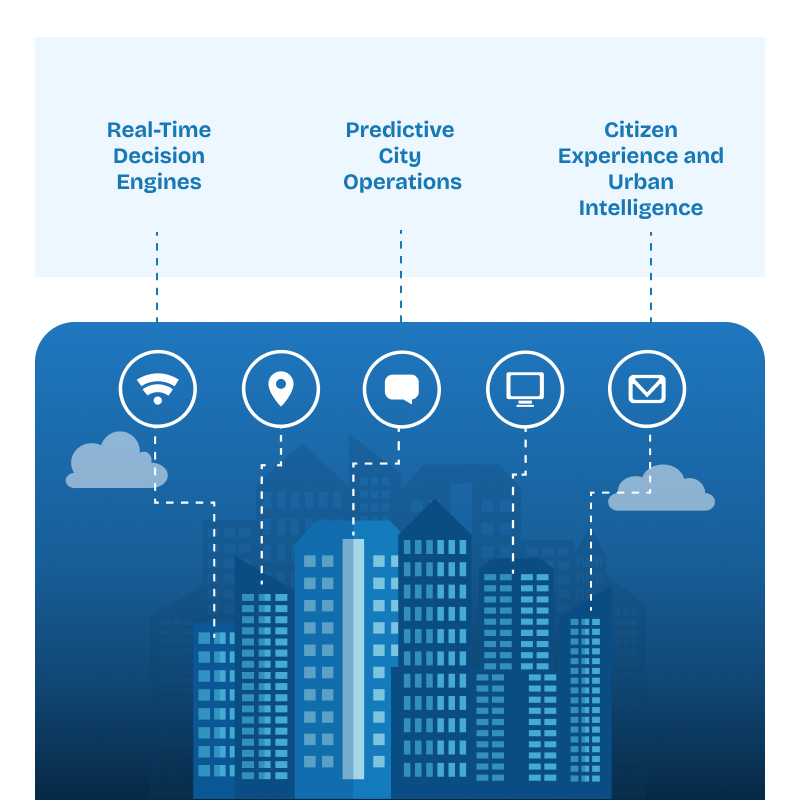
The true power of a smart city is realized when operations happen in "real time," moving beyond static data to a living, breathing urban intelligence.
Real-Time Decision Engines
A real-time decision engine acts as the city's nervous system. For example, during a sudden flash flood, the system can instantly analyze rainfall sensors, river level gauges, and traffic cameras to automatically close flooded roads and reroute emergency services without waiting for a human dispatcher to assess the situation.
Predictive City Operations
Predictive operations use historical data to stay one step ahead. If historical data shows that a specific public transport route becomes dangerously overcrowded during a local sports event, the AIoT system can preemptively deploy extra buses and update digital signage to manage the crowd flow.
Citizen Experience and Urban Intelligence
Ultimately, AIoT serves the people. Real-time urban intelligence translates to shorter commutes, cleaner air, and safer streets. By providing citizens with real-time apps that aggregate all this data, the city becomes more transparent and responsive to the needs of its inhabitants.
How Robots, IoT, and Artificial Intelligence Are Transforming the Police
Public safety is perhaps one of the most controversial yet impactful areas of AIoT. Understanding how robots iot and artificial intelligence are transforming the police involves looking at the shift toward high-tech, data-driven law enforcement.
AI-Enabled Surveillance and Monitoring
Police departments are using AI-powered cameras that can automatically recognize license plates or identify suspicious behavior (such as a person leaving a bag unattended in an airport). This allows a small number of officers to monitor vast areas more effectively.
Robotics and Autonomous Patrol Systems
In some jurisdictions, autonomous ground vehicles and drones are used to patrol parks or industrial zones. These robots are equipped with thermal cameras and 360-degree vision, acting as mobile IoT hubs that can stream data back to a central command center while identifying anomalies.
Predictive Policing and Crime Pattern Analysis
By analyzing years of crime data alongside variables like weather, time of day, and economic indicators, AI can identify "hot spots" where crime is likely to occur. Police can then be strategically deployed to these areas as a deterrent, moving law enforcement from a reactive to a preventive posture.
Ethical, Privacy, and Governance Considerations
The integration of AIoT in policing brings significant ethical challenges. Issues such as algorithmic bias, mass surveillance, and the "black box" nature of AI decision-making require strict governance. For these systems to be effective, they must be transparent and subject to human oversight to ensure that civil liberties are protected.
How Can We Combine Artificial Intelligence, IoT, and Chatbot Systems?
The interface between humans and complex AIoT systems is often the weakest link. A natural solution is the integration of conversational interfaces. So, how can we combine artificial intelligence iot and chatbot systems to create a seamless experience?
IoT as the Real-Time Data Provider
The IoT network serves as the "eyes" of the chatbot. Instead of a chatbot only knowing what is in its database, it can "see" the current state of the physical world. For example, a facility manager can ask a chatbot, "What is the humidity in Warehouse B?" and the chatbot retrieves that data instantly from the sensors.
AI as the Decision and Intelligence Layer
The AI processes the request and the data. If the warehouse manager asks, "Is everything okay in the cold storage?" the AI doesn't just report the temperature; it compares it against the safety threshold, checks the weather forecast for upcoming heatwaves, and provides a nuanced answer.
Chatbots as the Human Interaction Interface
The chatbot acts as the translator. It turns complex sensor data and AI predictions into natural language. This democratizes data, allowing non-technical staff to interact with complex systems using simple voice or text commands.
Use Cases of AI + IoT + Chatbots
- Smart monitoring assistants: Employees can query the status of industrial machines via Slack or Microsoft Teams.
- Conversational dashboards: Instead of looking at complex graphs, an executive can ask, "How is our energy efficiency this month compared to last?"
- Automated alerts and actions: A chatbot can notify a homeowner of a water leak and ask, "Would you like me to shut off the main valve?"
AIoT Architecture: From Sensors to Self-Learning Systems
Data Collection and Ingestion
The journey begins at the edge. Data must be timestamped and categorized at the source. High-fidelity ingestion ensures that the AI receives a clean and accurate representation of the physical environment.
Model Training and Inference
Models are typically trained in the cloud using historical data to learn patterns. Once trained, they are deployed for "inference" the process of applying the learned model to new, incoming IoT data to make predictions or decisions.
Continuous Feedback and Optimization
This is the "learning" in self-learning. The system records the results of its inferences. If a predictive model was wrong, that data point is prioritized in the next training cycle, allowing the system to evolve and adapt to changing conditions.
Human-in-the-Loop for Responsible AIoT
No system should be entirely autonomous without oversight. Human-in-the-loop (HITL) architecture ensures that critical decisions especially those involving safety or high financial risk are verified by a human expert, while the AI learns from the human's corrections.
Benefits of AIoT for Businesses and Governments
Operational Efficiency
By automating routine monitoring and adjustment tasks, AIoT reduces the need for manual intervention, lowers operational costs, and minimizes human error.
Predictive and Preventive Capabilities
The ability to foresee problems before they manifest is a massive financial advantage. In manufacturing, this means zero unplanned downtime; in governance, it means preventing infrastructure failures.
Real-Time Automation
AIoT allows for "closed-loop" automation where the system senses a change and reacts instantly. This is vital in fast-moving environments like high-frequency trading or automated logistics warehouses.
Scalable and Intelligent Decision-Making
As an organization grows, the complexity of its data grows exponentially. AIoT provides a scalable way to maintain high-quality decision-making across thousands of nodes without a proportional increase in headcount.
Challenges in Implementing Artificial Intelligence and IoT Together
Data Quality and Integration Issues
AI is only as good as the data it is fed. Inconsistent sensor calibrations, data gaps, and legacy systems that don't "talk" to modern AI platforms are significant hurdles to implementation.
Security and Privacy Risks
Every IoT device is a potential entry point for hackers. When you add AI, the stakes are higher; a compromised AIoT system could be manipulated to make dangerous physical decisions, such as opening a dam or shutting down a power plant.
Infrastructure and Scalability Constraints
Running complex AI models requires significant computational power. While 5G and edge computing are helping, the infrastructure costs of deploying AIoT at scale can be prohibitive for smaller organizations.
Ethical and Regulatory Challenges
As systems become more autonomous, who is liable when something goes wrong? The lack of clear legal frameworks for AIoT-driven accidents remains a major concern for governments and insurers.
The Future of Artificial Intelligence and IoT (AIoT)
Autonomous Systems and AI Agents
The future will see a shift from "smart devices" to "autonomous agents" that can negotiate with one another. Imagine a fleet of delivery drones that communicate with smart traffic lights and other drones to optimize their own flight paths without any human oversight.
Generative AI in AIoT Platforms
Generative AI will allow users to interact with AIoT systems in even more intuitive ways, such as asking the system to "Design a more efficient heating schedule for the winter months based on last year's performance."
Edge Intelligence at Scale
As chips become more efficient, we will see "TinyML" the ability to run sophisticated machine learning on very small, low-power devices. This will bring intelligence to the smallest components of our world, from smart bandages to intelligent food packaging.
AIoT as the Backbone of Smart Ecosystems
Ultimately, AIoT will move beyond individual cities or factories to create a global "System of Systems." Interconnected supply chains, energy grids, and transport networks will share intelligence to create a more efficient and sustainable planet.
Conclusion: Why AIoT Is the Foundation of Self-Learning Systems
The convergence of Artificial Intelligence and the Internet of Things is more than a technological upgrade; it is a fundamental shift in the capabilities of our digital infrastructure. By combining the sensory reach of IoT with the cognitive depth of AI, we are creating systems that don't just work for us, but learn with us.
AIoT is the foundation of self-learning systems because it bridges the final gap between data and action. It allows our machines to perceive, reason, and act in the physical world with a level of precision and foresight that was previously impossible. For organizations and governments, the message is clear: the era of simple connectivity is over. To remain competitive and resilient in a complex world, the adoption of AIoT is no longer optional it is a strategic necessity.
At TechQware, we help businesses unlock the full potential of AIoT through innovative and scalable solutions. As a leading AI App Development Company, we specialize in building intelligent IoT applications that integrate real-time data, machine learning, and automation to drive smarter outcomes. From concept to deployment, our team ensures seamless IoT app development tailored to your business needs empowering you to create self-learning systems, enhance efficiency, and stay ahead in the digital era. Contact us today to get started.

 TechQware