Key Takeaways:
- Build security and compliance into the app from day one.
- UAE PDPL compliance depends on your data, business, and jurisdiction.
- Map where user data is collected, stored, and transferred.
- Use strong security controls like encryption, MFA, and secure APIs.
- Review third-party and AI services before sharing user data.
- Conduct regular security audits and compliance reviews after launch.
Introduction
The mobile app market of Dubai is expanding as well. The expansion is not limited to just one area of application but is seen in fintech, health, e-commerce, travel, real estate, logistics, and government services as well. However, with the increasing amount of data and personal information that apps collect, the need for security and compliance required for processing digital payments, implementing AI systems, and integrating third-party services is becoming more complicated. Therefore, companies looking to introduce their products to the UAE market in 2026 will have to design their applications keeping in mind all the information-security, regulatory, and technical requirements beforehand.
Why App Security Can't Be an Afterthought in 2026
Today's mobile APP's are rarely created as a stand-alone product. These modern applications have various functions such as obtaining names, phone numbers and location information, linking with payment processors, keeping authentication tokens, connecting with cloud systems and relaying information to analytical or artificial intelligence systems. With every functionality created, a security and compliance risk arises.
Assume that a booking app based in Dubai has added an AI chatbot a few days before its launch. It is possible that user conversations are being transmitted to an outside AI provider without adequate legal and technical precautions. In such a case, the developers will create unnecessary risk relating to data protection and cross-border transfer.
Last but not the least, business implication goes beyond regulatory issues. A security incident may result in interruptions, loss of trust from customers, and delays in broader expansion.
Is Your App Actually Compliant, or Just Assumed to Be?
There are many businesses which think that by having HTTPS, adding a privacy policy, and hosting data with a reputed cloud service provider, their mobile application is compliant with laws. This is not the case because compliance requires more than just technological safeguards.
The important questions to be answered are: What is the purpose of collecting personal data? What kind of personal data is being collected? On what legal grounds is data being processed? Where is the data stored? Who has access to the data? Is the data transferred outside the UAE or any other jurisdiction? How do users exercise their rights? What will happen if a scandal occurs?
A good compliance review connects the legal issues with the real structure of the app and it assesses the mobile app securely, alongside the Application Programming Interfaces, cloud infrastructure, third-party SDKs, Authentication processes, and related internal processes.
What This Guide Will Help You Achieve
This guide describes the aspect of security and compliance that companies must consider when creating or using a mobile app in Dubai. It talks about the UAE Personal Data Protection Law, industry-specific regulations, data residency and cross-border transfers, technical safeguards, security testing, and the rising risks related to AI-powered apps.
The aim is not just to assist companies in achieving compliance but also to enable executives to create an infrastructure based on security principles.
The UAE's Data Protection and Security Landscape
Overview of UAE Data Protection Law (PDPL)
The Federal Decree-Law No. 45 of 2021 of the UAE on Protection of Personal Data, otherwise known as the UAE PDPL, provides a comprehensive framework for personal data protection. Depending on the organization, activity type and jurisdiction, additional laws and regulations might come into play. In fact, for mobile application companies that deal with continuous procession of personal data, the PDPL is extremely relevant. At the same time, the processes may include registration forms, profile data, device identifiers, location permissions, customer support conversations, and behavioral analytics.
The Act stresses the importance of appropriate safeguards, responsible processing, and the rights of individuals. Thus, companies should consider their entire data lifecycle instead of just focusing on data from registration screens.
Role of the UAE Data Office
The role of the UAE Data Office in the framework of the UAE's data protection strategy. The institution's area of competence encompasses a scope of issues related to establishing and enforcing legislative acts on the use of personal data at the national level.
In terms of commercial organisations, the importance of data protection can hardly be overstated. The launch of a secure application is based on the collaboration of many specialists, including developers, management, legal advisors, and security experts. Even if the company has only one department in charge of drafting the privacy policy, it should ensure that the statements made in the policy reflect the actual functionality of the software.
How Dubai's Regulations Compare to GDPR and Global Standards
The application of various data protection principles stemming from the laws of a number of countries is very similar to the laws adopted in the UAE. For instance, the concept of transparency, the principle of purpose limitation or the principle of data minimisation present in GDPR are also included in the PDPL adopted in the UAE. Despite that, the fact that the companies comply with GDPR may not guarantee that such companies comply with the PDPL.
It should be noted that jurisdiction is of great importance in this case. For example, a firm located in Dubai should comply with federal UAE law, free zone regulations and industry-specific obligations. In addition, if the application is running in international markets, its owner may need to comply with some foreign laws too.
Thus, the only conclusion that can be made here is that although international data protection laws can serve businesses as a source of confidence in complying with regulations, compliance with regional standards is the key to success.
UAE PDPL Compliance Requirements for Mobile Apps
What Counts as Personal Data Under PDPL
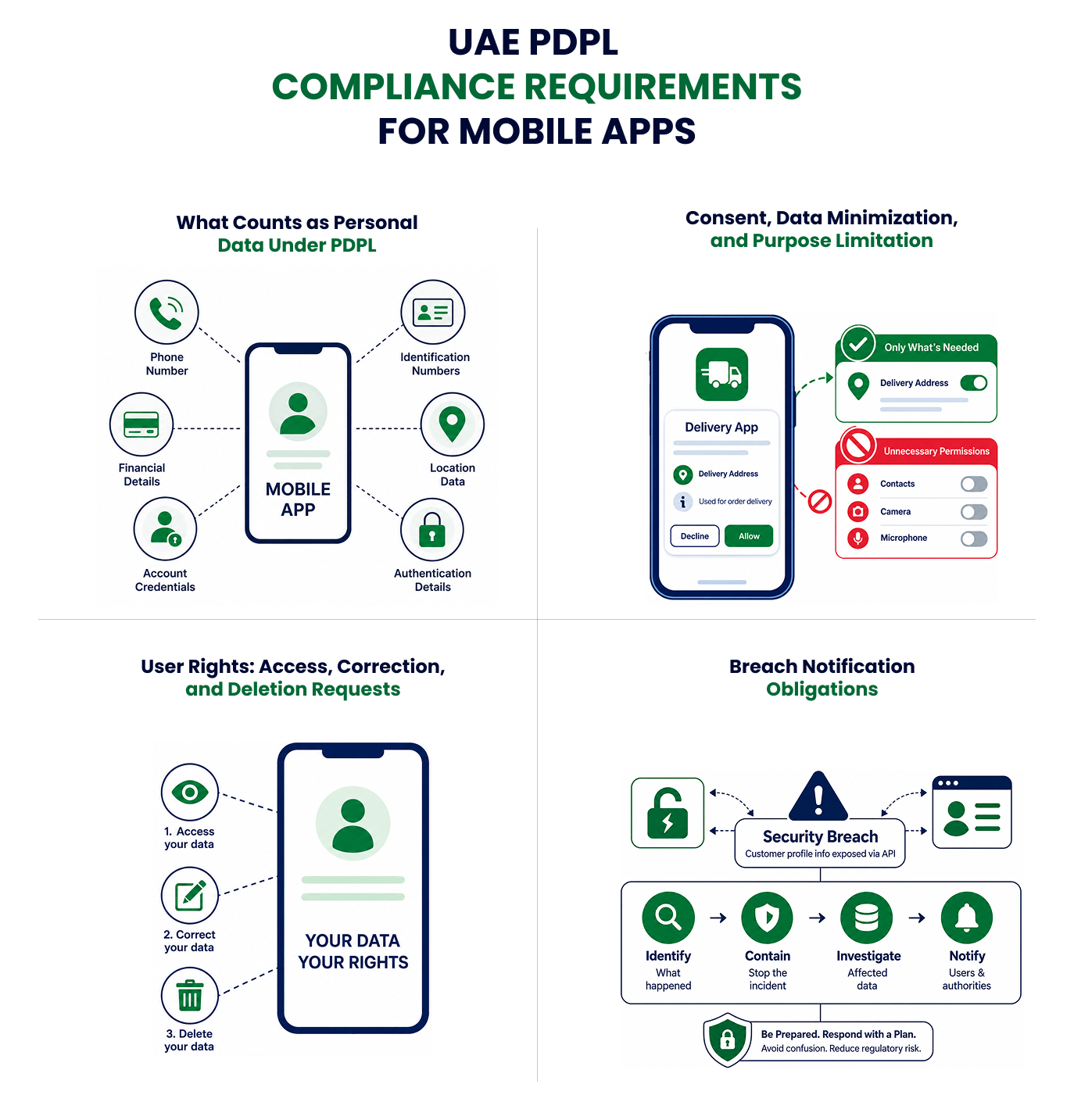
Personal information may involve much more than just the name and email address of a person. Mobile applications can handle various types of user data, including phone numbers, identification numbers, financial details, and location data along with authentication details, account credentials, and anything else applicable to a particular individual.
For example, a sport application can track some physical activity, health inputs, and location. A delivery application may use a customer’s address and live tracking information. However, even if each data piece might seem harmless on its own, its combination can dramatically increase potential risks to privacy.
Consent, Data Minimization, and Purpose Limitation
Consent is not just a step in the onboarding process for users. Instead, when collecting consent as a basis for processing, it is critical to provide the users with sufficient information on what they are agreeing to and why their data are required.
The importance of data minimization cannot be understated. If a delivery app only needs the delivery address, then it is hard to justify the constant tracking of precise location unless otherwise required by the operating nature of the app.
An example of such unreasonable permission granting can be an app that immediately requests access to contacts, camera, microphone, and precise location without actually needing it for any of its functions.
User Rights: Access, Correction, and Deletion Requests
Users may have rights concerning their personal data, including the ability to request access, correction or deletion in applicable circumstances. Mobile app businesses therefore need operational processes capable of identifying relevant user data across systems.
This can become challenging when information is spread across the main database, CRM platform, analytics tools, customer-support software and cloud backups. A “delete account” button that only removes the visible profile while leaving personal information across several connected systems may not represent a complete privacy process.
Breach Notification Obligations
A security breach should trigger a structured incident-response process rather than confusion and ad-hoc communication. The organisation should be able to identify what happened, contain the incident, investigate affected data and assess notification obligations.
For example, if an API vulnerability exposes customer profile information, the company needs clear ownership for technical containment, legal assessment, internal escalation and communications. Waiting until an incident occurs to decide who is responsible can increase both operational disruption and regulatory risk.
Data Residency and Storage Rules
Where Your App's Data Is Legally Allowed to Live
A common misconception is that every UAE mobile app must store every piece of data physically inside the UAE. The legal position depends on the applicable framework, sector and specific processing activity.
The correct approach is to classify the data, identify the laws and contractual obligations that apply and then document where each category of information is stored and processed. A fintech application, for instance, may face a very different compliance environment from a basic content app.
Cross-Border Data Transfer Restrictions
Cross-border data transfers require careful assessment because cloud services, analytics platforms and AI APIs may process information in multiple countries. Businesses should understand where data travels instead of relying on assumptions about a vendor's global infrastructure.
A practical example is a UAE app using a foreign customer analytics service. If user identifiers and behavioural data are transmitted to servers outside the relevant jurisdiction, the company should assess whether the transfer is permitted and what safeguards are required.
Choosing UAE-Compliant Cloud and Hosting Providers
The best cloud provider is not automatically the one with the largest global footprint. Businesses should evaluate security certifications, regional hosting options, data processing terms, access controls, encryption capabilities, incident support and contractual commitments.
The following framework can help teams compare hosting and data-processing decisions:
|
Evaluation Area
|
What the Business Should Check
|
|
Data location
|
Where primary, backup and disaster-recovery data may be stored or processed
|
|
Access management
|
Whether privileged access follows least-privilege and strong authentication principles
|
|
Encryption
|
Protection for data in transit, at rest and during key management processes
|
|
Vendor terms
|
Data-processing commitments, subprocessors and incident notification procedures
|
|
Regional compliance
|
Whether the deployment supports applicable UAE, free-zone or sector requirements
|
TDRA Guidelines for Apps in Dubai
App Store Submission and Regulatory Requirements
Mobile apps in Dubai must comply with applicable UAE laws and requirements of the app store. Depending on the specific app, developers should be aware of other considerations such as content and licensing as well as consumer protection and telecommunications requirements. Thus, submission to the app store should not be regarded as the sole compliance step. While Apple and Google may assess technical and policy matters, the consent of the relevant store does not liberate the developer from ensuring adherence to UAE laws.
Telecom and Connectivity Compliance Basics
Apps using telecommunications services, connectivity features, messaging functions or regulated digital services may need additional regulatory consideration. The requirements can vary depending on the business model and functionality.
For example, an app integrating communication capabilities may need to evaluate the legal status of those services before launch rather than assuming that technology available in another market can be deployed in exactly the same way in the UAE.
What Happens If an App Isn't TDRA-Compliant
Non-compliance can potentially lead to regulatory scrutiny, service restrictions, enforcement action or requirements to modify the product. The commercial impact can be particularly serious when a business has already invested heavily in customer acquisition and brand promotion.
The safest strategy is to assess regulatory requirements before development decisions become expensive to reverse.
Sector-Specific Compliance: DIFC and Fintech Apps
DIFC Data Protection Rules for Regulated Apps
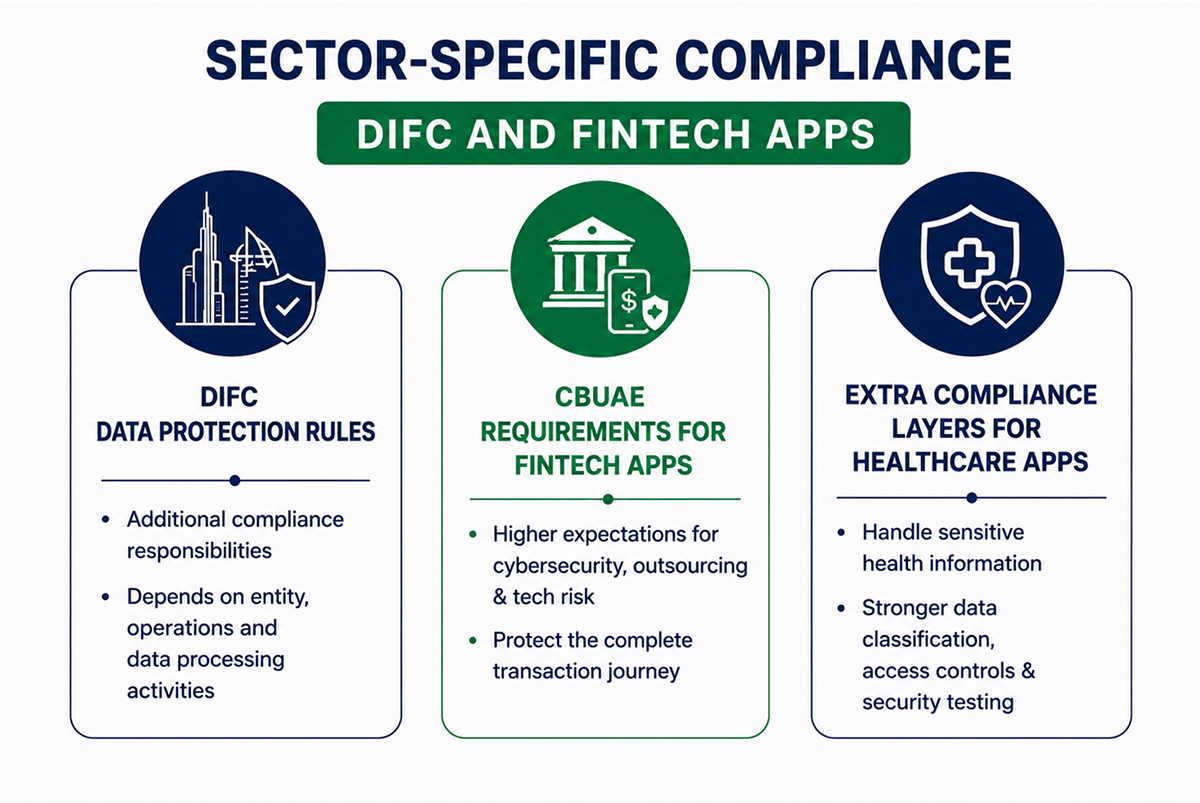
Businesses operating within or connected to the Dubai International Financial Centre may need to consider the DIFC's own data protection framework. DIFC requirements can create additional compliance responsibilities separate from the broader federal regime.
This is particularly important for apps handling high volumes of customer, employee or financial information. Businesses should establish which legal regime applies based on their entity, operations and data-processing activities.
CBUAE Requirements for Fintech and Banking Apps
Fintech and banking applications can face additional expectations relating to cybersecurity, outsourcing, technology risk and customer protection. Payment credentials, transaction information and account access create higher-risk environments that require stronger controls.
A realistic case scenario would be a digital wallet with excellent biometric login but an exposed API that allows an attacker to manipulate account queries. Strong front-end security cannot compensate for weak backend architecture. Security must protect the complete transaction journey.
Extra Compliance Layers for Healthcare Apps
Healthcare apps can process particularly sensitive information, making privacy, confidentiality and security even more critical. Appointment apps, telemedicine platforms and wellness solutions should carefully evaluate what health-related data they collect and who can access it.
A breach involving sensitive health information can cause far greater harm than the exposure of a generic marketing preference. Healthcare products should therefore apply stronger data classification, access controls and security testing appropriate to their risk profile.
Core Technical Security Standards
Data Encryption at Rest and in Transit
Sensitive information should be protected while moving between the mobile app, APIs and backend systems, as well as while stored in databases and other infrastructure. Encryption is only one part of the control environment, but it remains fundamental.
Businesses should also manage encryption keys securely. An encrypted database offers reduced protection if the keys are poorly controlled or exposed through insecure configuration.
Biometric and Multi-Factor Authentication
Biometric authentication can improve convenience, while multi-factor authentication can reduce the risk associated with stolen credentials. However, implementation matters.
Where possible, applications should use secure operating-system capabilities and avoid unnecessarily collecting or storing raw biometric information themselves. Authentication design should also consider account recovery, device changes and suspicious login attempts.
Secure Token and Session Management
Poorly managed tokens can allow attackers to maintain access after a user believes they have logged out. Tokens should be protected, appropriately scoped and rotated or invalidated where necessary.
A common failure scenario involves a user logging out of a banking or shopping app, while an old session token remains valid for an excessive period. Secure session management helps reduce this risk.
API and Backend Security Best Practices
APIs are a major attack surface for modern applications. Developers should implement strong authentication and authorisation, input validation, rate limiting, logging and protection against common vulnerabilities.
The following table summarises key technical controls and the business risks they address:
|
Security Control
|
Risk It Helps Reduce
|
|
TLS and encrypted communications
|
Interception of sensitive data during transmission
|
|
Strong authentication
|
Unauthorised account access
|
|
MFA and step-up verification
|
Credential-based attacks and suspicious logins
|
|
Secure API authorisation
|
Exposure of data through broken access controls
|
|
Rate limiting
|
Automated abuse and certain denial-of-service attempts
|
|
Centralised logging and monitoring
|
Delayed detection and investigation of incidents
|
Security Testing Before Launch
Why Penetration Testing Matters
Penetration testing helps identify vulnerabilities that may not be visible through normal development testing. An experienced security tester can examine authentication, APIs, business logic and mobile application behaviour from an attacker's perspective.
For a Dubai-based financial or customer-facing app, discovering a critical flaw before launch can prevent a far more expensive incident after thousands of users have registered.
Vulnerability Assessments and Code Audits
Automated vulnerability assessments are valuable, but they should not be the only security activity. Code reviews and architecture assessments can identify insecure design decisions before they become production vulnerabilities.
Testing should cover the mobile application and the surrounding ecosystem, including backend services, cloud configuration, third-party dependencies and administrative systems.
App Store Security Review Requirements (Apple & Google)
Apple and Google apply their own platform policies and review processes, but developers should not treat store approval as a security certification. An application can pass a store review while still containing weaknesses in backend infrastructure or business logic.
Teams should independently validate privacy disclosures, permissions, account handling and security controls before submission.
AI and Data Security Considerations in 2026
Securing AI Features and Model Data
AI features can create new data flows. Chatbots, recommendation engines and AI assistants may receive customer information, internal business data or prompts containing confidential details.
Businesses should determine what information enters AI systems, how long it is retained and whether it can be used for additional processing. AI architecture should be included in the same security and privacy reviews as the rest of the application.
AI Compliance Basics Under UAE Regulations
AI governance is evolving rapidly. Businesses using AI in the UAE should monitor applicable laws, sector requirements and government guidance while maintaining transparency and responsible data practices.
High-risk use cases deserve additional attention. An AI feature influencing financial decisions, healthcare interactions or identity-related processes can create more significant consequences than a simple content-recommendation tool.
Risks of Using Third-Party AI APIs with User Data
Third-party AI APIs offer speed, but convenience should not replace due diligence. Developers should review vendor terms, data handling, retention, access controls and geographic processing arrangements.
A useful case study scenario involves a customer-support app sending complete chat histories to an external AI service for automated summaries. Without data minimisation, the business could be transmitting unnecessary personal or confidential information. Sending only the data genuinely required for the feature can significantly reduce exposure.
Common Security Mistakes That Lead to Compliance Failures
Storing Data Outside Approved Jurisdictions
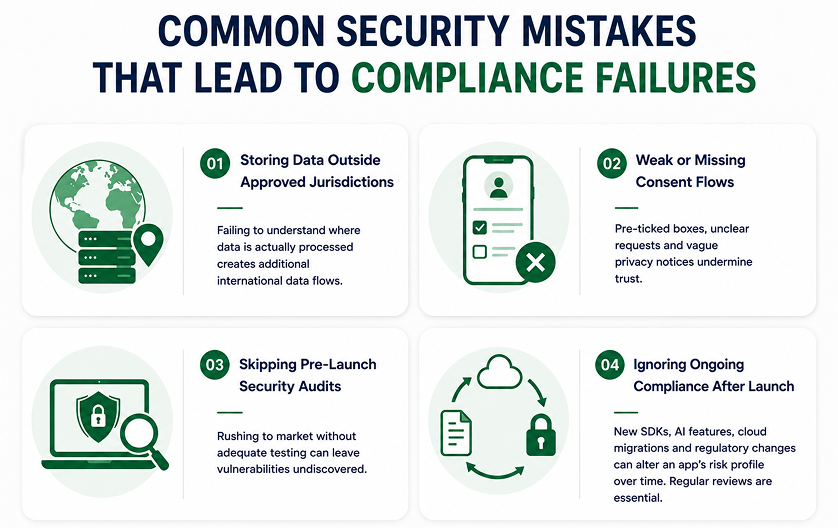
One of the most common mistakes is failing to understand where data is actually processed. A company may believe its application is hosted in one region while backups, analytics or third-party services create additional international data flows.
Weak or Missing Consent Flows
Pre-ticked boxes, unclear permission requests and vague privacy notices can undermine trust. Users should not have to guess why an app needs access to a particular category of information.
Skipping Pre-Launch Security Audits
Rushing an application to market without adequate testing can leave vulnerabilities undiscovered. The cost of a short launch delay is often lower than the cost of incident response, emergency development and reputational damage.
Ignoring Ongoing Compliance After Launch
Compliance is not a launch-day milestone. New SDKs, AI features, cloud migrations and regulatory changes can alter an app's risk profile over time. Regular reviews are essential.
Building a Security-First Development Process
Security Checklist Before You Launch
Before launch, businesses should review the complete application architecture, data map, privacy notices, permissions, authentication controls, API security, third-party integrations and incident-response process. The objective should be to identify gaps before real customers are affected.
Security acceptance criteria should also be included in the development lifecycle so that critical requirements are tested before features reach production.
Ongoing Monitoring and Compliance Reviews
Continuous monitoring helps organisations identify unusual activity and emerging vulnerabilities. Regular compliance reviews should consider changes to the app, new vendors, evolving regulations and lessons from security incidents.
An app that was compliant at launch can develop significant risk months later if its architecture changes without corresponding security review.
Working with Developers Who Understand UAE Regulations
Effective development partners emphasize technical skills in local business and regulatory environment. Compliance factors must be taken into account while designing the software architecture, hosting, APIs, and data flows at the beginning of the project.
Development teams in Dubai that excel at embedding security in the design and implementation process help minimize the need for future changes and ensure seamless growth.
Planning to Launch Your App in the UAE?
Contact Us
Final Thoughts: Making Compliance a Competitive Advantage
In Dubai, mobile application security is no longer an IT issue only. It is also a legal, operational and business issue. Clients prefer to use applications where their data is taken care of responsibly. At the same time, investors and partners have begun demanding proof of proper security practices applied.
The best strategy is to incorporate data privacy issues, compliance and security measures into the application since the very first architectural steps. It is bad practice for businesses to inquire whether the application can be made compliant before its launch anymore; they should look into the question of how to make the application design secure and compliant throughout its lifecycle instead.
At TechQware Technologies, we enable businesses to create secure and flexible mobile applications with security measures incorporated into the development process.
FAQs
Is UAE PDPL compliance mandatory for all mobile apps?
The applicability of UAE PDPL is contingent on the entity involved, the processing activity, and the relevant jurisdiction. Organizations running applications that gather personal data must determine their duties rather than relying on a privacy policy.
What happens if my app doesn't comply with PDPL?
instances of law-breaking can pose different legal, regulatory, financial and reputational hazards. Possible dangers depend on circumstances and applicable regulations, which means companies need to acquire proper legal and compliance advice.
Do I need to store user data inside the UAE?
Not necessarily in every situation. Data storage and transfer requirements depend on the applicable legal framework, sector and type of processing. Businesses should map all data locations, including backups and third-party services, before making hosting decisions.
What security standards do app stores require in the UAE?
Apple and Google maintain their own global developer and platform policies. However, app-store approval does not replace compliance with applicable UAE laws or sector-specific requirements. Developers should satisfy both platform and local regulatory expectations.
How is DIFC compliance different from PDPL?
DIFC has its own data protection framework that may apply to relevant entities and processing activities within its jurisdiction. Federal UAE requirements and DIFC rules should therefore be assessed based on the business's specific legal and operational circumstances.
How often should a mobile app undergo a security audit?
The frequency should be based on the application's risk profile, industry and rate of change. High-risk applications may require more frequent testing, while every significant architectural change, major feature release or new third-party integration should trigger a fresh security review.
Abhinav Srivastav
With years of experience in driving digital transformation, Abhinav Srivastav is the CEO & Director of TechQware Technologies, helping businesses build innovative mobile apps, AI-powered applications, and scalable digital solutions.

 TechQware