Key Takeaways:
- Dubai offers strong opportunities for food delivery apps due to its digital and diverse food-service market.
- Multiple app models are possible, including single-restaurant, aggregator, and cloud-kitchen platforms.
- Core features include easy ordering, secure payments, live tracking, Arabic-English support, and smart delivery management.
- Loyalty features like rewards, referrals, memberships, and personalized offers help drive repeat orders.
- AI and integrations can improve recommendations, demand forecasting, POS connectivity, and business operations.
- Development cost depends on scope, including features, platforms, integrations, design, security, and maintenance.
Dubai has become one of the world's most digitally connected food markets, where convenience, speed, variety, and mobile-first experiences strongly influence how people discover and order food. From restaurants and cafés to cloud kitchens and large food-service groups, businesses are increasingly using digital ordering platforms to reach customers beyond their physical locations.
For businesses considering mobile app development in Dubai, simply creating an application with a menu and checkout page is no longer enough. Customers expect accurate delivery estimates, real-time tracking, Arabic and English experiences, secure payments, personalized offers, loyalty benefits, and a frictionless ordering journey.
At the same time, restaurant businesses need sophisticated tools for managing orders, inventory, promotions, delivery operations, commissions, customer relationships, and performance analytics.
A well-designed food delivery platform therefore needs to connect customers, restaurants, delivery partners, administrators, payment providers, maps, and business systems into one reliable ecosystem.
Why Dubai Is a Strong Market for Food Delivery Apps
Dubai's combination of high smartphone adoption, diverse demographics, strong digital infrastructure, tourism, and a highly developed food-service industry creates an attractive environment for digital food ordering businesses.
According to Dubai's Digital Economy Strategy, the emirate is actively expanding its digital economy and digital services ecosystem, creating an environment where mobile-first consumer platforms can continue to grow.
Growing Demand for Online Food Ordering
Online food ordering has moved from being an occasional convenience to an important part of urban dining behavior. Customers can compare restaurants, browse menus, check ratings, apply promotions, pay digitally, and track their orders without making a phone call.
Dubai's dense urban environment also makes delivery particularly suitable for restaurants serving residential communities, offices, hotels, and mixed-use developments.
For businesses, digital ordering can create an additional sales channel without requiring customers to physically visit a restaurant.
Tech-Savvy and Multicultural Customer Base
Dubai serves residents and visitors from a wide range of nationalities, languages, and cultural backgrounds. This diversity has direct implications for food delivery application design.
Customers may search for Indian, Arabic, Chinese, Japanese, Italian, Lebanese, Pakistani, Turkish, or other cuisines within the same platform. An effective application therefore needs more than attractive visuals; it requires intuitive discovery, language flexibility, location-aware services, and culturally relevant content.
Mobile experiences are especially important because customers increasingly use smartphones as their primary channel for discovering and purchasing everyday services.
Opportunities for Restaurants, Cloud Kitchens, and Aggregators
The market supports multiple business models. Independent restaurants can create branded ordering channels, restaurant groups can centralize their digital operations, cloud kitchens can manage multiple virtual brands, and entrepreneurs can develop multi-restaurant marketplaces.
The opportunity is not limited to established food businesses. A well-designed platform can help smaller restaurants compete through targeted promotions, loyalty programs, better customer engagement, and direct ordering.
Types of Food Delivery App Models Businesses Can Build
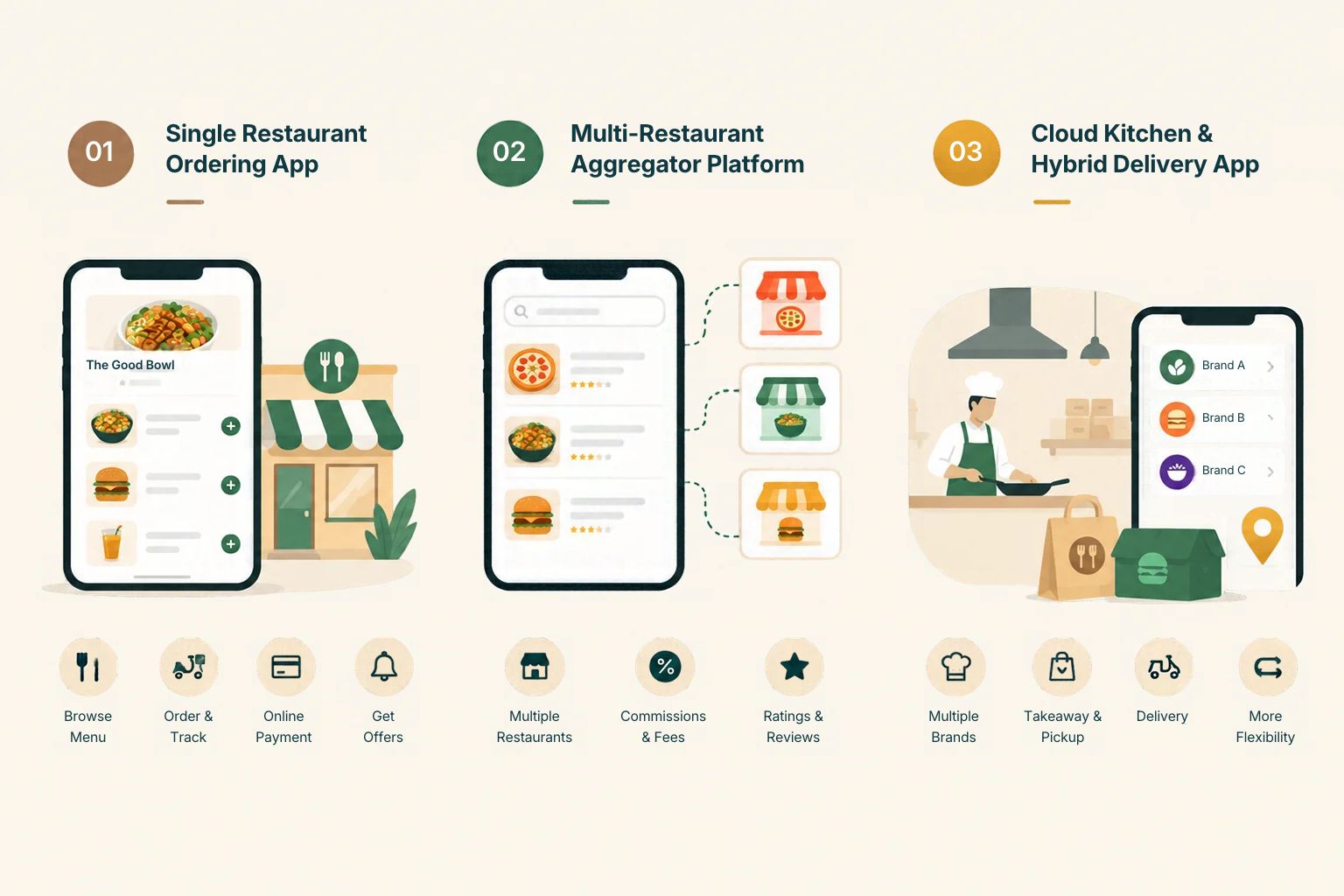
Choosing the right business model is one of the first decisions that determines the application's features, backend architecture, revenue structure, and operational complexity.
Single Restaurant Ordering App
A single-restaurant application gives one restaurant or restaurant group complete control over its digital ordering experience.
Customers can browse the menu, customize dishes, select delivery or pickup, pay online, track orders, and receive promotional notifications. The restaurant retains direct access to customer relationships rather than depending entirely on marketplace platforms.
This model is particularly useful for restaurant chains that want to strengthen their own digital presence.
Multi-Restaurant Aggregator Platform
An aggregator connects multiple restaurants with customers through one marketplace.
The platform can generate revenue through restaurant commissions, delivery fees, advertising placements, subscription plans, featured listings, or a combination of these models.
The challenge is operational complexity because the platform must coordinate restaurant onboarding, menu management, customer service, payments, commissions, delivery allocation, refunds, ratings, and dispute handling.
Cloud Kitchen and Hybrid Delivery App
Cloud kitchens can use food delivery applications to operate multiple brands from one or more commercial kitchens without relying on traditional dining spaces.
A hybrid platform can combine restaurant ordering, cloud-kitchen operations, takeaway, pickup, and delivery into one ecosystem.
This gives businesses greater flexibility to experiment with new brands, menus, locations, and customer segments.
Core Ordering Features Every Food Delivery App Needs
The ordering experience should be designed around one principle: customers should be able to discover what they want and complete their order with minimal friction.
Smart Menu and Search Experience
A well-structured menu should make it easy to understand dishes, prices, ingredients, portions, customization options, preparation times, dietary information, and availability.
Search should recognize restaurant names, dishes, cuisines, ingredients, and relevant categories rather than forcing users to browse endless lists.
Filters, Cuisine Categories, and Dietary Preferences
Filters can help users narrow results based on cuisine, price, ratings, delivery time, distance, offers, vegetarian options, vegan options, halal choices, spicy food, and other dietary preferences.
This becomes especially valuable in Dubai because of the market's cultural and dietary diversity.
Real-Time Menu and Stock Updates
Restaurants need the ability to mark dishes as available, unavailable, sold out, or temporarily paused.
Real-time synchronization prevents customers from ordering unavailable items and reduces cancellations caused by outdated menus.
Easy Cart and Checkout Flow
A complicated checkout process can turn a ready-to-buy customer into an abandoned cart.
The application should provide a clear breakdown of items, customization charges, delivery fees, discounts, taxes where applicable, and final payable amounts.
Address selection, delivery instructions, tip options, payment selection, and order confirmation should be presented in a logical sequence.
Secure Payment Options
Payment flexibility is essential for Dubai's digitally active consumer base.
Cards, Wallets, and Cash on Delivery
Depending on the business model, applications can support debit and credit cards, digital wallets, stored payment methods, and cash on delivery.
Wallet functionality can also become a loyalty tool by allowing businesses to issue credits, refunds, promotional balances, or rewards.
Local Payment Gateway Integration
The application should integrate payment providers appropriate to the UAE market and the company's commercial requirements.
For example, businesses can explore UAE-focused payment infrastructure such as Network International, while other international payment providers can be selected based on transaction requirements, settlement models, supported currencies, and business structure.
Order Scheduling and Reorder Options
Customers may want food delivered at a specific time rather than immediately. Scheduled ordering can be particularly useful for office lunches, family meals, events, and recurring requirements.
A reorder function can make repeat purchases faster by allowing customers to repeat a previous order without rebuilding their cart.
Multilingual Support (English and Arabic)
Arabic and English support can make the application more accessible to Dubai's diverse user base.
Localization should extend beyond translating buttons. Menus, notifications, promotional messages, customer support, error messages, payment flows, and right-to-left interface behavior should be considered during product design.
Delivery Features That Improve Speed and Customer Trust
Delivery is where the digital promise becomes a physical customer experience. Even a beautifully designed application can receive poor reviews if delivery estimates are inaccurate or customers cannot understand what is happening with their orders.
Live Order Tracking
Live tracking allows customers to see order progress from restaurant confirmation through preparation, pickup, transit, and delivery.
A map-based experience can display the delivery partner's approximate location and expected arrival time.
Smart Delivery Assignment and Route Optimization
A delivery engine can assign orders based on location, driver availability, current workload, distance, estimated preparation time, and delivery capacity.
Route optimization can reduce unnecessary travel and help businesses manage more orders with the available delivery fleet.
Delivery Partner App
The delivery partner application should include order acceptance, navigation, pickup confirmation, customer information, delivery instructions, status updates, earnings information, and support access.
For operational managers, driver availability and performance can also be monitored through an administrative dashboard.
Real-Time Notifications and Status Updates
Push notifications, SMS, email, or WhatsApp-based communications can inform customers when their order is accepted, being prepared, picked up, nearby, delivered, or delayed.
Accurate notifications reduce uncertainty and decrease the number of customers contacting support for basic order-status information.
Contactless Delivery and Proof of Delivery
The platform can support contactless delivery instructions, digital confirmation, delivery photos where appropriate, OTP verification, and other proof-of-delivery mechanisms.
These features can help resolve disputes while creating a clearer operational record.
Loyalty and Retention Features That Bring Customers Back
Customer acquisition can become expensive in a competitive delivery market, making retention an important component of the business model.
Points, Rewards, and Tier-Based Programs
A loyalty system can award points based on order value, frequency, referrals, reviews, or promotional campaigns.
Tier-based programs can offer progressively stronger benefits such as free delivery, exclusive offers, priority support, birthday rewards, or early access to promotions.
Coupons, Offers, and Referral Programs
Businesses can create first-order discounts, percentage-based promotions, restaurant-specific offers, time-limited campaigns, referral incentives, and personalized coupons.
The objective should not be to discount every order. Instead, promotions should be targeted toward specific business goals such as acquiring customers, increasing order frequency, moving slow inventory, or encouraging inactive users to return.
Subscription and Membership Plans
Membership programs can provide benefits such as free or discounted delivery, exclusive deals, priority access, or partner offers.
For customers who order frequently, a subscription can create measurable value while generating recurring revenue for the platform.
Personalized Recommendations
Recommendation systems can analyze previous orders, cuisine preferences, location, time of day, order frequency, and promotional responses.
A customer who frequently orders healthy lunches during weekdays, for example, could receive relevant lunch recommendations instead of generic restaurant promotions.
Ratings, Reviews, and Feedback Loops
Ratings provide social proof while helping restaurants identify service problems.
A mature platform can go beyond simple star ratings by collecting feedback about food quality, delivery speed, packaging, order accuracy, and overall experience.
Admin Panel and Restaurant Dashboard Features
The administrative ecosystem determines how efficiently the business can operate behind the customer-facing application.
Order and Inventory Management
Restaurants should be able to accept, reject, modify, and monitor orders while maintaining menu and stock availability.
Inventory alerts can help prevent orders for unavailable dishes and give managers better visibility into fast-moving items.
Analytics and Sales Reporting
Dashboards can display revenue, average order value, order volume, repeat customers, cancellation rates, delivery times, popular dishes, customer acquisition, and campaign performance.
These insights can turn the application into a decision-making tool rather than simply an ordering channel.
Commission and Payout Management
Aggregator businesses need automated commission calculations, restaurant settlements, delivery fees, refunds, adjustments, and payout reporting.
Automating these calculations reduces manual accounting work and provides greater transparency to restaurant partners.
Customer and Campaign Management
Administrators should be able to segment customers based on order history, location, spending, cuisine preferences, activity, or loyalty status.
Marketing campaigns can then be targeted instead of sending identical promotions to every user.
Advanced Features That Set Your App Apart
Competition in Dubai means businesses need more than basic ordering functionality to create a differentiated product.
AI-Based Recommendations and Demand Forecasting
AI can identify patterns in ordering behavior and forecast demand by location, time, cuisine, weather patterns, holidays, events, or historical sales.
For example, if a cloud kitchen consistently receives a surge in orders for a particular meal category during weekday evenings, forecasting models can help the business prepare inventory and staffing accordingly.
Recommendation models can simultaneously surface relevant dishes to customers, increasing the likelihood of additional purchases.
Group Ordering and Table Reservation Integration
Group ordering allows several people to contribute items to one shared order, making it useful for offices, families, and social gatherings.
Table reservation integration can connect delivery and dine-in experiences, allowing customers to discover a restaurant, reserve a table, or order food depending on their immediate needs.
Integration with POS and Third-Party Systems
POS integration can synchronize restaurant orders and menus with existing operational systems.
Other useful integrations can include accounting software, CRM systems, loyalty platforms, marketing tools, maps, payment providers, delivery management systems, customer-support platforms, and analytics services.
Food Delivery App Development Process
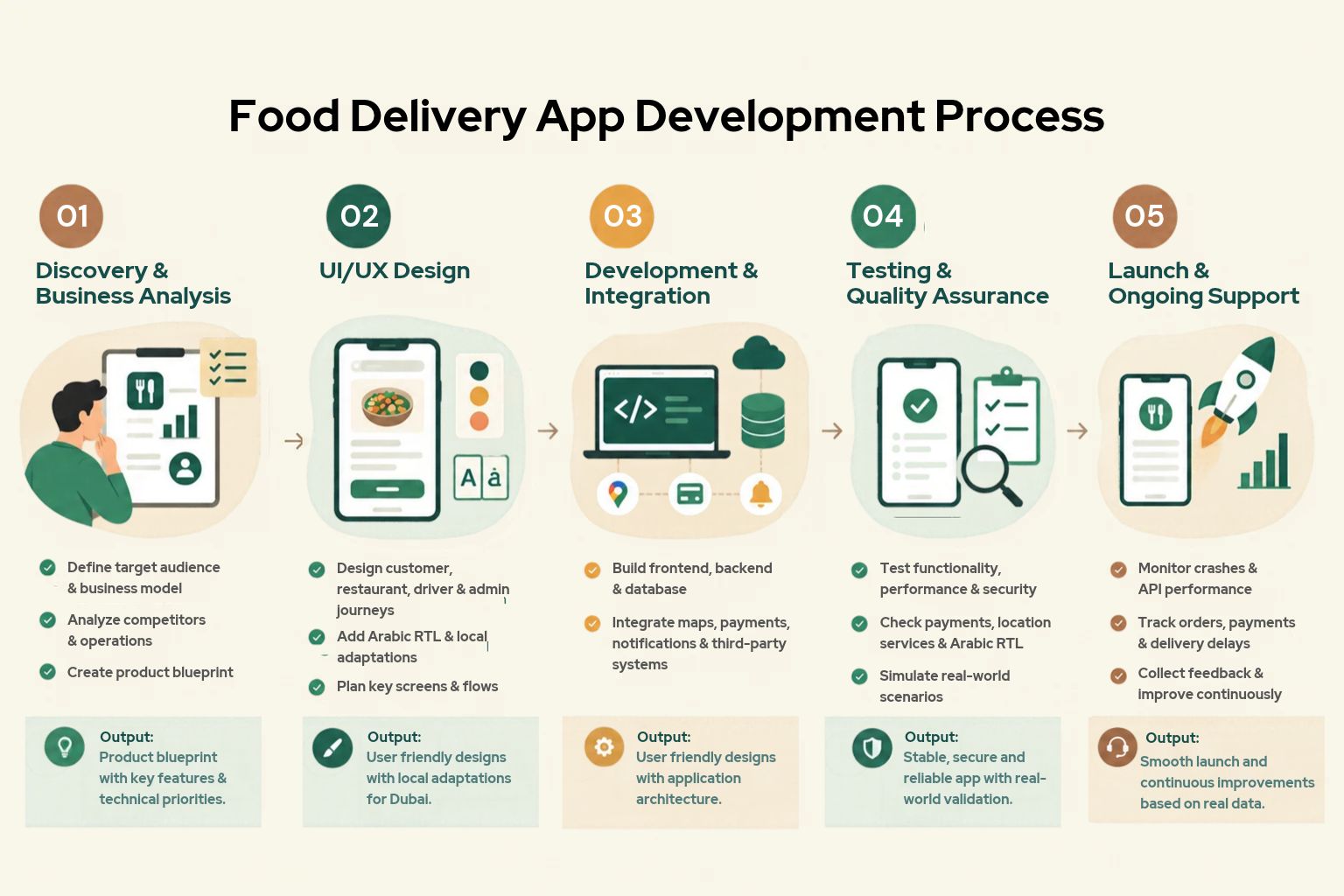
A structured development process reduces technical rework and ensures that business requirements remain connected to product decisions.
Discovery and Business Analysis
The process begins by defining the target customer, business model, restaurant ecosystem, delivery strategy, revenue model, geographic coverage, competitors, and operational requirements.
The result is a product blueprint that identifies essential features and technical priorities.
UI/UX Design
Design teams create customer, restaurant, delivery-partner, and admin journeys.
For Dubai-focused products, localization, Arabic RTL support, payment behavior, address formats, map interactions, and culturally appropriate interface patterns should be incorporated early.
Development and Integration
Developers then build the frontend, backend, database, APIs, dashboards, payment systems, maps, notifications, delivery management, and third-party integrations.
A modular architecture makes it easier to introduce new restaurants, cities, payment options, and features later.
Testing and Quality Assurance
Testing should cover functionality, performance, security, payment processing, location services, maps, notifications, device compatibility, Arabic RTL layouts, network conditions, and high-order scenarios.
Real-world simulations are especially valuable for testing simultaneous restaurant orders, driver allocation, payment failures, and location inaccuracies.
Launch and Ongoing Support
After deployment, teams should monitor crashes, API performance, order completion, payment failures, delivery delays, customer feedback, and infrastructure utilization.
Post-launch support is essential because operational data will reveal improvements that could not always be identified during development.
Technology Stack for Food Delivery App Development
The technology stack should be selected according to business requirements, expected scale, integrations, security requirements, and long-term maintenance strategy.
Frontend and Mobile Frameworks
Businesses can use native iOS and Android development or cross-platform frameworks such as Flutter or React Native.
Native development can be appropriate when device-specific performance or platform functionality is critical, while cross-platform development can accelerate delivery when the application has substantial shared functionality.
Backend and Database
The backend may use technologies such as Node.js, Python, Java, or .NET depending on architecture and engineering requirements.
Databases such as PostgreSQL, MySQL, or MongoDB can be selected based on the application's data model.
The architecture should support secure APIs, authentication, order management, real-time communication, analytics, and horizontal scaling.
Maps, Payments, and Cloud Infrastructure
Maps and location services can be powered through providers such as Google Maps Platform, while payment processing can be connected to appropriate UAE and international payment providers.
Cloud infrastructure from providers such as Amazon Web Services, Microsoft Azure, or Google Cloud can provide scalable computing, databases, storage, monitoring, and networking.
|
Technology Layer
|
Common Options
|
Primary Purpose
|
|
Mobile Application
|
Flutter, React Native, Swift, Kotlin
|
Customer and delivery experiences
|
|
Backend
|
Node.js, Python, Java, .NET
|
APIs and business logic
|
|
Database
|
PostgreSQL, MySQL, MongoDB
|
Users, orders, restaurants, transactions
|
|
Maps
|
Google Maps Platform, Mapbox
|
Location and route services
|
|
Cloud
|
AWS, Azure, Google Cloud
|
Hosting and scalability
|
|
Payments
|
UAE and international gateways
|
Secure transaction processing
|
|
Notifications
|
Firebase, SMS, email services
|
Order and promotional communication
|
|
Analytics
|
GA4, Mixpanel, custom dashboards
|
User and business intelligence
|
Factors That Influence Food Delivery App Development Cost
There is no single fixed cost for developing a food delivery platform because the technical scope can range from a branded restaurant ordering app to a large marketplace involving thousands of restaurants and delivery partners.
Feature Complexity and App Type
A single-restaurant application generally requires less infrastructure and fewer operational workflows than a multi-restaurant aggregator.
Live tracking, AI, loyalty programs, subscription plans, POS integration, advanced analytics, multilingual support, and automated delivery allocation can significantly increase development requirements.
Platform Choice (iOS, Android, or Both)
Developing for both iOS and Android increases testing and deployment requirements, although cross-platform frameworks can reduce duplicated development effort.
Businesses should choose platforms according to their target audience rather than automatically building every possible application from day one.
Design, Integrations, and Maintenance
Custom UI/UX, Arabic RTL design, payment integrations, POS connections, mapping systems, CRM integrations, cloud infrastructure, security, and post-launch maintenance all influence the overall investment.
The best approach is to prioritize features that directly support revenue, customer retention, and operational efficiency.
Compliance and Security Considerations in Dubai
Food delivery platforms process sensitive customer, payment, location, restaurant, and transaction information, making compliance and security fundamental rather than optional.
Data Protection and User Privacy
Businesses operating in the UAE should understand applicable privacy obligations under the UAE Personal Data Protection Law.
The application should implement appropriate data collection, storage, access, consent, retention, and security practices based on the business's legal obligations and operating structure.
Payment Security Standards
Payment processing should follow applicable security requirements and use established payment providers rather than storing sensitive card information unnecessarily.
Tokenization, secure APIs, encryption, authentication, fraud monitoring, and appropriate access controls can reduce payment-related security risks.
Licensing and Food Safety Compliance
Food businesses operating in Dubai must also consider applicable licensing and food-safety requirements.
The Dubai Municipality Food Safety Department provides information and regulatory resources relevant to food establishments and food safety in Dubai.
A technology platform should be designed so that operational workflows can support the business's regulatory requirements rather than creating additional compliance risks.
How to Choose the Right Food Delivery App Development Company in Dubai
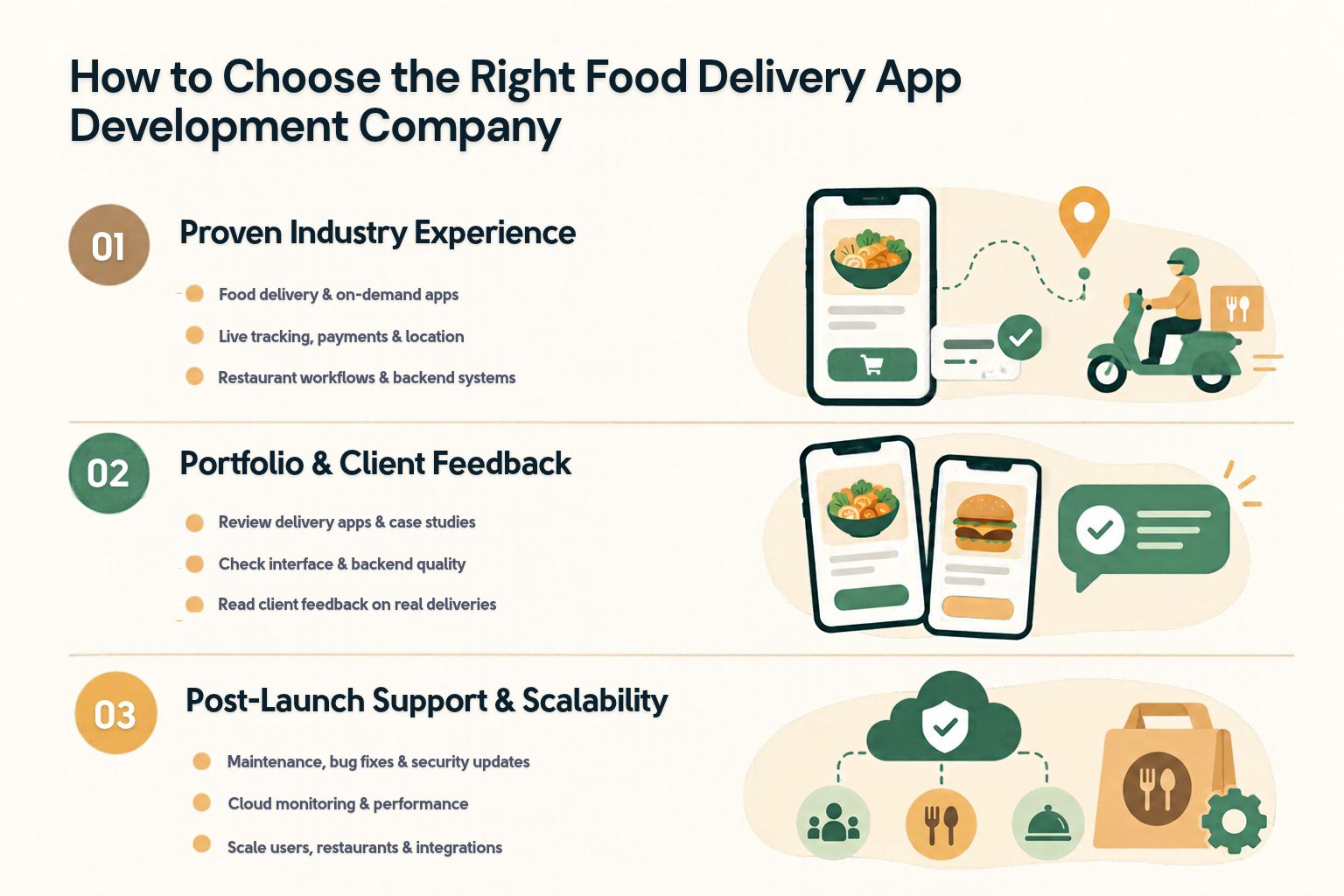
Selecting a development partner can have a major impact on product quality, scalability, and long-term operating costs.
Look for Proven Industry Experience
Look for a company that understands marketplace applications, real-time tracking, payment processing, location services, restaurant workflows, cloud architecture, and customer engagement.
Experience with food delivery or similar on-demand applications is particularly useful because the operational challenges are different from those of a standard content or business application.
Review Portfolio and Client Feedback
Review previous applications, technical case studies, interface quality, client feedback, and the company's ability to explain technical decisions.
A strong portfolio should demonstrate not only attractive screens but also evidence of reliable backend architecture and real-world product delivery.
Check Post-Launch Support and Scalability
The development relationship should not end immediately after app-store approval.
Ask about maintenance, bug fixing, cloud monitoring, security updates, performance optimization, feature enhancements, analytics, and scaling support.
A platform that succeeds in its first year will inevitably require new integrations, more users, additional restaurants, and evolving functionality.
Final Thoughts
Food delivery app development in Dubai presents an opportunity to build much more than a digital menu. A successful platform connects discovery, ordering, payments, restaurants, delivery operations, customer engagement, loyalty, analytics, and business intelligence into one seamless ecosystem.
The strongest products will focus on convenience while giving businesses greater control over their customers and operations. Features such as Arabic and English support, live tracking, smart recommendations, flexible payments, loyalty programs, AI-powered forecasting, and POS integrations can transform a basic ordering application into a competitive digital platform.
For restaurants, cloud kitchens, entrepreneurs, and food-service groups, the right technology strategy can create a direct digital channel that supports both immediate sales and long-term customer relationships.
Ready to build a food delivery platform for the Dubai market? TechQware can help transform your food-service idea into a scalable digital ecosystem with customer apps, restaurant dashboards, delivery solutions, admin panels, secure payments, real-time tracking, loyalty systems, AI capabilities, and third-party integrations. Connect with TechQware to discuss your food delivery app development requirements and build a platform designed for long-term growth.
FAQs
How much does food delivery app development cost in Dubai?
The cost depends on the business model, number of applications, feature complexity, integrations, design requirements, technology stack, security requirements, and expected scale. A basic single-restaurant application will cost considerably less than a multi-restaurant marketplace with customer, restaurant, delivery, and admin applications.
How long does it take to build a food delivery app?
A focused MVP can typically take several months, while a feature-rich marketplace can require significantly more development time. Requirements such as live tracking, advanced delivery optimization, loyalty, Arabic RTL support, POS integration, AI, and multiple payment systems can extend the timeline.
What are the must-have features of a food delivery app?
Essential features include restaurant and menu discovery, search, filters, cart, checkout, secure payments, address management, order scheduling, real-time tracking, notifications, ratings, customer support, restaurant management, delivery-partner management, and an admin dashboard.
Which food delivery app model is best for my business?
A single-restaurant app is suitable for businesses that want direct digital ordering, while a multi-restaurant marketplace is better for an aggregator business. Cloud kitchens can benefit from a hybrid platform supporting multiple brands and delivery operations.
Can I integrate local payment gateways in my app?
Yes, A food delivery application operating in Dubai can integrate suitable UAE payment providers alongside international payment solutions, subject to the business's commercial, technical, and regulatory requirements.
How do loyalty programs help food delivery businesses?
Loyalty programs encourage repeat purchases by giving customers reasons to return. Points, membership plans, referrals, personalized discounts, and tier-based rewards can increase order frequency and provide businesses with additional behavioral data for targeted campaigns.
Is it necessary to support Arabic in a Dubai food delivery app?
Arabic support is highly valuable for a Dubai-focused platform. It can improve accessibility and user experience for Arabic-speaking customers. A proper implementation should include RTL layouts, translated menus, notifications, checkout screens, customer support content, and other user-facing experiences rather than simply translating a few buttons.
What technology stack is best for a food delivery app?
There is no universal stack. Flutter or React Native can be useful for cross-platform mobile development, while Swift and Kotlin can be selected for native applications. Backend technologies such as Node.js, Python, Java, or .NET can support the application depending on architecture, team expertise, integrations, and scalability requirements.
Do I need separate apps for customers, restaurants, and delivery partners?
For a large marketplace, separate role-based applications or interfaces are generally beneficial because customers, restaurant staff, and delivery partners have very different workflows. A centralized admin panel is also required for managing users, restaurants, orders, payments, commissions, promotions, and platform operations.
How can I make my food delivery app stand out in the Dubai market?
Differentiation should come from the overall experience rather than one isolated feature. Faster ordering, accurate delivery estimates, Arabic and English experiences, personalized recommendations, loyalty benefits, reliable tracking, flexible payment options, restaurant-exclusive deals, group ordering, and strong customer support can collectively create a more compelling platform.