Key Takeaways:
- Super Apps bring multiple services like payments, shopping, messaging, and bookings into one platform.
- They improve customer retention by keeping users engaged within a single ecosystem.
- AI-powered personalization helps deliver better recommendations and user experiences.
- Businesses gain new revenue opportunities through cross-selling and integrated services.
- Fintech, healthcare, retail, travel, and logistics are leading Super App adoption.
- As demand for seamless digital experiences grows, Super Apps are shaping the future of mobile platforms.
Introduction
The digital economy has transformed significantly over the last decade. Consumers no longer interact with businesses through a single channel or a single service. They shop online, make payments digitally, communicate through messaging platforms, book travel, order food, manage healthcare appointments, and consume entertainment through mobile devices. As user expectations continue to evolve, businesses are increasingly searching for ways to simplify digital experiences while strengthening customer engagement.
This shift has led to the emergence of Super Apps, one of the most influential trends shaping the future of mobile applications. Rather than offering a single service, Super Apps combine multiple functionalities into a unified digital ecosystem. Users can access a variety of services through a single application, eliminating the need to download and manage multiple apps.
For businesses, Super Apps represent more than a technological innovation. They create opportunities to increase customer retention, improve engagement, generate multiple revenue streams, and establish powerful digital ecosystems. As organizations compete for customer attention in an increasingly crowded marketplace, Super Apps are becoming a strategic advantage rather than just a technology trend.
Rise of Super Apps Globally
The concept of Super Apps originated in Asia and quickly demonstrated how a single application could become an essential part of daily life. What started as messaging or transportation platforms gradually expanded into comprehensive ecosystems offering financial services, eCommerce, food delivery, entertainment, healthcare, and more.
Today, millions of consumers use Super Apps every day to perform a wide variety of tasks without switching between applications. This convenience has significantly influenced customer behavior and encouraged businesses across the globe to adopt similar strategies.
The global rise of mobile-first consumers, digital payments, and AI-powered experiences has accelerated the growth of Super Apps. Companies are increasingly recognizing that customers prefer integrated experiences over fragmented digital journeys. As a result, the Super App model is gaining traction not only in Asia but also in North America, Europe, the Middle East, and emerging digital markets.
Why Businesses Are Investing in Multi-Service Platforms
Businesses invest heavily in Super Apps because they offer a unique opportunity to create deeper customer relationships. Every additional service within a platform increases the likelihood that users will spend more time within the ecosystem rather than exploring competitor applications.
For example, a customer may initially use an app for payments. Over time, the same user may begin shopping, booking travel, purchasing insurance, ordering food, or using financial services within the same platform. Each interaction strengthens customer loyalty while creating new revenue opportunities.
Organizations also benefit from centralized customer data, enabling advanced personalization and improved decision-making. Instead of analyzing behavior across disconnected applications, businesses gain a comprehensive understanding of user preferences and engagement patterns.
Global Super App Market Statistics
The growing popularity of Super Apps is reflected in market research and industry forecasts.
|
Market Indicator
|
Industry Trend
|
|
Smartphone Users Worldwide
|
More than 6 billion users globally
|
|
Mobile Commerce Growth
|
Continues to increase year over year
|
|
Digital Wallet Adoption
|
Growing rapidly across multiple regions
|
|
AI-Powered Personalization
|
Becoming a standard expectation
|
|
Multi-Service Platform Usage
|
Increasing among digital consumers
|
According to industry reports from Statista and Gartner, mobile-first ecosystems are expected to drive significant digital revenue growth over the coming years. Businesses that successfully create integrated digital experiences are likely to gain competitive advantages in customer acquisition and retention.
What is a Super App?
As businesses seek to improve customer experiences and maximize digital engagement, understanding the concept of a Super App becomes increasingly important.
Definition of Super Apps
A Super App is a mobile application that combines multiple services, products, and functionalities within a single platform. Instead of focusing on one purpose, it acts as a digital ecosystem where users can access various services without leaving the application.
A typical Super App may include messaging, digital payments, eCommerce, ride-hailing, healthcare services, travel bookings, entertainment, and loyalty programs. The goal is to provide users with a seamless, all-in-one experience that simplifies everyday activities.
Unlike standalone applications that solve a specific problem, Super Apps are designed to become an integral part of users' daily lives by addressing multiple needs within one environment.
Evolution of Multi-Service Platforms
The evolution of Super Apps reflects broader changes in consumer behavior and technology capabilities. Early mobile applications focused on individual functions because hardware limitations and connectivity challenges restricted what could be achieved.
As smartphones became more powerful and cloud computing matured, businesses gained the ability to integrate multiple services into a single platform. APIs, microservices, AI, and cloud-native infrastructure made it easier to create scalable ecosystems capable of supporting millions of users.
Over time, companies realized that integrated platforms improved customer convenience and reduced friction. This realization transformed many successful applications into comprehensive digital ecosystems.
Difference Between Traditional Apps and Super Apps
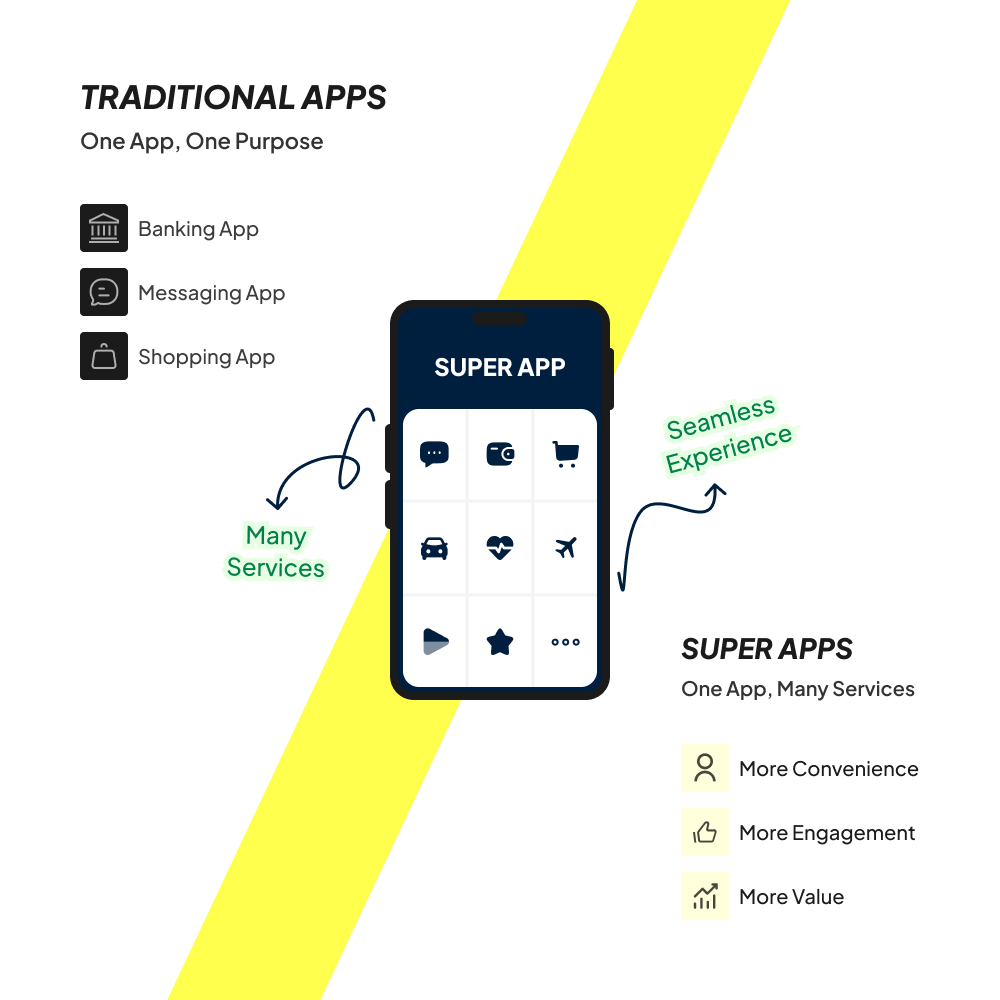
Traditional applications typically focus on one primary function. A banking app facilitates transactions, a messaging app supports communication, and a shopping app enables purchases.
Super Apps combine these capabilities into one platform. Users do not need to switch between applications or manage multiple accounts. Everything operates within a unified environment, creating a more streamlined and efficient experience.
This integrated approach benefits both consumers and businesses. Customers enjoy convenience, while organizations increase engagement and create additional monetization opportunities.
Why Super Apps Are Growing Rapidly
The rapid expansion of Super Apps is driven by evolving consumer expectations and business priorities.
Consumer Preference for Unified Experiences
Modern consumers expect convenience and efficiency. Managing numerous applications for different tasks can be frustrating and time-consuming.
Super Apps eliminate this challenge by centralizing services. A user can pay bills, communicate with friends, order products, schedule appointments, and access financial services from a single application.
This convenience significantly enhances user satisfaction and contributes to stronger adoption rates.
Increased User Retention
Customer retention remains a major challenge for digital businesses. Super Apps address this issue by encouraging users to engage with multiple services within the same ecosystem.
The more services customers utilize, the more dependent they become on the platform. This increased reliance naturally improves retention and customer lifetime value.
Higher Engagement and Revenue Opportunities
Super Apps create numerous touchpoints throughout the customer journey. Each interaction provides opportunities for engagement, personalization, and monetization.
Businesses can promote complementary services, offer targeted recommendations, and introduce premium features based on user behavior.
Business Ecosystem Expansion
One of the most powerful aspects of the Super App model is its ability to support ecosystem growth.
Companies can expand into new markets and industries without requiring customers to adopt additional platforms. This flexibility enables sustainable growth while reducing customer acquisition costs.
Key Features of a Successful Super App
A successful Super App combines multiple technologies and user-centric features to create a seamless experience.
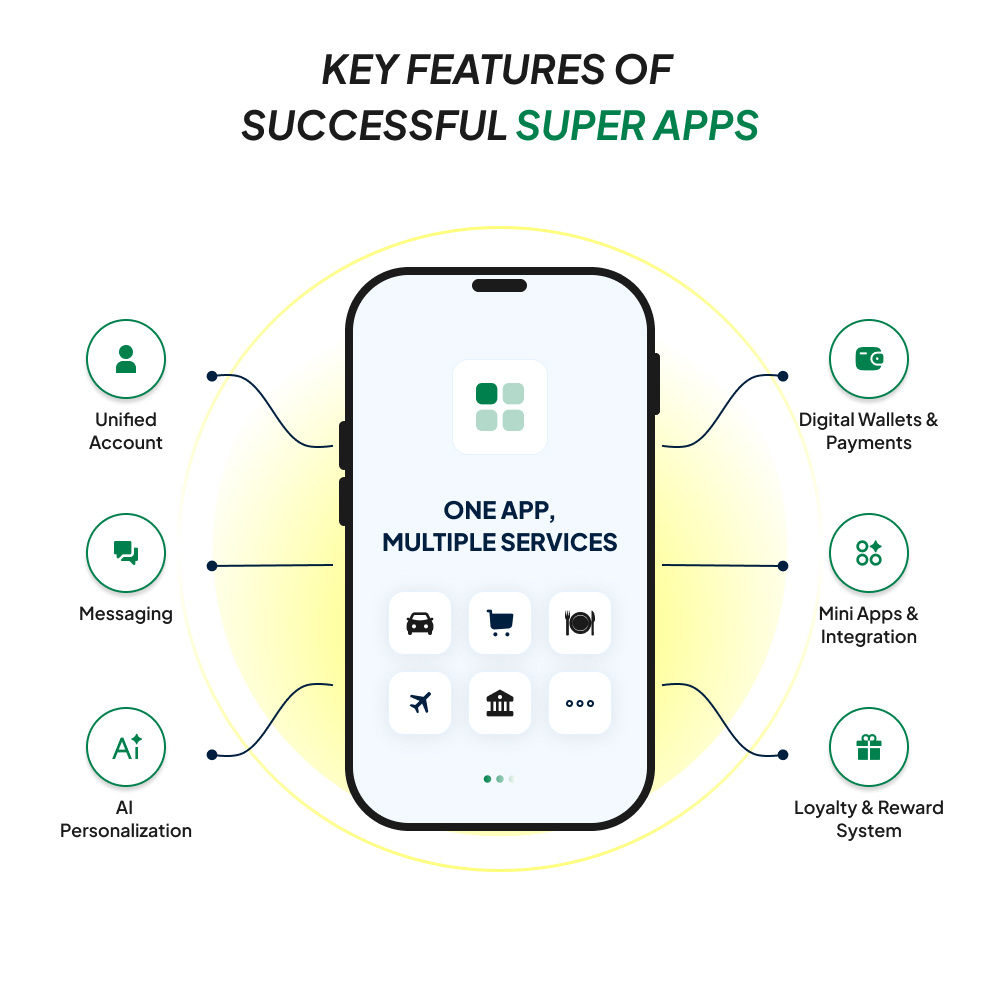
Unified User Accounts
Unified account systems allow users to access all services through a single login.
This approach simplifies onboarding, improves convenience, and enables consistent experiences across multiple functionalities.
Digital Wallets and Payments
Digital payment capabilities are often at the core of Super Apps.
Integrated wallets support purchases, transfers, subscriptions, rewards, and financial services while creating a frictionless transaction experience.
Messaging and Communication
Communication features increase engagement and support customer interactions.
Messaging systems may facilitate peer-to-peer communication, customer support, business notifications, and service updates.
Mini Apps and Integrations
Mini Apps enable businesses and third-party developers to offer specialized functionality within the Super App ecosystem.
This model accelerates innovation while expanding service offerings without increasing application complexity.
AI Personalization
Artificial intelligence enhances user experiences through intelligent recommendations and personalized interactions.
AI can analyze customer behavior, predict preferences, and present relevant products and services at the right time.
Loyalty and Rewards Systems
Rewards programs encourage continued engagement by providing incentives for platform usage.
Points, cashback programs, discounts, and exclusive benefits strengthen customer loyalty and increase transaction frequency.
How Super Apps Work
The functionality of a Super App depends on sophisticated architecture and seamless integration between services.
Super App Ecosystem Architecture
Super Apps operate as interconnected ecosystems where multiple services share infrastructure, user accounts, and data resources.
This architecture allows businesses to deliver unified experiences while maintaining operational efficiency.
Mini-App Infrastructure
Mini-App infrastructure enables rapid expansion by allowing external services to operate within the primary application.
This approach creates a marketplace-like environment where users can access additional services without downloading separate apps.
API and Third-Party Integrations
APIs connect internal systems with external partners and service providers.
These integrations support payment gateways, logistics providers, healthcare systems, travel platforms, and numerous other services.
Data Synchronization and User Management
Data synchronization ensures consistency across all services.
User preferences, transaction histories, rewards, and account information remain updated throughout the ecosystem.
Super App Architecture Explained
The technical foundation of a Super App plays a critical role in scalability and performance.
Microservices Architecture
Microservices divide applications into smaller, independent components that can be developed, deployed, and maintained separately.
This approach improves flexibility and enables faster innovation.
Cloud Infrastructure
Cloud platforms provide the scalability necessary to support growing user bases and increasing service complexity.
Cloud-native environments also improve reliability, performance, and disaster recovery capabilities.
AI and Recommendation Systems
Recommendation engines analyze user behavior to deliver personalized experiences.
These systems increase engagement by presenting relevant products, services, and content.
Security and Compliance Layers
Strong security frameworks protect sensitive information and maintain regulatory compliance.
Businesses must implement encryption, identity management, fraud detection, and monitoring systems to safeguard users.
Benefits of Super Apps for Businesses
The business advantages of Super Apps extend beyond customer convenience.
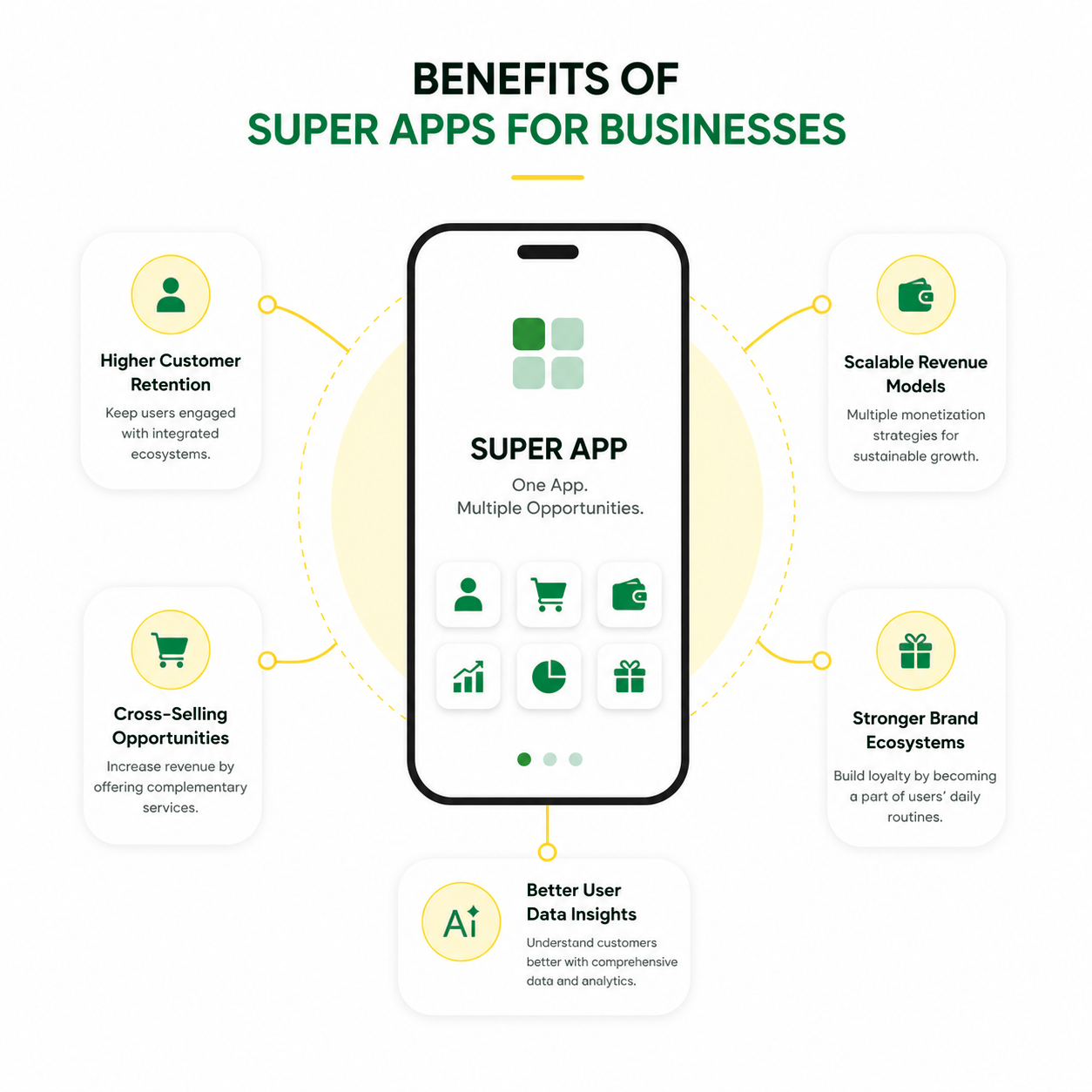
Higher Customer Retention
Integrated ecosystems encourage users to remain active within a platform, improving long-term retention rates.
Cross-Selling Opportunities
Businesses can introduce complementary services to existing customers, increasing revenue without significant acquisition costs.
Better User Data Insights
Comprehensive customer data enables deeper understanding of behavior, preferences, and purchasing patterns.
Scalable Revenue Models
Super Apps support multiple monetization strategies including subscriptions, commissions, advertising, transaction fees, and premium services.
Stronger Brand Ecosystems
By becoming central to users' daily routines, Super Apps strengthen brand loyalty and competitive positioning.
Industries Building Super Apps
Several industries are actively embracing the Super App model.
Fintech
Financial institutions combine payments, banking, investments, lending, and insurance services within unified platforms.
Retail and Commerce
Retailers integrate shopping, payments, rewards, customer support, and delivery services.
Travel and Hospitality
Travel businesses offer bookings, accommodations, transportation, payments, and travel experiences through a single platform.
Healthcare
Healthcare organizations provide telemedicine, appointment scheduling, prescription management, insurance coordination, and patient engagement tools.
Logistics and Delivery
Logistics companies integrate shipment tracking, transportation management, inventory visibility, and communication capabilities.
Technologies Used in Super App Development
Technology plays a central role in enabling scalable and intelligent Super Apps.
AI and Personalization Engines
AI drives recommendation systems, predictive analytics, fraud detection, and customer support automation.
Cloud-Native Infrastructure
Cloud-native technologies provide scalability, resilience, and operational efficiency.
APIs and Microservices
APIs and microservices enable modular development and seamless integrations.
Payment Gateway Integrations
Secure payment gateways facilitate transactions across multiple services.
Real-Time Analytics
Analytics platforms provide actionable insights that support decision-making and optimization.
Challenges in Super App Development
Developing a Super App presents several technical and operational challenges.
Scalability Challenges
Supporting millions of users requires careful planning and infrastructure optimization.
Complex User Experience Management
Maintaining simplicity while offering numerous services can be challenging.
Data Security and Privacy
Protecting sensitive customer information is essential for maintaining trust.
Infrastructure Costs
Large-scale ecosystems require significant investments in technology and operations.
Third-Party Integration Challenges
Integrating external services often introduces technical complexity and ongoing maintenance requirements.
Super App Development Process
Building a successful Super App requires a strategic and structured approach.
Market Research and Strategy
Research helps identify customer needs, competitive opportunities, and market gaps.
Feature Planning
Businesses must prioritize features that align with customer expectations and business objectives.
UI/UX Design
User experience design ensures accessibility, usability, and engagement.
Backend and Infrastructure Development
Development teams build scalable systems capable of supporting growth.
Testing and Deployment
Comprehensive testing ensures performance, security, and reliability.
Continuous Scaling and Optimization
Successful Super Apps evolve continuously through updates, enhancements, and infrastructure improvements.
Cost of Building a Super App
Super App development costs vary depending on complexity and business requirements.
Factors Affecting Super App Development Cost
Feature scope, integrations, infrastructure, security requirements, and scalability objectives all influence development costs.
MVP vs Enterprise Super App
An MVP focuses on validating core functionality, while enterprise-grade platforms require extensive infrastructure and advanced capabilities.
Infrastructure and Maintenance Costs
Long-term success requires ongoing investments in hosting, monitoring, updates, and customer support.
|
Development Component
|
Relative Cost Impact
|
|
Research & Planning
|
Medium
|
|
UI/UX Design
|
Medium
|
|
Core Development
|
High
|
|
Integrations
|
High
|
|
Cloud Infrastructure
|
Ongoing
|
|
Maintenance & Optimization
|
Ongoing
|
Future of Super Apps
The future of Super Apps is closely connected to AI and ecosystem-driven innovation.
AI-Powered Super Apps
AI will continue enhancing personalization, automation, and predictive capabilities.
Agentic Commerce
AI agents may soon conduct transactions, bookings, and purchasing activities on behalf of users.
AI-Native Ecosystems
Future Super Apps will embed intelligence into every layer of the platform.
Global Expansion of Multi-Service Platforms
As digital adoption grows worldwide, Super Apps are expected to expand into new industries and markets.
Final Thoughts
Super Apps are redefining the digital landscape by transforming standalone applications into comprehensive ecosystems capable of serving multiple user needs. As consumers increasingly demand convenience, personalization, and seamless experiences, businesses are recognizing the strategic value of integrated platforms.
From fintech and healthcare to retail and logistics, organizations across industries are investing in Super App development to improve customer retention, create diversified revenue streams, and strengthen brand ecosystems. By combining AI, cloud-native technologies, advanced analytics, and scalable architecture, Super Apps are becoming a powerful driver of digital transformation.
At TechQware Technologies, we specialize in building next-generation Super Apps that combine cutting-edge technology, AI-powered personalization, secure payment systems, cloud-native architecture, and exceptional user experiences. Whether you are looking to create a fintech ecosystem, healthcare platform, retail marketplace, travel solution, or multi-service digital platform, our experienced team can help bring your vision to life.
Ready to build a scalable, future-ready Super App that drives engagement, retention, and revenue growth? Contact us today and discover how our custom Super App development services can help your business create a powerful digital ecosystem that stands out in today's competitive market.
FAQs
What is a super app?
A Super App is a multi-service digital platform that combines various functionalities such as payments, shopping, messaging, and service bookings within a single application.
How do super apps work?
Super Apps operate through integrated ecosystems supported by APIs, cloud infrastructure, microservices, and centralized user management.
What are examples of successful super apps?
Several globally recognized platforms have successfully integrated transportation, payments, commerce, financial services, and communication capabilities into unified ecosystems.
What features should a super app have?
Key features include unified accounts, digital payments, messaging, mini-app support, AI personalization, and loyalty programs.
How much does super app development cost?
Costs depend on complexity, integrations, infrastructure requirements, and business objectives.
Which industries benefit from super apps?
Fintech, healthcare, retail, logistics, travel, and numerous other industries can leverage Super Apps to improve customer engagement and revenue generation.
What technologies are used in super apps?
Cloud computing, AI, microservices, APIs, payment gateways, and analytics platforms are commonly used in Super App development.
Are super apps the future of digital platforms?
Many industry experts believe Super Apps represent the next evolution of digital ecosystems because they combine convenience, personalization, and multiple revenue opportunities within a unified experience.

 TechQware
.png)