Key Takeaways:
- Build an MVP first to validate your idea before investing in advanced features.
- Core features like booking, GPS tracking, payments, and ratings are essential for launch.
- A typical Uber-style MVP takes 4–6 months and costs $220K–$365K.
- AI-powered routing and demand prediction can improve efficiency and reduce operational costs.
- A commission-based business model remains the most effective monetization strategy for on-demand apps.
- Budget 20–30% of your initial development cost annually for maintenance, updates, and scaling.
Why Entrepreneurs Are Betting on the On-Demand Model and Why 2026 Is Your Golden Opportunity
The on-demand economy has evolved from a Silicon Valley experiment into a $335 billion global industry that's reshaping how consumers access services, and smart entrepreneurs are capitalizing on this shift at unprecedented scale. The statistics are compelling: between 2019 and 2024, the global on-demand services market grew at a compound annual growth rate (CAGR) of 18.3%, with projections indicating continued expansion through 2030 as consumer preferences permanently shift toward convenience-first solutions. What makes this moment particularly advantageous for new entrants is the democratization of technology enterprise-grade infrastructure, AI capabilities, and payment processing that once required millions in development investment are now accessible to startups with modest budgets.
Consider the real-world impact: TaskRabbit, which started in 2008 with a simple MVP, now operates in over 70 cities and generates hundreds of millions in annual transaction volume. Similarly, Instacart disrupted grocery delivery by recognizing a specific pain point in the market. These successes weren't built on unlimited venture capital alone; they were built on understanding market gaps, solving real problems, and executing strategic technology choices. In India specifically, the on-demand economy is experiencing explosive growth with platforms like Swiggy, Dunzo, and UrbanClap creating thousands of employment opportunities while generating billions in economic value. The Confederation of Indian Industry estimates that India's gig economy will create 23.8 million jobs by 2029, up from 7.7 million in 2020.
What's changed since the early days of Uber is the competitive landscape. Today's entrepreneurs must build smarter apps with better user experiences, more sophisticated matching algorithms, and stronger unit economics from day one. The barriers to entry have lowered, which means the barriers to sustainable differentiation have risen. This guide exists to help you navigate that reality to understand not just what features you need, but why they matter, how much they cost, and most importantly, how to build a business around them that actually generates profits.
Is an Uber-Style App Right for Your Business Idea? Understanding Market Viability Before You Invest
Not every business idea requires an Uber-style on-demand platform, and the entrepreneurs who succeed are those who critically evaluate whether this model actually serves their market. The on-demand business model excels when three conditions are met:
- There's immediate demand that can't wait days for fulfillment.
- The service requires geographic proximity between supply and demand.
- You can build sustainable unit economics where supply and demand consistently match at profitable price points.
Let's examine this practically. A rush healthcare consultation platform where patients need expert advice within hours? Perfect for the on-demand model because time sensitivity is inherent to the use case. A furniture rental service for special events? Excellent because geographic constraints are real customers need physical items delivered to their location quickly. A freelance accounting service? Less ideal for on-demand because most accounting needs aren't time-sensitive, and the supply-demand matching becomes complex (clients want specific expertise, not just any accountant).
The graveyard of failed startups is filled with companies that built impressive technology for markets that didn't actually want it. Homejoy, a home-cleaning platform once valued at $600 million, shut down in 2015 despite massive market size because they couldn't achieve sustainable unit economics supply and demand never aligned efficiently enough at prices consumers would pay. This failure teaches a crucial lesson: market demand and business model fit are prerequisites for technology investment.
What This Guide Will Help You Decide and How to Use It for Maximum Impact
This comprehensive guide walks you through every dimension of on-demand app development so you can make informed decisions about building, timing, and scaling your platform. You'll understand the business models that work, the technology stacks that scale, the costs associated with different levels of sophistication, and crucially, how to avoid the common mistakes that doom first-time founders.
As you read, keep these questions in mind: What specific market gap am I addressing? Who are my initial users, and how will I acquire them? Can I achieve profitability at scale, or am I depending on indefinite subsidy? What geographic market will I launch in first, and why? The sections that follow will give you the frameworks to answer these questions rigorously. By the end of this guide, you'll have a clear picture of what it actually takes to build and scale an on-demand app in 2026, and you'll be equipped to make the critical decision of whether this path is right for your business.
Understanding the Uber Business Model and How It Applies to Your Industry
How Uber's App Ecosystem Actually Works and Why Understanding This Architecture Matters for Your Launch
Uber's genius wasn't inventing ride-sharing it was creating a technological and operational framework that solved the coordination problem that had plagued traditional taxi industries for decades. To understand how to build your own on-demand app, you need to understand the core mechanics of how Uber actually works, because the same fundamental architecture applies across virtually every on-demand service category.
At its core, Uber operates a real-time matching system. When a customer opens the app and requests a ride, Uber's algorithm must simultaneously consider dozens of variables: driver location and availability, passenger location, estimated trip duration, surge pricing conditions, driver rating history, passenger safety score, traffic conditions, and predicted demand in the next 15 minutes. This happens in milliseconds. The algorithm then presents options to available drivers within a defined radius, and the moment a driver accepts, both parties see real-time location tracking, route optimization, and dynamic ETA updates. Payment processes automatically, instantly no cash, no friction, no surprises when the ride ends.
The technology stack enabling this is sophisticated. Uber uses geospatial databases (which efficiently store and query location data), WebSocket connections (which maintain real-time two-way communication between app and server), machine learning models trained on millions of historical trips (to predict demand patterns and optimize pricing), and distributed systems architecture (to handle millions of concurrent requests without service degradation). When you build your on-demand app, you're not copying a feature set you're implementing this same real-time, location-aware, algorithm-driven coordination system, adapted for your specific service category.
The business model itself is elegant in its simplicity but brutal in its execution: Uber takes a commission on every transaction (typically 20-30% from riders, with variable percentages from drivers), charges service fees, and in some markets, has implemented subscription models (Uber Plus, Uber Pass) to create predictable revenue. The platform generates 80%+ of revenue while drivers and restaurants generate the service, but Uber controls the supply-demand matching algorithm, the pricing, and the customer relationship. This is the fundamental power dynamic in every on-demand marketplace.
The Three Apps You'll Need to Build and Why Each Requires Distinct Technical and UX Considerations
Most entrepreneurs don't realize they're actually building three separate applications when they decide to create an on-demand platform, not one. Each has different requirements, different user journeys, and different complexity considerations. Understanding this distinction is critical for budgeting, timeline planning, and technical architecture decisions.
The Customer App is what most people think of when they imagine an on-demand platform. This is the consumer-facing application where users browse available services, place orders, track real-time progress, make payments, and rate their experience. For a ride-hailing app, this is the passenger interface; for food delivery, it's the diner interface; for home services, it's the homeowner interface. The customer app must be elegant, intuitive, and fast. Users will abandon your platform if the booking experience takes more than 45 seconds. It requires an integrated map interface (for location-based search), real-time notifications (so users know their order status), payment processing (with PCI-DSS compliance), and customer support integration (so users can reach help when something goes wrong). The customer app is your primary brand touchpoint, so the UX quality directly correlates to retention and word-of-mouth growth.
The Provider App (driver app, restaurant app, service provider app) is equally complex but optimized for a completely different user journey. Providers need to efficiently manage availability, track earnings, see incoming requests with relevant context (pickup location, customer rating, estimated destination for drivers), and access support tools. Unlike customers, providers use these apps during their work, often while multitasking or in transit, so the interface must be glanceable and work with one hand. Providers need transparency into commission structure and earnings, sophisticated navigation capabilities, and mechanisms to communicate directly with customers when necessary. The provider app is where you make or lose money if providers can't efficiently accept and complete orders, your supply side fractures. A UX change in the provider app can shift your commission costs by 5-10% because it affects how efficiently providers work.
The Admin Dashboard is the operational nerve center that most entrepreneurs forget to budget for properly, yet it's absolutely essential. Admins use this platform to monitor platform health, manage disputes between customers and providers, handle customer support escalations, analyze performance metrics, manage incentives and promotions, remove fraudulent users, track driver/provider quality, adjust dynamic pricing, and generate financial reports. The admin dashboard requires role-based access controls (different admins have different permissions), real-time dashboards (so ops teams can respond to supply shortages immediately), and complex reporting tools. During my work with platforms handling 50,000+ daily transactions, we learned that a poorly designed admin dashboard increases issue resolution time by 300% a support team that could resolve disputes in 10 minutes took 30 minutes with a slow, unclear interface.
Can the Uber Model Work for Your Industry? Critical Questions to Evaluate Market Fit
The Uber model works brilliantly in some industries and generates losses in others. Before you commit to building your platform, honestly evaluate whether the fundamentals align with your market.
The Uber model thrives when: (1) supply and demand need to match in real-time or near-real-time (same-day delivery works; mail fulfillment doesn't), (2) geographic proximity is fundamental to the transaction (you need a driver near you; you don't need a plumber near you before calling), (3) the service can be standardized sufficiently that any provider can fulfill any request (ride-sharing allows this; specialized medical services don't), (4) the transaction frequency is high enough that network effects create value (daily food delivery creates habits; quarterly furniture moving doesn't generate the same habit), and (5) you can achieve positive unit economics at scale (the revenue from a transaction exceeds the costs to facilitate it).
Conversely, the Uber model fails when service complexity prevents real-time standardization (custom software development requires deep consultation, not instant matching), when supply concentration is inherent (if only 5% of people can provide a service, network effects never build), when the customer acquisition cost exceeds lifetime customer value (we've seen this in niche B2B services), or when regulatory barriers prevent geographic expansion (which we'll discuss later).
A practical framework: calculate your unit economics. If a customer average order value is $30, your commission is 20% ($6), and your payment processor costs are 2.9% plus $0.30, you're left with roughly $5 in revenue per transaction. If customer acquisition cost is $15, you need that customer to place 3 orders before you break even on acquisition. If average customer lifetime is 4 orders, you're profitable. If it's 2 orders, you're not. These simple calculations tell you whether the Uber model works for your specific market, before you spend six months building the technology.
On-Demand App Ideas You Can Build Like Uber and Market Categories Ripe for Disruption
Ride-Hailing and Transportation Services Beyond Traditional Taxi Replacement
When most people think about ride-hailing, they picture Uber and Lyft. But this category has fragmented into dozens of sub-segments, each with distinct economics and competitive opportunities. Traditional ride-hailing (everyday point-to-point travel) in major cities is hypercompetitive and capital-intensive due to subsidized pricing wars. Smarter entrepreneurs are targeting adjacent segments with better unit economics.
Corporate ride services for employees represent a $8.2 billion market with higher transaction values and consistent demand. Companies budget for employee transportation but lack visibility into spend; a B2B ride platform that integrates with expense systems and provides compliance tracking can command 25-35% commissions. Similarly, airport and long-distance transportation (airport-to-hotel, city-to-city) has different economics than short city rides lower frequency but significantly higher average order value. Specialized driver transportation (medical transport for elderly patients, dialysis appointments) combines ride services with compliance requirements, enabling premium pricing and lower price sensitivity. Premium ride services (luxury cars, executive drivers) exist in high-end markets but remain fragmented, with no dominant national player in many regions.
The real opportunity in ride-hailing isn't competing with Uber it's either dominating a specific geographic market (where you can achieve 80%+ penetration before a competitor notices), serving a specific demographic or use case better than generic platforms, or integrating with complementary services. In India, Jugaad Ride focuses on affordable ride-sharing with unique features for tier-2 cities, where Uber has limited presence, and has achieved profitability while remaining regional.
Food and Grocery Delivery Expanding Beyond Urban Convenience
Food delivery has matured as a category but remains fragmented. Swiggy and Zomato dominate Indian markets but struggle with profitability at scale.
The global food delivery market reached $128 billion in 2024, growing at 11.3% annually, but unit economics remain challenging. Yet opportunities exist in specific niches and geographies.
Cloud kitchens (restaurants without front-of-house dining) create inventory management challenges they need demand prediction and inventory optimization. A delivery platform that integrates inventory management with demand forecasting can increase cloud kitchen efficiency by 30-40%, enabling premium commission rates. Ghost kitchens also benefit from marketplace dynamics; a platform that helps coordinate multiple ghost kitchens serving a neighborhood can offer consumers greater selection and faster delivery through optimized routing.
Grocery delivery specifically has different unit economics than restaurant delivery. Grocery items are higher volume, lower margin, and sensitive to delivery time (customers want fresh items, not items that sat in a vehicle for 2 hours). Building a platform specifically optimized for grocery (with pickup-from-warehouse-aisle precision, colder delivery vehicles, optimization for density) can be more profitable than horizontal platforms. Similarly, meal subscription integration where customers get recurring meal plans and your platform optimizes delivery routes around these schedules creates predictability and improves economics.
Home Services and On-Demand Repairs Solving the Trust and Reliability Problem
The home services market is fragmented globally, with no single player commanding more than 5-10% of any major market. This fragmentation exists partly because trust is everything you're inviting a stranger into your home and partly because service quality varies dramatically. There's an enormous opportunity for a platform that solves the trust problem better than competitors.
TaskRabbit and Urban Company have demonstrated the model works, but they face supply side challenges: ensuring consistent quality, managing cancellation rates, and achieving provider retention. A home services platform that differentiates on any of these dimensions can capture market share. Some approaches: hyper-local networks (one city at a time, building deep community trust before scaling), specific service verticals (focusing only on appliance repair, or plumbing, or cleaning, and building expert reputation), or integration with consumer insurance where platforms help insurers expedite claim repairs.
Real scenario: A startup in Southeast Asia focused on air-conditioning repair (high demand, seasonal spikes, quality variance is dangerous) achieved 60% of the market in their city by ensuring every technician was certified, response time was under 2 hours, and pricing was transparent with no hidden charges. Their model involved training and certifying all service providers themselves, which required capital but created genuine quality differentiation. They now operate at 35% net margins because trust and quality justified premium pricing.
Logistics and Courier Delivery Creating Micro-Fulfillment Networks
E-commerce remains fragmented in fulfillment logistics. While established players like DHL, FedEx, and Amazon handle macro logistics, micro-logistics (last-mile delivery in congested cities) remains inefficient. A platform that coordinates local couriers, freelance delivery personnel, and small logistics operators can optimize routes and reduce delivery costs by 20-30% compared to incumbent operators.
In India, platforms like Ecom Express and Xpressbees have built massive networks, but opportunities exist for city-specific or vertical-specific logistics. Same-day delivery for e-commerce (what Amazon Prime requires heavy investment to provide) could be achieved through platforms that aggregate existing logistics capacity. Likewise, B2B logistics (coordinating local deliveries for small retail shops) remains largely manual.
Healthcare and On-Demand Medical Consultations Addressing Access and Affordability
Telemedicine grew 38% year-over-year in 2023, with projected growth continuing at 15%+ through 2028. However, unlike Uber, healthcare platforms must navigate complex regulations, insurance integration, and medical liability. This creates barriers to entry that protect first-movers but also prevent market consolidation. Opportunities exist in specific medical segments: mental health consultations, dermatology (visual assessment works well remotely), nutritionist advice, and post-hospital follow-ups.
Practo and 1mg (acquired by Reliance) have built large Indian platforms, but regulated healthcare remains fragmented by geography and specialty. A platform connecting specialist doctors to rural areas, or a platform specializing in chronic disease management (diabetes, hypertension where ongoing monitoring creates recurring revenue), can differentiate despite regulatory complexity.
Rental and Equipment-Sharing Platforms Building the Sharing Economy
The equipment rental market ($42 billion globally in 2024) remains dominated by traditional rental shops that operate like hardware stores. Technology-enabled equipment sharing (think Airbnb for tools, camping gear, party equipment) removes friction and enables price optimization. The unit economics are superior to services because inventory (once acquired) generates recurring revenue with lower customer acquisition costs (sharing economy users actively search for alternatives to purchase).
Zilok in Europe and Rent the Runway in fashion demonstrate the model works, but geographic fragmentation creates opportunities. A bike-sharing platform that serves both commuters (daily rentals at commuter-friendly prices) and tourists (daily rentals at premium prices, with delivery to hotels) can optimize inventory allocation and pricing in ways traditional rental shops cannot.
Must-Have Features Your App Needs to Compete in 2026
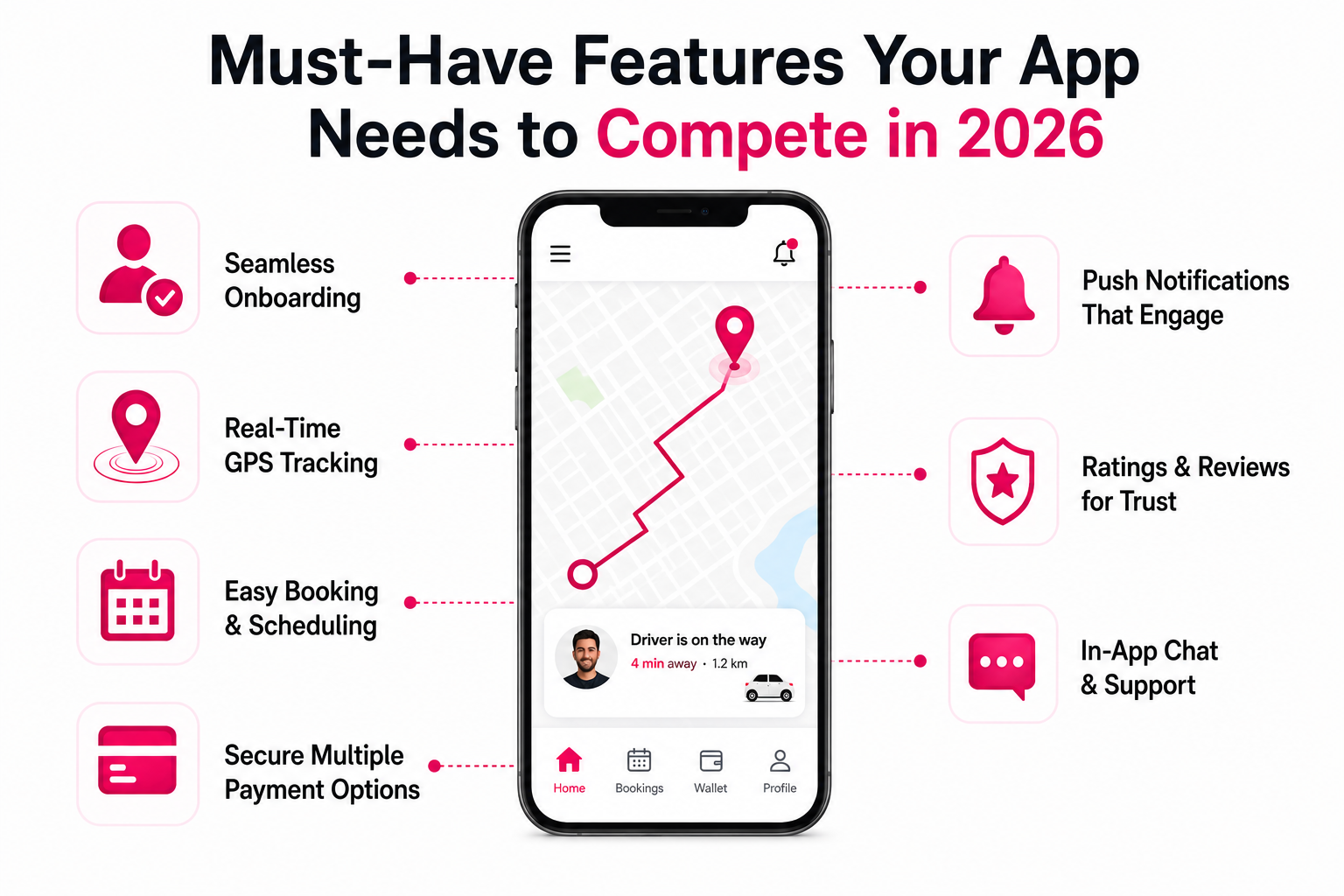
Seamless Registration and Onboarding That Reduces Drop-Off From 40% to Under 5%
The difference between successful apps and failed apps often comes down to friction during onboarding. Studies show that 40% of users abandon apps during registration if the process takes more than three steps or two minutes. For on-demand apps, this is catastrophic because every abandoned registration is lost transaction opportunity and therefore lost revenue.
Effective onboarding for customer apps requires: (1) social login integration (Google, Apple, phone number OTP for quick authentication without password creation), (2) minimal required information upfront (location and payment method), (3) profile completion incentives (offer a discount for completing full profile within 24 hours), (4) context-aware guidance (for first-time users, explain how to place an order with visual cues). For provider apps, onboarding is more complex because you must verify identities, confirm service history, and collect documentation. However, the principle remains: identify the critical path (identity verification, bank account linking) and defer everything else until after the first successful transaction.
Real impact: When Grab (Southeast Asian ride platform) simplified driver onboarding from a 20-minute process to an 8-minute process, driver signup completion increased 43%, directly increasing available supply. When DoorDash streamlined restaurant onboarding, they reduced the time-to-first-order for restaurants from 14 days to 3 days, dramatically shortening their payback period on acquisition investment.
Real-Time GPS Tracking Creating Transparency and Reducing Cancellations by 25-35%
Users don't want to wonder where their driver is, where their delivery is, or how much longer they'll wait. Real-time GPS tracking isn't a luxury feature it's table stakes that reduces customer anxiety, cuts cancellation rates, and improves customer satisfaction scores by 30-40% compared to apps without real-time tracking. Beyond customer experience, GPS data feeds your matching algorithm with critical information about actual versus estimated times, helping you predict provider capacity more accurately.
Implementation requires continuous location updates from provider devices (typically every 5-10 seconds for accuracy without battery drain), map visualization on the customer app (showing provider location, route, and estimated arrival), and handling edge cases (tunnels where GPS signal drops, user permissions to access location).
Easy Booking and Scheduling That Converts Browser Interactions Into Actual Transactions
The booking interface is your highest-converting funnel stage. Every extra click reduces conversion by 5-8%. Effective booking flows understand the difference between booking and scheduling. Booking is immediate fulfillment (ride-sharing, food delivery) customers want to confirm location and place the order in under 60 seconds. Scheduling is future fulfillment (home repair service, apartment cleaning) customers want to browse time slots, select preferences (morning vs. afternoon, specific technician if available), and confirm details.
Effective booking interfaces use: (1) auto-location detection (GPS location pre-fills), (2) saved locations (home, work, frequently-visited places enable one-click ordering), (3) reordering favorites (users reorder the same thing; make it one-tap), (4) transparent pricing (show final price before confirming, not after), (5) multiple payment options (card, digital wallet, cash). For scheduling, include calendar interfaces showing available slots, provider profiles (photos, ratings, reviews), and the ability to request specific providers if they're returning customers.
Secure Multiple Payment Options Creating Frictionless Transactions for Every User Segment
Payment processing is fundamental to on-demand apps, and user segments have wildly different payment preferences. In developed markets, card and digital wallet adoption is nearly universal. In emerging markets, a significant population uses cash, mobile money, or bank transfers. Platforms that accommodate all payment methods capture significantly more transactions than those with limited options.
Essential payment features: (1) credit/debit cards processed through PCI-DSS compliant gateways, (2) digital wallets (Apple Pay, Google Pay, PayTM), (3) cash on delivery (critical in many markets), (4) in-app wallet (customers pre-load funds for faster checkout), (5) buy-now-pay-later integration (Affirm, Klarna in developed markets), (6) bank transfer/UPI for markets where this is preferred. For providers, you need: (1) automated payouts (daily, weekly, or on-demand depending on market), (2) payment history transparency (detailed earnings breakdown), (3) payout options matching provider preferences (bank transfer, mobile wallet, cash pickup).
Payment security requires: PCI-DSS compliance (handled by payment processors), encryption of all transaction data, fraud detection (flagging unusual patterns), and dispute resolution mechanisms (enabling chargebacks for customers, protecting providers from payment disputes).
Push Notifications That Drive Engagement Without Annoying Users Into Uninstalling Your App
Push notifications are wildly abused in mobile apps, leading to terrible opt-in rates and uninstalls. However, when used strategically, notifications increase daily active user (DAU) by 20-40% because they remind users that your service exists and lower the friction to opening the app. The difference is strategic relevance: notifications about actual orders (your food delivery is arriving, your driver is 4 minutes away) have 85%+ engagement. Random promotional notifications have 8-12% engagement.
Effective notification strategies: (1) transactional notifications (order status updates, delivery arrival, payment confirmation) are non-negotiable, (2) personalized recommendations (based on order history, these restaurants match your preferences) drive engagement, (3) time-sensitive promotions (lunch rush discounts at 11:45am, weekend specials on Friday evening) are more effective than random promos, (4) re-engagement campaigns (you haven't ordered in 7 days, here's a discount) work when timed properly. The key: every notification should feel relevant to the user or increase their chances of a conversion.
Ratings, Reviews, and Trust-Building Tools Creating Supply-Side Accountability
Two-way rating systems (customers rate providers, providers rate customers) create accountability for both sides. On-demand marketplaces live or die by trust, and ratings are the primary trust signal. A provider with 4.2 stars will be selected 60-80% more frequently than one with 3.8 stars, directly impacting provider earnings and therefore retention.
Effective rating systems: (1) request reviews immediately after transaction completion (80%+ of reviews are submitted if requested within 2 minutes of completion, dropping to 15% after 24 hours), (2) allow detailed reviews with photos (for home services especially, photos prove quality), (3) surface reviews in search results (providers with better reviews appear higher), (4) have human moderation (removing fake reviews and spam), (5) allow provider responses to negative reviews (showing they care about fixing issues).
Real scenario: When Airbnb introduced strict review requirements and made review removal difficult, negative reviews accumulated faster. This initially reduced new host signup (understandably) but created such strong quality signals that booking conversion from search results improved 23%. By creating genuine trust, they solved the information asymmetry problem, enabling more transactions overall.
In-App Chat and Support Creating Friction-Free Communication Between All Parties
When issues arise a driver is going the wrong direction, a delivery item is missing, a service provider isn't showing up resolution speed determines customer satisfaction and repeat usage. In-app chat where customers can message drivers in real-time eliminates the friction of phone calls and enables problems to be solved before they become cancellations or complaints.
Essential support infrastructure: (1) in-app messaging between customers and providers (with message history), (2) customer support access (24/7 chat support for disputes or emergency issues), (3) automated support tools (FAQ bot handling common questions), (4) escalation workflows (when chat support can't resolve, escalating to human support), (5) support quality metrics (average response time, resolution rate, customer satisfaction on support interactions).
Advanced Features That Give You an Edge in 2026 and Differentiate You From Competitors
AI-Powered Demand Prediction Optimizing Supply Allocation and Pricing Strategy
The difference between an app that breaks even and one that generates 20%+ net margins often comes down to demand prediction and dynamic pricing. Uber's surge pricing works because their algorithm predicts demand surges minutes or hours before they happen, enabling them to raise prices and incentivize driver supply accordingly. This prevents system collapse (all drivers are busy, no one to fulfill new orders) and optimizes driver earnings (drivers are incentivized to work during high-demand periods).
AI models trained on historical demand data can predict demand patterns for specific neighborhoods at specific times with 80%+ accuracy. These models account for: time of day (lunch rush, evening commute), day of week (Friday nights have different patterns than Wednesday mornings), weather (rainy days increase ride-sharing demand), local events (concerts, sports games), and seasonal patterns (holiday season, school holidays). With this prediction, you can: (1) notify providers in advance to be available, (2) adjust pricing to incentivize supply when demand is predicted to spike, (3) pre-position inventory (ride-sharing drivers in surge-prone areas), (4) optimize customer acquisition (promote the platform in times and places where demand exceeds supply).
Smart Surge Pricing Increasing Revenue Without Sacrificing Demand During Peak Hours
The goal of surge pricing isn't to maximize revenue per transaction it's to optimize overall system health and allocate scarce supply efficiently. When demand exceeds supply, prices go up, which has three effects: (1) some customers postpone their order (demand reduction), (2) customers who are price-insensitive still order (at higher price points), (3) providers are incentivized to work during surge hours. The net effect can be: demand reduced by 15-25%, supply increased by 25-35%, resulting in more total transactions at higher margins despite lower individual order volume.
Smart surge pricing models dynamically adjust multipliers based on: supply-demand ratio (fewer available drivers = higher surge), predicted demand in next 5-15 minutes (if demand is predicted to spike, surge early), provider distribution (if all providers are concentrated in one area, surging in that area pulls them away from less-served areas), and customer price sensitivity segmentation (regular commuters are more price-sensitive than occasional users, so surge less for frequent users). The key insight: it's not a simple ratio, it's a dynamic optimization problem.
AI Route Optimization for Faster Service and Lower Delivery Costs
Delivery time and delivery cost are the two primary efficiency metrics in logistics-based on-demand apps. A minute saved per delivery, multiplied by hundreds of daily deliveries, compounds into significant savings. Route optimization algorithms can reduce delivery time by 15-25% compared to simple straight-line routing.
Real scenario: An Indian food delivery platform implemented AI route optimization that reduced average delivery time from 34 minutes to 27 minutes (a 21% improvement). This had downstream effects: (1) customer satisfaction scores improved by 15% (faster delivery increases likelihood of repeat orders), (2) delivery partner efficiency increased (fewer minutes per delivery means more deliveries per hour, higher provider earnings), (3) operating costs decreased (fewer vehicle hours to deliver the same volume).
Route optimization algorithms must consider: traffic patterns (real-time and historical), multiple-order optimization (should this driver deliver to three customers in one trip or separately?), and constraints (time windows when customers are available, vehicle capacity). This requires real-time data integration with traffic APIs (Google Maps, OpenStreetMap), optimization algorithms running every 60 seconds, and provider trust (drivers are often skeptical of algorithm-driven routes initially).
Voice-Enabled Booking Capturing Convenience-Focused Users and Differentiating From Text-Only Competitors
Voice ordering ("Hey Google, order me a taxi to the airport") eliminates friction for users with hands full or in situations where phone typing isn't possible. Voice-enabled apps see 15-25% higher completion rates for bookings because voice is faster than typing and feels more natural. Voice also appeals to older users and non-native speakers who find text-based interfaces more difficult.
Implementation requires: speech-to-text transcription (handled by APIs from Google, AWS, or specialized providers), natural language processing to understand user intent (extracting pickup location, destination, vehicle type from voice commands), and fallback to text input if voice fails (due to noise, unclear speech, etc.). Voice booking is increasingly table stakes, especially in ride-hailing and food delivery where it's now standard.
In-App Wallet and Loyalty Rewards Creating Repeat Usage Habits and Reducing Payment Friction
Users with prepaid wallets exhibit 2-3x higher transaction frequency than those paying per-transaction. This occurs partly from reduced friction (no payment confirmation on every transaction) and partly from psychological commitment (money is already spent in the account, so users feel motivated to use it). In-app wallets also improve cash flow for the platform because customer funds are held until they use them.
Loyalty rewards (points earned per transaction, redeemable for discounts) increase customer lifetime value by creating reasons to use the platform repeatedly. When Starbucks implemented their rewards program, customer visit frequency increased 27%, and repeat customers increased from 48% to 67% of their customer base. The investment in loyalty mechanics typically has 300-500% ROI.
A practical loyalty structure: customers earn 1 point per dollar spent, with 100 points = $5 discount. Tier-based rewards (after 10 orders, unlock 2x points) incentivize reaching thresholds. Seasonal bonuses (double points on weekends, bonus points during lunch hour) drive usage during high-margin times. The key: make the math obvious to users so they feel the value.
Multi-Language and Multi-Currency Support Enabling Geographic Scaling Without Rebuilding the App
If your goal is geographic expansion, you need to plan for language and currency from the start because retrofitting these capabilities later is expensive and technically complex. Apps that support 3+ languages scale geographically 2.5x faster than those requiring localization for each market.
Technical implementation: all strings are externalized (not hardcoded in the app) and stored in translation databases, currency conversion happens at the backend based on the user's selected region, payment processing adjusts based on local currency and payment methods, and date/time formatting adapts to local preferences. The challenge isn't technical (these are well-solved problems) but operational you need native speakers reviewing translations to ensure they're culturally appropriate, not just technically accurate.
Choosing the Right Technology for Your App and Building Infrastructure That Scales
What Tech Stack Should You Ask Your Developer For and Why These Choices Matter More Than Brand Names
The difference between an app that scales to 100,000 daily users and one that crashes at 10,000 daily users isn't the programming language you choose (JavaScript, Python, or Go can all handle scale with proper architecture). It's the architectural choices: how data is stored, how real-time communication is handled, how requests are routed and cached, and how the system degrades gracefully under load.
For customer and provider apps (mobile-first), you need native iOS and Android apps (or high-quality cross-platform solutions like React Native) for performance and native features like maps, location, and camera access. Web-based apps can't access GPS and camera reliably on mobile, which are essential for on-demand apps. For the backend, you need: (1) scalable API architecture (typically microservices where ride-matching is separate from payment processing is separate from notifications), (2) real-time messaging (WebSockets or similar for live location updates), (3) geospatial databases (PostgreSQL with PostGIS extension, or MongoDB with geospatial indexes), (4) message queuing (for asynchronous tasks like sending notifications, processing payments), and (5) caching layer (Redis for storing frequently-accessed data like provider availability).
The classic stack that scales: iOS/Android for mobile apps, Node.js or Python for backend APIs, PostgreSQL for relational data, Redis for caching, Kafka for messaging, and Docker/Kubernetes for deployment. This stack is proven by platforms handling millions of requests daily. The key is that you're choosing based on what the application needs (real-time, geographic queries, high concurrency) rather than what's trendy.
Cloud Infrastructure for Reliable Scaling Without Breaking the Bank
Hosting your on-demand app on a single server or unmanaged cloud instance is like building a house on sand. The moment you get real traffic (which will happen faster than you expect if you do marketing right), your infrastructure collapses. Cloud infrastructure (AWS, Google Cloud, Azure) enables you to start small and scale as needed, paying for only what you use.
For most on-demand apps, the architecture looks like: (1) load balancer distributing traffic across multiple API servers, (2) containerized deployment (Docker containers managed by Kubernetes) enabling rapid scaling up and down, (3) managed databases (AWS RDS, Google Cloud SQL) handling backup and high availability, (4) CDN (CloudFlare, Akamai) caching static assets globally for fast delivery, (5) object storage (AWS S3) for photos, documents, and files. This infrastructure costs roughly $5,000-15,000 monthly for platforms handling 1-2 million requests daily. As you grow, you optimize things like using reserved instances (30% cheaper than on-demand if you commit for a year) or implementing caching reduce costs 40-50%.
The decision between AWS, Google Cloud, and Azure comes down to: regional availability (does the provider have data centers in your target markets?), cost (AWS is typically cheaper than Azure for startup volumes), and services (AWS has the most comprehensive marketplace of third-party integrations). Most successful startups begin with AWS, not because it's inherently superior, but because the largest ecosystem of documentation, tutorials, and talent exists for AWS.
GPS, Mapping, and Payment API Integrations Creating Partnerships You Can't Build Alone
You won't build your own maps, GPS system, or payment processing from scratch. These services are so fundamental and so well-solved by specialized companies that it's economically irrational to reinvent them. Your job is choosing which partners to integrate and building a system that doesn't fail when one of your partners has an outage.
GPS and Mapping: Google Maps API ($7 per 1,000 requests for certain features, up to $700/month for high-traffic apps), MapBox ($0.50 per 1,000 requests, often more cost-effective at scale), or OpenStreetMap (free, but lower quality). The choice depends on the features you need (routing, geocoding, distance matrices) and your scale. Many platforms use MapBox for consumer-facing maps (often better aesthetics) and Google Maps for backend routing (better accuracy).
Payment Processing: Stripe ($2.9% + $0.30 per transaction for card payments), PayPal (2.9% + $0.30), Square (2.9% + $0.30), local processors in your target market. For international expansion, you need providers that support your target currencies and payment methods. Indian platforms, for instance, need UPI integration (Razorpay handles this exceptionally well).
Notifications: Firebase Cloud Messaging (free for up to 500M messages/month), Twilio ($0.50-1.50 per SMS depending on recipient country). For production systems, you typically use a notification service that aggregates providers so if one fails, another is used automatically.
AI/ML for Personalization Creating Network Effects That Lock In Users
Personalization showing each user a unique experience tailored to their preferences increases customer lifetime value by 30-50% because users feel the platform understands them and becomes an integral part of their routine. Machine learning models that predict what users want (which restaurants they'll like based on their order history, which products are worth recommending) feel magical and drive significant engagement.
Building ML models requires: (1) data infrastructure to collect and store user behavior (order history, search queries, cancellations, ratings), (2) feature engineering (transforming raw data into signals the model can learn from), (3) model training (using historical data to teach the model patterns), and (4) serving the model at scale (showing personalized recommendations in real-time when users open the app). This is complex, but companies like Amazon and Netflix have proven the ROI is substantial.
Starting simple: collaborative filtering (if user A orders the same restaurants as user B, recommend to user A the new restaurants user B just tried) can be implemented without deep ML expertise. As you scale, invest in more sophisticated models. The key is starting with data collection now, so that when you're ready to implement personalization, you have historical data to train on.
How Will Your App Make Money? Comparing Monetization Models That Work
Commission-Based Model: The Default That Works When You Control Supply and Demand Matching
Most successful on-demand apps take a commission on every transaction. Uber takes 20-30% from riders (who don't mind because they're comparing against taxis, which are expensive), and variable amounts from drivers (who are compared against not having a job, so a 20% cut of sporadic income is better than no income). DoorDash takes 15-30% from restaurants and delivery fees from customers. TaskRabbit takes 20% from service providers.
The commission model aligns incentives: as the platform, you make more money when more transactions happen and when transaction values are higher. You're incentivized to improve matching, reduce cancellations, and build features that increase transaction frequency. The risk is setting commission rates too high (providers stop working because net earnings are too low) or too low (platform can't be sustainable).
Real data: DoorDash's take-rate (revenue as % of gross merchandise value) is roughly 30% (15% from restaurants as commission, 15% from customers as service/delivery fees). At $3 billion in annual GMV, that's $900 million in revenue. With improved delivery efficiency and scale, they've increased net margins from -15% five years ago to +5% currently, showing that commission models can reach profitability with disciplined execution.
Subscription-Based Model: Predictable Revenue From Users Willing to Pay Monthly for Premium Benefits
Subscription models (customers pay $9.99/month for free delivery, or $99/year for DashPass) create predictable revenue that doesn't depend on transaction volume. They're especially effective when you can create genuine value: frequent users quickly reach a point where the subscription fee pays for itself through delivery fee savings.
The challenge: subscription models only work if a meaningful percentage of users are frequent enough to justify the cost. If the average user places 2 orders per month (each with $3 delivery fee = $6 value), they won't subscribe to $10/month. Platforms need 4+ transactions per month to make subscription attractive. Driving frequency becomes critical, which is why subscription platforms invest heavily in engagement features and push notifications.
Best used for: mature platforms with high-frequency users (5+ transactions/month), where subscription fee is dramatically cheaper than alternative per-transaction fees. Uber Eats Pass, DashPass, and similar programs succeed because frequent users genuinely save money.
Delivery Fee Model: Direct Charges to Customers for Last-Mile Economics
Separate from commission on merchants, many platforms charge customers a delivery fee ($2-5 depending on distance). This fee directly covers delivery partner wages and logistics costs. The benefit: merchants aren't subsidizing delivery (so restaurants can be more profitable), and the fee structure is transparent to customers. The risk: high delivery fees reduce order frequency (customers perceive the total cost as high), especially for low-order-value purchases.
Effective delivery fee structures use distance-based or time-based calculation: order from restaurant 2km away costs $2 delivery, order from 8km away costs $6. This creates transparency and fairness. Some platforms have shifted to "dynamic delivery fees" during surge times (high-demand periods have higher fees), but this creates customer perception issues (customers feel gouged).
Freemium Model: Free Base Service With Premium Features Creating Revenue From Top Users
The freemium model offers a free version with basic features (no upfront cost, removes barrier to adoption) and premium features available via subscription or one-time purchase (priority support, advanced features, priority booking). This model excels at acquisition (free removes adoption friction) but requires that premium features have genuine value to convert users.
Examples: Skype (free calling, premium features like group calling and voicemail), Evernote (free note-taking, premium features like offline access and advanced search). For on-demand apps, this might look like: free app with basic features, premium subscription that includes priority booking, exclusive provider access, or advanced scheduling.
The risk: if too much value is in the premium tier, free users leave before converting. If too much value is in the free tier, premium conversion never happens. Most successful freemium products have 95%+ free users, 5% paid users, with high lifetime value for paid users (10x or more than free users generate in platform revenue).
Choosing the Right Model for Your Business Based on Market Realities
The right monetization model depends on your market and your competitive position. In a concentrated market (ride-hailing in most cities is dominated by 1-2 players), you might take high commissions because switching costs are high and you have pricing power. In a fragmented market (home services, logistics), high commissions will drive providers to competitors, so lower commissions but higher volume is more sustainable.
A framework: calculate your unit economics. If average customer lifetime value (total profit from a customer before they stop using your platform) exceeds 3x your customer acquisition cost, the business is sustainable. If it's less than 1.5x, the business model is broken regardless of revenue. This calculation tells you whether your monetization model can sustain growth or whether you need to adjust commissions, optimize retention, or find adjacent revenue sources (advertising to merchants, data services, etc.).
What Affects the Cost of Your On-Demand App and Making Disciplined Budget Decisions
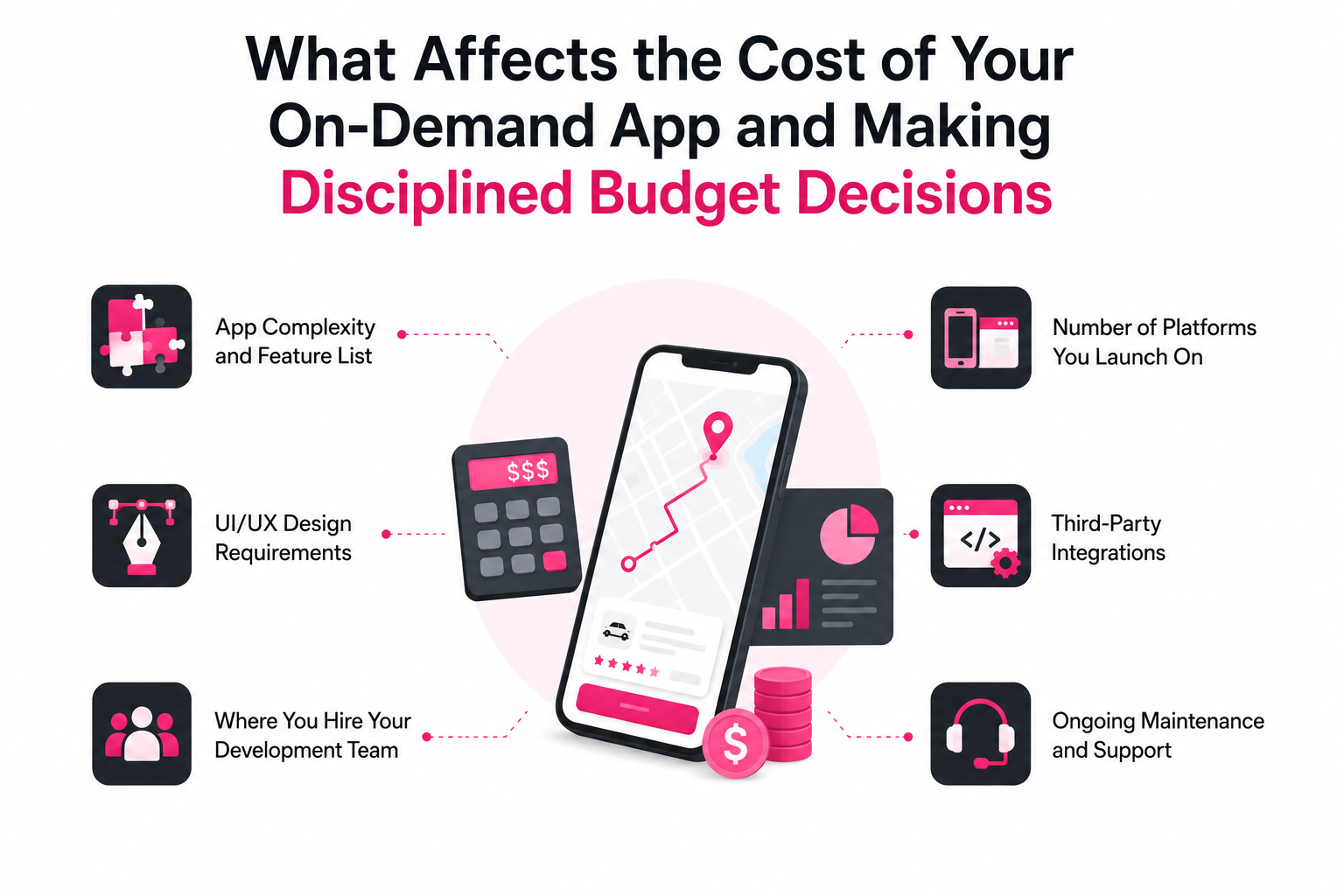
App Complexity and Feature List: Distinguishing Core from Nice-to-Have
Building an MVP (Minimum Viable Product) with core features costs 40-60% less than building a full-featured app. The question is: which features are genuinely core to market validation, and which are nice-to-have? This distinction determines whether you launch in 6 months for $200,000 or 18 months for $1.2 million.
Core features for MVP: user authentication, provider matching, booking, real-time tracking, payment processing, and ratings. Nice-to-have for MVP: in-app chat, voice booking, AI personalization, loyalty rewards, multi-language support, advanced surge pricing. Most founders overestimate the importance of nice-to-have features; customers validate the core experience first, then you add depth. Launch with 70% of features working perfectly, not 100% of features working poorly.
Number of Platforms You Launch On: Web, iOS, Android, and the Device-Specific Complexity
Building for iOS, Android, and web costs 1.8-2.2x more than building for a single platform because each platform has different design patterns, different APIs, and different capabilities. The efficiency loss (code duplication, platform-specific bugs, separate testing efforts) compounds if you don't use cross-platform frameworks like React Native or Flutter.
Smart platforms usually launch on the platform where their target users are concentrated. If your market is primarily Android users (as in India, where 95% of smartphones are Android), launch Android first, then iOS. If you're serving urban professionals in developed markets, iOS first makes sense. Web should follow both platforms because most users will open the app on their phone, not a web browser.
UI/UX Design Requirements: Investing in Design That Converts, Not Design That Impresses
Design quality dramatically affects app performance. An excellent design (clear hierarchy, obvious conversion paths, beautiful visuals) increases conversion rates by 25-40% compared to poor design. However, the cost difference between a $50,000 design and a $150,000 design often yields diminishing returns after a certain point.
Smart design investment: invest heavily in the critical paths (registration, booking, checkout) where every improvement directly increases revenue. Invest less in utility pages (account settings, order history, support) where design quality has minimal effect on conversions. Use design systems and component libraries to reduce the cost of applying good design across the entire app.
Third-Party Integrations Multiplying Complexity and Ongoing Costs
Every third-party integration (payment processor, GPS mapping, notification service, analytics) adds complexity: more APIs to integrate, more service dependencies (if the API is down, your feature breaks), more vendor management, and ongoing costs. Stripe costs $0.29 per successful transaction (plus credit card processing fees), Google Maps costs $7-700/month depending on usage, Firebase notifications cost $0/month for the first 500M messages but more above that.
A typical app might have 10-15 critical integrations. At $100-500 per integration monthly, that's $1,000-7,500 in integration costs before you scale significantly. As you grow to millions of transactions monthly, these costs scale dramatically: payment processing for $5M in monthly GMV costs $145,000 in processor fees alone (assuming 2.9% + $0.30).
Where You Hire Your Development Team: Comparing In-House, Nearshore, and Offshore Development
Developer cost is the single largest line item in app development budget. A senior developer in San Francisco costs $150-200/hour. A developer with similar skill in Eastern Europe costs $60-90/hour. A developer in India with equivalent skill costs $25-45/hour. The question is how much you're willing to trade cost savings for coordination challenges, timezone differences, and quality variability.
In-house team (full-time employees): highest cost ($150,000-250,000 annual per developer in developed markets), but full control, fastest communication, and deep product knowledge. Best if you have stable product direction and enough work to keep them utilized.
Nearshore teams (Mexico, Eastern Europe, Poland): moderate cost ($50,000-90,000 annual per developer, though usually hired as agencies at $70-150/hour for a team), overlapping timezones (easier for real-time coordination), similar culture and work expectations. Growing faster as a preferred option.
Offshore teams (India, Philippines, Vietnam): lowest cost ($15,000-35,000 annual per developer, or $25-50/hour for a team), but timezone challenges (midnight calls for handoff), potential communication barriers, and higher quality variability. Best for well-specified work and stable requirements that don't change mid-sprint.
Real scenario: A startup with $300,000 budget could hire: (1) 2 senior San Francisco developers ($450k/year, over budget), (2) 4 Eastern Europe developers ($360k/year, fits budget, plus coordination overhead), or (3) 8 India developers ($160k/year, under budget, maximum coordination challenge). The right choice depends on how much you can specify requirements upfront and how much daily coordination you need.
Ongoing Maintenance and Support: The Costs That Continue Forever
Building the app is a one-time cost. Maintaining it is an ongoing cost that continues indefinitely. Bug fixes, performance optimizations, new features, platform updates (iOS releases new versions, Android versions), security patches these compound to roughly 20-30% of the initial development cost per year for a stable app. For rapidly-growing apps adding new features monthly, maintenance can equal 30-50% of new development.
Budget conservatively: if initial development was $500,000, budget $100,000-150,000 annually for maintenance. This includes infrastructure costs, tools, hosting, and developer time for fixes and updates. Many startups fail not because they can't build an app, but because they underestimate ongoing costs and run out of money on the maintenance phase.
How Much Does It Cost to Build an Uber-Like App? Breaking Down Costs by Component
MVP Cost: Start Lean and Validate Your Idea Before Investing in Complexity
An MVP (Minimum Viable Product) for an on-demand app includes: customer app (iOS and Android), provider app (iOS and Android), admin dashboard, basic backend, payment processing, and GPS mapping. No advanced features like AI personalization, voice booking, or multi-language support. MVP timelines range from 4-6 months with experienced teams.
|
Component
|
MVP Cost Range
|
Notes
|
|
Customer App (iOS + Android)
|
$40,000 - $70,000
|
Basic UI, registration, booking, tracking, payment
|
|
Provider App (iOS + Android)
|
$35,000 - $55,000
|
Acceptance interface, tracking, earnings, basic support
|
|
Admin Dashboard
|
$25,000 - $40,000
|
Manage users, view metrics, basic dispute resolution
|
|
Backend/API Development
|
$50,000 - $80,000
|
User management, matching algorithm, payment integration
|
|
Infrastructure & DevOps
|
$10,000 - $20,000
|
Setup, deployment, initial optimization
|
|
Third-Party Integrations
|
$15,000 - $25,000
|
Payment gateway setup, GPS/mapping, notifications
|
|
UI/UX Design
|
$20,000 - $35,000
|
Wireframes, mockups, design system
|
|
Testing & QA
|
$15,000 - $25,000
|
Manual testing, bug fixing, performance testing
|
|
Project Management & Documentation
|
$10,000 - $15,000
|
PM overhead, documentation, handover
|
|
TOTAL MVP COST
|
$220,000 - $365,000
|
4-6 months, basic features only
|
This assumes hiring an experienced development partner or team. Building in-house with junior developers would take 12-18 months with similar cost. Building with offshore teams in India would reduce costs to $120,000-180,000 but extend timeline to 8-10 months due to coordination challenges. Building in the U.S. would increase costs to $400,000-550,000.
Full-Featured App Cost for Scaling Up: Investing in Features That Drive Retention and Revenue
Once you've validated your market with an MVP, you'll invest in features that increase retention, reduce churn, and improve monetization. This includes: advanced matching algorithms, surge pricing, in-app chat, detailed analytics dashboard, multi-language support, loyalty rewards, and provider quality management tools. Building on the MVP foundation, these additions cost 60-80% of the original MVP cost and take 3-4 months.
Cost Breakdown by App: Understanding Where Development Effort Concentrates
The customer app is typically the highest cost (40-45% of total) because this is the primary brand touchpoint and must be exceptionally polished. The provider app costs slightly less (35-40%) but requires efficiency features (navigation, earnings tracking) that add complexity. The admin dashboard costs least (15-20%) but is absolutely critical for platform operations. Backend/infrastructure costs roughly 25-30% of total and are often underestimated.
Budgeting for Post-Launch Maintenance: The Hidden Costs That Continue Forever
After launch, budget 20-30% of initial development cost annually for maintenance and improvement. For a $300,000 MVP, that's $5,000-7,500 monthly in ongoing costs. This includes: bug fixes ($2,000-3,000/month), performance optimization ($1,000-2,000/month), platform updates and compatibility fixes ($1,500-2,000/month), security patches ($500-1,000/month), and minor feature improvements ($2,000-3,000/month).
Additionally, infrastructure costs scale with usage: hosting for 1M monthly API requests costs $2,000-3,000/month, but for 100M monthly requests, costs escalate to $15,000-25,000/month if optimizations aren't implemented. Payment processing fees scale directly with transaction volume. Customer support costs increase with user base (more users = more support tickets). These variable costs often surprise founders who have only accounted for fixed costs.
Common Roadblocks You Should Plan For and How Successful Platforms Overcome Them
Handling Scale During Peak Demand: Building Infrastructure That Doesn't Collapse When You Get Traction
Every startup founder dreams of a problem: "Our app got so popular that it crashed." When this happens on day three after launch, it's a nightmare. Most on-demand apps are victim to what's called "thundering herd" problems sudden spikes in traffic that overwhelm unprepared infrastructure. India's Ola, during their launch phase, experienced multiple crashes during lunch hours when hundreds of users simultaneously requested rides. They solved it not through brute-force adding servers, but through intelligent load balancing, request prioritization, and horizontal scaling architecture.
Technical solutions: database read replicas (spreading read queries across multiple servers), caching layers (Redis storing frequently-accessed data so the database isn't hit with every request), message queues (deferring non-critical processing), and auto-scaling infrastructure (cloud platforms that automatically add servers during high load). Operationally: performance testing before launch (simulating peak load to identify bottlenecks), monitoring and alerting systems (knowing immediately when performance degrades), and graceful degradation (if the system is overloaded, reduce feature richness rather than complete failure).
Retaining Drivers and Service Providers: Solving the Supply-Side Retention Challenge
The graveyard of failed on-demand startups is filled with platforms that had great customer demand but couldn't retain providers. A provider (driver, delivery person, service provider) will use your app if: (1) they can earn more money than alternatives, (2) work flexibility matches their needs, (3) interactions with the platform and customers are respectful and predictable, and (4) they feel fairly treated relative to the platform.
Retention challenges: when customers cancel frequently (providers waste time showing up for cancellations), when low customer ratings cascade (providers quickly drop to bottom of matching queue), when algorithm changes suddenly reduce earnings (providers feel manipulated), and when customer interactions are disrespectful. Real scenario: A food delivery platform in Southeast Asia lost 40% of active drivers in three months when they introduced a "move to wait" feature that required drivers to relocate to predicted high-demand areas, then sit idle if demand didn't materialize. Drivers who accepted five offers expecting to make $50 that day instead made $15 because the algorithm was wrong. Trust collapsed. They eventually rolled back the feature.
Solutions: transparent earnings models (drivers understand exactly how much they'll earn before accepting work), provider support infrastructure (rapid problem resolution when issues arise), and provider appreciation programs (regular bonuses, recognition, exclusive perks for high-quality providers). Keeping 20% of your best drivers happy is worth more than keeping 100% of your drivers minimally satisfied.
Keeping Payments Secure: Avoiding the Fraud and Chargeback Disasters
Payment fraud costs on-demand platforms roughly 0.5-1% of GMV (Gross Merchandise Value). For a platform doing $1M in daily GMV, that's $5,000-10,000 daily in fraud losses. Beyond direct losses, chargebacks (customers disputing charges) damage relationships with payment processors, and excessive chargebacks can get your platform shut down by the processor entirely.
Fraud patterns on on-demand platforms: stolen credit cards used for orders (the cardholder doesn't recognize the charge and disputes it), provider account takeovers (fraudsters access a legitimate provider account and change bank details to redirect earnings), and false orders (ordering services and claiming they never occurred, creating refund chargebacks). Real scenario: A ride-sharing platform in Brazil lost their processing relationship with MasterCard after chargeback rates hit 2% (industry average is 0.05%). Rebuilding processor relationships took 18 months and cost them market position.
Prevention measures: (1) 3D Secure authentication (additional verification for card payments), (2) address verification system (AVS, checking if billing address matches card address), (3) device fingerprinting (flagging unusual device patterns), (4) behavior analysis (ML models detecting unusual ordering patterns), (5) multi-factor authentication for provider accounts, and (6) immediate settlement to bank accounts (limiting time fraudsters can access funds). These measures reduce fraud to 0.1-0.2%, well below tipping points where processors shut you down.
Navigating Local Regulations: Understanding Government Approval and License Requirements
On-demand platforms exist in a regulatory gray zone in many jurisdictions. Ride-sharing platforms fight classification as "employers" (which would require offering employee benefits) versus "platforms" (where drivers are independent contractors). Food delivery platforms navigate health and safety regulations. Home services deal with licensing requirements. The regulatory landscape can make or break your business, and ignoring it until post-launch is dangerous.
Real examples: Uber spent hundreds of millions fighting regulations globally. In many European cities, their ride-sharing service is literally illegal despite its massive user base. In India, Swiggy and Zomato have navigated GST (Goods and Service Tax) complexity and local restaurant licensing requirements. Regulations aren't obstacles you overcome; they're constraints that shape your business model from the beginning.
Guidance: talk to lawyers in your target markets before launch, understand local labor laws (do you need to offer benefits to providers?), understand local service licenses (does operating a platform require government approval?), understand tax implications (what is your tax liability in different jurisdictions?), and understand consumer protection rules (what are your obligations if things go wrong?). Building the product is the easy part; navigating regulations can take longer and cost more than development.
Avoiding Common First-Time Founder Mistakes: Learning From Failures Without Repeating Them
The most expensive education is learning by failing when the knowledge exists. Common first-time founder mistakes: (1) Building too many features too early (MVP with 40 features when MVP should have 8), (2) Not validating product-market fit before raising money (raising $1M to scale a product no one wants), (3) Underestimating unit economics (assuming you'll be profitable at scale when the math doesn't work), (4) Hiring the wrong team (choosing based on resume rather than ability to execute under uncertainty), and (5) Ignoring customer feedback (building what you think users want rather than what they actually need).
The successful pattern: talk to 50+ potential customers before building anything (validate that the problem actually exists and people will pay to solve it), build an MVP that solves one specific problem exceptionally (not multiple problems adequately), launch to a small geographic area (not nationwide), measure carefully (LTV, CAC, churn rate, and other metrics that tell you if the business works), and iterate based on data rather than assumptions. This pattern requires humility accepting that your initial idea might be wrong, and being willing to pivot based on evidence.
Security and Compliance You Can't Ignore and How to Build Trust Into Your Platform
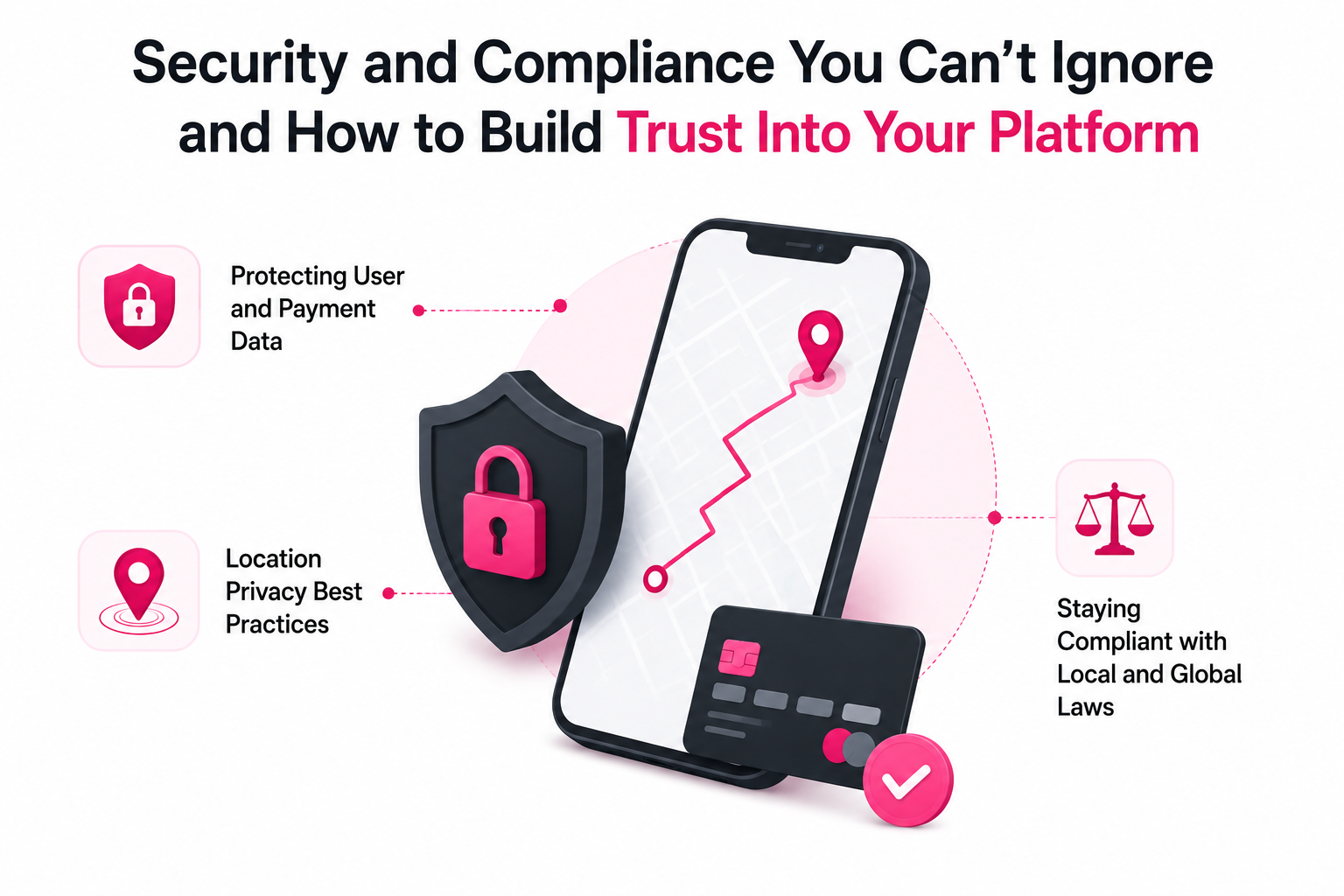
Protecting User and Payment Data: Building Defenses Against Breaches and Data Theft
Your platform will store sensitive data: payment information (credit cards, bank accounts), personal information (names, addresses, phone numbers), and potentially location history. A data breach exposing this information is catastrophic: legal liability, customer lawsuits, regulatory fines, and brand damage that may be irreversible. Building security from the start costs less than fixing it after a breach.
Payment data must be encrypted in transit (using HTTPS) and at rest, and must follow PCI-DSS standards (managed by payment processors, not by you). PCI-DSS compliance means: no storing full credit card numbers on your servers, encrypting sensitive data, restricting access to card data, testing security regularly, and maintaining detailed audit logs. If you violate PCI-DSS and suffer a breach, you're liable for costs and legal damages.
Personal data requires: encryption at rest (so if someone gains database access, data is unreadable), encryption in transit, secure authentication (difficult passwords, multi-factor authentication), minimal data retention (delete data once no longer needed), and access controls (employees access only the data they need). GDPR (in Europe) and similar regulations (CCPA in California) give users rights to download their data, delete their data, and opt out of processing. Building compliance into your platform from the start is simpler than retrofitting it.
Location Privacy Best Practices: Respecting User Privacy While Enabling Core Features
On-demand apps collect precise location data continuously. This data is essential for core features (finding nearby drivers, calculating delivery routes) but creates privacy risks if misused. Users don't want their detailed location history sold to advertisers or used to track their movements. Regulations like GDPR require explicit consent before collecting location data, and users expect the app to access location only when necessary (not continuously in the background).
Best practices: (1) request location permission when needed, explaining why (not on app open), (2) minimize location data retention (delete location history older than 30 days), (3) disable background location tracking (only track during active ride/delivery, not after), (4) allow users to delete location history, and (5) be transparent about what data you collect and how you use it. These practices build user trust users are willing to share location data if they trust you're respecting their privacy.
Staying Compliant with Local and Global Laws: Navigating a Complex Regulatory Landscape
Regulations governing on-demand platforms vary dramatically by jurisdiction: labor laws, consumer protection laws, data protection laws, and industry-specific regulations. Operating in multiple countries means complying with 5-10 different regulatory frameworks simultaneously. Ignoring compliance until you're large enough for regulators to notice is expensive.
Critical compliance areas: (1) labor laws (are your providers employees or contractors? different countries have different answers), (2) data protection (GDPR in Europe requires explicit consent before processing personal data), (3) consumer protection (what refund rights do customers have?), (4) payment processing (different countries have different rules about holding customer funds), and (5) service licenses (do you need licenses to operate a platform in specific industries?).
Governance approach: hire compliance consultants in each target market before launch ($10,000-30,000 per country), document compliance decisions and build them into your product (e.g., if GDPR requires consent before using location, build a consent flow into your app), implement legal holds on data when disputes arise (don't delete data if someone's suing), and maintain detailed audit logs (regulators want to see that you took compliance seriously).
MVP vs Full-Scale App: What Should You Build First and When to Expand Features
Benefits of Starting with an MVP: Why Speed to Market and Customer Learning Trump Feature Completeness
Many founders want to launch a "perfect" app with every feature and flawless execution. The result: 18 months and $1.5M spent, only to discover the market doesn't actually want the product. The MVP approach launching with the minimum features required to solve a core problem, in 4-6 months for $300k lets you validate the market in real time, learning from real users rather than assumptions.
Benefits: (1) faster feedback (you discover what users actually want, not what you think they want), (2) lower cost of learning (you spend less money figuring out what works), (3) lower risk (if the market doesn't exist, you've lost less time and money), (4) faster iteration (each cycle of learning and improvement moves faster when there's less code to change), and (5) stronger team alignment (your team is learning from real data, not debating assumptions).
Real example: Uber launched in San Francisco with a relatively simple MVP: smartphone app, basic ride-matching algorithm, credit card payment, and real-time tracking. They didn't have: surge pricing (added later), multiple ride types (UberX, UberBlack came much later), or international expansion. This MVP validated that people wanted convenient ride-sharing, then they added features and complexity based on what they learned.
When It Makes Sense to Go Full-Scale: Knowing When Your MVP Has Graduated to a Full Platform
Once your MVP proves market demand (customers are using it regularly, metrics like retention and repeat usage are strong), it's time to invest in full-scale features. The trigger: when your MVP can't support the customer base you're acquiring, or when your competitive position is threatened by missing features.
Signals it's time to expand: (1) your retention metrics are strong (50%+ of users who download the app return monthly), (2) you're acquiring customers profitably (CAC is less than LTV/3), (3) competitors are building features you don't have (and losing them to competitors because of it), or (4) infrastructure is becoming a bottleneck (the MVP architecture can't efficiently handle the scale you've reached). Expanding before these signals is premature you're building features for a scale that doesn't exist yet.
How to Plan Your Growth Roadmap: Building a Realistic Path From MVP to Market Leader
A realistic roadmap has phases: (1) MVP launch and validation (4-6 months), (2) market expansion and optimization (4-6 months adding features and expanding to additional cities/geographies), (3) competitive differentiation (6-12 months building unique features that competitors can't easily replicate), and (4) scale and profitability (12+ months achieving unit economics and expanding nationally/internationally).
Each phase has different metrics you're optimizing for. During MVP validation, you optimize for retention and product-market fit (do users love this?). During market expansion, you optimize for unit economics (can we profitably acquire customers?). During differentiation, you optimize for competitive advantage (what can we do that competitors can't?). During scale, you optimize for absolute profitability and market share. The roadmap aligns your engineering roadmap with your business objectives at each phase.
How to Choose the Right Development Partner and Getting Your App Built Right the First Time
Questions to Ask Before You Hire a Development Team: Separating Experienced Partners From Inexperienced Ones
Hiring the wrong development partner can cost you 6 months in delays and force a costly rewrite. Experienced partners can cut your development time by 30-40% through battle-tested patterns and knowledge of what typically goes wrong. The difference between an exceptional partner and an average one often comes down to their questions and push-back.
Questions to ask: (1) "Tell me about a project where requirements changed significantly mid-way. How did you handle it?" (Listen for flexibility and communication, not blame-shifting), (2) "How do you approach scalability? Walk me through your database design for 10M users." (Listen for thoughtful architecture, not hand-waving), (3) "What's your experience with on-demand apps specifically?" (Relevant experience matters a partner who's built 5 ride-sharing apps will spot issues that a generalist would miss), (4) "How do you handle security and compliance?" (Listen for detailed answers about encryption, PCI-DSS, etc., not vague statements), (5) "What's your testing process? How do you prevent bugs?" (Listen for comprehensive testing strategies, not "we test manually"), and (6) "How transparent are you with progress? How often do we communicate?" (A partner who insists on daily standups and weekly reviews, or weekly standups with detailed written updates, is more communicative than one who offers monthly check-ins)
Red flags: partners who say "yes" to every requirement without pushback (experienced partners will say "you don't need this feature for MVP"), partners who guarantee fixed timelines without understanding requirements (scope creep is inevitable), partners who show no previous on-demand app work, and partners with terrible client references (talk to recent clients, ask specifically about whether they delivered on time and on budget).
Why Industry Experience Matters: How Specific Knowledge Saves You Time and Money
An experienced on-demand app partner knows: common matching algorithm patterns (they won't reinvent the wheel), typical user flows (they understand from hundreds of hours of observation what users actually do), scaling challenges (they know the infrastructure patterns that work), and business dynamics (they understand commission structures, unit economics, and what features actually drive retention).
Building with an inexperienced partner means you pay for their learning. First-time on-demand app builders often: build matching algorithms that work for 100 users but fail at 10,000, create databases that need rewriting when you add new features, miss security considerations that create liability later, and spend 2x the time on basic problems that experienced builders solve in 1/4 the time.
Cost of experience: experienced partners typically cost 30-50% more than inexperienced ones. But they deliver 2-3 months faster and require fewer rewrites. The math: inexperienced partner costs $250k and takes 10 months. Experienced partner costs $350k and takes 6 months. Experienced partner is cheaper when you account for the 4-month faster launch (4 months earlier revenue, 4 months earlier learning what actually works in your market).
What Sets TechQware Apart in On-Demand App Development: Why Your Development Partner Matters
TechQware brings 8+ years of experience building and scaling on-demand platforms across ride-sharing, delivery, home services, and logistics. Our team has delivered platforms handling millions of daily transactions, scaled from MVP to national presence, navigated international regulatory landscapes, and optimized unit economics to profitability. We don't just build apps we build apps that businesses can be built around.
What differentiates us: (1) we've made every mistake in the handbook and learned from them, so you don't have to, (2) we start conversations about unit economics and business model before writing code (because beautiful code doesn't matter if the business doesn't work), (3) we architect for scale from the beginning (your MVP infrastructure actually becomes your production infrastructure instead of needing a rewrite), (4) we prioritize ruthlessly (we say "not in MVP" more often than "yes" because we understand the cost of feature creep), (5) we have experienced designers and product strategists, not just developers, (6) we provide post-launch support and optimization (the first 6 months after launch are when you learn most we help you iterate effectively), and (7) we're transparent about costs, timeline, and the tradeoffs you're making.
Our process: initial discovery (understanding your market, competitive landscape, and unit economics), MVP scoping (ruthless prioritization of core features), iterative development (2-3 week sprints with weekly deliverables and feedback), launch and optimization (helping you measure what matters and iterate based on data), and scaling support (helping you expand to new markets, add new features, and grow your provider and customer base).
The Future of On-Demand Apps: Emerging Trends and What to Build For
AI-Driven Personalization at Scale: From Showing Every User the Same App to Showing Each User Their Perfect Experience
The current generation of on-demand apps shows mostly-uniform experiences to all users. The next generation will be hyper-personalized: the restaurants you see when you open DoorDash will be different from restaurants other users see (because your ordering history and preferences are different), the drivers who get matched to your ride request will be algorithmically selected based on your preferences and history (not just geographic proximity), and the promotions you see will be unique to your price sensitivity and engagement patterns.
Enabling this requires: massive data collection (user behavior, preferences, engagement patterns), machine learning infrastructure (processing this data to train predictive models), and real-time personalization (serving personalized experiences in milliseconds). Platforms investing in this now will have dramatic advantages in retention and customer lifetime value by 2027-2028. For new platforms: plan your data architecture today to enable personalization later. Collect more data than you immediately use, so that when you're ready to implement personalization, you have the historical data required to train effective models.
Automation and Drone/Autonomous Delivery: When Humans Are No Longer Required for Last-Mile Fulfillment
Drone delivery is increasingly viable as technology improves and regulations evolve. Alphabet's Wing, Amazon's Prime Air, and numerous Chinese and European companies are deploying drone delivery systems. Autonomous vehicle delivery (self-driving delivery vans) is being piloted by multiple companies. These aren't science fiction they're imminent reality within 3-5 years.
The implications for on-demand platforms: delivery cost structure changes dramatically (autonomous delivery is far cheaper than human delivery), supply becomes unlimited (if delivery is fully automated, delivery becomes a utility rather than a bottleneck), and pricing dynamics shift (because delivery is cheap, final prices to customers drop, making takeout a substitute for going to restaurants rather than just a convenience). Platforms building solely on human labor will face disruption. Smart platforms are: building driver relationships that survive automation (retraining drivers for other roles), optimizing for a future where delivery is cheap and abundant (competing on speed and convenience rather than price), and preparing infrastructure that can handle autonomous fleets (routing algorithms, safety protocols).
Expanding Into a Super App: Building Multiple Services Into One Platform Creating Stickiness
Single-purpose apps (ride-sharing only, delivery only) lose users to multi-purpose platforms. WeChat and Alipay in China demonstrated that super-apps (one app for rides, delivery, payments, social, payments, dating, and more) capture more user attention and more wallet share. European platforms like Uber and Asian platforms like Grab are expanding into multiple services on the same app.
Strategy for super app: launch with one service (be exceptional at it), then expand adjacent services (a ride platform can expand to delivery because both require the same logistics and matching infrastructure), create unified payment and user identity (one wallet, one account, one loyalty program), and optimize for consolidation (if a user needs rides AND delivery on the same day, reduce switching and combine in one app). Building super app infrastructure requires sophisticated backend architecture but creates powerful network effects (each additional service increases the value of the unified account).
Sustainable, Eco-Friendly Delivery Options: Addressing Environmental Concerns Creating Brand Differentiation
Environmental consciousness is increasing, especially in younger demographics. Platforms offering eco-friendly delivery options (electric bikes, electric scooters, consolidated delivery reducing vehicle trips) are differentiating themselves and justifying premium positioning. Swiggy's Instamart offers delivery on bicycles in certain areas, Deliveroo is expanding electric vehicle options, and multiple platforms are trialing consolidated delivery (bundling orders headed to the same neighborhood for one vehicle to deliver multiple orders).
Business case: eco-friendly delivery options can be cheaper than traditional delivery (bicycles are cheaper than cars to operate) while appealing to environmentally-conscious customers willing to wait slightly longer or pay a small premium for sustainability. Building these options into your platform from the beginning (not retrofitting later) enables you to design logistics, pricing, and messaging around sustainability.
Final Thoughts: Is Now the Right Time to Build Your App and Taking Action Today
Building an on-demand app in 2026 is simultaneously easier and harder than ever. Easier because the technology is proven and accessible you can build a scalable platform with $300k and 6 months that would have cost $2M and 18 months in 2015. Harder because the market is more competitive successful platforms like Uber, DoorDash, and Swiggy have proven the model works, attracting well-funded competitors to every attractive market.
The winners in the next phase won't be those who build the most features or raise the most capital. They'll be those who solve a specific problem exceptionally well, in a specific market, with sustainable unit economics and authentic differentiation. They'll launch with ruthless MVP focus, learn from real customers, adapt quickly, and scale methodically.
The opportunity is real, the time window is open, and the technology is ready. The question is whether your idea, your team, and your execution will match the opportunity. Use this guide not just as information, but as a decision-making framework. Ask yourself: Do I solve a real problem? Can I achieve sustainable unit economics? Can I build a team capable of execution? Do I have the capital and runway to reach profitability or compelling milestones for funding? If the answers are yes, the time to start is now.
FAQs
How much does it cost to build an app like Uber and what factors affect this cost most significantly?
MVP cost ranges from $200,000-$400,000 for experienced teams, with most of the variance coming from team location (U.S. teams cost 2-3x more than Indian teams) and feature scope. The single largest cost factor is developer time (roughly 60-70% of total budget). The answer to "what factors affect cost most" is: decisions about MVP scope drive everything else. A tight MVP costs $200k, a sprawling MVP costs $500k.
How long will it take to develop my on-demand app from concept to launch?
4-6 months for a well-scoped MVP with an experienced team, 8-12 months with an average team, and 12-18 months if building in-house with junior developers. The wildly varying timeline is driven by scope decisions and team experience. A startup that disciplines itself to MVP scope can launch in 4 months; one that adds features constantly is still building 12 months later.
What features do I really need for launch and what can I defer until later?
For launch (core features): user registration, provider matching, booking, real-time tracking, payment processing, and basic ratings. Defer to Phase 2: in-app chat, advanced analytics, loyalty programs, voice booking, and multi-language support. The test for each feature: "Is this required to solve the core problem?" If no, defer it to later when you've validated the core experience.
Should I start with an MVP or go full-scale if I have the budget?
Always start with MVP, even if you have the budget for full-scale. The reason: it's not about cost, it's about learning. You'll learn more about your market in 6 months with 1,000 real users than you'll learn in 18 months building in isolation. MVP doesn't mean cheap or low quality—it means focused. Build your MVP beautifully, just with narrow scope.
How do on-demand apps make money and what's the most effective model?
Most successful platforms use commission-based model (taking a percentage of each transaction) because it aligns incentives—you make more money when there are more and larger transactions. Subscription models work for very frequent users. The model depends on your market: commission works for transaction-heavy services, subscription works for habit-building services.
What should I look for in a development partner and how do I avoid hiring the wrong team?
Look for: specific on-demand app experience (not just mobile development), ability to discuss business model and unit economics (not just technical capability), strong references from recent clients, and willingness to be transparent about tradeoffs and constraints. Avoid: partners who promise fixed timelines without understanding requirements, partners with no relevant experience, and partners who say "yes" to everything without pushback.
Can my on-demand app scale to other cities or countries after launch?
Yes, but scaling requires more than just deploying your app. You need: local payment processing infrastructure, local supply (drivers, providers) to onboard, local customer acquisition, and navigation of local regulations. Geographic expansion typically takes 2-3 months per new city/market (building local supply, local marketing, and resolving regional issues). Plan expansion strategically, not simultaneously to all geographies.
What ongoing costs should I budget for after launch and how do they change as you grow?
Expect 20-30% of initial development cost annually for maintenance (bug fixes, platform updates). Add infrastructure costs that scale with usage ($2,000-5,000/month for early scale, $15,000-30,000/month at significant scale). Add payment processing fees (roughly 2.9% + $0.30 per transaction). For 1M monthly transactions at $30 average value, that's roughly $27,000 in payment fees monthly alone. Total ongoing costs typically equal 15-25% of gross revenue for mature, optimized platforms.
Abhinav Srivastav
With years of experience in driving digital transformation, Abhinav Srivastav is the CEO & Director of TechQware Technologies, helping businesses build innovative mobile apps, AI-powered applications, and scalable digital solutions.

 TechQware