Key Takeaways:
- Dubai app development costs AED 50K–800K+, depending on features, complexity, and compliance.
- MVP apps cost around AED 50K–120K, while enterprise apps can exceed AED 300K.
- Arabic-English apps may add 10–20% to development and testing effort.
- Security and compliance can add AED 10K–75K+ to the overall budget.
- AI features increase both development and ongoing infrastructure costs.
- Plan 15–25% of development cost annually for maintenance and updates.
Introduction
Dubai has become one of the most attractive markets for businesses building mobile-first digital products, but one question continues to dominate every early-stage discussion: How much does it actually cost to build a mobile app in Dubai in 2026? The honest answer is that an app can cost anywhere from a relatively lean MVP budget to a multi-million-dirham enterprise investment, depending on functionality, integrations, security, compliance, design, infrastructure, and long-term scalability.
Why "It Depends" Isn't a Good Enough Answer in 2026
Saying "it depends" is technically correct, but it does not help a founder prepare a business case or compare development proposals. In 2026, Dubai app development costs can be estimated much more realistically by breaking the project into technology, feature, design, infrastructure, security, and compliance layers.
A basic appointment-booking application and a regulated fintech platform may both be called "mobile apps", but their development requirements are fundamentally different. A fintech product may require secure authentication, transaction monitoring, payment infrastructure, encryption, audit trails, regulatory controls and penetration testing that a simple booking application does not need.
That is why a realistic estimate should begin with the business risk and technical scope, rather than simply counting screens.
Same App Idea, Three Different Quotes : Why?
Imagine three companies asking developers to build a food-delivery application for Dubai. One receives a quote of AED 80,000, another receives AED 180,000, and a third receives AED 400,000. All three quotes may be legitimate.
The first agency may be proposing a cross-platform MVP with basic ordering and a standard payment gateway. The second may include a custom backend, delivery tracking, bilingual UX, analytics, admin dashboards and stronger QA. The third may be designing an enterprise-grade platform with multiple user roles, advanced logistics, AI recommendations, high availability, extensive security testing and scalable infrastructure.
The difference is therefore not necessarily overcharging. It is often a difference in what is included in the product architecture.
What This Guide Will Help You Achieve
This guide gives Dubai-based founders, SMEs and enterprises a practical framework for estimating mobile app investment in 2026. Rather than looking only at development hours, it considers platform selection, features, Arabic-English experiences, UAE PASS, payments, compliance, AI, cloud infrastructure, maintenance and security.
The objective is simple: help you identify what you actually need, understand where your budget is going and choose a development partner based on business value rather than the lowest initial quotation.
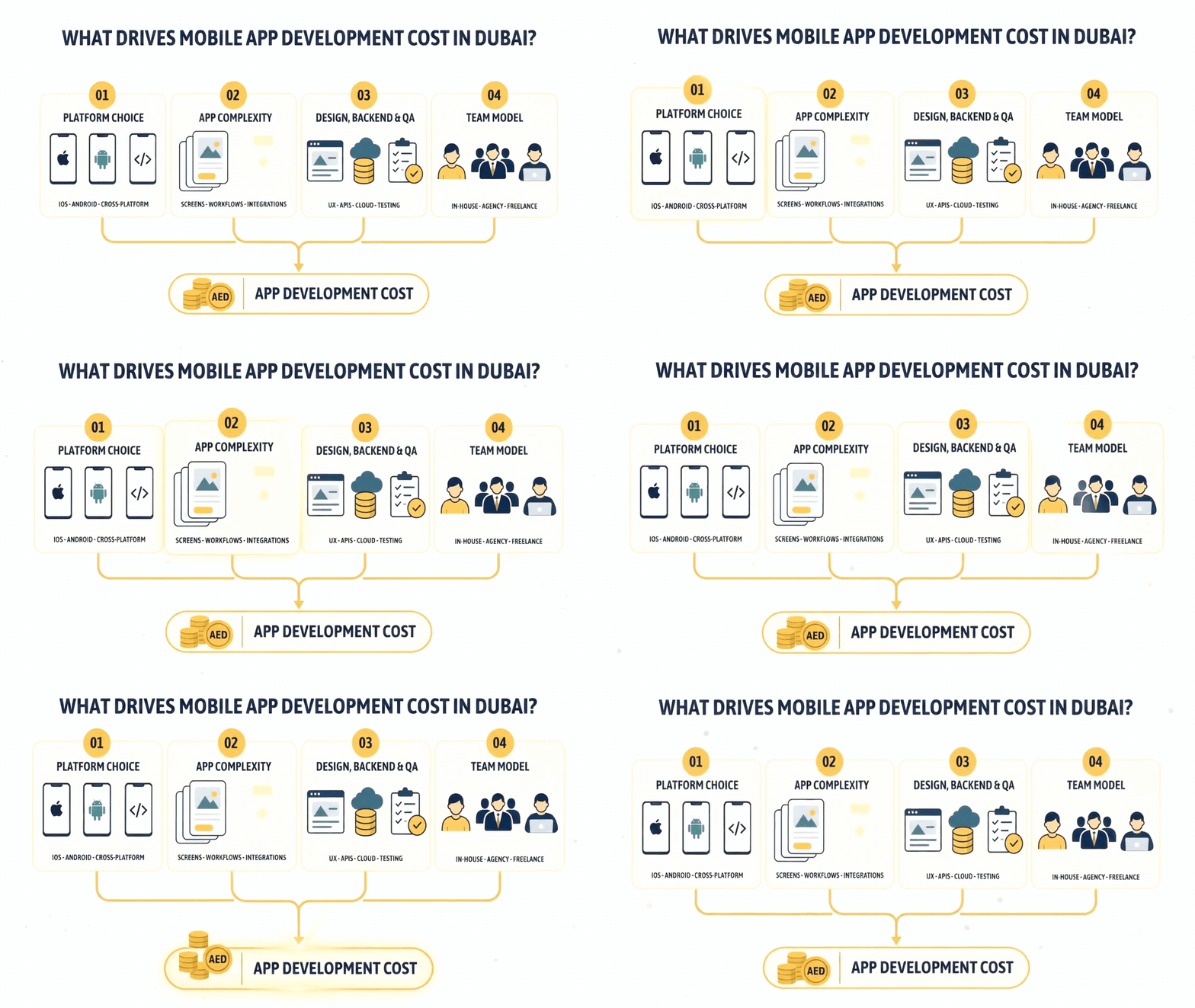
What Actually Drives Mobile App Development Cost in Dubai
Platform Choice: iOS, Android, or Cross-Platform
The first major cost decision is whether your application will launch on iOS, Android or both. Building separate native applications can increase development and testing requirements because teams maintain two technology stacks.
Cross-platform frameworks such as Flutter and React Native can reduce duplicated development work and are particularly attractive for startups seeking faster market entry. However, native development can still be preferable when an application depends heavily on platform-specific capabilities, advanced device functionality or extremely high-performance requirements.
For a Dubai startup validating its business model, launching a carefully scoped cross-platform MVP can often be financially smarter than investing immediately in two completely separate native products.
App Complexity and Number of Screens
The number of screens matters, but it is not the only indicator of complexity. A ten-screen application with complex payment, location and authentication workflows can require considerably more engineering than a twenty-screen content application.
Features such as real-time tracking, multi-role dashboards, subscription systems, document verification, messaging, video calling and transaction processing introduce additional backend logic and testing requirements.
Design, Backend, and QA as Cost Layers
A professional app budget includes much more than the mobile interface. UX research, wireframing, UI design, backend APIs, database architecture, cloud infrastructure, QA automation, device testing and release management all contribute to the final cost.
This becomes especially important in Dubai because applications serving diverse audiences may need multilingual experiences, accessibility considerations and high-quality performance across different devices and network conditions.
TDRA's digital accessibility approach highlights the importance of inclusive digital experiences, with its own platforms aligned with WCAG 2.2 AA standards.
Team Type: In-House vs. Agency vs. Freelance
An in-house team provides direct control but creates recurring salary, recruitment, management and infrastructure costs. Freelancers can be economical for narrowly defined modules, although coordination and long-term ownership can become challenges.
A specialist agency can provide product managers, designers, developers, QA engineers, DevOps specialists and security expertise under one delivery structure. For businesses that need predictable execution without building an entire technology department, this hybrid model can offer a stronger balance between cost and capability.
Base Cost by App Tier (2026 Breakdown)
MVP / Basic App Pricing
A basic MVP generally focuses on validating the core business proposition rather than implementing every possible feature. Typical examples include appointment-booking applications, simple marketplaces, internal employee apps, basic service platforms and information-driven applications.
For Dubai businesses, a realistic MVP budget can start around AED 50,000–120,000, depending on platform coverage, design requirements, backend complexity and integrations.
Standard / Mid-Range Business App Pricing
A standard business application usually includes a polished UX, user authentication, backend APIs, admin functionality, notifications, payment integration, analytics and stronger QA.
For this category, businesses should commonly plan around AED 120,000–300,000. Arabic-English functionality, third-party integrations, location services and advanced dashboards can move the project toward the upper end of this range.
Enterprise-Grade App Pricing
Enterprise applications require a completely different level of engineering discipline. They may include multiple user roles, complex workflows, high availability, enterprise integrations, sophisticated security controls, extensive analytics, AI capabilities and regulatory requirements.
Budgets can reasonably reach AED 300,000–800,000+, with heavily regulated fintech, healthcare or government-facing platforms potentially requiring substantially more.
Real AED and USD Price Table by Tier
|
App Tier
|
Typical Dubai 2026 Budget
|
Approx. USD Range
|
Typical Scope
|
|
MVP / Basic
|
AED 50,000–120,000
|
$13,600–$32,700
|
Core features, limited integrations, cross-platform option
|
|
Standard / Mid-Range
|
AED 120,000–300,000
|
$32,700–$81,700
|
Custom UX, backend, payments, APIs, analytics, admin
|
|
Enterprise
|
AED 300,000–800,000+
|
$81,700–$217,800+
|
Complex workflows, scalability, security, AI, enterprise integrations
|
USD conversions are approximate and intended for budgeting; actual project pricing depends on scope and exchange rates.
How Must-Have Features Affect Your Budget
Cost of Bilingual Arabic-English UX and RTL Design
Arabic support is not simply a matter of translating English labels. A properly localized application must support right-to-left layouts, mirrored navigation patterns, typography, text expansion, Arabic numerals where appropriate, localized validation and bilingual content management.
If Arabic is part of the target market from day one, designing for RTL during the initial architecture is significantly better than retrofitting it after launch. Depending on the application, bilingual UX can add roughly 10–20% to design, development and QA effort.
Cost of UAE PASS and Local Payment Gateway Integration
UAE PASS is increasingly relevant for applications requiring trusted digital identity and simplified authentication. The official UAE PASS developer platform provides service providers with authentication and digital-signature integration toolkits.
Payment integration also requires careful planning around transaction flows, refunds, failed payments, webhooks, reconciliation and security. The UAE's payment ecosystem is rapidly becoming more digital; the Central Bank reported that Aani exceeded 12.5 million registered users by April 2026 and supported approximately 774,000 merchants, with transfers completing in around three seconds.
A standard payment integration may add several thousand dirhams, while multiple gateways, wallet functionality, complex reconciliation and financial workflows can increase the engineering requirement substantially.
Cost of Location-Based Services and Offline Support
Location functionality becomes more complicated when an application requires live tracking, geofencing, route calculation or background location updates.
Offline functionality adds another layer because the application must store data locally, determine what happens without connectivity and synchronise changes once the connection returns. For logistics, travel, field-service and delivery applications, these capabilities can be worth the additional investment because they directly affect operational reliability.
The Cost of Getting Compliance Right
UAE PDPL Compliance Costs
The UAE Personal Data Protection Law establishes a framework for protecting personal data and governing how organisations process and secure it. The law covers electronic processing and places obligations around privacy, security and responsible data handling.
For an app handling names, identification details, financial information, health data or behavioural information, compliance should influence architecture from the beginning. Costs can include privacy assessments, consent mechanisms, data retention controls, access management, encryption, documentation and legal review.
A practical compliance budget can range from AED 10,000–50,000+, depending heavily on the application's data sensitivity and legal requirements.
TDRA Guideline Compliance Costs
TDRA-related requirements can become particularly important for applications operating within regulated digital environments or serving government-related users. Accessibility is also increasingly important in UAE digital services, with national policy focused on making digital products accessible to people of determination and elderly users.
Compliance should therefore be treated as an engineering requirement rather than a document prepared immediately before launch.
DIFC and Fintech-Specific Compliance Costs
Fintech applications operating in or connected to DIFC may face additional regulatory expectations. The DIFC Data Protection Law No. 5 of 2020 regulates personal data within the Centre, including special categories such as biometric and health-related information.
For financial applications, the compliance layer can include identity verification, transaction monitoring, auditability, fraud controls, secure data handling and regulatory reporting.
The DFSA reported an 18% increase in authorisation applications during the first three quarters of 2025, demonstrating the continuing expansion of the DIFC financial-services ecosystem.
Security Audits and Penetration Testing Costs
Security testing should not be treated as an optional final checkbox for applications handling sensitive information. Penetration testing can identify authentication vulnerabilities, API weaknesses, insecure data storage, broken access controls and other risks before attackers discover them.
A basic security assessment may cost several thousand dirhams, while comprehensive penetration testing and remediation for a fintech or enterprise platform can run into AED 20,000–75,000+, depending on application size and testing scope.
AI Features and What They Add to the Budget
Cost of Personalization and Predictive Analytics
Personalization can range from simple rule-based recommendations to machine-learning models that continuously learn from user behaviour. A retail application might recommend products, while a travel platform could predict destinations or experiences based on previous searches.
The development cost depends on data availability, model complexity, infrastructure and whether an external AI service or custom model is used.
Cost of AI Chatbots with Arabic NLP Support
A multilingual AI chatbot requires more than connecting an API to a chat window. Businesses need conversation design, knowledge retrieval, authentication, escalation to human agents, monitoring and safeguards against inaccurate responses.
Arabic NLP can require additional testing because users may communicate using different dialects, Arabic-English combinations and informal expressions.
Cost of Generative AI Features
Generative AI can support document summarisation, content generation, intelligent search, customer support and conversational interfaces. The initial development cost may be manageable using commercial APIs, but ongoing inference, storage, monitoring and model-management expenses must be included in the operating budget.
Is AI Worth the Investment for Your App Tier?
AI should solve a measurable business problem rather than exist simply because competitors mention it. For an MVP, a lightweight recommendation or support feature may be sufficient. For an enterprise platform, predictive analytics or generative AI can become a strategic capability.
Careem provides a useful real-world example of personalization at scale. Its 2025 Careem Moments experience used customer activity across rides, food and other services to create personalized summaries and user personas.
Hidden Costs Most Founders Don't Budget For
Cloud Hosting, APIs, and Infrastructure
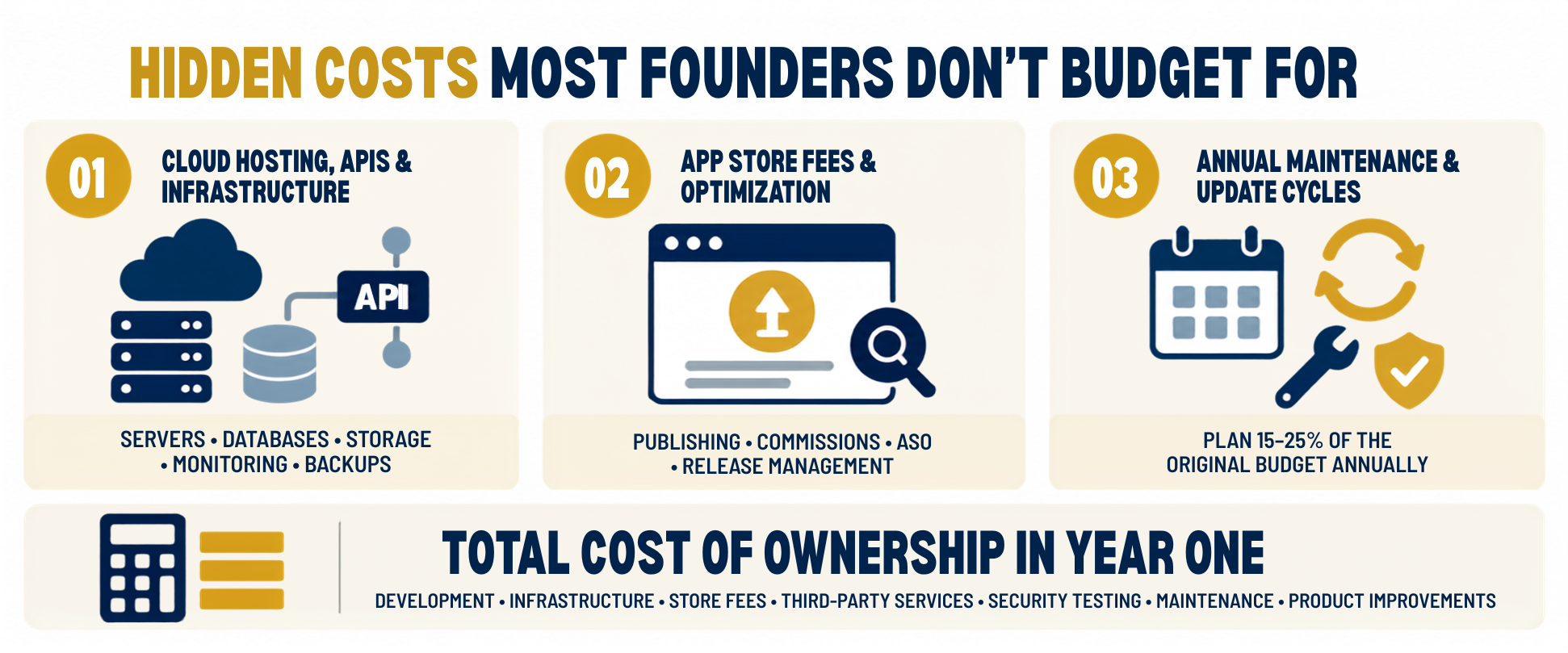
Cloud costs begin after development rather than ending with launch. Servers, databases, object storage, monitoring, backups, maps, messaging, authentication and third-party APIs can all generate recurring expenses.
The correct approach is to estimate infrastructure based on expected traffic and growth rather than choosing the cheapest hosting plan initially.
App Store Fees and Ongoing Store Optimization
Publishing also carries platform-related expenses. Apple's Developer Program costs US$99 per membership year, while its Small Business Program provides a 15% commission rate for eligible paid apps and in-app purchases.
Google Play similarly applies service fees depending on the developer's situation, with Google stating that 99% of developers subject to a service fee qualify for a fee of 15% or less.
App Store optimization, screenshots, descriptions, localization and ongoing release management can create additional marketing and operational costs.
Annual Maintenance and Update Cycles
A mobile app is not a one-time development purchase. Operating-system updates, security patches, third-party API changes, device compatibility, bug fixes and new business requirements all require ongoing engineering.
A common planning benchmark is to reserve approximately 15–25% of the original development budget annually for maintenance and continuous improvements, although highly active applications can require considerably more.
Total Cost of Ownership in Year One
The first-year cost should therefore include development, infrastructure, app-store expenses, third-party services, security testing, maintenance and product improvements.
This is why a project quoted at AED 100,000 may not actually cost AED 100,000 during its first year. The more meaningful number for business planning is the total cost of ownership, not merely the initial development invoice.
Worked Cost Examples
Sample MVP App: Realistic Total Budget
Consider a Dubai-based service marketplace launching with customer registration, provider profiles, service booking, notifications, payment integration and an admin panel.
A cross-platform build could fall around AED 75,000–110,000 for development and launch, with additional allowance for cloud services, payment charges, app-store operations and maintenance.
The smart approach would be to launch the core booking experience first, measure adoption and add advanced capabilities once actual user behaviour provides evidence for them.
Sample Fintech App: Realistic Total Budget
A fintech application could include secure onboarding, KYC integration, payment functionality, transaction history, notifications, biometric authentication, admin controls and extensive security testing.
A realistic first-phase development budget could be approximately AED 300,000–600,000+, before considering certain licensing, legal and regulatory costs.
A real-world example is Careem Pay's remittance infrastructure. Careem's engineering team describes how international remittance experiences had to account for different user purposes and corridor-specific infrastructure rather than treating international transfers as one generic workflow.
Sample E-Commerce App: Realistic Total Budget
|
Example
|
Development Budget
|
Additional First-Year Allowance
|
Realistic First-Year Planning Range
|
|
MVP Service App
|
AED 75,000–110,000
|
AED 15,000–30,000
|
AED 90,000–140,000
|
|
Fintech App
|
AED 300,000–600,000+
|
AED 60,000–150,000+
|
AED 360,000–750,000+
|
|
E-Commerce App
|
AED 150,000–280,000
|
AED 30,000–70,000
|
AED 180,000–350,000
|
For an e-commerce application, the budget can cover product catalogues, search, cart, checkout, payments, order tracking, customer accounts, promotions, notifications and administration. Integrations with ERP, CRM, inventory or logistics systems can increase the investment considerably.
Careem's regional experience also demonstrates why commerce and delivery applications need to be designed around real operational behaviour. During Ramadan 2025, Careem Food reported a 36% increase in Suhoor order volumes, while Careem Pay remittances increased 6%, illustrating how demand patterns can change dramatically around local events and consumer behaviour.
How to Reduce App Development Costs Without Cutting Corners
Choosing Cross-Platform Frameworks
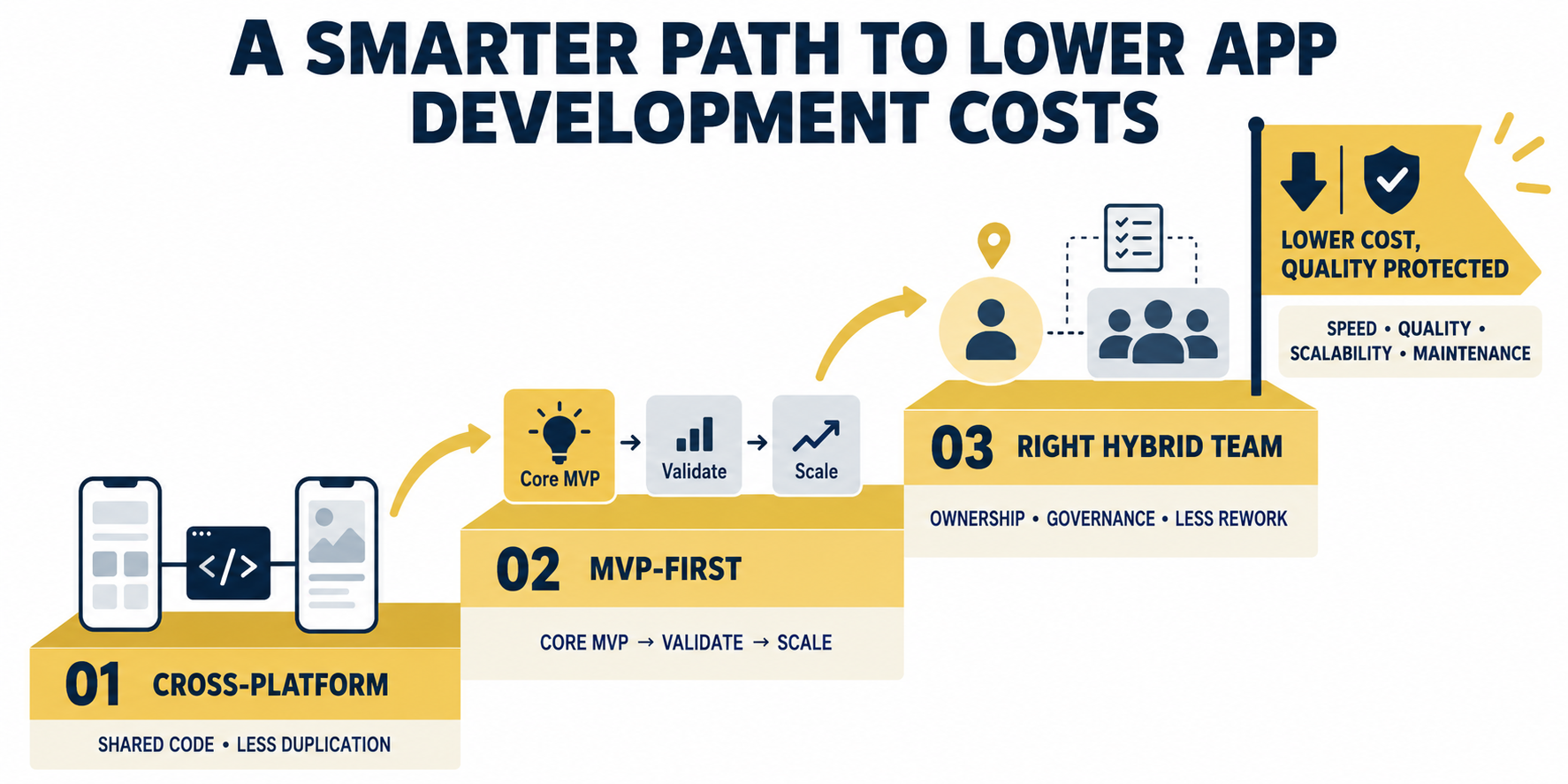
Cross-platform development can reduce duplicated engineering effort when iOS and Android applications share most business logic and interface requirements. Flutter or React Native can therefore be strong choices for startups and SMEs that need to validate an idea quickly.
The objective should not be choosing the cheapest technology; it should be choosing technology that gives the business the best balance of speed, quality, scalability and future maintenance.
Phased Development and MVP-First Approach
One of the strongest cost-control strategies is to separate essential functionality from future functionality.
Instead of launching with every possible feature, define the smallest product capable of generating meaningful customer feedback. Once the product demonstrates demand, investment can move toward analytics, automation, AI, advanced integrations and additional customer journeys.
Working with the Right Hybrid or Offshore Team
Dubai businesses can also reduce development costs by working with a hybrid delivery model where product ownership and client communication remain close to the business while engineering resources are strategically distributed.
The key is governance. A lower hourly rate does not create savings if poor documentation, weak QA or frequent rework doubles the project timeline.
Choosing the Right Development Partner for Your Budget
Questions to Ask Before Accepting a Quote
Ask exactly what the quotation includes: UX research, UI design, backend development, APIs, QA, DevOps, security testing, deployment, documentation and post-launch support.
You should also ask who owns the source code, how change requests are priced, what happens when third-party APIs change and whether the quoted architecture can support your expected user growth.
A professional development partner should be able to explain why a feature costs a certain amount rather than simply presenting a final number.
Red Flags in Unusually Low or High Quotes
An unusually low quotation can indicate missing QA, limited security testing, template-based design, inexperienced development or a backend architecture that will become expensive to replace.
An unusually high quote is not automatically better either. Businesses should look for a clear relationship between cost, technical complexity, business risk and expected outcomes.
The strongest proposal is usually the one that makes the scope transparent, identifies risks early and gives you a realistic roadmap from MVP to scale.
Planning to Launch Your App in the UAE?
Contact Us
Final Thoughts: Budgeting for a Realistic, Compliant App
The real cost of building a mobile app in Dubai in 2026 is determined by much more than screens and coding hours. Platform choice, bilingual UX, payments, UAE PASS, cloud infrastructure, AI, security, compliance and post-launch maintenance can all materially change the investment.
For a straightforward MVP, businesses may begin around AED 50,000–120,000. A professional mid-range product can move into AED 120,000–300,000, while enterprise and regulated applications can exceed AED 800,000 depending on scope.
The best strategy is to invest where the user and business actually need sophistication. A well-planned MVP can reduce unnecessary expenditure while still creating a scalable foundation for future growth.
For Dubai businesses, the development partner should therefore be more than a coding vendor. The right technology partner should understand product strategy, regional user behaviour, security, integrations, compliance and long-term scalability.
Planning a mobile app for the Dubai or UAE market? TechQware can help you move from product idea to a secure, scalable and market-ready mobile application. From UI/UX and cross-platform development to payment integrations, UAE PASS, AI, cloud infrastructure, testing and long-term maintenance, our team can structure the right technology roadmap around your budget and business goals.
Talk to Us Now today and get a realistic mobile app development estimate for your project.
FAQs
How much does it cost to build a mobile app in Dubai in 2026?
A mobile app in Dubai can cost approximately AED 50,000–120,000 for a basic MVP, AED 120,000–300,000 for a standard business application and AED 300,000–800,000 or more for enterprise-grade solutions. Fintech, healthcare, government-facing and highly integrated products can exceed these ranges because of additional security, compliance and infrastructure requirements.
Does UAE PDPL compliance add significantly to the cost?
It can, particularly when an application processes sensitive or high volumes of personal information. Compliance can require privacy controls, consent management, data governance, security measures, documentation and specialist review. Planning these requirements during architecture is generally more cost-effective than rebuilding the application after development.
Is UAE PASS integration expensive to add?
The development effort is usually manageable for a properly structured application, but the overall requirement depends on authentication flows, verification requirements and the surrounding business process. UAE PASS provides official developer toolkits for authentication and digital-signature integration, making it a practical option for eligible applications that require trusted digital identity.
How much do AI features typically add to app cost?
AI can add anywhere from a relatively modest amount for API-based functionality to a significant investment for custom recommendation engines, predictive analytics or advanced generative-AI systems. The major variables are data requirements, model complexity, integrations, monitoring, infrastructure and ongoing usage costs.
What's a realistic budget for a Dubai fintech app?
A serious fintech MVP should generally be planned at a substantially higher budget than a basic consumer application. A range of approximately AED 300,000–600,000+ can be realistic for a feature-rich first release, although regulatory scope, payment infrastructure, KYC, security, fraud prevention and integrations can push the cost higher.
How can I lower my app development cost without sacrificing quality?
Start with a clearly defined MVP, prioritize high-value workflows, use cross-platform technology where appropriate, reuse proven backend components and avoid unnecessary custom functionality. Most importantly, do not remove security, QA or architectural planning simply to reduce the initial quotation, because those shortcuts often create much larger expenses after launch.
Abhinav Srivastav
With years of experience in driving digital transformation, Abhinav Srivastav is the CEO & Director of TechQware Technologies, helping businesses build innovative mobile apps, AI-powered applications, and scalable digital solutions.

 TechQware