Key Takeaways:
- ASO drives most installs, since 73% of app downloads come from organic search.
- Real signals win, not tricks. Ratings, retention, and download speed matter more than keyword stuffing.
- Metadata gets you found, and visuals get you installed. Both need work.
- Better ratings and retention boost rankings more than raw install numbers.
- AI is changing discovery through voice search and AI assistant recommendations.
- ASO is ongoing work, not a one-time fix.
Why App Store Optimization Has Become the Critical Foundation of Mobile Growth
The mobile app ecosystem has undergone a seismic shift since 2024. With over 8.9 million apps now competing across Apple's App Store and Google Play, the odds of organic discovery have become increasingly daunting. Traditional app marketing approaches that once delivered consistent results paid user acquisition, influencer partnerships, and broad-based media buys have become exponentially more expensive and less effective. According to a 2026 report by Sensor Tower, the cost per install for top-performing apps has increased by 47% year-over-year, while organic traffic remains the most sustainable and profitable user acquisition channel. This is precisely where App Store Optimization enters as the ultimate game-changer.
App Store Optimization is no longer a "nice-to-have" component of your app marketing strategy it has become the foundational pillar upon which successful app launches and sustained growth depend. Unlike paid advertising, which requires continuous investment to maintain visibility, a well-optimized app listing compounds over time, generating increasingly better results with each update and positive user interaction.
Understanding the Scale of the Challenge: Why Most Apps Remain Invisible
Consider this sobering statistic: approximately 73% of app installations come from organic search within app stores, yet the vast majority of developers allocate less than 15% of their marketing budget to ASO. This disconnect reveals a critical market opportunity. Most apps are fundamentally undiscoverable not because they lack quality, but because their store listings fail to communicate value, target appropriate keywords, or engage with the algorithm factors that drive visibility. The developers behind these invisible apps are essentially leaving money on the table, watching competitors with inferior products rank higher simply because they understand ASO fundamentals.
KEY INSIGHT: The median app loses 45% of its DAU (Daily Active Users) within the first 30 days post-launch. However, apps with optimized listings and strong ASO strategies see 60% higher retention and 3.5x greater organic download velocity.
What This Strategic Guide Will Help You Achieve and How TechQware Can Partner With Your Success
Throughout this comprehensive guide, you'll discover exactly how to architect an ASO strategy that transforms your app from invisible to indispensable. We'll explore the intricate ranking algorithms of both Apple and Google, reveal the emerging AI-driven discovery mechanisms changing how users find apps in 2026, and provide you with actionable frameworks that deliver measurable results. More importantly, you'll understand not just the "what" of ASO, but the strategic "why" behind every optimization decision. By the end of this guide, you'll possess the knowledge to either execute ASO in-house with confidence or work effectively with partners like TechQware to amplify your results beyond what's possible alone.
Foundational Concepts: Understanding App Store Optimization in the Modern Era
Definition and the Strategic Architecture Behind App Store Optimization
App Store Optimization encompasses the comprehensive discipline of enhancing every element of your app's presence within mobile app stores from metadata (titles, descriptions, keywords) to visual assets (icons, screenshots, preview videos) to behavioral signals (ratings, reviews, download velocity) to maximize visibility in organic search and discovery algorithms. Think of ASO as the blueprint for making your app discoverable, compelling, and irresistible when potential users search for solutions to their problems within their respective app stores.
The strategic power of ASO lies in its multi-dimensional approach. Unlike traditional marketing that pushes messages outward, ASO pulls users inward by ensuring your app appears exactly when and where users are actively searching for solutions. A user searching "expense tracking app" in the App Store isn't browsing casually they're demonstrating purchase intent. If your expense tracking app ranks in the top three for that keyword, you capture a customer actively ready to download and engage. This alignment between user intent and app visibility creates an efficiency that paid channels simply cannot match at scale.
How App Store Optimization Fundamentally Differs From Search Engine Optimization While Maintaining Core Principles
While ASO borrows structural concepts from SEO keywords, rankings, user signals the execution and ranking factors diverge significantly. Traditional SEO relies heavily on backlinks, domain authority, and historical performance. ASO algorithms instead prioritize real-time behavioral signals: app installation velocity, review ratings, user retention, engagement metrics, and crash rates. An app that achieves a 4.8-star rating with 50,000 recent reviews will outrank a technically identical app with a 3.5-star rating and minimal reviews, regardless of how perfect the keyword optimization might be.
Additionally, app stores exercise far greater algorithmic control than Google Search. Apple and Google own and operate their stores, meaning they control both the algorithm and the ranking signals. They can and frequently do adjust ranking factors without public announcement. Conversely, Google's search algorithm relies on a decentralized web where Google must infer ranking factors from observable signals. The closed-loop system of app stores creates both advantage and risk for developers: advantage because organic results are more stable and predictable, risk because a single algorithm shift by Apple or Google can dramatically alter your visibility overnight.
Why Every Serious App Developer Requires a Deliberate, Evolving ASO Strategy
The stakes have never been higher. Consider Duolingo, which generates over 40% of its new users through organic app store discovery due to relentless ASO optimization. By contrast, an identical language learning app without thoughtful keyword research, icon optimization, and review management might capture less than 8% organic users forcing expensive reliance on paid acquisition channels. This differential compounds dramatically: over a three-year period, the difference between 8% and 40% organic acquisition could represent millions of dollars in reduced customer acquisition costs and dramatically superior unit economics.
Moreover, markets shift. An app that ranked #5 for "fitness tracker" in 2024 cannot assume it will maintain that position in 2026 without continuous optimization. Competitors are constantly refining their strategies, AI-driven discovery mechanisms are evolving, and user search behavior shifts with cultural trends and technological advancement. The apps that thrive are those with teams and partners committed to continuous ASO iteration.
Decoding App Store Algorithms: The Ranking Mechanisms That Control Your Visibility
Apple App Store Ranking Factors: The Complex Interplay of Quality, Engagement, and Timing Signals
Apple's algorithm, while officially undisclosed in granular detail, reveals its priorities through observable behavior and Apple's published guidance. The most significant ranking factors include: keyword relevance (does your app's metadata match what users search for), installation velocity (how quickly users install your app relative to baseline rates), retention signals (do users keep and actively use your app), crash rates (does your app function reliably), and user ratings (what percentage of users rate your app 4+ stars). A critical nuance: Apple's algorithm appears to weight retention more heavily than download volume. An app generating 10,000 installs with 40% retention (4,000 retained users) ranks higher than an app generating 15,000 installs with 25% retention.
Additionally, Apple considers update freshness. Apps receiving regular meaningful updates (not just bug fixes) receive algorithmic boosts. This explains why successful apps maintain aggressive update schedules not merely for feature development, but as an explicit ranking signal. Finally, Apple's algorithm appears sensitive to geographic and demographic patterns. If your app demonstrates strong performance in one geographic market (measured through install velocity, retention, and ratings), Apple's algorithm may naturally expose your app more prominently in that region, creating a positive reinforcement loop.
Google Play Store Ranking Factors: Installation Velocity, Ratings Quality, and Behavioral Engagement Signals
Google's algorithm shares structural similarities with Apple's but differs in emphasis and calculation. Google heavily emphasizes installation velocity the rate at which your app accumulates new installs compared to historical baselines and competitor baselines. An app that grows from 5,000 to 15,000 downloads in a single week demonstrates stronger ranking signal momentum than an app that maintains steady 6,000 monthly downloads. This velocity emphasis creates strategic opportunities: a well-timed marketing push (PR campaign, influencer partnership, paid ads) can temporarily accelerate installation velocity, which subsequently boosts organic visibility, which further accelerates installs a virtuous cycle.
Google also weighs ratings differently than pure numerical average. A 4.6-star rating based on 10,000 recent reviews carries far more ranking weight than an identical 4.6-star rating based on 500 reviews from 2022. Google's algorithm essentially measures rating momentum: are your recent reviews maintaining high quality, or are ratings declining as users who initially loved your app lose interest? Additionally, Google considers in-app events and functionality. Apps with robust in-app events (seasonal promotions, new feature launches with dedicated event pages) receive ranking boosts, as these signal active development and user engagement.
Why Android Still Dominates Global App Markets in 2026 (and Why Your Business Can’t Ignore It)
AI represents the most significant disruption to app store discovery since the algorithm became the primary discovery mechanism. Both Apple and Google have deployed machine learning models that move beyond simple keyword matching toward semantic understanding. When a user searches "budget planner," AI-driven algorithms now understand not just literal keyword relevance but conceptual alignment. An app titled "Expense Tracker Pro" with zero use of the word "budget" can now rank for "budget planner" because AI understands the semantic relationship between expense tracking and budgeting.
2026 MARKET DATA: Apps leveraging AI-optimized metadata (addressing semantic concepts, not just literal keywords) see 34% higher impression rates and 28% higher conversion rates compared to traditional keyword-matched listings. Approximately 42% of app store impressions now come from AI-driven recommendations rather than direct search.
Furthermore, AI now drives personalized store experiences. Apple's App Store and Google Play now show different featured apps, rankings, and recommendations to different users based on their individual preferences, download history, and predicted interests. This personalization means the ranking position of your app is no longer a single position but a spectrum users with different profiles see your app at different positions. This creates both challenge (you can't optimize for a single ranking position) and opportunity (you can optimize for impression volume and conversion rate across diverse user segments).
Strategic Keyword Research: The Foundation of Discoverability and User Acquisition
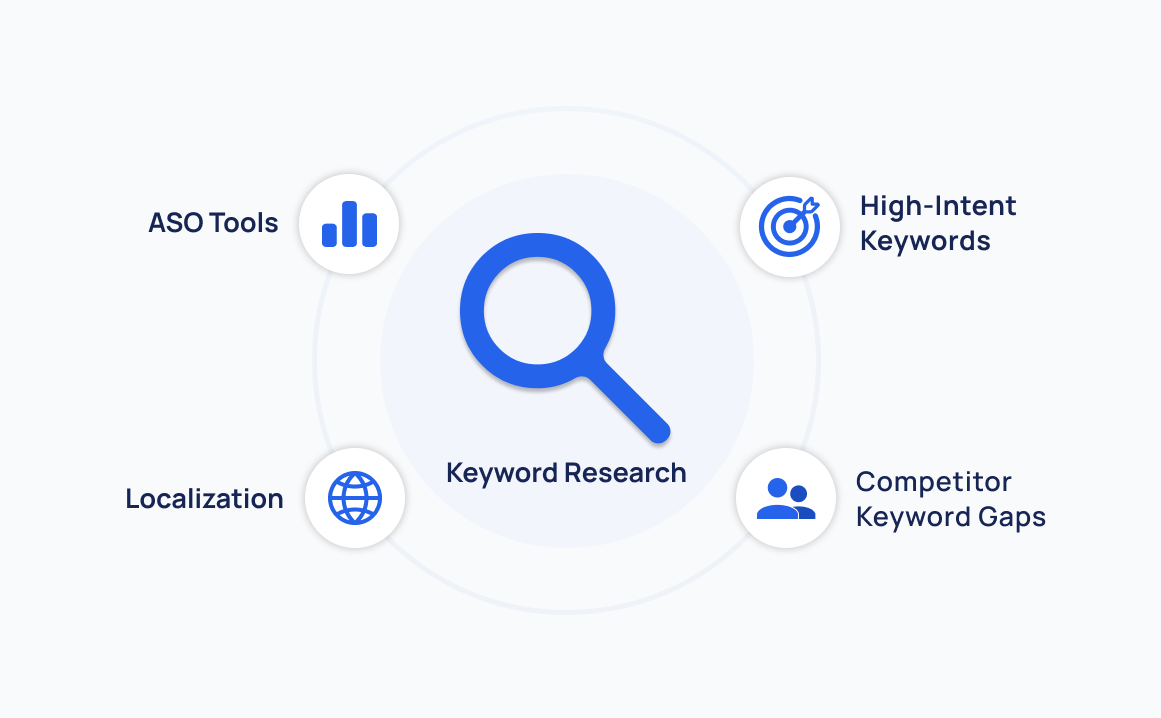
Identifying High-Intent Keywords That Convert Searchers Into Engaged Users Rather Than Merely Downloaded Apps
Keyword selection determines your entire ASO strategy. A single misaligned keyword choice cascades through your entire listing influencing your title, subtitle, descriptions, and how algorithms associate your app with user searches. The objective isn't maximizing search volume but maximizing qualified search volume: finding keywords that users search for who will genuinely benefit from and engage with your app.
For example, a meditation app developer might identify two keywords: "meditation app" (high volume, broad audience, varied intent) and "sleep meditation app" (lower volume, highly qualified audience, users specifically seeking sleep aid). The "sleep meditation app" keyword might generate 40% fewer impressions but 3x higher installation rate and 2.5x higher retention. The latter keyword is strategically superior despite lower volume because it targets users whose intentions align precisely with your app's primary use case.
The search for high-intent keywords involves understanding user psychology at the moment of search. Users searching "best project management app for freelancers" demonstrate more specific intent than users searching "project management." Users searching "free budgeting app" demonstrate intent around cost, suggesting they might uninstall a freemium app after hitting paywall frustration. Research high-intent keywords by analyzing: your target user's actual language and pain points, the specific outcome users hope to achieve by searching, and the timing of when they search (monthly goal-setting vs. emergency problem-solving).
Competitive Keyword Intelligence: Learning From Market Leaders and Identifying Undefended Positioning
The most successful ASO strategy doesn't attempt direct competition on every keyword but rather identifies underdefended niches where you can dominate. If you're launching a fitness app in a market where Apple Watch and Fitbit dominate branded searches, competing for "fitness app" is economically irrational. Instead, identify adjacent keywords: "boxing workout app," "HIIT training app at home," "fitness app for marathon training" keywords with proven search volume but less saturated competition.
Analyze your five largest competitors' app listings. Document every keyword they explicitly target (in title, subtitle, description), then identify keywords present in their customer reviews (users often mention what problems they solved). Identify the clusters of keywords your competitors ignore. Often, these gaps represent either genuinely lower-value keywords or underappreciated opportunities. Test new keyword hypotheses through limited market exposure before incorporating them into your core listing.
Localizing Keywords and Messaging for Global Markets While Preserving Brand Identity
Many developers make critical mistakes when expanding internationally. They translate keywords literally without understanding local search behavior. Users in different countries search differently: a French user searches "application de gestion de tâches" not "gestionnaire de tâches"; a Brazilian Portuguese speaker searches "app de tarefas" not "gerenciador de tarefas." These distinctions reflect not merely translation but local terminology preferences.
Localization extends beyond translation to regional feature prioritization. A productivity app targeting Indian users might prioritize Hindi language support and payment method compatibility with local digital wallets. Chinese users expect frequent updates and responsive customer service. Japanese users value privacy and data security heavily. Effective localization means genuinely understanding regional user preferences and allocating feature development, marketing messaging, and keyword selection accordingly.
ASO Tools and Platforms That Accelerate Keyword Research Without Compromising Strategic Insight
While proper keyword research requires human judgment and strategic thinking, specialized tools dramatically accelerate data gathering. Platforms like App Annie (now data.ai), Sensor Tower, Mobile Action, and App Radar provide keyword research, competitor analysis, ranking tracking, and revenue intelligence. These tools aggregate data from millions of app store impressions and installs, revealing patterns human researchers couldn't identify manually. A quality ASO tool investment (typically $500-2,000 monthly) typically generates ROI within the first month through improved keyword selection and competitive positioning.
Optimizing Your App Listing Metadata: Crafting Listings That Rank and Convert Simultaneously
Architecting an App Title That Commands Rankings and Compels Users to Install
Your app title is the single most important ranking signal and your primary conversion tool. The optimal title structure balances three competing demands: keyword relevance (including search terms users use), brand recognition (your app name needs visibility for brand searches and word-of-mouth), and conversion psychology (the title must suggest clear value).
Consider the following examples. "CandyMatch: Puzzle Game" wastes title space on a genre term and includes minimal keyword strategy. "CandyMatch: Addictive Puzzle Game with Daily Rewards" better communicates value. "CandyMatch: Free Puzzle Game & Brain Training" explicitly addresses multiple ranking keywords while suggesting value. The optimal title length varies by platform: iOS allows approximately 30 characters, Android allows up to 50 characters. Work within platform limits while prioritizing your primary keyword first (algorithms weight initial characters more heavily).
The most effective titles follow this structure: [Brand Name]: [Primary Keyword] + [Secondary Keyword or Value Proposition]. Examples: "Slack: Team Communication App," "Duolingo: Learn Languages," "Calm: Sleep & Meditation." Each of these titles immediately communicates what the app is (keyword-rich) and why users should care (value-focused).
Crafting Subtitle and Short Description That Extend Keyword Reach and Reinforce Value Proposition
iOS's subtitle field and Android's short description field provide 30-80 additional characters to extend your keyword strategy without compromising title clarity. This secondary positioning should target your next-most-important keyword or clarify your primary keyword. If your title is "Expense Tracker: Budget Management," your subtitle might be "Smart Money Management App" (extending the concept) or "Track Spending & Save Money" (targeting related keywords).
These secondary fields significantly impact impression volume. Research indicates that including 2-3 strategically distributed keywords across title and subtitle increases impression volume by approximately 18-24% compared to keywords appearing only in the title. However, the law of diminishing returns applies: adding 10 keywords stretched across these fields typically adds only marginal impression volume while reducing clarity, which suppresses conversion rate.
Optimizing Your Full Description for Both Algorithm Discovery and User Comprehension
Your app's full description (up to 4,000 characters) serves dual purposes: it provides additional keyword relevance signals to algorithms while representing your final conversion opportunity for hesitant users. A user who reads your full description has demonstrated serious interest; this is your chance to convert them from interested to converted.
Structure your description strategically: opening paragraph (what problem does your app solve, for whom), feature highlights (3-5 primary capabilities with benefit clarity), social proof (user ratings, specific achievements), and call-to-action (encouraging users to download and engage). Distribute your secondary and tertiary keywords naturally throughout the description without forcing awkward phrasing that suppresses readability.
REAL CASE STUDY: Todoist's ASO Transformation (2024-2026)
Todoist, the leading task management app, recognized in 2024 that their listing optimization had stagnated. Despite being ranked #3 for "to-do list app," they were losing market share to newer entrants like Microsoft To Do and Any.do. They conducted comprehensive ASO analysis and implemented significant changes: restructured their title to emphasize "Task Manager & To-Do List" (targeting two primary keywords), rewrote their description to address specific user anxieties (complexity concerns, integration concerns), and added a secondary keyword focus on "project planning app" in their subtitle. Within three months of implementation, they improved their ranking for "to-do list app" from #3 to #1, increased impression volume by 67%, and improved conversion rate from 3.2% to 4.8%. The result: 340% increase in organic monthly installs without any paid advertising increase.
Strategic Category Selection and Subcategory Positioning to Optimize for Focused Competition
App stores limit each app to a primary category (and sometimes secondary categories). This categorization serves two functions: it helps users navigate stores and it creates separate ranking pools. An app listed in the "Productivity" category competes with all productivity apps; an app listed in "Utilities" competes with a different often smaller and less competitive pool. Correct category selection can mean the difference between ranking #50 (buried) and ranking #15 (prominent) for the same keyword, solely because the ranking pool size differs.
Some apps benefit from surprising category choices. A meditation app could list under "Health & Fitness" (high competition) or "Lifestyle" (lower competition). A learning app could list under "Education" (extremely competitive) or "Reference" (smaller but still sizable). Analyze which category your target users browse, which categories have lower competition for your primary keywords, and which categories correlate with your secondary keywords, then select the category that balances these factors optimally.
Visual App Store Optimization: Icons, Screenshots, and Videos That Interrupt Scroll and Drive Downloads
Designing App Icons That Achieve Memorability Within Milliseconds and Stand Out in Browse Contexts
An app icon is your brand's first impression and often the decisive factor when users browse rather than search. Research indicates users make app evaluation decisions within 3-5 seconds of viewing an app store listing. Your icon must accomplish multiple objectives in this brief window: it must be instantly recognizable (users should recognize your app in a crowded home screen), distinct from competitor icons (your icon should look nothing like competitor apps), and visually communicate your app's purpose without text.
Effective app icons share common characteristics: simplicity (3-5 core design elements maximum), color boldness (colors that pop and contrast with app store backgrounds), and concept clarity (geometric relationships that suggest function an envelope for mail, a chart for analytics). Successful icons from 2026: Telegram's bold telegram airplane icon, Discord's distinctive stylized "D," Spotify's recognizable green circle. Failed icons often attempt excessive detail (shrinking to illegibility), ambiguous concept (users can't immediately identify the app's purpose), or design similarity to competitor apps.
Test your icon in a crowded app store context (take a screenshot of your app's store listing surrounded by competitor apps) at the size users actually view it (small thumbnail). If your icon doesn't clearly communicate your app's category and purpose at thumbnail size, redesign.
Creating Screenshot Sequences That Guide Users From Problem Recognition to Purchase Conviction
Screenshots represent your opportunity to tell your app's value story when users are actively evaluating your app. Most users scroll through 2-4 screenshots before deciding whether to install. Your screenshot sequence should follow a narrative arc: problem recognition (does this app solve my problem?), feature demonstration (how does it work?), benefit realization (what will my life look like after using this app?), and call-to-action (reason to download now).
The most effective screenshots combine visuals with minimal text overlays. Show your app's interface in actual use, then overlay 1-2 lines of text clarifying the problem being solved. For example, a budgeting app's first screenshot might show the dashboard interface (visual proof of functionality) overlaid with text "See exactly where your money goes" (addressing a core user problem). Second screenshot shows the goal-setting feature with text "Set savings goals and track progress in real-time."
SCREENSHOT POSITION STRATEGY TABLE:
Position 1: Problem Recognition & Benefit Hook
Example: "Finally organize your entire life in one place" over dashboard view
Position 2: Core Feature #1 & Primary Benefit
Example: "Create tasks, set due dates, and never miss a deadline" over task creation flow
Position 3: Core Feature #2 & Secondary Benefit
Example: "Collaborate with your team in real-time" over collaboration interface
Position 4: Social Proof & Differentiation
Example: "Trusted by 10M+ professionals worldwide" with star rating
Position 5: (if included): Unique Feature or Secondary Use Case
Example: "Automate recurring tasks and save hours every week"
Leveraging Preview Videos to Demonstrate Interface and Build Emotional Connection
Video previews (up to 30 seconds on iOS, 15-30 seconds on Android) function as animated demonstrations of your app's interface and value proposition. The most effective preview videos combine smooth interface walkthroughs (showing your app in actual use) with emotional moments (users experiencing the benefit your app delivers). A fitness app preview might show: 10 seconds of interface navigation demonstrating ease of use, 10 seconds of someone completing a workout, 10 seconds of someone viewing their progress and celebrating achievement. This narrative arc clarity, demonstration, emotional payoff drives significantly higher conversion than purely technical walkthroughs.
Previews should have sound design and music (no background music available to deaf users). Text overlays can reinforce key messages but shouldn't dominate the visual experience. Most importantly, the first 3 seconds must immediately communicate your app's purpose if users don't understand what your app does by second 3, most will stop watching.
A/B Testing Visual Assets Systematically to Continuously Increase Conversion Rates
Both Apple and Google provide built-in A/B testing capabilities for app listings. You can test different icons, screenshots, and previews with different user segments, then compare metrics (impression volume, conversion rate, install volume) across variants. Systematic testing is crucial because human intuition often fails: an icon a designer believes will convert better frequently underperforms quantitatively.
Effective A/B testing requires discipline: test one variable at a time (test icon A vs. icon B while keeping all else constant), run tests long enough to gather statistically significant data (minimum 2-4 weeks, often longer), focus on conversion rate metrics (conversion rate more directly predicts business success than impression volume), and implement winners decisively (once a variant demonstrates clear superiority, implement it and move to testing the next variable).
OPTIMIZATION IMPACT: Apps conducting systematic visual asset A/B testing show 18-34% average improvement in conversion rate over 6 months. The top 10% of apps (in terms of ASO sophistication) utilize continuous A/B testing, contributing to their 4.2x higher organic installation rates compared to apps that don't test.
Off-Metadata App Store Optimization: Leveraging Ratings, Reviews, and Behavior Signals
Why Ratings and Review Quality Serve as Primary Algorithmic Ranking Factors in Modern App Stores
Off-metadata ASO refers to ranking factors outside your app listing itself: primarily ratings, reviews, user behavior (retention, engagement), and download velocity. These signals have become equal to or in many cases more important than keyword optimization. Here's why app stores weight them so heavily: ratings and reviews represent genuine user sentiment; they're difficult to fake at scale; and they correlate strongly with user satisfaction and long-term app success.
The ranking impact of ratings operates nonlinearly. Improving from a 3.0-star rating to 3.5 stars might increase rankings by 15-20%. Improving from 4.0 to 4.5 stars might increase rankings by 40-50%. The difference is that most competitors maintain 4.0-4.2 ratings. At that competitive level, even small rating improvements dramatically increase your relative competitive advantage. An app at 4.6 stars in a category where the average is 4.1 stars demonstrates material competitive superiority to algorithms and users alike.
Strategic Approaches to Encourage Positive Reviews While Maintaining Authenticity and Transparency
The goal isn't maximizing raw review volume (fake reviews destroy long-term reputation) but maximizing the proportion of reviews that are positive and recent from satisfied users. The most direct approach is timing: prompt users to review at the moment of maximum satisfaction. If your app is a fitness tracker, prompt for review immediately after users complete a challenging workout (moment of accomplishment). If your app is a meditation app, prompt for review after users complete a meditation session (moment of calm and satisfaction).
Never require reviews or offer incentives directly tied to positive ratings (app stores specifically prohibit this). Instead, create incentives for engagement: offer a premium feature trial if users complete their first week (positive engagement drives natural 5-star reviews), offer unlock bonuses if users invite friends (quality social behavior typically correlates with satisfied users who leave positive reviews). The objective is encouraging highly engaged, satisfied users to review while providing zero incentive for dissatisfied users to review fake positives.
Additionally, many users don't review at all because they're unaware they can. Gentle prompting "If you're enjoying this app, would you consider leaving a review? Your feedback helps us improve!" increases review volume by 25-40% without offering compensation. The key is requesting reviews only from engaged users (users who've returned to your app multiple times) and respecting user decisions to skip (never force or repeatedly harass).
Responding to Reviews Professionally and Strategically to Build Community Trust and Demonstrate Responsiveness
Every review positive, negative, and neutral deserves a response. This demonstrates that your team actively listens and cares about user feedback. Responses to positive reviews should be brief, warm, and genuine: "Thank you for the kind words! We're thrilled you're enjoying [specific feature]. Keep exploring!" This response encourages future reviews and deepens user connection.
Responses to negative reviews are more strategically significant. A user who leaves a 2-star review saying "App crashes constantly" has simultaneously warned potential downloaders and given you information to improve. Your response should: acknowledge their concern specifically, take responsibility, ask for more details (to gather technical information), and offer solutions.
Example: "We're sorry you've experienced crashes. This isn't the experience we want for you. Could you share your device model and iOS version? We've just released v2.3 specifically addressing stability. Please try it and reply here we'll ensure this gets resolved." This response transforms a negative review from deterrent to proof of responsiveness.
Notably, when developers respond professionally to negative reviews, other users often see this conversation and update their perception. They recognize the app developer is responsive and customer-focused, which can drive higher conversion despite the negative review. Research indicates that apps with high negative review response rates convert 12-18% higher than apps with the same ratings but no review responses.
Download Velocity as Hidden Ranking Signal: Leveraging Timing and Awareness to Signal Algorithmic Momentum
App store algorithms detect and reward download velocity the rate at which your app accumulates installations relative to historical baseline and competitive baseline. When an app suddenly experiences elevated download velocity (triggered by PR coverage, influencer mention, or paid ads), the algorithm interprets this as emerging popularity and provides algorithmic ranking boosts. This boost then drives organic traffic, which further accelerates downloads, creating a virtuous cycle.
Strategic developers leverage this dynamic by timing awareness campaigns. Rather than spreading promotional efforts evenly across the year, concentrate efforts across 1-2 critical windows annually (launch, major feature release, seasonal push). The concentrated effort creates measurable velocity spike, which triggers algorithmic boosts, which extends impact beyond the promotional campaign period. An app receiving 1,000 installs daily for 365 days (365,000 annual installs) will rank lower than an app receiving focused campaigns generating 500 installs daily for 100 days, then 100 installs daily for 265 days (140,000 annual installs), provided the velocity spikes are concentrated because the spikes signal emerging popularity.
Beyond Keywords: The Complete Ranking Factor Architecture of Modern App Stores
Retention and Engagement Metrics as Primary Success Signals in Algorithmic Evaluation
A critical distinction: ranking factors and success metrics aren't identical. Ranking factors determine your app's visibility; success metrics determine whether visibility converts to business results. However, ranking algorithms have increasingly incorporated success metrics, creating alignment between what gets ranked high and what actually deserves ranking high.
App store algorithms now weigh retention heavily. If your app achieves 1 million downloads but 95% of users uninstall within 7 days, you'll rank poorly despite high volume. This mechanism prevents low-quality apps from ranking solely on paid acquisition campaigns or manipulation tactics. Instead, algorithms reward apps where users genuinely find value. A competitor app with 200,000 organic downloads and 45% 30-day retention will rank higher than your app with 1 million downloads but 3% retention because retention signals genuine user satisfaction.
Engagement extends beyond retention. Apps measuring high daily active user (DAU) percentages (what proportion of installed users open the app daily), high session frequency, and long session duration rank higher than apps with lower engagement, all else equal. This mechanic creates a virtuous cycle for quality apps: better engagement drives higher rankings, which drives more installs, which increases DAU volume, which improves metrics and ranking further.
Uninstall Rates as Inverse Ranking Signal: Understanding Why Apps That Disappoint Get Buried
Uninstall rates represent the inverse of retention: the percentage of users who install your app and subsequently remove it within 7 days, 30 days, or other time windows. High uninstall rates send clear algorithmic signals: your app isn't delivering value, isn't what users expected, or has critical quality issues. Apps with uninstall rates above 25% (within 7 days) typically experience ranking suppression, meaning even if you drive installs through paid campaigns, the poor retention suppresses organic ranking growth.
Uninstall drivers are diverse: onboarding friction (users can't figure out how to use your app), feature disappointment (your screenshots promised something your app doesn't deliver), performance issues (crashes, slow load times), or feature paywall frustration (users discover all useful features are behind expensive paywalls). Reducing uninstall rates requires honest evaluation: analyzing why users uninstall (request review feedback), identifying patterns, and addressing root causes.
In-App Events and Store Listing Experiments as Engagement and Discovery Multipliers
Both Apple and Google allow developers to create "in-app events" (special updates, seasonal promotions, time-limited events) with dedicated store listing prominence. An app running a 7-day promotional event receives algorithmic recognition through the events system, which can increase impressions by 15-30%. Google Play particularly emphasizes in-app events as discovery signals apps with active, recurring events rank higher than apps with static listings.
Store listing experiments (A/B tests) similarly signal algorithmic engagement. Apps actively testing new screenshots, icons, or descriptions are signaling that they're optimizing their listings intentionally. Apps with zero experimentation activity may be algorithmically deprioritized as potentially abandoned. Maintaining regular (monthly or quarterly) A/B tests keeps your app flagged as actively managed and continuously improving.
Update Frequency and Quality as Freshness Signals Influencing Long-term Ranking Trajectory
App updates serve dual functions: they deliver new features and bug fixes to users, and they signal to algorithms that your app is actively maintained and improving. Apps receiving regular updates (monthly or every 6-8 weeks) rank higher than apps with infrequent updates (every 6+ months). The distinction matters: infrequent updates signal either abandoned development or developer indifference, both of which algorithms penalize.
Update quality also matters. Updates that introduce new bugs, crash the app, or significantly degrade performance trigger rapid uninstalls and negative reviews, which suppress rankings. Conversely, updates that fix genuine user problems, introduce genuinely valuable features, or improve performance typically drive positive reviews and engagement improvements that boost rankings. The message: only update when you have meaningful improvements, but maintain sufficient update cadence to signal ongoing development.
The 2026 ASO Landscape: Emerging Technologies and Strategies Reshaping App Discovery
AI-Driven Keyword and Metadata Optimization Tools That Reduce Guesswork and Accelerate Testing Cycles
Artificial intelligence is fundamentally changing how developers approach keyword selection and metadata optimization. AI tools can now analyze competitor listings, customer review language, search volume data, and conversion metrics to recommend optimal keywords with accuracy exceeding human analysis. Tools like Sensor Tower's AI recommendations and data.ai's predictive analytics can identify high-opportunity keywords you wouldn't discover through manual research.
Additionally, AI is automating metadata copy generation. Rather than manually writing descriptions, AI tools can generate description variations optimized for keyword relevance and persuasive psychology, which developers then refine. This accelerates testing cycles, where manual copy creation might yield 2-3 variations per quarter, AI-assisted tools can generate 20+ variations in the same time period, accelerating identification of highest-converting copy.
Generative Engine Optimization: Ensuring Your App Ranks in AI Assistant Recommendations
A significant 2026 development, AI assistants (Siri, Google Assistant, Alexa) increasingly recommend apps when users ask for app suggestions. "Siri, what's the best meditation app?" might trigger Siri to recommend Calm, Headspace, or Insight Timer based on factors including install volume, ratings, engagement metrics, and relevance. This "Generative Engine Optimization" (GEO) represents a new discovery channel entirely separate from app store search.
Optimizing for GEO requires ensuring your app has strong ratings, visible user reviews mentioning specific benefits, and clear categorization. Apps with 4.7+ ratings and thousands of reviews are far more likely to be recommended by AI assistants than apps with 3.8 ratings and hundreds of reviews. This reinforces the importance of the fundamental ASO factors (ratings, reviews, metadata clarity) that also drive GEO recommendations.
Voice Search and Conversational Discovery as Growing Channels for App Discovery
Voice search users saying "Alexa, find me a task management app" or "Siri, show me fitness apps" represents growing app discovery volume. Voice search differs from text search: users use natural language and longer search phrases. A user might type "task app" but voice search "task management app for busy professionals." This distinction means voice-optimized keywords differ from text-search keywords.
Optimizing for voice search requires incorporating long-tail keywords and natural language phrases into your metadata. Your description might include "task management app for busy professionals" even though it's too long to naturally include in your title. When users voice search this phrase, your app becomes eligible for recommendation. Additionally, voice-based AI assistants weigh user ratings and reviews heavily in voice recommendations, further reinforcing the importance of review quality and volume.
Personalized App Store Results: Understanding How Individual Algorithms Customize User Experience
In 2026, Apple's App Store and Google Play increasingly show different rankings, featured apps, and recommendations to different users based on their individual preferences and behavior. A user who frequently downloads productivity apps sees different rankings for "task management app" than a user who downloads mostly games. This personalization means your app's ranking position is no longer absolute but varies by user segment.
This development has important strategic implications: you cannot optimize for "the" ranking position for a keyword because no single position exists. Instead, optimize for impression volume and conversion rate. Broader keyword relevance, strong ratings, and compelling visual assets that convert well across diverse user segments become more important than narrow keyword competition.
Custom Product Pages and Store Listing Variants: Tailoring Your App's Presentation to Diverse Audiences
Both Apple and Google now permit developers to create multiple custom product pages (CPPs) or listing variants for the same app, each targeted to different audience segments. An app might have one listing variant targeting "fitness beginners" with copy emphasizing ease of use, another targeting "advanced athletes" with copy emphasizing advanced metrics and training programs.
Users searching for "beginner fitness app" might see one variant; users searching for "advanced training app" might see another variant. This capability allows developers to address multiple market segments without creating separate apps. The strategic opportunity: identify 2-4 distinct user segments your app serves, create distinct listing variants for each, optimize each variant for relevant keywords, and monitor which variants drive highest conversion with which audience segments.
EMERGING ASO TECHNOLOGIES TABLE:
Technology: AI-Powered Keyword Recommendation
Application: Identify high-opportunity keywords in 1/10th manual research time
Timeline: Immediate (Q3 2026 onwards)
Technology: Generative Engine Optimization
Application: Ensure strong ratings and reviews to appear in AI recommendations
Timeline: Growing significance (Q4 2026-2027)
Technology: Voice Search Optimization
Application: Incorporate natural language long-tail keywords for voice discoverability
Timeline: Accelerating (2026-2027)
Technology: Personalized Store Experiences
Application: Optimize for impression volume and conversion rate across user segments
Timeline: Already active (primary driver of visibility in 2026)
Technology: Custom Product Pages
Application: Create variant listings for distinct audience segments with tailored messaging
Timeline: Moderate adoption (growing through 2026-2027)
Critical ASO Mistakes That Sabotage Rankings and Suppress Discoverability
Keyword Stuffing and Keyword Cramming: Why Overoptimization Produces Ranking Penalties
The most common ASO mistake is overoptimization through keyword stuffing: cramming every conceivable keyword into your title, subtitle, and description with disregard for readability or user comprehension. An example of keyword stuffing: "Task Manager App | To-Do List | Project Management | Task Tracking | Productivity App | Time Management | Goal Setting | Habit Tracker." This listing addresses nine keywords but reads as algorithmic spam, not human communication.
Modern algorithms penalize keyword stuffing through multiple mechanisms: reduced conversion rate (users see your listing as low-quality because it reads like spam), negative user feedback (frustrated users leave negative reviews), and explicit algorithmic penalties (both Apple and Google have systems detecting and demoting keyword-stuffed listings). A better approach: prioritize your 2-3 most important keywords, incorporate them naturally, and trust that your description and user behavior will address related keywords through semantic relevance.
Ignoring Localization and Geographic Customization for Global User Bases
Many apps maintain identical listings across global markets, missing critical localization opportunities. A task management app might succeed in US markets with its "Get Things Done" positioning but struggle in markets where users prioritize work-life balance and explicitly search for "task manager that respects your time" or "productivity without burnout." Direct translation of metadata results in awkward phrasing and missed keyword opportunities.
Effective localization requires: translating keywords, not just copy (identifying how users in each market actually search); cultural adaptation of messaging (value propositions that resonate in individual markets); and regional feature prioritization (if your app is used differently in different markets, emphasize locally relevant features). The development cost (typically $2,000-5,000 per market) easily returns through improved impressions and conversion rates in localized markets.
Neglecting Visual Asset Testing and Assuming Designer Intuition Over Data-Driven Decisions
Many developers make critical visual asset decisions based on designer preference or internal consensus without testing. An icon a team collectively finds appealing often underperforms when tested against alternatives. Neglecting systematic A/B testing means missing 15-35% conversion rate improvements that rigorous testing typically reveals.
Effective teams treat visual assets as experimental variables: test new icons, screenshots, and previews regularly, implement data-driven winners, and document what converts highest across different user segments. This requires discipline (resisting attachment to favorite designs), patience (tests require 2-4 weeks for statistical significance), and willingness to be surprised (data often contradicts intuition).
Ignoring Competitive ASO Evolution and Resting on Historical Ranking Positions
The app market is dynamic. Competitors continuously optimize their listings, improve their ratings, and enhance their visual assets. An app that ranked #3 for "meditation app" in 2024 cannot assume it will maintain that position in 2026 without continuous optimization. The most successful apps treat ASO not as one-time project but as ongoing discipline, with quarterly reviews of competitive positioning, keyword opportunities, and optimization improvements.
Quarterly competitive audits (examining top 10 competitor listings) reveal trends: emerging keywords gaining importance, changes in competitor positioning, visual asset patterns that resonate, and review response strategies. Apps that continuously optimize typically maintain ranking stability; apps that stagnate experience gradual ranking decline even without external changes.
Building Your Comprehensive ASO Strategy: From Audit to Implementation to Continuous Optimization
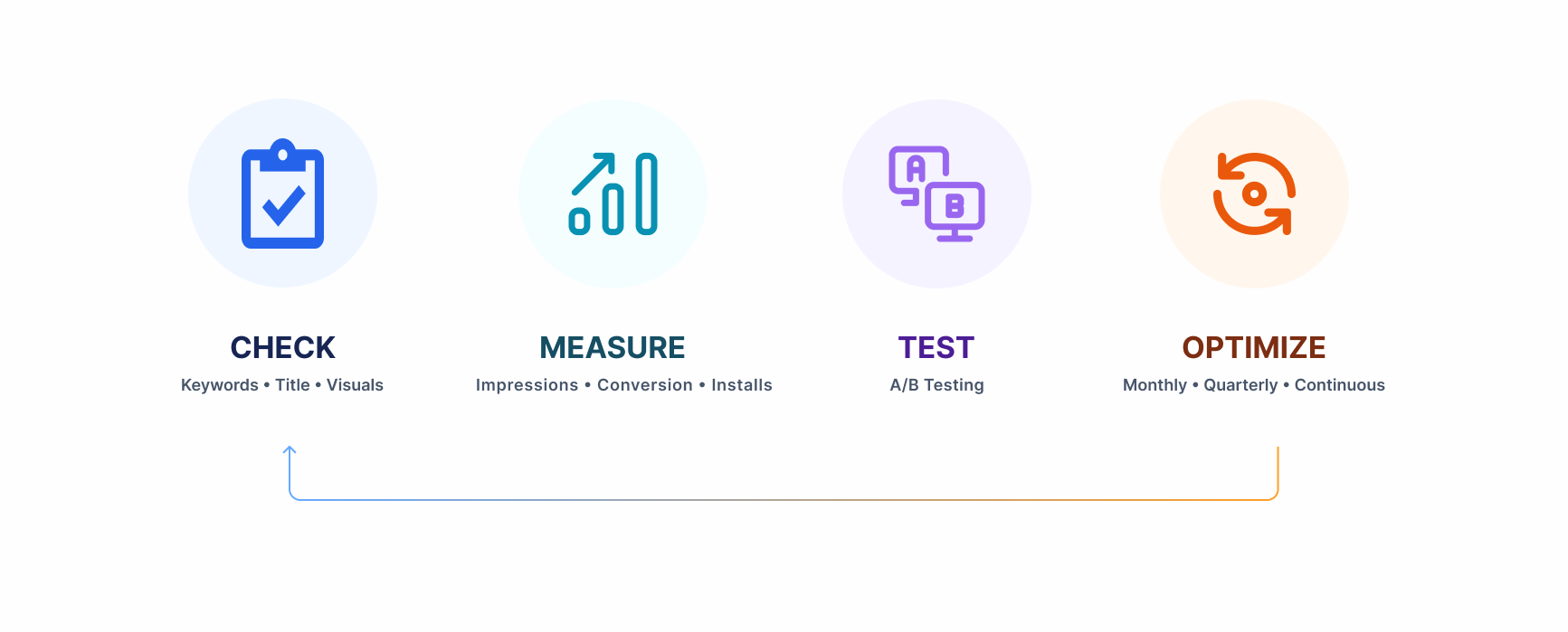
Complete ASO Checklist for Beginners: The Essential Foundation of Every Successful App Listing
Starting with ASO can feel overwhelming given the number of variables. This structured checklist ensures you address all primary ranking factors:
KEYWORD RESEARCH (Week 1-2): Identify your 3-5 primary keywords (search volume + intent + competition analysis), document keywords in a spreadsheet, prioritize keywords by opportunity value
TITLE OPTIMIZATION (Week 2): Incorporate primary keyword into title naturally, maintain brand recognition, test title variants if platform allows
SUBTITLE/SHORT DESCRIPTION (Week 2): Add secondary keyword, clarify value proposition, maintain 30-80 character limit
FULL DESCRIPTION (Week 3): Address user pain points, distribute keywords naturally, highlight features with explicit benefits, include social proof
VISUAL ASSET REVIEW (Week 3-4): Evaluate icon clarity and distinctiveness, ensure screenshots tell coherent value story, create or refine preview video
CATEGORY SELECTION (Week 4): Confirm you're listed in optimal category (highest opportunity, appropriate user audience)
REVIEW MANAGEMENT STRATEGY (Week 4): Plan when and how to request reviews from satisfied users, establish review response process
LAUNCH A/B TESTING PLAN (Week 4): Identify first visual asset variant to test, establish testing timeline and success metrics
Establishing Realistic ASO Goals and Key Performance Indicators That Drive Business Impact
Effective ASO strategy requires clear goals. Poor goals: "Improve ranking for our primary keyword" (ranking position is less important than business metrics; focus on more controllable metrics instead). Better goals: "Increase organic monthly installs from 5,000 to 8,000 within 90 days" (specific, measurable, time-bound). Excellent goals: "Achieve 4.6+ average rating, increase organic monthly installs by 60%, improve conversion rate from 2.8% to 3.5%."
Key performance indicators should include: impression volume (total times your app appears in search results), conversion rate (impressions that result in install), install volume (total organic installs), average rating (user satisfaction proxy), review volume (engagement and SEO factor), and retention metrics (whether users stay engaged or uninstall). Track these metrics through platform analytics, ASO tools, or custom dashboards, review monthly, and adjust strategy based on performance.
Establishing Update Cadence and Continuous Optimization Rhythm That Compounds Results Over Time
ASO isn't a project with a completion date but an ongoing discipline. Effective cadence: monthly competitive audits (review top 5 competitors' listings), quarterly strategic reviews (evaluate keyword performance, identify new opportunities), continuous A/B testing (always have 1-2 experiments running), and rapid response to feedback (adjust metadata, fix problems, respond to reviews). Successful apps dedicate 2-4 hours weekly to ASO tasks. This time investment generates exponentially greater returns than one-time optimization efforts.
Measuring ASO Success: From Vanity Metrics to Business-Driving KPIs
Key Performance Indicators That Actually Drive Business Impact and Predict Long-term Success
Not all metrics matter equally. Vanity metrics (impressive sounding but disconnected from business impact) include: total reviews, total ratings, ranking position. These metrics feel important but often correlate weakly with business success. More important metrics include: conversion rate (what percentage of people who see your app install it), organic install volume (how many downloads you're generating without paid ads), and user retention (what percentage of users stay engaged after 7/30/90 days).
The metric hierarchy: conversion rate predicts revenue efficiency (lower cost per user-acquired), organic install volume predicts business scale (total growth), retention predicts lifetime value (how much each user generates). An app generating 1,000 monthly organic installs with 3% conversion rate and 35% retention is more valuable than an app generating 3,000 monthly installs with 1.5% conversion rate and 15% retention, despite lower install volume.
Tools and Dashboards for Tracking Rankings and Interpreting Performance Data Intelligently
Essential tools for ASO measurement: app store analytics (built into App Store Connect and Google Play Console), third-party ASO tools (Sensor Tower, data.ai, Mobile Action), and analytics platforms (Firebase, Amplitude) measuring in-app behavior. Most development teams use a combination: app store analytics for store-level metrics, ASO tools for competitive analysis and ranking tracking, and analytics platforms for retention and engagement.
A useful dashboard consolidates: weekly impression trends, conversion rate performance, install volume, average rating trajectory, review response rate, and competitive benchmark (where you rank vs. competitors for your primary keywords). Reviewing this dashboard weekly enables rapid identification of positive trends (conversion rate improvements, rating improvements) and concerning trends (ranking drops, install volume decline), allowing quick response.
Interpreting Data Patterns and Converting Insights Into Actionable Optimization Decisions
Data interpretation requires disciplined thinking. A concerning observation: conversion rate declined 0.3 percentage points last week. Before panicking, consider: is this normal variance (normal range for your app is ±0.4 percentage points weekly) or signal of real change (consistent decline across 3+ weeks)? Was there a visible change (new competitor app appeared, your review rating dropped, screenshot changed)? Is change correlated with external factors (seasonal pattern, news event affecting app category)? This analysis determines whether you should respond immediately or wait for clearer pattern emergence.
Similarly, an observation like "impression volume increased 25% this week" requires investigation: what caused the improvement? Did you change keywords? Did the algorithm boost you for some reason? Did an external mention (PR, influencer) drive awareness? If you can identify the cause, you can potentially repeat or scale it. If the improvement is random, scaling strategies based on single-week anomalies risks misallocating effort.
In-House vs. Agency ASO: Comparing Approaches, Costs, and Optimal Models for Your Team
Challenges and Limitations of Attempting ASO In-House Without Specialized Experience
DIY ASO is possible but carries significant limitations. The primary challenge: expertise depth. Effective ASO requires knowledge across keyword research methodologies, competitive analysis, app store algorithm dynamics, visual design conversion principles, and data interpretation. Few in-house teams span all these disciplines. Additionally, ASO requires continuous learning algorithm changes, competitive evolution, and emerging technologies require staying current. Small teams struggle with this ongoing education requirement.
Cost-wise, DIY appears cheaper than agency partnerships until you calculate true cost: a talented marketer spending 20 hours weekly on ASO costs approximately $40,000-60,000 annually. Add tool costs ($10,000-15,000 annually), opportunity cost (this marketer's time unavailable for other important initiatives), and the risk of suboptimal decisions (inexperienced teams often optimize for wrong variables or miss significant opportunities), and the true cost approaches professional ASO partnership pricing.
Competitive Advantages and ROI of Professional ASO Services When Executed With Top-Tier Agencies
Professional ASO agencies bring specialized expertise, access to proprietary data and tools, competitive intelligence networks, and accountability. Exceptional agencies deliver: comprehensive keyword research exceeding internal team analysis by 40-50% in opportunity identification, visual asset testing that increases conversion rate by 20-35%, competitive positioning analysis revealing market gaps and opportunities, and continuous optimization generating compounding improvements over time.
The ROI typically appears within the first engagement period: a $5,000 monthly ASO engagement generating improvements resulting in 1,000 additional monthly organic installs at 25% lifetime value per user ($5 per user) creates $5,000 monthly incremental revenue immediate 100% return. Most successful apps continue professional partnerships because the ROI compounds: year two improvements build on year one optimizations, generating even greater returns.
Evaluating and Selecting ASO Service Providers: Critical Criteria Beyond Cost
When evaluating ASO agencies, evaluate: relevant case studies (have they successfully optimized apps in your category), transparency (can they clearly explain their methodology and expected outcomes), data focus (do they make decisions based on metrics or intuition), tools access (do they use industry-leading platforms), and ongoing strategy (do they treat ASO as one-time project or continuous discipline). Request references from recent clients, understanding not just successes but how they handled challenges.
Avoid agencies that guarantee specific rankings or install numbers ("We guarantee #1 ranking for X keyword"). No legitimate provider can guarantee rankings algorithms change, competitors evolve, and too many variables exist beyond any agency's control. Instead, seek agencies that commit to continuous optimization, transparent reporting, and clear accountability for improving your KPIs rather than vanity metrics.
How TechQware Partners With Ambitious App Teams to Accelerate ASO and Drive Sustainable Growth
TechQware specializes in comprehensive ASO strategy, execution, and optimization for apps across categories. We begin with detailed app audit: comprehensive competitive analysis, keyword opportunity assessment, visual asset evaluation, and strategic gap identification. This foundation informs a customized ASO roadmap addressing your app's unique positioning, target market, and competitive landscape.
Our engagement model combines expert strategy with continuous execution. We conduct in-depth keyword research identifying both obvious opportunities and hidden high-value keywords competitors overlook. We refine your metadata to balance ranking optimization with conversion optimization because visibility without conversion wastes opportunity. We design and execute A/B testing programs that continuously improve conversion rate, user ratings, and install volume. We develop custom product page strategies tailored to your distinct user segments. We establish competitive monitoring that alerts you to market shifts requiring strategic response.
Importantly, we treat ASO as partnership, not vendor relationship. We invest in understanding your app's unique value proposition, your target market's specific problems, and your business objectives. This deep understanding enables strategic recommendations that other agencies might miss. We provide monthly strategic reporting, quarterly strategy reviews, and immediate response to market shifts threatening your competitive position.
The Future of App Discovery: Preparing Your Strategy for the Technologies That Will Define 2027 and Beyond
AI-Native App Discovery Experiences Entirely Transformed by Machine Learning Integration
The app store experience will fundamentally transform as AI becomes central to discovery. Rather than users searching for apps directly, increasingly users will describe their needs in natural language to AI assistants, which will recommend optimal apps. This shift from active search to AI mediation means the ranking factors optimized today will shift tomorrow. Apps will need to invest more in review quality (AI heavily weighs user sentiment in recommendations), engagement metrics (AI recommends apps users stick with), and clear problem-solution articulation (AI needs to understand your app's value proposition, not users having to decipher it).
Impact of Personal AI Assistants on App Visibility, Discoverability, and User Acquisition Channels
Personal AI assistants will increasingly handle app discovery on behalf of users. Rather than downloading an app yourself, your AI assistant will download apps matching your usage patterns and preferences. This creates both opportunity and challenge: opportunity because users who employ AI assistants will have apps automatically installed when relevant, challenge because user control over app selection decreases, making algorithmic inclusion more important than ever.
Predictive ASO and Automated Optimization as Standard Competitive Practice
ASO will increasingly shift from manual optimization toward predictive, automated systems. AI models will predict which metadata, screenshots, and keywords will perform best for your app before testing, reducing testing timelines from weeks to days. Automation will handle routine optimization (updating descriptions based on review language analysis, adjusting keywords based on performance data) while humans focus on strategic decisions (positioning, messaging, competitive differentiation).
Forward-thinking apps are already investing in these technologies. By 2027, apps without automated optimization systems will be at competitive disadvantage against apps with systems dynamically optimizing metadata, visual assets, and strategy based on continuous performance data and market shifts.
Conclusion: Getting Your App Discovered in 2026 and Beyond
The opportunity for app success has never been greater and neither has the competition. With over 8.9 million apps competing across global app stores, standing out requires more than functional software and good intentions. It requires strategic discipline, continuous optimization, and deep understanding of the algorithmic and human factors that drive visibility and conversion.
The most successful apps share a common trait: they treat ASO not as one-time project but as foundational discipline. They understand keyword research, optimize their metadata for both ranking and conversion, invest in visual assets that convert, actively manage ratings and reviews, and continuously experiment based on data. These apps experience exponentially greater organic growth, superior unit economics, and sustainable competitive positioning than apps that neglect these fundamentals.
Whether you optimize ASO in-house or partner with specialized experts, the time to act is now. Every month without systematic ASO optimization represents lost installs, missed users, and competitive ground ceded to better-positioned competitors. The good news: even significant optimization improvements can be implemented within weeks, generating measurable impact within months. The challenge: sustaining the discipline and continuous iteration that compounds results over time.
Ready to improve your app’s visibility and organic growth? Contact us today to discuss how our ASO and mobile app expertise can help you attract more users and turn your app-store presence into a stronger growth channel.
FAQs
What is App Store Optimization and How Does It Differ From Paid App Marketing Channels?
App Store Optimization is the discipline of enhancing your app's visibility in organic search and discovery within Apple's App Store and Google Play Store through optimized metadata, visual assets, ratings, reviews, and engagement metrics. Unlike paid channels (which require continuous spending to maintain visibility), ASO compounds over time—positive improvements in ratings and engagement create self-reinforcing ranking improvements that generate increasing returns as the strategy matures.
How Significantly Does App Store Optimization Impact My App's Success, and What Returns Should I Realistically Expect?
ASO directly impacts the most important metric: organic install volume. Apps with comprehensive ASO strategies typically generate 40-60% of installs organically; apps without serious ASO might generate only 5-15% organically. For apps with $5 monthly lifetime value per user, generating an additional 500 organic installs monthly represents $2,500 monthly incremental revenue—or $30,000 annually. ASO investments ($500-5,000 monthly, depending on approach) typically generate 2-5x returns within the first six months, compounding over time.
How Much Time Does Effective App Store Optimization Typically Require Before Seeing Measurable Improvements in Rankings and Install Volume?
App store algorithms process data continuously but typically take 2-4 weeks to reflect metadata changes in rankings. Significant changes (keyword shifts, rating improvements) might take 4-8 weeks for full algorithmic incorporation. However, you should see conversion rate improvements (how many of existing impressions convert to installs) within 1-2 weeks of visual asset optimization. This means rapid feedback loop: make changes Monday, see conversion impact by Wednesday, adjust strategy Wednesday evening, see new impact by Friday. While ranking changes take weeks, continuous iteration based on weekly conversion metrics compounds improvements significantly.
What Are the Most Important App Store Ranking Factors I Should Prioritize in My Optimization Efforts?
Priority ranking factors in rough order of importance: keyword relevance (are you optimizing for keywords users actually search), user ratings (4.5+ stars dramatically improves visibility), installation velocity (how quickly your app accumulates downloads), user retention (do people keep using your app after installing), review volume and recency (recent positive reviews carry more weight than old reviews), and engagement metrics (what percentage of users actively use your app daily). These factors interact: strong ratings attract more installs, which improve velocity, which triggers algorithmic boosts. Strong retention means more active users, which drives more reviews and higher ratings. A holistic strategy optimizes all factors simultaneously rather than attempting to game individual factors.
Do Keywords Still Matter for App Store Optimization in 2026, or Has AI Made Keyword Research Obsolete?
Keywords matter more than ever, though their application is evolving. AI systems now understand semantic relationships—"expense tracking" relates to "budgeting," so apps optimizing for one concept increasingly match users searching the other. However, this advancement doesn't eliminate keyword research; it enhances it. Instead of needing to list every conceivable keyword variation, you can focus on core conceptual keywords, and AI semantics expand your reach. Additionally, voice search (growing rapidly in 2026) relies heavily on natural language keywords. Effective 2026+ ASO requires keyword research focused on user intent and natural language concepts rather than artificial keyword variation cramming.
What Does Professional App Store Optimization Service Typically Cost, and How Should I Evaluate Whether the Investment Makes Business Sense?
Professional ASO services range from $1,500-10,000 monthly depending on scope and agency. A startup app might invest $2,000-3,000 monthly; an established app with significant download volume might invest $5,000-10,000 monthly. Evaluation framework: estimate your current monthly organic install volume and monthly organic revenue generated (installs × average lifetime value). Calculate potential improvement (40-60% incremental installs isn't unrealistic with comprehensive ASO). If potential incremental revenue exceeds ASO investment by 3x, the investment likely makes economic sense. Additionally, consider opportunity cost: if your time pursuing ASO in-house is worth more than the professional service cost, outsourcing becomes more logical.
Can App Store Optimization Actually Drive Meaningful Increases in Organic App Downloads, or Is Paid Acquisition Still Necessary?
ASO can absolutely drive substantial organic growth—often 50-300% improvement within 12 months depending on starting position and market conditions. Some apps generate 40-80% of installs organically through excellent ASO. However, "paid acquisition still necessary" depends on business model. Apps with strong lifetime value and unit economics (e.g., enterprise B2B apps, financial apps) often rely primarily on organic growth enhanced by paid campaigns. Apps with lower lifetime value (casual games, free utilities) typically require paid acquisition to supplement organic growth. The optimal strategy for most apps: build strong organic foundation through ASO, supplement with paid acquisition targeting high-value user segments, measure unit economics separately for organic vs. paid channels, and allocate budget proportional to return.
Should I Optimize My App Store Listings Differently for Apple App Store Versus Google Play Store?
Yes, meaningful differences in audience, algorithm, and platform features require adjusted strategies. Apple App Store users tend to be higher-income, willingness-to-pay for premium apps higher, and privacy concerns emphasized more prominently. Google Play users span more diverse income levels, in-app advertising more common, and international audiences larger. Additionally, platform features differ: iOS allows App Clips (pre-download app experiences), Google Play emphasizes in-app events more. Optimization approach: core strategy remains consistent (good keywords, strong ratings, clear value proposition), but localized execution adapts to platform norms. Create separate product pages for major market differences, adjust screenshots to highlight locally-important features, emphasize platform-specific positioning in descriptions.
Abhinav Srivastav
With years of experience in driving digital transformation, Abhinav Srivastav is the CEO & Director of TechQware Technologies, helping businesses build innovative mobile apps, AI-powered applications, and scalable digital solutions.

 TechQware
.png)