Key Takeaways:
- The UAE does not have one single comprehensive AI law.
- AI apps must consider data protection, cybersecurity, and sector-specific regulations.
- DIFC and ADGM have additional rules for data processing and automated decision-making.
- Privacy and security should be built into the app from the development stage.
- AI licensing depends on the business activity, jurisdiction, and sector.
- Compliance requires ongoing monitoring, documentation, and risk management.
Introduction : Why AI Compliance Matters for Dubai App Developers in 2026
Dubai has positioned itself as one of the world’s most ambitious markets for artificial intelligence, digital government and smart services. From AI-powered government assistants to intelligent healthcare systems and financial technology platforms, AI is moving from experimentation into real business operations. For app developers, however, adding an AI model is no longer simply a technical decision. The way an application collects data, makes recommendations, profiles users or automates decisions can create privacy, security and regulatory obligations.
For businesses planning an mobile app in Dubai, compliance should therefore be treated as part of product architecture rather than something added immediately before launch. The UAE already has a federal Personal Data Protection Law, while financial centres such as DIFC and ADGM have additional frameworks. Sector regulators can also introduce requirements depending on what the application actually does.
Rising AI Adoption Across UAE Businesses and Government Services
The UAE's AI ambitions are backed by significant government investment and adoption. The UAE Strategy for Artificial Intelligence was designed to increase the use of AI across government and strategic sectors, including healthcare, transport, energy, education and technology. The country's National Strategy for AI 2031 also places governance, regulation and ethical AI among its objectives.
This direction is already visible in real services. The UAE Government's U-Ask platform uses generative AI to answer questions about government services, while Dubai.AI has been introduced as a generative-AI-powered digital assistant accessible through official Dubai digital channels. These examples demonstrate an important lesson for private app owners: users and regulators increasingly expect AI systems to be useful, transparent and responsibly designed.
Who This Guide Is For (Startups, Enterprises, Fintech and Healthcare Apps)
This guide is relevant to startups building AI-first mobile products, established businesses adding recommendation engines or AI assistants, fintech companies using automated decision-making, and healthcare businesses processing sensitive health information. It is equally relevant to companies outsourcing application development because regulatory responsibility does not automatically disappear when software development is delegated to a technology partner.
Consider a Dubai startup developing an AI financial assistant. If the application merely provides general educational information, its risk profile may be very different from an application that analyses a customer's financial information and influences a lending decision. Similarly, a healthcare chatbot that provides general wellness information is fundamentally different from an AI system processing medical records or supporting clinical decisions.
Understanding the UAE's AI Regulatory Landscape
No Single Federal AI Law: A Layered Compliance Model
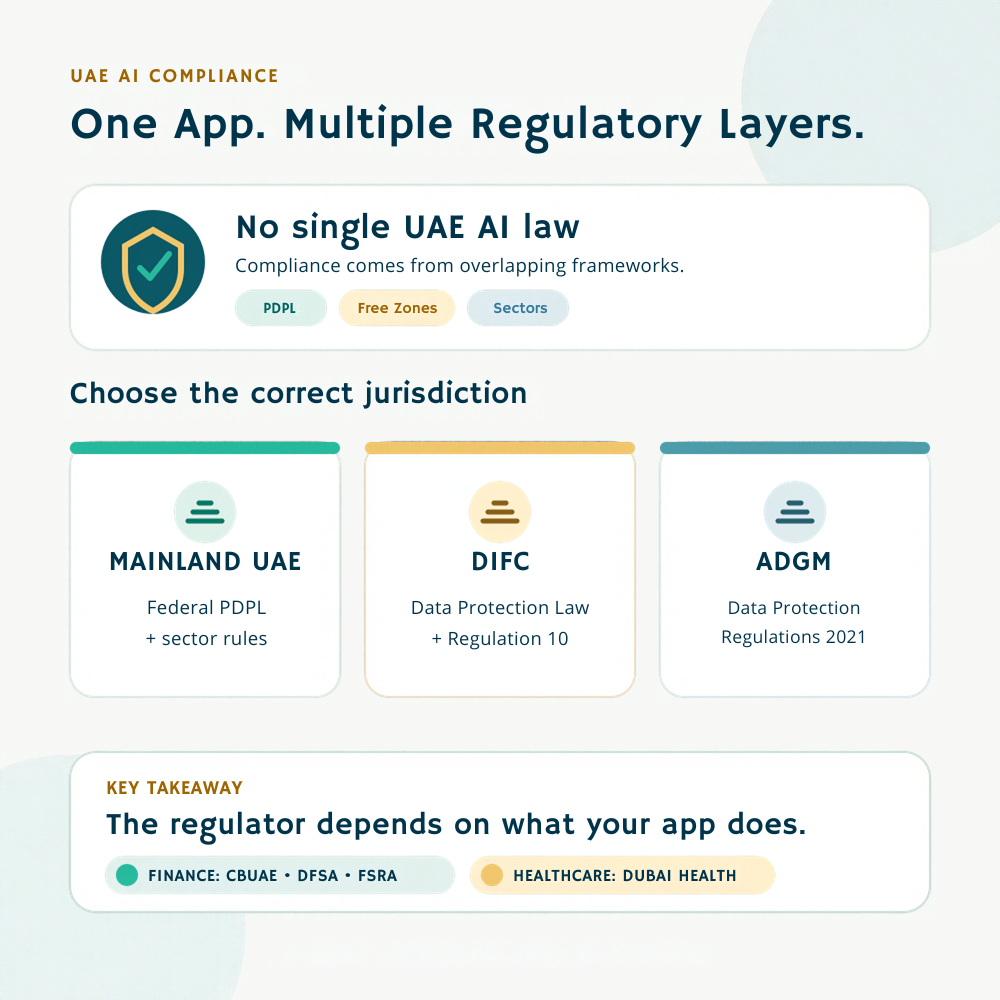
One of the most important points for app owners is that UAE AI compliance cannot be reduced to checking whether a single "UAE AI Law" applies. Instead, compliance can involve several overlapping layers, including federal data protection requirements, sector-specific regulations, free-zone rules, cybersecurity requirements, contractual obligations and AI governance principles.
The UAE's Personal Data Protection Law is particularly important because AI applications frequently depend on personal information. The law establishes requirements around the processing, security and confidentiality of personal data and applies to processing carried out through electronic systems in or outside the UAE in circumstances covered by the law.
Mainland UAE vs DIFC vs ADGM: Why Jurisdiction Matters for Your App
The legal environment can change depending on where your business operates and which regulated ecosystem your application touches. A mainland company processing personal information may primarily consider the federal PDPL alongside sector rules, while a company operating within DIFC may have to consider DIFC's own data protection framework, including Regulation 10 for personal data processed through autonomous and semi-autonomous systems.
ADGM also operates under its Data Protection Regulations 2021. ADGM requires registered entities processing personal data to register as data controllers, maintain appropriate safeguards and comply with requirements covering areas such as DPIAs, international transfers and data subject rights.
Key Regulators and Authorities to Know
The applicable regulator depends on the business model rather than simply the technology stack. For example, banking applications may interact with the Central Bank of the UAE, DFSA or FSRA depending on their regulatory perimeter. Fitness applications may need to consider Dubai Health or other applicable health authorities, while data protection obligations can involve federal or free-zone data protection regimes.
For developers, the practical takeaway is straightforward: identify the regulatory perimeter before finalising the application's architecture. Doing this early can prevent expensive redesigns involving databases, cloud infrastructure, consent mechanisms and AI workflows.
The Personal Data Protection Law (PDPL) and AI Compliance
What PDPL Requires From AI-Powered Apps
AI systems can consume enormous quantities of information, but regulatory compliance does not mean an application should collect everything it can technically access. The UAE PDPL establishes requirements around lawful processing, data protection, confidentiality and the responsibilities of organisations handling personal data.
For an AI application, this means development teams should know exactly what information enters the model, why it is being collected, where it is stored, who can access it, whether it is shared with third-party AI providers and how long it needs to be retained. This becomes especially important when developers integrate external large language models, analytics platforms or cloud AI services.
Consent, Data Minimization and Automated Decision-Making
Consent should not be treated as a generic checkbox hidden inside an application's onboarding flow. Users should understand what data is being collected and why it is required. Developers should also apply data minimisation so that an AI model receives only the information necessary for its intended purpose.
Automated decision-making deserves additional attention. If an AI system influences access to financial products, insurance, employment opportunities, telecom services or another significant outcome, organisations should evaluate whether additional transparency, safeguards and human oversight are required under the applicable regulatory framework.
Compliance Deadline and What It Means for Developers
For development teams, the important lesson is that compliance preparation should begin before the application reaches production. Regulatory implementation and guidance can evolve, and businesses should verify the current requirements that apply to their specific processing activities rather than relying on an old compliance checklist.
A practical AI development roadmap should therefore include privacy requirements alongside API design, database architecture, authentication, testing and deployment. Compliance should become a technical requirement with measurable controls rather than a document produced after the application has already been built.
DIFC Regulation 10 : Rules for AI Systems in the Financial Free Zone
What Regulation 10 Covers
DIFC Regulation 10 is particularly significant because it specifically addresses personal data processed through autonomous and semi-autonomous systems. DIFC introduced the regulation into its data protection framework in 2023, making it one of the region's most notable regulatory developments concerning AI and personal data.
The regulation is relevant when AI systems operate on personal data and create elevated risks for individuals. Developers therefore need to consider more than whether a model technically works. They must also examine how the system behaves, how decisions are explained, how risks are assessed and how affected individuals are protected.
AI Impact Assessments and Documentation Requirements
For high-risk AI processing, documentation becomes a critical part of the development lifecycle. A company should be able to explain what its AI system does, what information it processes, what risks have been identified and what controls have been implemented.
DIFC's Regulation 10 Accelerator also reflects the regulator's emphasis on privacy-by-design and responsible AI testing. The accelerator provides a structured environment for assessing autonomous or semi-autonomous systems against Regulation 10 requirements.
Penalties for Non-Compliance
Non-compliance should not be viewed merely as a potential financial penalty. For an AI-powered business, regulatory failure can create operational disruption, reputational damage, customer distrust and costly technical remediation.
This is particularly important for fintech businesses because an AI system can directly influence financial decisions. A model that cannot explain or defend its outputs may create both regulatory and commercial problems even when its technical accuracy initially appears strong.
ADGM Data Protection Regulations and AI
How ADGM Rules Apply to AI Apps
ADGM's Data Protection Regulations 2021 establish a detailed framework for personal data processing. The framework includes data protection by design, records of processing, data protection impact assessments, security requirements, international transfer mechanisms and individual rights.
Automated decision-making is also specifically addressed. ADGM guidance explains that individuals may need meaningful safeguards when decisions are made solely through automated processing, including the ability to obtain human intervention, express their views and challenge a decision.
DIFC vs ADGM: Key Differences
Although DIFC and ADGM both operate sophisticated data protection regimes, their regulatory structures are not identical. DIFC has a specific Regulation 10 framework addressing personal data processed through autonomous and semi-autonomous systems, whereas ADGM approaches AI largely through its broader data protection and automated decision-making requirements.
|
Area
|
DIFC
|
ADGM
|
|
Core framework
|
DIFC Data Protection Law and Regulations
|
ADGM Data Protection Regulations 2021
|
|
AI-specific provision
|
Regulation 10 addresses autonomous and semi-autonomous systems
|
AI addressed through data protection and automated decision-making requirements
|
|
DPIA
|
Important for high-risk processing
|
Required for projects likely to create high risk
|
|
Human oversight
|
Relevant to responsible automated processing
|
Explicit safeguards for certain solely automated decisions
|
|
Data transfers
|
Subject to DIFC requirements and safeguards
|
Adequacy and Article 42 safeguards apply
|
|
Registration
|
DIFC-specific requirements depend on entity and processing activities
|
Data controllers must register with ADGM's Office of Data Protection
|
ADGM also requires data controllers to maintain compliance evidence and provides specific guidance on international transfers and DPIAs.
Sector-Specific AI Rules Your App May Need to Follow
Fintech Apps and Central Bank, DFSA, FSRA Guidelines
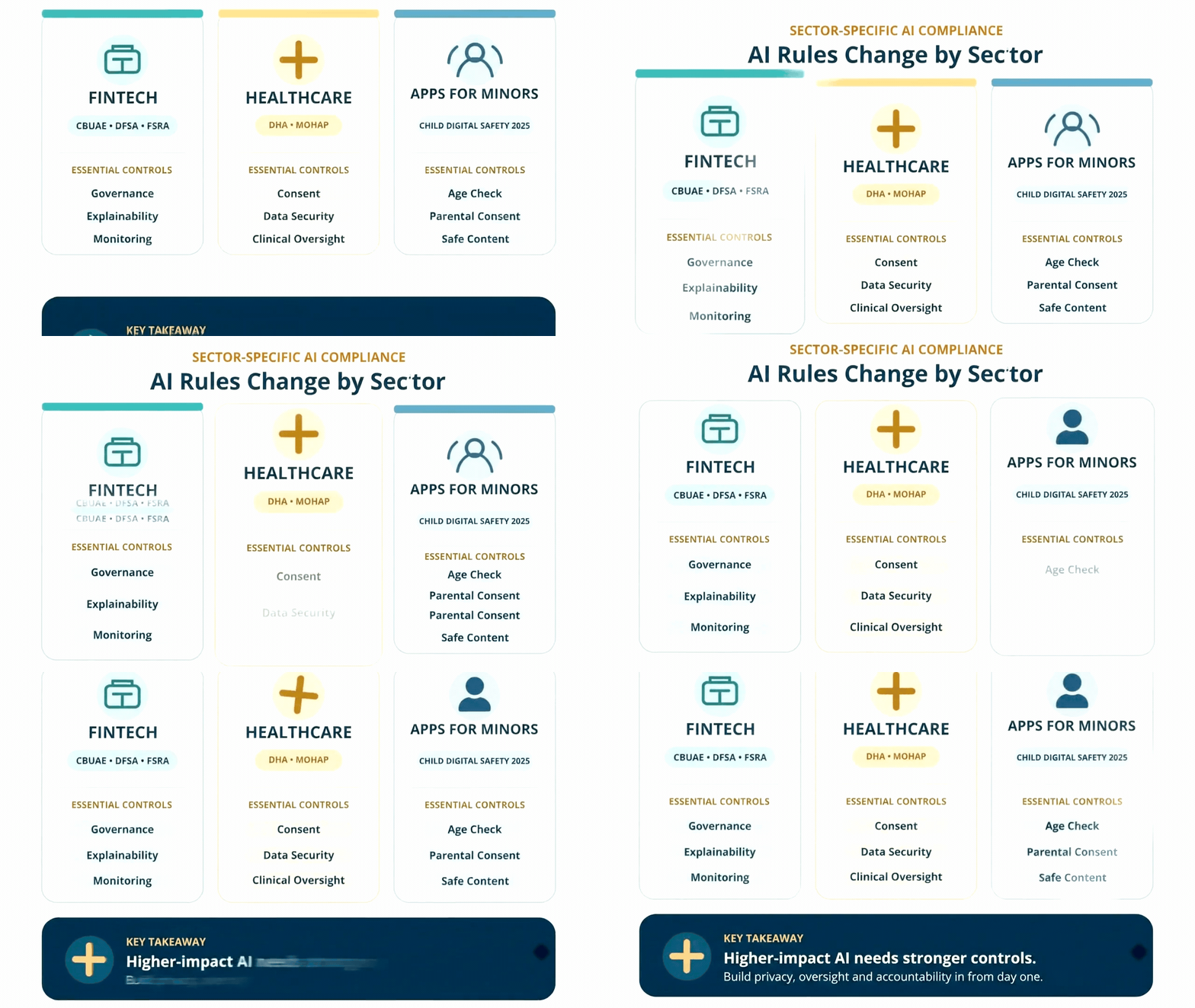
Financial applications require a higher level of governance because AI outputs can materially affect consumers. The Central Bank of the UAE issued a guidance note in 2026 covering responsible AI and machine learning adoption by licensed financial institutions. It addresses governance, transparency, data quality, privacy, security and high-impact decisions.
The CBUAE framework also expects financial institutions to maintain documented AI governance, validate models, monitor their performance and ensure senior management remains accountable for AI outcomes. Earlier joint guidance from the CBUAE, SCA, DFSA and FSRA also established principles for financial institutions adopting AI, big-data analytics, cloud computing and other enabling technologies.
Real-life scenario: imagine a fintech app using AI to recommend whether a customer should receive a loan. A technically accurate model is not automatically a compliant model. The organisation needs appropriate governance, reliable data, explainability, monitoring and controls around the decision because the output can materially affect the customer.
Healthcare Apps and DHA Requirements
Healthcare AI requires particularly careful treatment because health information can qualify as sensitive personal data. Dubai's health ecosystem has already been moving toward AI-enabled services, while DHA maintains policies and standards covering areas such as health information assets, confidentiality and consent.
The UAE Ministry of Health and Prevention reported that it developed the "Biosigns" project, using AI to turn smartphone camera technology into a tool for measuring vital signs and linking information to medical records. MoHAP has also held discussions around the ethics of AI in healthcare to support responsible use of emerging health technologies.
This illustrates why healthcare developers should build privacy, consent, security and clinical governance into the product from day one rather than treating them as post-launch compliance tasks.
Child Digital Safety Law for Apps Used by Minors
Apps designed for children or likely to be used by minors face additional requirements. The UAE's 2025 Child Digital Safety framework introduced stronger obligations around age verification, platform classification, privacy settings, parental controls and protection from harmful digital content.
The UAE Government states that personal data of children under 13 cannot generally be collected or used unless strict conditions are met, including appropriate parental consent and restrictions around targeted advertising. Digital platforms also have obligations concerning age verification and child-safety controls.
For an AI-powered education, gaming or social application, these requirements can affect onboarding, identity verification, recommendation systems, advertising logic and content moderation architecture.
UAE's National AI Strategy and Ethical AI Principles
What the National AI Strategy 2031 Means for App Developers
The National AI Strategy 2031 signals that AI is intended to become a major component of the UAE's economic and government infrastructure. Its objectives include stronger AI governance, regulation and ethics-by-design, creating an environment where technological development is balanced with responsible use.
For developers, this means the competitive advantage will increasingly belong to applications that combine innovation with trustworthy engineering. Building for the UAE market should therefore involve thinking beyond model selection and considering explainability, cybersecurity, privacy, accountability and user experience together.
Voluntary AI Ethics Guidelines and Why They Still Matter
Ethical frameworks may not always operate like traditional legislation, but they can strongly influence how organisations design AI systems. The UAE's AI Charter emphasises principles including human commitment, responsible innovation, respect for rights and compliance with applicable laws.
For businesses, following these principles can also reduce future compliance costs. When fairness testing, transparency, human review and risk documentation are already part of development, adapting to new regulatory expectations becomes significantly easier.
A Step-by-Step Compliance Checklist for Building Your AI App
Step 1: Map Which Jurisdictions Apply to Your App
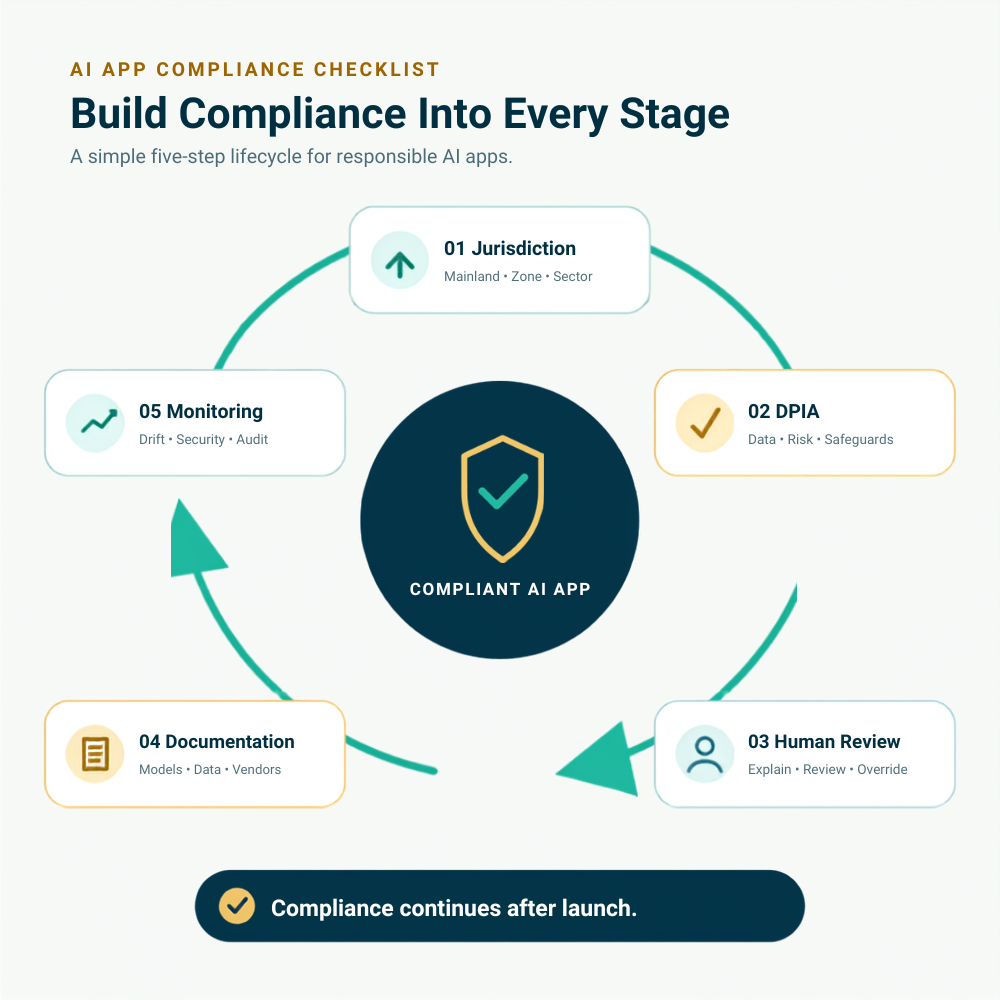
Start by identifying where the business is incorporated, where users are located, which free zone or mainland framework applies and whether a sector regulator is involved. Then map the application's data flows, including third-party AI providers and international cloud infrastructure.
Step 2: Conduct a Data Protection Impact Assessment
A DPIA should examine the personal information involved, processing purposes, potential risks to individuals and technical and organisational measures used to reduce those risks. ADGM explicitly requires DPIAs for projects likely to result in high risks to individuals' rights and freedoms.
Step 3: Build in Transparency and Human Oversight
Users should understand when AI is being used and, where appropriate, how it affects them. High-impact applications should have escalation mechanisms that allow qualified humans to review or override automated outputs.
Step 4: Document Your AI Systems and Data Sources
Maintain an internal record of models, datasets, vendors, processing purposes, versions, decision logic, testing results and known limitations. Good documentation gives product teams a way to investigate failures instead of treating every AI incident as an unexplained technical problem.
Step 5: Plan for Ongoing Monitoring and Audits
AI compliance does not end when an application enters production. Models can drift, datasets can change, vendors can update models and new regulations can emerge. Continuous monitoring, security testing, performance reviews and compliance audits should therefore become part of the product lifecycle.
Common Compliance Mistakes to Avoid
Assuming One Set of Rules Covers Every Emirate and Free Zone
A company may build an application for the Dubai market while overlooking the fact that its customers, financial partners, healthcare providers or corporate structure place it under additional regulatory requirements. DIFC, ADGM, mainland UAE and sector regulators can have materially different requirements.
A better approach is to create a regulatory map before development begins and review it whenever the business expands into a new sector, jurisdiction or user category.
Treating Compliance as a One-Time Checklist Instead of an Ongoing Process
An AI application is not static. Its models evolve, new datasets are introduced, APIs change and functionality expands. A chatbot can eventually become a recommendation engine, while a recommendation engine can later influence decisions that carry greater regulatory significance.
Compliance should therefore operate like security testing: continuously monitored, documented and improved throughout the application's lifecycle.
How TechQware Builds Compliant AI-Powered Apps for the Dubai Market
Our Approach to Privacy and Security by Design
At TechQware, we approach AI application development with the understanding that compliance needs to work alongside business objectives, user experience and technical performance. Our development approach can incorporate secure authentication, controlled data access, encrypted communication, role-based permissions, audit logging, API security and privacy-aware data flows according to the application's requirements.
Whether the project involves an AI chatbot, recommendation engine, automotive application, fintech platform or intelligent enterprise solution, our focus is to create an architecture where responsible AI principles can be incorporated from the beginning rather than retrofitted after development.
Working Alongside Legal and Compliance Partners
Technology teams should not replace qualified legal or regulatory advisers. Instead, the strongest implementation model is collaborative: legal and compliance specialists establish the applicable obligations while experienced technology teams translate those requirements into product features, system controls and development processes.
TechQware can work alongside your internal compliance teams and external legal advisers to convert regulatory requirements into practical technical specifications. This approach helps businesses build applications that are not only innovative, but also prepared for the regulatory expectations of the Dubai market.
Conclusion : Staying Ahead as UAE AI Regulations Evolve
The UAE's AI ecosystem is moving rapidly, and regulation is evolving alongside adoption. The introduction of federal data protection requirements, DIFC Regulation 10, ADGM's mature privacy framework, financial-sector AI guidance and child digital safety requirements demonstrates that responsible AI is becoming an increasingly important part of digital product development.
The opportunity for businesses is equally significant. The UAE Government itself is using AI across public services, while Dubai continues to expand its digital infrastructure and AI capabilities. Dubai's digital strategy reports that 99.5% of government services had been digitised by 2023, demonstrating the scale of the country's digital transformation.
For companies entering this market, the objective should not simply be to build an AI application that works. The goal should be to build an AI application that can scale responsibly, protect user data, explain important decisions and adapt as regulations develop.
If you are planning an AI-powered app for Dubai or the wider UAE market, TechQware can help you move from AI concept to a scalable, secure and market-ready digital product. Get in touch with TechQware to discuss your AI application requirements and build a solution designed for the UAE's evolving digital ecosystem.
Build smarter. Build securely. Build for the UAE market with TechQware.
Note: This article is intended for general technology and business awareness and should not be treated as legal advice. AI and data-protection requirements can depend on the application's exact business model, jurisdiction, data flows and regulated activities.
FAQs
Is there a dedicated AI law in the UAE?
The UAE does not currently operate under one single comprehensive federal AI law covering every AI application in the same way. Instead, organisations may need to comply with a combination of data protection, sector-specific, cybersecurity, consumer protection and AI governance requirements. DIFC is a notable example because Regulation 10 specifically addresses personal data processed through autonomous and semi-autonomous systems.
Which UAE data protection law applies to AI apps?
For many businesses operating under the federal UAE framework, Federal Decree-Law No. 45 of 2021 concerning the Protection of Personal Data is a key consideration. However, DIFC and ADGM have their own data protection regimes, and sector-specific rules may also apply depending on the application's activities and users.
Do free zone companies (DIFC, ADGM) follow different AI rules than mainland companies?
Yes, DIFC and ADGM operate under their own regulatory frameworks, which can create additional obligations beyond the general federal framework. DIFC's Regulation 10 specifically addresses personal data processing through autonomous and semi-autonomous systems, while ADGM's Data Protection Regulations contain detailed provisions covering high-risk processing and automated decision-making.
What happens if my AI app is non-compliant?
The consequences depend on the applicable law and regulator. They can include regulatory enforcement, financial penalties, corrective measures, operational restrictions, reputational damage and the cost of rebuilding parts of the application. For regulated industries, non-compliance can also affect the organisation's relationship with its regulator and customers.
Does my app need a separate AI license to operate in the UAE?
Not every AI-powered application automatically requires a standalone AI licence. Licensing depends on the company's activities, business model, jurisdiction and regulated sector. The UAE has also introduced AI-focused initiatives, including an AI and coding licence associated with DIFC's innovation ecosystem, but businesses should verify the specific licensing requirements applicable to their activities rather than assuming that the presence of AI determines licensing by itself.
How can TechQware help make my app AI-compliant?
TechQware can support businesses with the technology implementation required for responsible AI application development, including secure architecture, privacy-aware data flows, API integrations, authentication, access control, AI integration, monitoring and documentation. Our team can also work alongside your legal and compliance advisers to translate regulatory requirements into practical product and engineering controls.
Abhinav Srivastav
With years of experience in driving digital transformation, Abhinav Srivastav is the CEO & Director of TechQware Technologies, helping businesses build innovative mobile apps, AI-powered applications, and scalable digital solutions.

 TechQware