Key Takeaways:
- Enterprise AI costs are driven more by integrations, infrastructure, and compliance than AI models alone.
- Starting with an MVP helps reduce costs, validate ROI, and minimize project risk.
- Ongoing costs like monitoring, retraining, and cloud infrastructure are essential to long-term AI success.
- Custom AI delivers greater long-term value, while SaaS AI offers faster and lower-cost deployment.
- Healthcare, fintech, retail, logistics, and manufacturing are leading enterprise AI investments.
Ask any business leader who has signed off on an AI project what they wish they'd known going in, and the answer is almost always some version of the same thing: "I didn't know what I didn't know about the cost." Not because the project failed many of them worked exactly as intended but because the budget conversation started from the wrong place. Someone had a number in their head from an article they'd read, or a vendor's ballpark estimate that didn't account for data preparation, compliance work, or the ongoing costs of keeping a model useful after launch.
This guide is an attempt to fix that. Not with a single magic number anyone who gives you one without understanding your specific situation is guessing but with a clear breakdown of what actually drives cost in enterprise AI development, where businesses consistently get surprised, and how to think about investment decisions in a way that holds up past the initial build.
Growing Enterprise AI Investments
Enterprise AI spending has moved from a line item that needed justification to a budget category that leadership is actively trying to grow. The shift happened faster than most forecasts anticipated. Three years ago, most enterprise AI budgets were concentrated in a handful of innovation-focused projects. Today, AI investment is spread across customer experience, operations, finance, HR, and internal tooling often managed by multiple departments simultaneously rather than centrally by a single team.
What's driving the growth isn't just enthusiasm. It's visible returns in early deployments that have given CFOs evidence to fund the next phase, and a competitive reality that's making "we're still evaluating AI" an increasingly uncomfortable position to hold as peers and competitors move forward.
Why Businesses Are Prioritizing AI Development
The business case for AI has shifted from cost reduction arguments to something more strategic. Yes, AI automation reduces labor costs for repetitive, high-volume tasks and that matters. But the more compelling reason enterprises are accelerating AI investment is that AI-enabled businesses operate differently, not just cheaper. They respond faster, personalize at scale, spot problems earlier, and compound their advantages as their models improve with more data. Businesses that wait are not just paying more later they're operating without capabilities that their competitors are already using.
Enterprise AI Market Statistics and Spending Trends
Enterprise AI spending growth has been consistent and steep across the last several years, with no sign of a plateau in sight. Organizations in sectors from financial services to healthcare to logistics report significant planned increases in AI development budgets. What's particularly telling is where the money is going: less and less into exploratory research and pilots, more and more into production deployments and scaling systems that have already proven their value. The experimentation phase is largely over for enterprises that moved early; the current wave is about building at scale and building reliably.
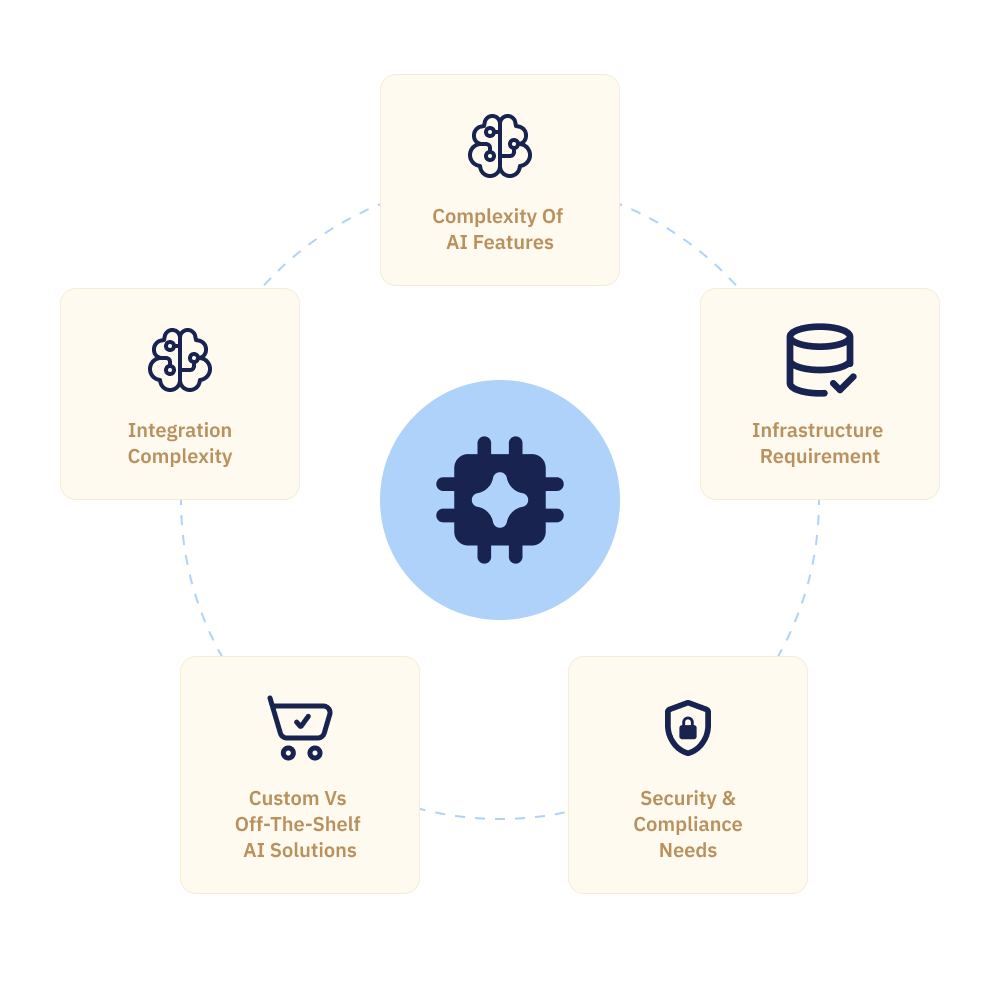
What Impacts Enterprise AI Development Cost?
Complexity of AI Features
Not all AI is created equal from a cost standpoint, and the single biggest driver of development cost is what the AI actually needs to do. A rule-enhanced recommendation engine is far less expensive to build than a multi-agent system that can reason across multiple data sources, take actions, and handle exceptions intelligently. The more a feature requires custom reasoning, nuanced understanding of domain-specific context, or the ability to operate reliably on unpredictable inputs, the more it costs in development time, in model selection and tuning, and in testing before it can be trusted in production.
Custom vs Off-the-Shelf AI Solutions
The build-vs-buy decision is one of the most consequential cost choices in enterprise AI, and the right answer varies significantly by use case, data privacy requirements, and how differentiated the capability needs to be. Off-the-shelf AI platforms and SaaS tools deliver faster time to value and lower upfront cost, but come with limitations on customization, potential concerns about proprietary data leaving the organization, and per-seat or usage-based pricing that can surprise at scale. Custom AI development costs more upfront but creates a proprietary capability the competition can't simply license, and typically offers more control over data and model behavior.
Infrastructure Requirements
What infrastructure an AI system needs to run reliably at production scale is often underestimated in early cost conversations. GPU availability for training and inference, scalable storage for model artifacts and data pipelines, low-latency serving infrastructure, and robust monitoring tooling all add up. The infrastructure choices made early in a project cloud versus on-premise, which managed services to use, how to architect for scale have long-tail cost implications that last the entire lifetime of the system.
Security and Compliance Needs
Regulated industries finance, healthcare, government, insurance face AI compliance requirements that add meaningful cost to development. Model explainability requirements, data residency constraints, audit logging, bias testing documentation, and access controls all need to be built rather than bolted on. The cost of doing this right from the start is real; the cost of retrofitting compliance into a system that wasn't designed for it is substantially higher, and the cost of a compliance failure higher still.
Integration Complexity
Most enterprise AI doesn't live in isolation it needs to integrate with existing CRMs, ERPs, data warehouses, APIs, and business systems that weren't designed with AI in mind. The complexity of these integrations is one of the most consistently underestimated cost drivers in enterprise AI projects. Legacy systems with poor documentation, data quality problems that need to be resolved before AI can work reliably, and the need to maintain existing workflows while adding new AI capabilities all contribute to a scope that often exceeds the initial estimate.
Cost Breakdown of Different AI Solutions
AI Chatbot Development Cost
AI chatbot cost spans an enormous range depending on what the chatbot is actually doing. A simple FAQ bot using an off-the-shelf platform sits at the low end. A sophisticated conversational AI that integrates with backend systems, handles multi-turn complex interactions, maintains memory across sessions, and escalates gracefully to a human when needed sits at a categorically different level. The gap between these isn't incremental it reflects fundamentally different engineering, integration, and testing requirements.
AI Agent Development Cost
AI agents systems that can reason, plan, use tools, and take autonomous multi-step action represent a higher tier of development complexity and cost than chatbots. The reasoning architecture, tool integration layer, memory management, error handling, and the testing required to trust an autonomous system with consequential actions all add significant scope. Multi-agent systems, where multiple specialized agents collaborate on complex workflows, add another layer of orchestration complexity and cost on top of that.
AI SaaS Platform Cost
Building an AI-powered SaaS platform one where AI is a core feature of a product sold to many customers carries all the costs of the AI itself plus the platform layer: multi-tenancy architecture, usage-based billing infrastructure, security isolation between customers, and the scalability requirements of a product that needs to serve unpredictable volumes reliably. For enterprise SaaS with demanding uptime requirements and large customers, these platform concerns often rival the AI itself in development cost.
AI Mobile App Development Cost
AI mobile app development costs reflect both the mobile development investment and the AI layer on top of it. On-device AI adds complexity around model optimization for constrained hardware. Cloud-dependent AI requires robust offline handling for degraded-connectivity scenarios. Cross-platform requirements (iOS and Android) add testing and sometimes development scope. For enterprise mobile apps with field operations use cases, the integration requirements connecting to backend systems, respecting enterprise security policies, operating in low-connectivity environments are often the dominant cost driver.
Computer Vision Application Cost
Computer vision applications typically involve model training or fine-tuning on domain-specific image data, which requires substantial labeled training data (often itself expensive to create), significant GPU compute, and domain expertise to validate. The production requirements around latency, accuracy thresholds, and handling of edge cases add further scope. Computer vision for consumer contexts and computer vision for industrial quality control or medical imaging have very different accuracy and reliability standards and correspondingly different development costs.
Predictive Analytics Software Cost
Predictive analytics cost depends heavily on data availability and quality, model complexity, and how the predictions need to be served. A predictive model running nightly batch jobs from clean, structured data is far less expensive than a real-time system serving predictions at millisecond latency from messy, multi-source data. The integration of predictions into operational workflows so decision-makers actually act on them is often as expensive as the modeling work itself.
Enterprise AI Development Stages and Associated Costs
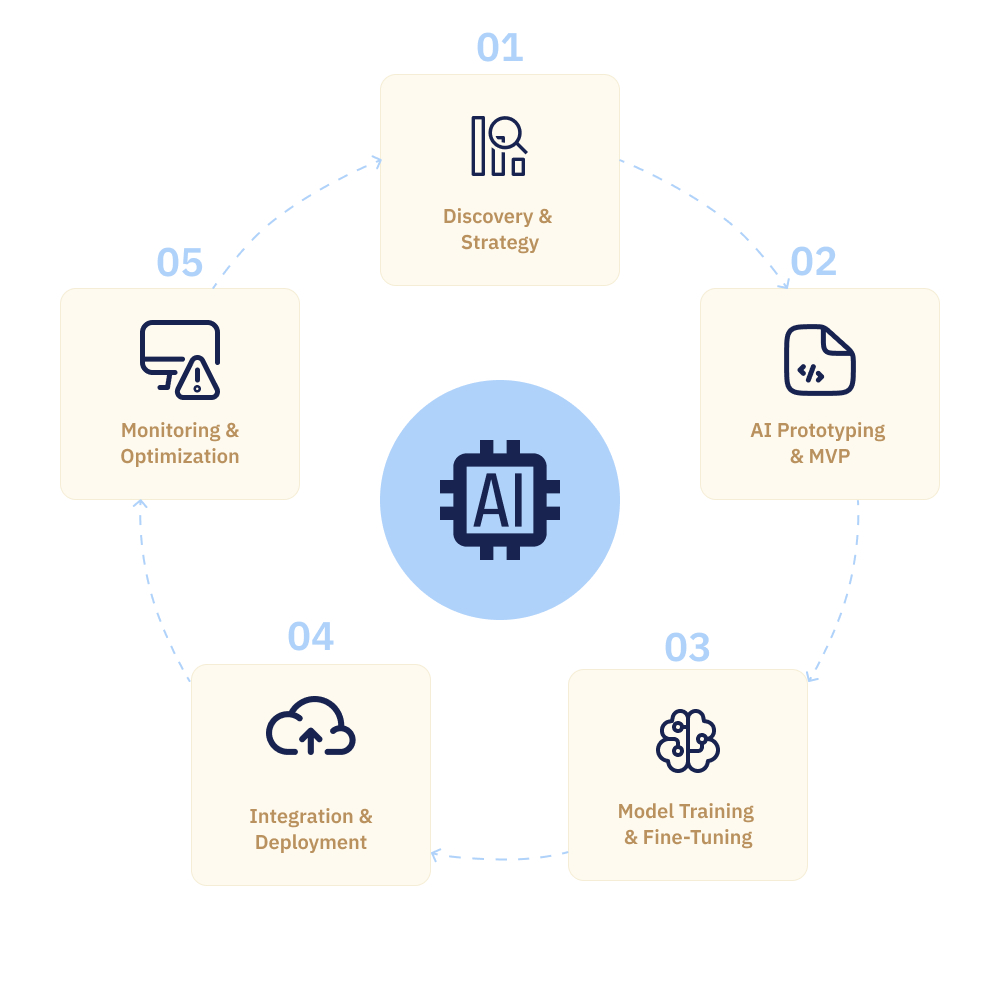
Discovery and Strategy Phase
This phase is often undervalued in budget planning, but getting it right pays dividends through the entire project. Discovery involves understanding the business problem in detail, assessing the available data, evaluating whether AI is the right solution (not every problem needs AI), selecting an architecture approach, and defining success metrics that are meaningful to the business. Done properly, discovery prevents expensive mid-project pivots. Done poorly or skipped entirely, it sets a project up for the kinds of course corrections that cost far more than the discovery work would have.
AI Prototyping and MVP Development
The prototype or MVP phase validates core technical assumptions and business value before committing to full-scale development. A focused AI MVP tests the most critical hypothesis: does the AI actually work well enough, on real data, to justify the investment in a production system? An honest MVP surfaces problems while they're still cheap to address wrong data, incorrect assumptions about user behavior, accuracy gaps that need more training data rather than after a full build.
Model Training and Fine-Tuning
Training costs vary dramatically based on model size, the volume of training data, and whether the project is training from scratch (rare and expensive) or fine-tuning a foundation model on domain-specific data (far more common and cost-effective). Fine-tuning a frontier model on proprietary data is now accessible without the enormous compute budget that training from scratch would require, and it's the approach most enterprise AI projects take to get domain-specific performance without prohibitive infrastructure cost.
Integration and Deployment
Integration and deployment is consistently where timelines slip and budgets stretch in enterprise AI. Connecting an AI system to production enterprise infrastructure with all the data quality issues, legacy API quirks, security requirements, and change management considerations that entails takes longer and costs more than the development team initially models. Building in meaningful contingency at this stage isn't pessimism; it's pattern recognition from projects that didn't.
Monitoring and Optimization
AI systems in production aren't static. Models drift as real-world data diverges from training data. Edge cases surface that the model handles poorly. Business requirements evolve and the system needs to evolve with them. The ongoing cost of monitoring, retraining, and optimizing an AI system in production is a real budget item that needs to be planned for from the start typically represented as a percentage of the initial build cost per year.
AI Infrastructure and Cloud Costs
Cloud Hosting Expenses
Cloud hosting for AI applications carries costs that traditional web hosting doesn't: GPU instances for training and inference, higher-tier storage for model artifacts and embeddings, networking costs for moving large volumes of data, and managed AI services that add convenience at a cost premium over raw compute. These costs are highly usage-sensitive a system that runs at consistent load has very different economics from one with large usage spikes and modeling expected usage patterns accurately is essential for realistic infrastructure budgeting.
GPU and AI Processing Costs
GPU compute is one of the most significant infrastructure cost lines in AI development, particularly during training. GPU availability has been constrained in recent years, making both procurement and pricing volatile. For inference in production, the choice between running on GPU and running on CPU (possible for smaller models with some latency trade-off) has meaningful cost implications. On-device AI inference, where the model runs on the end user's hardware, shifts this cost entirely off the provider's infrastructure a significant economic advantage for the right use cases.
Vector Databases and Storage Costs
Vector databases required for semantic search, RAG systems, and similarity-based retrieval add a storage and query cost layer that didn't exist in traditional software architecture. At small scale these costs are negligible; at enterprise scale, with millions of embedded documents being searched in real time, they become a meaningful budget item. Evaluating vector database options for cost efficiency alongside performance is worth doing before committing to an architecture at scale.
API Usage and LLM Costs
LLM API costs charged per token of input and output can be surprisingly significant at production scale. A system that runs thousands of complex prompts per hour accumulates API costs that look very different from what a development team incurred during testing. Careful prompt engineering (reducing unnecessary token usage), caching common responses where appropriate, and matching model capability to task complexity (using smaller, cheaper models where they're sufficient) are all levers for managing LLM API cost at scale.
Hidden Costs Businesses Often Overlook
AI Maintenance Costs
AI systems require ongoing maintenance that traditional software doesn't model health monitoring, periodic retraining, prompt updates as the underlying model versions change, and dependency management for a technology stack that moves unusually fast. This maintenance is not optional if the system needs to remain accurate and reliable. Businesses that budget well for building but poorly for maintaining often find themselves with systems that degrade quietly over time.
Model Retraining
Models need to be retrained as the real-world data they encounter in production diverges from what they were trained on. The frequency and cost of retraining depends on how quickly the relevant domain changes a model for predicting equipment failure in a stable manufacturing environment might remain accurate for a long time; a model for classifying customer sentiment in a fast-moving consumer market may need more frequent updates. Budgeting for retraining as a recurring cost, rather than a one-time expense, reflects how production AI actually works.
AI Monitoring and Governance
Monitoring an AI system in production requires more than watching uptime metrics. It means tracking model accuracy over time, monitoring for bias drift, logging decisions for auditability, and building alerting for when the model's behavior diverges from expected parameters. The tooling and human time required for this ongoing governance is a real cost that often doesn't appear in initial project budgets.
Compliance and Security Costs
For businesses in regulated industries, compliance costs are ongoing rather than one-time. Regulatory environments are evolving rapidly around AI new requirements for model documentation, impact assessments, and explainability are emerging in multiple jurisdictions. Staying compliant requires legal and technical expertise that needs to be budgeted for on a continuing basis, not just at initial deployment.
Infrastructure Scaling Costs
A system designed and priced for current usage volumes will cost more as usage grows sometimes significantly more, if the architecture wasn't built to scale efficiently. Unexpected usage spikes, new use cases added to an existing system, and organic growth all drive infrastructure costs upward. Building with observability and scalability in mind from the start limits the cost of growth; retrofitting scalability into a system that wasn't designed for it can be expensive.
Enterprise AI Team Structure
AI Engineers
AI engineers are the core technical practitioners who design, build, and deploy AI systems. They bridge the gap between data science research and production software engineering understanding both how models work and how to deploy them reliably in real-world systems. Demand for experienced AI engineers significantly exceeds supply, which keeps compensation high and makes this one of the most significant cost drivers in enterprise AI development teams.
Data Scientists
Data scientists own the modeling work defining the right problem framing, selecting and evaluating models, designing experiments, and interpreting results. In enterprise AI, data scientists increasingly work alongside engineers rather than in isolation, and the most valuable practitioners are those who understand both the statistical depth of the role and the practical constraints of deploying models in production systems.
Mobile and Web Developers
Mobile and web developers build the interfaces through which AI capabilities reach end users whether that's a customer-facing app, an internal operations tool, or an embedded feature in an existing product. Their cost is the same as in non-AI development for the interface layer itself, but they need enough understanding of AI system behavior and limitations to build interfaces that set appropriate expectations and handle model uncertainty gracefully.
AI Product Managers
AI product management is a distinct discipline from traditional product management. AI product managers need to understand what AI can and can't do reliably, how to define success metrics that are meaningful for AI features (not just output volume), how to manage user expectations around probabilistic systems, and how to prioritize work in a domain where capability and cost are both rapidly changing. Good AI product managers are relatively rare and command a premium.
DevOps and Infrastructure Teams
The DevOps and infrastructure requirements for AI systems are meaningfully different from traditional software MLOps tooling for model versioning and deployment, GPU resource management, data pipeline reliability, and the monitoring requirements of AI systems in production all require specialized knowledge. Organizations often underinvest here relative to the model development work, and then encounter reliability and scalability problems in production that reflect the gap.
Cost Comparison: Custom AI vs Prebuilt AI Tools
Advantages of Custom AI Solutions
Custom AI development creates a proprietary capability tailored to a specific business context, trained on proprietary data, and optimized for the exact use case at hand. It provides full control over model behavior, data privacy, and the ability to evolve the system as the business evolves. For use cases where the AI capability is a genuine competitive differentiator, custom development is often the right investment the business owns what it builds rather than licensing capability that any competitor can also access.
Advantages of SaaS AI Platforms
Prebuilt AI platforms and SaaS tools offer speed and cost efficiency that custom development can't match for use cases that don't require deep customization. They eliminate infrastructure management overhead, provide regular capability upgrades without additional development cost, and have typically been hardened across many customer deployments. For use cases where the business need is common enough that a vendor has already solved it well, a SaaS solution often makes significantly more economic sense than a custom build.
Long-Term ROI Comparison
The ROI comparison between custom and prebuilt AI shifts significantly over time. SaaS tools typically show a better ROI in the short term due to lower upfront investment. Custom solutions often show a better ROI over a longer horizon, particularly when the AI capability is differentiating, when usage volume makes per-unit SaaS pricing expensive relative to the infrastructure cost of a custom system, or when the proprietary training data creates a model that genuinely outperforms anything available off the shelf. The right answer depends heavily on the specific use case, the time horizon, and the strategic importance of the capability.
Factors That Increase AI Development Costs
Complex Integrations
Every integration with an existing enterprise system a legacy CRM, an ERP, a proprietary data warehouse adds scope, risk, and cost. The more systems an AI solution needs to interact with, and the more those systems differ in their data formats, APIs, and access control models, the more the integration layer dominates the total development cost.
Enterprise-Grade Security
Enterprise security requirements role-based access control, data encryption at rest and in transit, audit logging, penetration testing, single sign-on integration, and sometimes data residency constraints add meaningful development scope. Security done well at the architecture stage is far less expensive than security retrofitted into a system that wasn't designed with it in mind.
Large-Scale AI Deployment
Scaling an AI system from a pilot to enterprise-wide deployment introduces engineering challenges that don't exist at small scale: latency consistency under high load, cost efficiency at volume, operational reliability for a system that many people depend on, and change management across a large user population. Each of these adds to the cost of the deployment phase and the ongoing operational cost.
Advanced AI Features
Features that push the frontier of current AI capability high-accuracy, real-time decision-making under uncertainty, multi-agent orchestration, systems that need to reason across very large contexts, or applications that require extremely low error rates in high-stakes domains are more expensive to build, test, and maintain than more standard AI applications. The combination of advanced AI capabilities with enterprise reliability requirements is where development costs tend to be highest.
How Businesses Can Reduce AI Development Costs
MVP-First Approach
The single most effective way to manage AI development cost is to resist the urge to build everything at once. An MVP focused on the highest-value, most clearly defined use case validates assumptions with real user data, surfaces problems while they're cheap to fix, and provides a business case for subsequent investment that's grounded in actual results rather than projections. Organizations that start narrow and expand based on evidence consistently deliver better AI ROI than those that try to solve every problem in the first release.
Phased AI Implementation
Phasing AI implementation across multiple stages each with clear success criteria before the next phase is funded keeps investment proportional to demonstrated value. It also allows the organization to build AI expertise internally with each phase rather than depending entirely on external development resources, which reduces cost and increases institutional knowledge over time.
Reusing Existing Infrastructure
Where existing cloud infrastructure, data pipelines, or integration layers can be extended rather than replaced, reuse saves meaningful cost. This requires honest technical assessment of existing systems rather than reflexively rebuilding everything from scratch for the AI project an assessment that a good development partner will do rather than defaulting to a greenfield build.
Choosing the Right AI Development Partner
The development partner choice has outsized impact on both total cost and outcome quality. Partners with genuine experience in the relevant domain and use case type avoid expensive mistakes that less experienced teams make on their first attempt at a similar problem. Partners who are honest about what AI can and can't do reliably prevent the most common and expensive AI project failure mode: building something sophisticated that doesn't actually work well enough to deploy.
ROI of Enterprise AI Investments
Productivity Improvements
Productivity ROI from AI tends to compound in ways that are easy to underestimate at the outset. The initial gains from automating specific tasks are measurable and often significant. But as AI tools become embedded in daily workflows and employees develop fluency in using them effectively, the gains extend beyond the originally targeted tasks people find new ways to apply AI capabilities that weren't in the original design brief, and the total productivity impact exceeds the projection.
Automation Benefits
Automation ROI is the most straightforward to model: how many hours of manual work does this eliminate, at what fully-loaded cost, and how does that compare to the cost of the system doing it instead? For high-volume, repetitive processes, the math is often favorable within a reasonable payback period. The less visible benefit the reduction in errors and the consistency of output compared to manual processes often adds further value that's harder to put in a spreadsheet but very real.
Customer Experience Gains
Customer experience improvements from AI show up in retention rates, satisfaction scores, and conversion metrics all of which have revenue implications that can be modeled even if they're less immediately visible than cost reduction. The businesses with the clearest AI ROI stories often combine cost savings with revenue impact, showing that AI investment improved customer outcomes in ways that directly supported revenue growth.
Long-Term Business Value
The longest-term value of AI investment is the compound effect of better data, better models, and greater organizational capability over time. An AI system trained on two years of proprietary operational data is genuinely more capable than the same architecture trained on six months of data. Teams with years of experience building, deploying, and optimizing AI systems make fewer expensive mistakes than teams doing it for the first time. These compounding advantages are real and significant but they require sustained investment rather than one-time projects to materialize.
Industries Investing Most in Enterprise AI
Healthcare
Healthcare AI investment is driven by the twin pressures of a documented clinician shortage and an enormous administrative burden that's consuming clinical time that should be spent on patient care. Document AI that handles clinical notes, scheduling systems that optimize appointment flow, diagnostic support tools that give clinicians a second opinion these are areas where investment is active and growing, backed by evidence of meaningful clinical and operational impact.
Fintech
Financial services have arguably the most mature enterprise AI ecosystem of any industry, driven by both the high value of the use cases (fraud prevention, credit risk, trading) and the competitive intensity that makes AI capability directly translate to financial performance. Investment continues at high levels, with recent growth concentrated in generative AI applications for customer communication, compliance documentation, and internal knowledge management.
Logistics
Logistics AI investment is driven by the operational complexity of managing global supply chains in a volatile environment weather, geopolitical disruption, demand volatility, carrier capacity that makes AI-assisted decision-making genuinely valuable relative to human intuition and spreadsheets. Route optimization, demand forecasting, and dynamic inventory management are active areas of investment with clear, measurable impact.
Retail
Retail AI spans both consumer-facing and operational applications, and investment has been strong across both. Personalization and recommendation engines on the consumer side, and demand forecasting, pricing optimization, and supply chain coordination on the operational side, represent large ongoing investment categories for major retailers and a growing category for mid-market players as the tools become more accessible.
Manufacturing
Manufacturing AI investment is concentrated in predictive maintenance, quality control, and production optimization areas where the cost of failure is high and the data available for training is rich. Industrial computer vision for defect detection and AI-powered predictive maintenance for reducing unplanned downtime are among the highest-ROI applications in the sector.
Future of Enterprise AI Investments
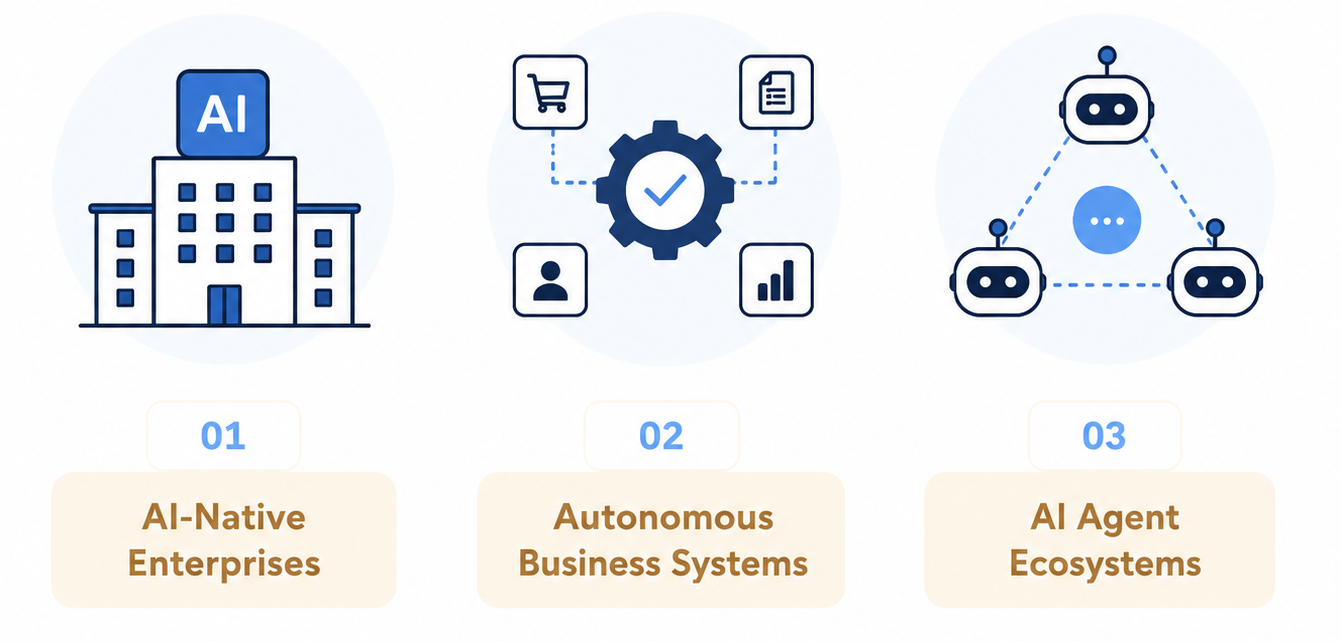
AI-Native Enterprises
The direction of enterprise AI investment is moving toward something more fundamental than adding AI features to existing systems. AI-native enterprises are being built or rebuilt around AI as a core operating capability, not a tool layered on top of traditional processes. This means different organizational structures, different data strategies, different software architectures, and a different relationship between human judgment and AI-assisted action. The investment required to make this transition is substantial, but so is the structural advantage it creates.
Autonomous Business Systems
The trajectory of AI capability points toward increasing autonomy in business systems not AI replacing human judgment on consequential decisions, but AI handling more of the operational execution layer with less moment-to-moment supervision. Procurement systems that manage supplier relationships. Financial systems that handle routine compliance and reporting. Operations systems that coordinate logistics without constant human orchestration. The investment in building these autonomous systems reliably and safely is one of the defining enterprise AI challenges of the next several years.
AI Agent Ecosystems
Enterprise AI investment is increasingly flowing toward agent-based architectures systems where multiple specialized AI agents collaborate on complex business processes, each handling the part of the workflow it's best suited for. The tooling for building, orchestrating, and governing these multi-agent systems is maturing rapidly, and the capability they enable automating business processes that were previously too complex and judgment-intensive for traditional automation represents one of the largest untapped opportunities in enterprise AI.
Enterprise AI Starts with the Right Strategy
Contact Us
Final Thoughts
Enterprise AI development costs are real, and they're often higher than initial estimates suggest but that's an argument for planning carefully, not for avoiding investment. The businesses that have moved thoughtfully on AI have found that the returns justify the investment across a range of use cases, and that the cost of waiting is increasingly visible in the operational gap that opens up between AI-enabled competitors and those still evaluating.
The most important thing any leadership team can do before committing budget to an AI project is to understand what they're actually buying not a technology, but a capability, with costs and returns that extend far beyond the initial build. With clear-eyed cost planning, realistic expectations about timelines, and a partner who tells you the truth about what AI can and can't do, the ROI on enterprise AI investment is there. The path to it is just more detailed than a single number in a pitch deck.
At TechQware, we help businesses plan, build, and scale enterprise AI solutions with a focus on cost efficiency, security, and measurable business outcomes. Whether you're validating an idea or deploying AI across your organization, our experts can help you move forward with confidence.
Ready to build your enterprise AI solution? Talk to our AI experts and get a customized development roadmap.
FAQs
How much does enterprise AI development cost?
Enterprise AI development costs range widely from relatively modest investments for a focused MVP built on API-accessed models, to multi-million dollar programs for sophisticated custom systems with deep integrations and complex AI features. The honest answer to this question requires understanding the specific use case, the data situation, the integration requirements, the compliance environment, and the scale at which the system will operate.
What factors affect AI development cost?
The primary cost drivers are the complexity of the AI features required, whether the project uses custom-built models or existing foundation models, the number and complexity of system integrations, the security and compliance requirements, the scale of deployment, and the ongoing infrastructure and maintenance costs over the system's operational lifetime.
Is custom AI development better than off-the-shelf AI tools?
Neither is categorically better the right answer depends on the use case, the importance of data privacy, the degree of customization required, the time horizon, and the strategic importance of the capability. For common use cases where a vendor has already built a strong solution, SaaS typically wins on economics. For differentiated capabilities built on proprietary data, custom development often creates more durable value.
What is the cost of building an AI chatbot?
AI chatbot cost ranges from modest for a simple FAQ bot on an off-the-shelf platform, to substantial for a sophisticated conversational AI with backend integrations, memory across sessions, and the ability to handle complex, multi-turn interactions reliably. The most important variable is what the chatbot actually needs to do well.
How long does enterprise AI development take?
A focused MVP can be delivered in weeks to a few months. A full enterprise AI system with complex integrations, compliance requirements, and multi-phase development typically takes considerably longer. The timeline depends on the scope, the data readiness, the integration complexity, and how much foundational work needs to be done before AI development can begin.
What are the hidden costs of AI projects?
The most commonly underestimated costs are model maintenance and retraining, ongoing monitoring and governance, the integration work required to connect AI to existing enterprise systems, compliance requirements in regulated industries, and the infrastructure scaling costs as usage grows beyond pilot volumes.
Can startups afford enterprise AI development?
Startups can absolutely build AI-powered products, but the path looks different from a large enterprise's approach. API-first development (using foundation model APIs rather than training custom models), focused MVP scope, and open-source tooling where appropriate make sophisticated AI capabilities accessible at a fraction of the cost that would have been required even three years ago. The key is matching scope to budget rather than trying to build everything at once.
What industries invest most in AI development?
Financial services, healthcare, logistics, retail, and manufacturing are consistently among the highest-investing sectors, driven by a combination of high-value use cases, competitive intensity, and the availability of operational data that makes AI models genuinely useful.
Abhinav Srivastav
With years of experience in driving digital transformation, Abhinav Srivastav is the CEO & Director of TechQware Technologies, helping businesses build innovative mobile apps, AI-powered applications, and scalable digital solutions.

 TechQware