Key Takeaways:
- AI automates workflows, reducing manual effort and improving productivity.
- AI personalization boosts engagement, conversions, and user retention.
- Healthcare, fintech, retail, and logistics are driving AI adoption.
- ML, NLP, and Generative AI power smarter mobile experiences.
- AI-native apps and AI agents represent the future of mobile innovation.
There's a quiet revolution happening on every smartphone in every pocket, and most people don't notice it because it feels seamless. The app that recommends exactly the product you'd want before you think to search for it. The mobile banking assistant that flags a suspicious charge before you've opened your statement. The logistics platform that reroutes a driver around a delay nobody explicitly programmed it to anticipate. This is what AI woven into mobile apps actually looks like in practice not dramatic, but decisive.
For businesses, the implications go well beyond a better user experience. AI-powered mobile apps are changing how operations run, how teams work, how customers engage, and how quickly decisions get made. This guide unpacks all of it what these apps actually are, what they're doing across industries, and why the businesses investing in them now are building a structural advantage that's increasingly hard to close from behind.
Rise of AI in Mobile Applications
Mobile apps were already central to how businesses operate long before AI entered the picture. But AI has changed what those apps are capable of in a fundamental way. Where a traditional app responds to what a user explicitly does, an AI-powered app can anticipate what a user is likely to need next, adapt to individual behavior patterns, flag anomalies, and take action all within the same interface a person is already using every day.
The integration has happened gradually and then all at once. Recommendation engines first, then chatbots, then voice interfaces, then generative AI features that can draft content, summarize data, or run a conversation that genuinely resembles talking to a knowledgeable person. The category has expanded so quickly that "AI features in mobile apps" now covers everything from a smart autocomplete to a fully autonomous workflow running in the background of an enterprise operations platform.
Growing Enterprise Investment in AI Apps
Enterprise investment in AI-powered mobile experiences has moved from exploratory budget lines to core infrastructure spending. The shift reflects a change in expectations both from customers who've grown accustomed to intelligent, adaptive experiences in their consumer apps, and from employees who expect the tools their employer gives them to be at least as smart as the apps on their personal phones.
Businesses that once piloted AI features in a single app or a single department are now expanding AI capabilities across their entire mobile footprint customer-facing apps, field operations tools, internal productivity platforms, and everything in between. The question has shifted from "should we invest in AI for our mobile apps?" to "how fast can we move without creating technical debt that costs us later?"
AI Mobile App Market Statistics and Growth Trends
The scale of the market reflects the urgency businesses are bringing to this space. AI integration has rapidly become one of the top priorities cited in mobile app development strategies across sectors. The market for AI-powered mobile applications has grown sharply in the past two years and shows no sign of plateauing driven by falling costs of AI infrastructure, more accessible APIs from major model providers, and a widening gap in business outcomes between organizations that have AI-enabled mobile tools and those that don't.
Particularly notable is how the growth is distributed: it's not concentrated in tech or fintech. Healthcare, logistics, retail, and manufacturing are all seeing significant AI mobile investment, driven by the realization that field operations, customer service, and supply chain management all benefit enormously from real-time intelligent tools on the devices workers and customers already carry.
What Are AI-Powered Mobile Applications?
Definition and Core Capabilities
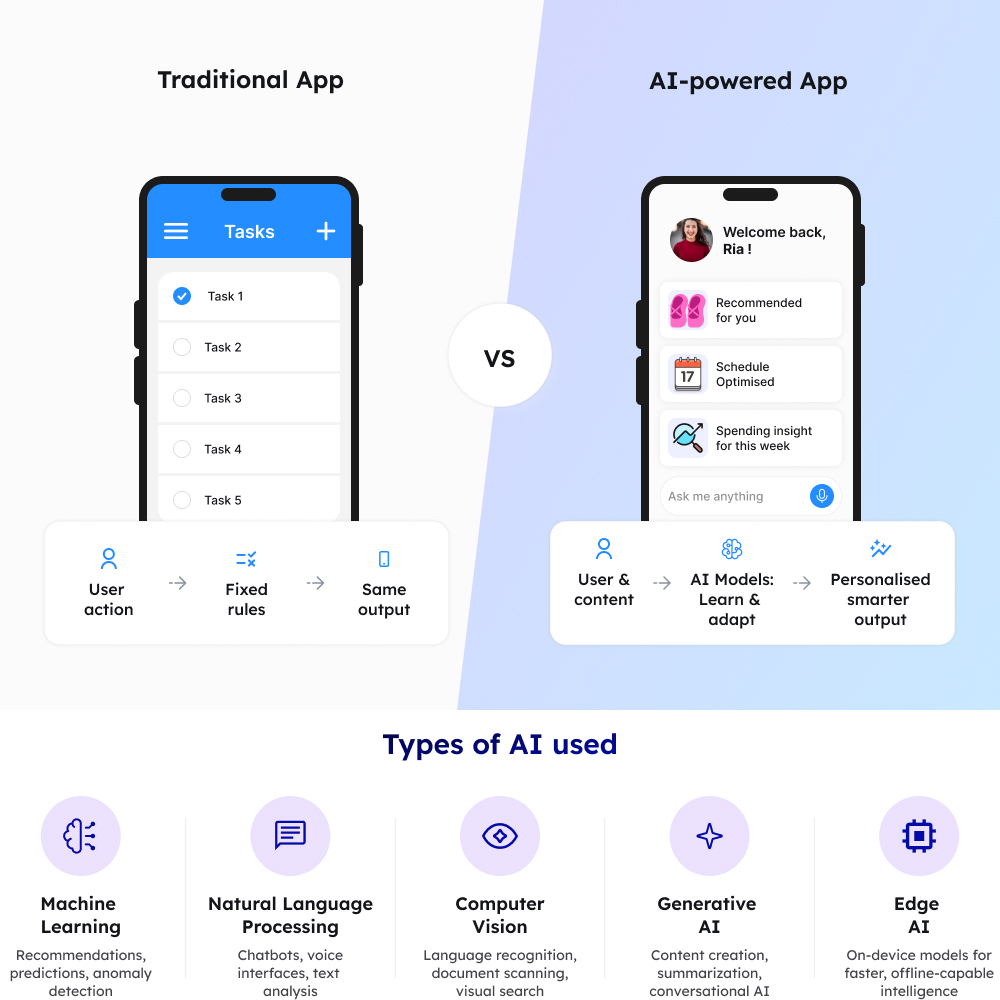
An AI-powered mobile application is a mobile app that uses machine learning, natural language processing, computer vision, predictive analytics, or generative AI often in combination to deliver experiences and perform functions that go beyond what static, rule-based programming can achieve.
The defining characteristic isn't the presence of any specific technology, but a capability: the app gets smarter over time, adapts to individual users and contexts, and can handle tasks that require understanding rather than just execution. An AI-powered app doesn't just carry out a command it interprets it, contextualizes it, and sometimes anticipates it before the user gives it.
Difference Between Traditional and AI-Powered Apps
A traditional mobile app is fundamentally a set of instructions: if the user does this, show them that. It follows rules written in advance by a developer and behaves identically for every user in every context. That predictability is also its ceiling the app can only do what it was explicitly programmed to do.
An AI-powered app replaces many of those fixed rules with models that learn from data. The result is an app that can handle inputs the developer never specifically anticipated, personalize responses to individual users at scale, improve over time as more data becomes available, and surface insights that no human could manually extract from the volume of data flowing through a modern mobile application. The difference in practice is the difference between a tool that helps a user do what they already know they want, versus one that helps them discover what they didn't know they needed.
Types of AI Used in Mobile Apps
Modern AI-powered mobile apps typically draw on several types of AI working together. Machine learning models power recommendations, predictions, and anomaly detection. Natural language processing enables chatbots, voice interfaces, and text analysis. Computer vision handles image recognition, document scanning, and visual search. Generative AI enables content creation, summarization, and conversational interfaces that can reason and draft responses. Edge AI runs certain models directly on a device rather than in the cloud, enabling faster, offline-capable intelligence. In practice, a sophisticated mobile app might use all of these simultaneously, each handling the layer of intelligence it's best suited for.
Why Businesses Are Integrating AI Into Mobile Apps
Operational Efficiency
The most immediate reason businesses invest in AI-powered mobile apps is that they make operations faster and less error-prone. Workflows that required human coordination at every step can now flow with much less friction. Field technicians get AI-assisted diagnostics before they arrive at a job site. Sales reps get real-time recommendations during a customer call. Warehouse staff get AI-optimized picking routes on a handheld device. Efficiency gains compound quickly when the people doing the work have better information, right when they need it, on the device already in their hand.
Personalized User Experiences
Personalization at scale has been a holy grail for consumer apps for years, and AI is what finally makes it achievable. An AI-powered app can tailor the experience the content surfaced, the features foregrounded, the recommendations made to each individual user based on their behavior, preferences, and context, without a human manually configuring anything. At scale, this is simply impossible without AI, and the business impact is real: personalized experiences consistently outperform generic ones on every metric that matters, from engagement to conversion to retention.
Business Automation
AI enables a category of automation that rule-based systems couldn't touch: automation of tasks that require understanding, not just execution. Intelligent document processing that can read and route an invoice without human intervention. Customer service conversations that resolve issues end to end without escalation. Sales pipelines that update themselves based on email activity. When AI handles these tasks, the business doesn't just save time it removes entire categories of manual work from the operational model.
Better Customer Engagement
Customers engage more with apps that feel intelligent and responsive to their specific needs. An AI-powered app can respond faster (often instantly), understand natural language rather than forcing users into rigid menus, remember preferences and history across sessions, and proactively surface relevant information at the right moment. Each of these individually improves engagement; together they produce a qualitatively different kind of relationship between a customer and a business.
AI Adoption Statistics Across Industries
Adoption varies by industry, but the direction is consistent: more investment, faster deployment cycles, and an expanding definition of what counts as a legitimate AI use case for mobile. Industries that were cautious early adopters healthcare and finance, primarily for regulatory reasons have accelerated significantly as the tools for building compliant, auditable AI have matured. Retail and logistics were early movers and are now operating sophisticated AI-powered mobile ecosystems. Enterprise SaaS has moved from "AI as a feature" to "AI as the core interface" in many product categories.
Core AI Features Businesses Are Prioritizing
AI Chatbots and Virtual Assistants
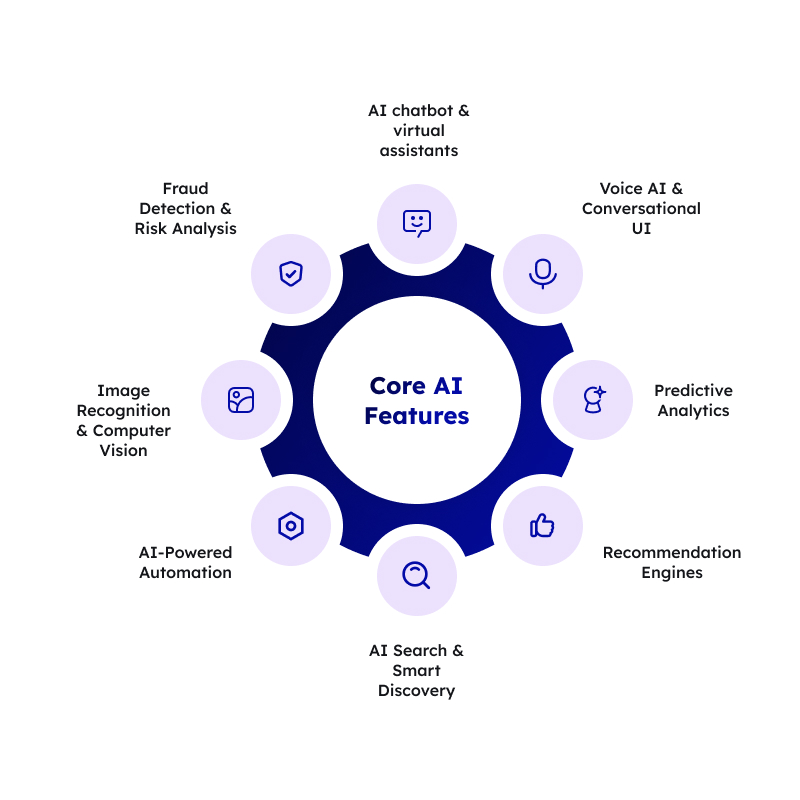
Chatbots have come a long way from the frustrating keyword-matching bots of a decade ago. Modern AI chatbots powered by large language models can handle nuanced, multi-turn conversations, understand context, and resolve genuinely complex requests without reaching a "sorry, I don't understand" dead end. For businesses, this means customer service, internal helpdesks, and onboarding flows can be handled at scale without proportional staffing growth and without the quality being perceptibly worse than a human interaction for a large share of requests.
Voice AI and Conversational Interfaces
Voice has become a serious business interface rather than a novelty, particularly in contexts where a user's hands are occupied a field technician on a job, a warehouse worker moving stock, a driver in a vehicle. Conversational AI that can understand and respond accurately to natural speech, handle accents and phrasing variations, and maintain context across a multi-step voice interaction is now mature enough to deploy in production environments where reliability is non-negotiable.
Predictive Analytics
Predictive analytics in a mobile context means giving decision-makers real-time, forward-looking intelligence at the point where they actually make decisions which is increasingly on a phone or tablet. Demand forecasting, churn prediction, maintenance scheduling, sales pipeline probability AI models can surface these insights proactively in a mobile interface rather than waiting for someone to run a report on a desktop and act on the results hours later.
Recommendation Engines
Recommendation engines are perhaps the most widely understood AI feature, but their business applications go far beyond "you might also like." Product recommendations drive eCommerce revenue. Content recommendations drive media engagement. Service recommendations drive upsell in B2B platforms. Next-best-action recommendations guide sales reps in CRM apps. The underlying technology is similar across all of these; what changes is the domain and the data the model trains on.
AI Search and Smart Discovery
Traditional keyword search requires a user to know exactly what to search for. AI-powered search understands intent, handles natural language queries, returns semantically relevant results rather than literal matches, and improves based on what users actually click. For a product catalog with thousands of SKUs, or a knowledge base covering hundreds of topics, the difference between keyword search and AI-powered search is the difference between finding what you want and giving up and calling someone.
AI-Powered Automation
Beyond specific task automation, AI is enabling a more general class of workflow intelligence systems that observe patterns in how work flows through an organization and proactively surface optimizations, flag bottlenecks, or route tasks without waiting for a human to notice and intervene. This ambient automation layer is becoming one of the most valuable aspects of AI integration in enterprise mobile tools.
Image Recognition and Computer Vision
Computer vision on a mobile device opens capabilities that were genuinely impossible without it: scanning a physical product and instantly surfacing its digital record, inspecting a component for defects with a smartphone camera, verifying identity through facial recognition, or translating a physical document into structured digital data in seconds. Industries from insurance to construction to retail are finding high-value applications for vision AI on the devices their workers already carry.
Fraud Detection and Risk Analysis
Real-time fraud detection on mobile is now a baseline expectation in financial services, and is spreading to any business where digital transactions are at risk. AI models can analyze transaction patterns, device fingerprints, location data, and behavioral signals in real time to flag anomalies with far more accuracy than rule-based systems, and with the speed that's necessary to intervene before damage is done.
How AI-Powered Apps Are Transforming Business Operations
Customer Service Automation
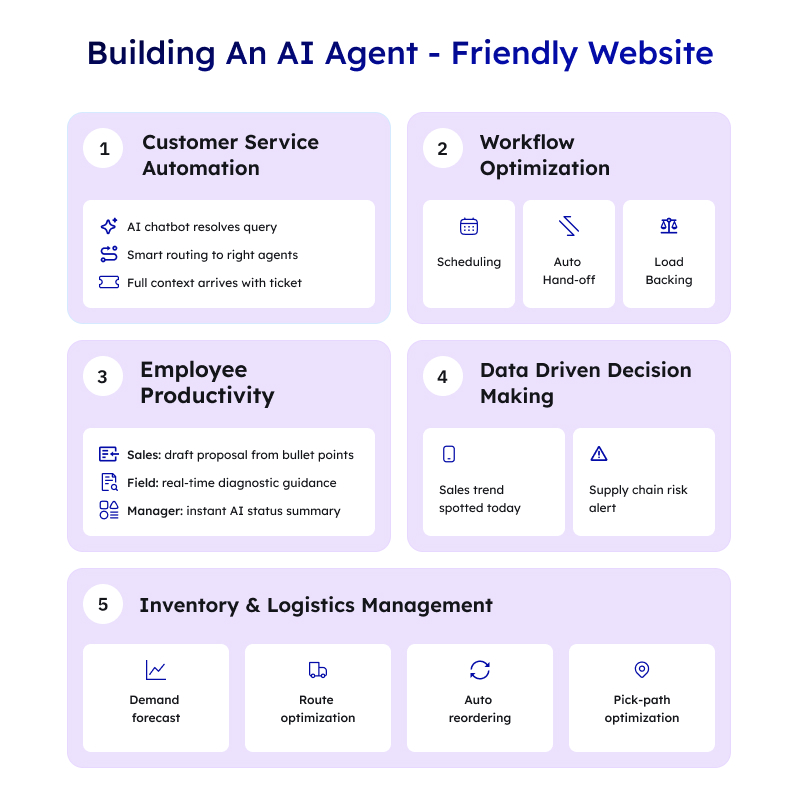
Customer service has been transformed more visibly than almost any other business function by AI in mobile apps. The combination of AI chatbots, smart routing, real-time knowledge retrieval, and predictive issue resolution means a much larger share of service interactions can be resolved without a human agent, and a much higher proportion of the interactions that do reach a human arrive with better context and history than a traditional support system would provide.
Workflow Optimization
AI in mobile apps is changing how work gets sequenced and prioritized across entire organizations. Intelligent scheduling, automated handoffs between steps in a process, real-time workload balancing these capabilities turn a mobile device from a way to view a workflow into a way to actively orchestrate it.
Employee Productivity
The productivity impact of AI-powered tools on employees is significant and compounding. When a salesperson can generate a first draft proposal from a few bullet points, a field technician can get AI-assisted diagnostic guidance in real time, and a manager can get an AI summary of their team's status without digging through reports the cumulative time saved across a workforce adds up quickly, and it tends to show up in both output volume and output quality.
Data-Driven Decision Making
Decisions that used to wait for a weekly report or a quarterly review are increasingly being made in real time with AI-surfaced intelligence on a mobile device. A regional manager can see AI-identified trends in that day's sales data on a phone. A procurement officer can get AI-powered alerts about supply chain risk before a disruption becomes visible in inventory numbers. The speed of the decision-making cycle accelerates significantly when the intelligence reaches the decision-maker where they actually work, not in an office in front of a desktop dashboard.
Inventory and Logistics Management
AI has found some of its highest-value enterprise applications in inventory and logistics, where the volume of data involved makes human management of every variable simply impossible. Demand forecasting, real-time route optimization, automated reordering, warehouse pick-path optimization these capabilities are increasingly delivered through mobile interfaces that give the people managing physical operations intelligent guidance exactly when and where they need it.
Industry-Specific AI Mobile App Use Cases
Healthcare
In healthcare, AI mobile apps are tackling some of the most impactful problems in the industry reducing the documentation burden on clinicians, enabling faster diagnostic support, improving patient communication and follow-up, and making clinical decision support available at the point of care rather than back at a desktop. Remote patient monitoring apps that use AI to flag abnormal readings, clinical photography tools that use computer vision to assist in assessment, and AI scheduling tools that reduce appointment no-shows all represent real deployments making a measurable difference in how care is delivered.
Fintech
Fintech has arguably been the most aggressive early mover on AI-powered mobile features. Intelligent spend analysis, real-time fraud protection, AI-driven credit assessment, personalized savings recommendations, and conversational banking interfaces are now standard features in leading financial apps rather than competitive differentiators. The industry has also pushed hard on compliance-grade AI models that can explain their decisions in ways that satisfy regulators, not just produce accurate outputs.
Retail and eCommerce
Retail AI mobile apps have transformed how consumers discover and buy, and how retailers manage the operations behind the transaction. Visual search lets a customer photograph a product they like and instantly find where to buy it. Personalized promotions reach the right customer at the right moment based on behavioral signals. AI-powered inventory management reduces both stockouts and overstock simultaneously. Post-purchase, AI handles returns triage, refund processing, and follow-up communication at a scale no human team could match.
Logistics and Transportation
Logistics was built for AI enormous volumes of data, constantly changing conditions, and optimization problems of a complexity that makes human intuition inadequate. AI mobile apps in logistics give dispatchers real-time route recommendations accounting for traffic, weather, and vehicle load. They give drivers navigation that accounts for cargo constraints, not just roads. They give operations managers predictive alerts about delays before they cascade into larger problems.
Travel and Hospitality
Travel apps are using AI to take the friction out of the most frustrating parts of travel: real-time rebooking when a flight is disrupted, proactive hotel check-in, personalized itinerary suggestions based on actual preferences rather than generic tourist defaults, and multilingual customer support that doesn't require waiting for a human agent in a different time zone. The hospitality side is using AI to personalize the guest experience at a granularity that was previously only achievable for the most high-touch luxury properties.
Enterprise SaaS
Enterprise SaaS mobile apps have undergone a transformation from "desktop features on a smaller screen" to genuinely mobile-first AI experiences. CRM apps that suggest next best actions. Project management tools that flag risks before they become delays. HR platforms that surface retention signals. Financial tools that generate narrative summaries of complex data. The AI layer in enterprise SaaS mobile apps increasingly does more than assist it actively shapes how work gets done.
Technologies Used in AI Mobile App Development
Machine Learning Frameworks
The foundational layer of most AI mobile features is built on machine learning frameworks libraries that allow developers to train, tune, and deploy predictive models. TensorFlow Lite and Core ML are the leading frameworks for running ML models on-device, enabling AI features that work quickly and offline. Server-side training and inference use frameworks like PyTorch and TensorFlow at full scale.
NLP and Conversational AI
Natural language processing capabilities in mobile apps are delivered through a combination of cloud-based large language model APIs for sophisticated conversational tasks, and lighter, on-device NLP models for simpler tasks that benefit from lower latency and offline capability. The practical development landscape in 2026 involves mixing these approaches based on the specific requirement accuracy, speed, privacy, cost rather than committing entirely to one.
Generative AI APIs
Generative AI accessed through APIs has dramatically lowered the barrier to adding sophisticated AI features to mobile apps. Rather than training a model from scratch, development teams can integrate state-of-the-art capabilities content generation, summarization, code assistance, conversational reasoning through an API call, with the heavy lifting done by a foundation model maintained by a provider. This has made AI features accessible to teams that couldn't previously justify the infrastructure investment.
Edge AI and On-Device AI
On-device AI has moved from a nice-to-have to a genuine requirement in many categories. Running AI inference on the device itself rather than making a cloud call provides lower latency (often critical for real-time features), offline functionality (essential for field operations), and stronger privacy guarantees (no data leaving the device). Modern smartphone chips have dedicated neural processing hardware that makes on-device inference meaningfully fast for a wide range of use cases.
Cloud Infrastructure for AI Apps
Cloud AI infrastructure provides the scale, flexibility, and access to the most powerful models that on-device processing can't match. Major cloud platforms offer managed AI services that handle the infrastructure complexity of running models at scale training pipelines, model hosting, real-time inference endpoints, monitoring, and auto-scaling so development teams can focus on building the application layer rather than managing GPU clusters.
AI Personalization and User Retention
AI-Based User Recommendations
AI recommendation systems drive some of the most measurable retention improvements in consumer and enterprise apps alike. By analyzing what a user engages with, what they ignore, how long they spend on different content or features, and how their behavior compares to similar users, AI recommendation engines surface the content, products, or next actions most likely to be relevant turning an app that requires effort to navigate into one that proactively delivers value.
Behavioral Analytics
Behavioral analytics powered by AI go deeper than traditional usage metrics. Rather than reporting that a feature was used X times, AI-powered behavioral analysis can identify patterns that predict churn, flag friction points before they show up in drop-off rates, and segment users in ways that reveal meaningful distinctions between groups distinctions that inform both product decisions and personalized engagement strategies.
Dynamic User Experiences
AI enables mobile apps to present genuinely different experiences to different users different layouts, different default views, different content based on what each individual user has shown they respond to. This kind of dynamic personalization was only achievable with massive engineering investment a few years ago; today it's a feature that well-resourced development teams can build into the core of an app.
AI-Driven Engagement Strategies
AI also shapes how and when an app reaches out to a user which push notifications get sent, when, with what content, and through which channel. Rather than batch-and-blast notifications that annoy more users than they engage, AI-driven engagement tools identify the right moment and the right message for each individual user, improving both the response rate and the relationship between the user and the app.
Challenges of Integrating AI Into Mobile Apps
Data Privacy and Compliance
AI-powered mobile apps consume and process substantial amounts of user data behavioral signals, preferences, location, transaction history and the regulatory environment around that data is complex and tightening. GDPR, CCPA, sector-specific regulations in healthcare and finance, and evolving standards around AI transparency all place real requirements on how data is collected, stored, and used. Building compliant AI into a mobile app requires deliberate architecture decisions from the start, not retrofits after a regulator asks questions.
AI Bias and Accuracy
AI models can perpetuate or amplify biases present in the data they're trained on, and in a mobile app used by millions of people, the effects can scale quickly. Recommendation engines that steer certain users toward worse options, fraud detection systems that flag legitimate transactions from certain demographics at higher rates, NLP models that perform worse on certain accents or dialects these aren't hypothetical risks. Addressing them requires diverse training data, rigorous testing across demographic groups, and ongoing monitoring in production.
Infrastructure Complexity
Building a sophisticated AI mobile app requires integrating multiple systems model hosting, data pipelines, inference endpoints, monitoring, and the mobile app itself in ways that need to be reliable, scalable, and maintainable. The complexity is real, and it's a common reason why AI features that work impressively in a demo fall short in production.
High Development and Maintenance Costs
AI-powered mobile apps cost more to build and maintain than traditional apps, for straightforward reasons: the development skills required are scarcer and more expensive, the infrastructure has ongoing costs, and models require regular retraining and tuning as the underlying data distributions change. Businesses need to go in with realistic expectations about total cost of ownership, not just initial build cost.
AI Scalability Challenges
An AI feature that works well at modest traffic volumes can become a bottleneck or a cost problem when usage scales. Inference costs grow with usage, latency can degrade under load, and models can behave differently on the long tail of inputs they encounter in production that they didn't see in training. Planning for scale from the architecture stage, rather than addressing it as an afterthought, makes a significant difference in how these challenges play out.
Cost of AI Mobile App Development
Factors Affecting AI App Costs
The cost drivers in AI mobile app development include the complexity of the AI features involved, the volume and quality of data available for training or fine-tuning models, the number and complexity of system integrations required, the platform scope (iOS only, Android only, or cross-platform), the security and compliance requirements specific to the industry, and whether the team is building custom models or integrating via third-party APIs. Any realistic cost estimate has to account for all of these rather than providing a single round number.
AI MVP vs Enterprise AI Applications
An AI MVP a focused, single-feature build designed to prove a concept and gather real user data is the most cost-efficient entry point for most businesses, and the most appropriate one when the use case hasn't been validated in a specific context yet. Enterprise AI applications with multiple AI features, deep system integrations, compliance requirements, and support for large user bases are categorically more expensive, reflecting the scope and reliability demands involved.
Infrastructure and API Costs
Beyond development cost, AI apps carry ongoing infrastructure and API costs that scale with usage. Cloud inference, model hosting, data storage, and API calls to third-party model providers all show up in the operating budget. These costs can be modeled in advance with reasonable accuracy if usage projections are realistic, but businesses that don't budget for them in advance often find them surprising.
Maintenance and Optimization Costs
AI models are not static. They drift as the real-world data they're exposed to diverges from their training data, and they require retraining and tuning to maintain performance over time. The mobile app itself also requires updates as platform requirements change. Maintenance and optimization are ongoing costs that should be budgeted from the beginning rather than treated as unexpected expenses when performance starts to degrade.
Future Trends in AI Mobile Applications
AI-Native Mobile Apps
The next generation of mobile apps is being designed AI-first rather than having AI bolted on apps where the AI is the interface, not a feature within an interface. Instead of a traditional navigation structure with AI assistance available at various points, AI-native apps take a goal from a user and handle the path to completing it, surfacing information and actions dynamically rather than presenting a static menu.
Multimodal AI Experiences
Mobile devices are naturally multimodal they have cameras, microphones, displays, and touch and AI is increasingly capable of working across all of these modalities simultaneously. A multimodal AI experience might involve a user pointing their camera at something, asking a voice question about it, and receiving a response that's part spoken, part visual overlay, part text. The coherence of these multimodal interactions is improving rapidly, and the mobile use cases are compelling.
Autonomous AI Assistants
AI assistants embedded in mobile apps are moving from reactive (answering questions when asked) to proactive (identifying opportunities and problems without being prompted) to increasingly autonomous (taking action on behalf of a user within defined permissions). The transition to autonomous AI mobile assistance is already underway in task management, email, scheduling, and CRM and the scope will expand as trust in the reliability of these systems builds.
Voice-First Interfaces
Voice as a primary interaction modality is gaining ground, particularly in use cases where visual attention is constrained. The convergence of better speech recognition, more natural conversational AI, and hardware improvements in noise cancellation is making voice-first mobile interfaces genuinely practical for a wider range of business applications than before.
AI Agent Integration in Mobile Apps
As AI agents systems that can take multi-step, autonomous action toward a goal become more capable and more trusted, their integration into mobile apps will deepen. The mobile device is both a control surface for these agents and a delivery channel for their outputs, and the category of "things an AI agent can do for a user through a mobile app" will expand significantly in the near term.
Benefits of AI-Powered Mobile Applications
Increased Operational Efficiency
The throughput and reliability of AI-assisted operations consistently exceed what's achievable with manual processes at the same scale. Work moves faster, errors occur less frequently, and the people doing the work spend more time on tasks that genuinely require human judgment and less on tasks that can be reliably handled by an intelligent system.
Improved Customer Experience
AI-powered mobile apps deliver experiences that feel responsive, intelligent, and personalized in a way that generic apps simply can't match. Customers notice in engagement metrics, in satisfaction scores, and in the organic advocacy that comes from genuinely liking the tool a business has put in front of them.
Better Retention and Engagement
Apps that learn and adapt to individual users create a dynamic that pure utility-based apps don't: the longer a user engages, the better the app gets for them specifically, creating a retention mechanism that compounds over time rather than declining as novelty fades.
Reduced Operational Costs
Automation of customer service, data entry, document processing, scheduling, and a dozen other operational functions through AI-powered mobile tools reduces the headcount cost of running those functions at scale. The savings aren't always linear AI works best when it handles the high-volume, lower-complexity work, freeing humans for higher-value tasks but the cost reduction is real and often substantial.
Competitive Business Advantage
Businesses operating with AI-powered mobile tools faster decisions, better customer experiences, leaner operations accumulate advantages over competitors that aren't. The gap widens as AI models improve with more data, as teams develop expertise in deploying and optimizing AI features, and as user expectations shift upward in response to the best experiences in the market.
Final Thoughts
The window where "AI in our mobile app" was a differentiator is narrowing. What's replacing it is a more demanding question: how well is the AI actually integrated, how reliably does it work, and does it genuinely improve what the business and its customers are trying to do or does it just add a chat bubble and a "powered by AI" badge to the marketing page?
The businesses pulling ahead aren't the ones with the flashiest demo. They're the ones that picked the right problems, built with the right architecture, kept humans in the loop where it matters, and treated AI as a long-term operational capability rather than a one-time feature ship. The opportunity is real. So are the pitfalls. The difference between the two usually comes down to how seriously a business takes the craft of building AI well.
AI should make your app more useful not more complicated. At TechQware, we help businesses build AI-powered mobile apps that solve real problems, improve user experiences, and scale with confidence. Whether you're building a new app or adding AI to an existing one, we're here to help you do it the right way.
Ready to build an AI-powered mobile app? Let's discuss your idea and explore how we can turn it into a scalable, intelligent solution.
FAQs
What are AI-powered mobile apps?
AI-powered mobile apps are applications that use artificial intelligence technologies machine learning, natural language processing, computer vision, predictive analytics, or generative AI to deliver personalized, adaptive, and intelligent experiences that go beyond what traditional, rule-based programming can achieve.
How does AI improve mobile app user experience?
AI improves the mobile app user experience by personalizing content and recommendations to individual users, enabling natural language interfaces rather than rigid menus, proactively surfacing relevant information before a user has to search for it, and handling tasks autonomously that would otherwise require multiple manual steps.
Which industries use AI mobile apps the most?
Fintech, healthcare, retail and eCommerce, logistics, and enterprise SaaS are among the most active adopters, though AI mobile app investment is now broad across industries rather than concentrated in a few.
What are the most useful AI features in mobile apps?
The most business-impactful AI features vary by use case, but consistently high-value categories include AI chatbots and virtual assistants, predictive analytics, recommendation engines, voice interfaces, computer vision, and intelligent workflow automation.
How much does AI mobile app development cost?
Development costs range widely depending on the scope of AI features, the complexity of integrations, compliance requirements, and whether the build uses custom models or third-party AI APIs. AI MVPs can be built for a fraction of the cost of a full enterprise AI application, and ongoing infrastructure and maintenance costs should be factored into any budget.
Is AI integration expensive for mobile apps?
It's more expensive than traditional mobile app development, but the cost gap has narrowed significantly as AI APIs have made powerful capabilities more accessible without requiring custom model development. The relevant question is usually total cost relative to expected business impact which, for the right use cases, favors investment in AI integration significantly.
What technologies are used in AI mobile apps?
Common building blocks include machine learning frameworks (TensorFlow Lite, Core ML), NLP and large language model APIs, generative AI APIs, edge AI for on-device inference, cloud infrastructure for model hosting and training, and computer vision libraries for image recognition applications.
What is the future of AI-powered mobile applications?
The trajectory points toward AI-native apps where intelligence is the core interface rather than a feature within one, multimodal experiences that work fluidly across voice, vision, and text, increasingly autonomous AI assistants embedded in mobile workflows, and the deep integration of AI agents that can take meaningful, multi-step action on a user's behalf.
Abhinav Srivastav
With years of experience in driving digital transformation, Abhinav Srivastav is the CEO & Director of TechQware Technologies, helping businesses build innovative mobile apps, AI-powered applications, and scalable digital solutions.

 TechQware