Key Takeaways:
- 70%+ of organizations are actively investing in AI initiatives.
- MCP enables AI systems to share context, memory, and workflows seamlessly.
- Context-aware AI delivers more personalized and accurate user experiences.
- Healthcare, finance, retail, and SaaS are leading MCP adoption.
- MCP is shaping the future of AI-native applications and autonomous AI agents.
Introduction
Artificial Intelligence is rapidly evolving from a tool that simply generates responses into a sophisticated ecosystem of intelligent systems capable of understanding context, remembering information, coordinating tasks, and interacting with software autonomously. Businesses worldwide are investing heavily in AI-driven transformation, but many organizations are discovering a significant challenge: most AI systems still operate in isolated environments. They can process information effectively within a single interaction but often struggle to maintain context across applications, workflows, and organizational systems.
This challenge has given rise to the importance of MCP, or Model Context Protocol. As enterprises move toward AI-native applications, MCP is emerging as a foundational framework that allows AI models, tools, agents, and applications to communicate using shared context. Rather than functioning as disconnected components, AI systems can collaborate intelligently, creating seamless experiences for users and organizations.
For businesses planning long-term AI strategies, understanding MCP is becoming just as important as understanding APIs was during the rise of cloud computing. Companies that embrace context-aware AI architectures today will be better positioned to build scalable, intelligent, and future-ready digital ecosystems.
Why Context Is Critical in AI Systems
Context is the difference between a generic AI response and a truly intelligent interaction. When humans communicate, they naturally rely on memory, history, and situational awareness. We understand references made earlier in conversations, recognize recurring patterns, and adapt our responses based on prior interactions.
Traditional AI systems often struggle with this continuity. An AI assistant may answer a question accurately but fail to remember information from a previous interaction. In enterprise environments, this limitation can create inefficiencies, repetitive workflows, and fragmented user experiences.
Imagine a customer interacting with a banking AI assistant. The customer asks about a mortgage application, follows up with questions about eligibility, and later requests document status updates. Without contextual continuity, the AI must repeatedly request information, creating frustration. With shared context enabled through MCP, the AI can maintain awareness of previous interactions, providing a more natural and efficient experience.
Growth of AI-Native Applications
The rise of AI-native applications is transforming how businesses develop digital products. Unlike traditional software that uses AI as an add-on feature, AI-native applications place intelligence at the core of the user experience.
Examples include AI-powered healthcare platforms that assist doctors in diagnosis, fintech applications that provide intelligent financial guidance, customer support systems that resolve complex issues autonomously, and enterprise productivity tools that coordinate workflows across departments.
Industry analysts predict that AI-native software markets will experience substantial growth over the next decade as organizations seek competitive advantages through automation, personalization, and intelligent decision-making. This expansion creates a pressing need for standardized methods of sharing context across AI systems.
The Need for AI Interoperability
As organizations deploy multiple AI tools simultaneously, interoperability becomes essential. A sales assistant, customer support chatbot, analytics platform, and workflow automation engine may all need access to the same contextual information.
Without interoperability, businesses risk creating disconnected AI silos. Information becomes fragmented, decision-making slows down, and opportunities for automation are lost.
MCP addresses this challenge by providing a common protocol that enables AI systems to exchange context efficiently, creating a more connected and intelligent digital environment.
Understanding MCP (Model Context Protocol)
The emergence of MCP represents a significant advancement in AI infrastructure. Rather than focusing solely on data exchange, MCP focuses on contextual understanding and shared intelligence.
.jpg)
Definition of MCP
Model Context Protocol (MCP) is an open framework designed to standardize how AI models, applications, agents, and tools exchange contextual information. It enables AI systems to access relevant knowledge, maintain continuity across interactions, and coordinate activities more effectively.
Instead of treating every interaction as isolated, MCP allows AI systems to operate within a broader context that includes memory, user preferences, workflow states, and operational data.
Core Purpose of MCP
The primary purpose of MCP is to ensure that AI systems can access the information necessary to make intelligent decisions. Rather than forcing every application to develop proprietary integrations, MCP creates a common language for context sharing.
This approach reduces development complexity while improving consistency across AI-powered experiences.
Businesses benefit from faster deployment cycles, enhanced interoperability, and greater scalability as AI initiatives expand across multiple departments and platforms.
How MCP Enables Context Sharing
MCP enables context sharing by acting as an intermediary layer between AI models and information sources. When an AI agent requires contextual data, MCP provides standardized mechanisms for retrieving and distributing relevant information.
For example, an AI sales assistant can access customer interaction history, CRM data, product knowledge, and support tickets through MCP without requiring separate integrations for each source.
This centralized approach improves efficiency while ensuring consistent context across applications.
Why MCP Matters in the AI Era
The growing complexity of AI ecosystems makes MCP increasingly important for organizations pursuing digital transformation initiatives.
AI Memory and Context Challenges
One of the most significant limitations of traditional AI systems is memory management. While modern AI models can process large amounts of information, maintaining persistent context across interactions remains challenging.
Organizations often find themselves rebuilding context repeatedly, increasing operational costs and reducing user satisfaction.
MCP introduces mechanisms for storing, retrieving, and sharing contextual information, enabling AI systems to function more like knowledgeable collaborators rather than isolated tools.
Limitations of Traditional APIs
APIs have served as the foundation of digital integration for decades. However, APIs were designed primarily for data exchange rather than contextual intelligence.
An API may provide customer records, inventory information, or transaction history, but it does not inherently explain how these data points relate to a broader workflow or user objective.
MCP extends beyond data retrieval by incorporating contextual awareness, making it more suitable for AI-driven environments.
AI Agent Interoperability
As AI agents become increasingly specialized, interoperability becomes critical.
A customer support agent may need information from a billing agent, while a logistics agent may require insights from inventory management systems. MCP enables these agents to collaborate effectively by sharing relevant context.
This interoperability creates opportunities for sophisticated automation and intelligent workflow orchestration.
How MCP Works
Understanding the operational mechanics of MCP helps businesses appreciate its transformative potential.
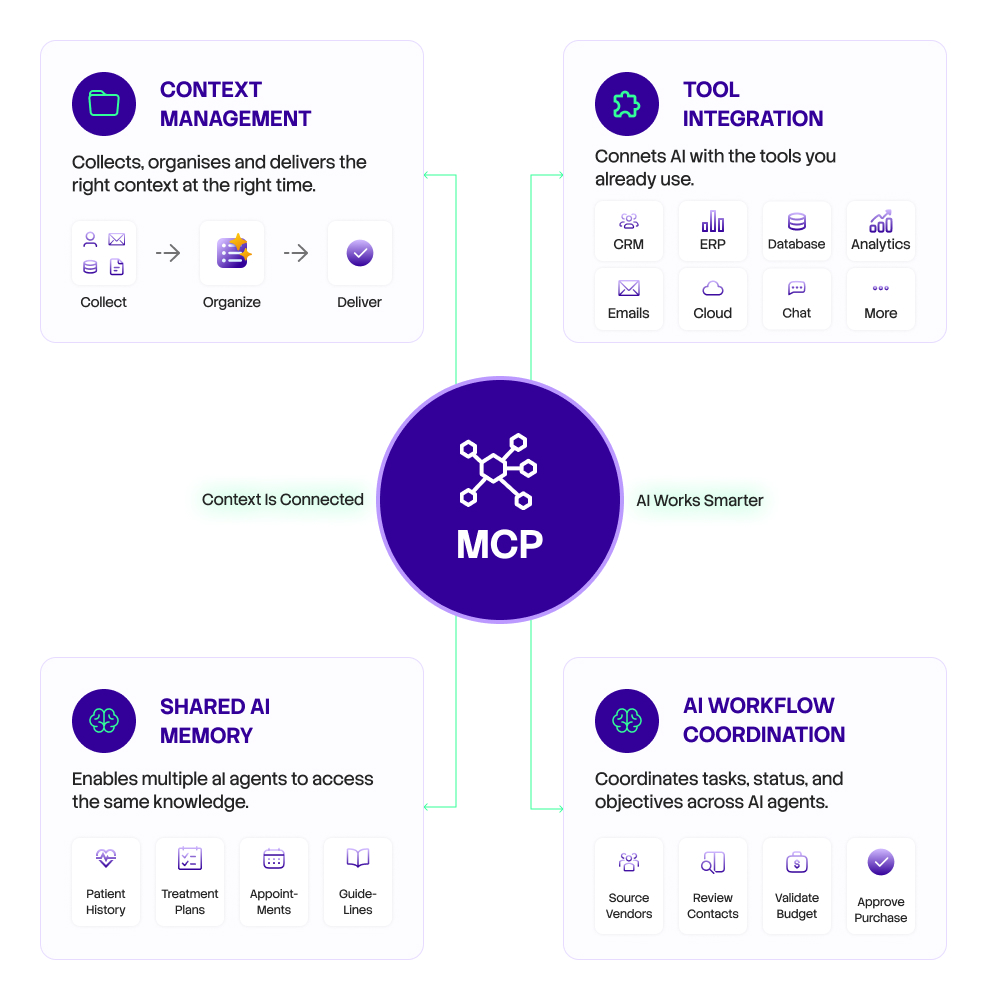
Context Management
Context management serves as the foundation of MCP. Relevant information is collected, organized, updated, and distributed based on user needs and system requirements.
Rather than forcing AI models to process unnecessary information, MCP ensures that only relevant context is delivered at the appropriate time.
Tool Integrations
Modern AI systems rely on numerous external tools including CRMs, ERPs, analytics platforms, databases, communication systems, and cloud applications.
MCP provides standardized integration methods that allow AI systems to interact with these tools while maintaining contextual continuity.
Shared AI Memory
Shared memory enables multiple AI agents to access common knowledge repositories. This eliminates duplication, improves consistency, and enhances collaboration across intelligent systems.
For example, a healthcare provider's AI ecosystem may maintain shared memory related to patient history, treatment plans, appointments, and clinical guidelines.
AI Workflow Coordination
MCP supports workflow coordination by ensuring that AI agents understand task status, dependencies, and objectives.
A procurement workflow might involve multiple agents responsible for sourcing vendors, reviewing contracts, validating budgets, and approving purchases. MCP helps coordinate these activities through shared contextual awareness.
MCP Architecture Explained
The architecture of MCP consists of multiple interconnected layers that support intelligent communication.
Context Layer
The context layer stores and organizes relevant information required by AI systems. This may include user preferences, organizational knowledge, workflow states, and historical interactions.
By centralizing contextual information, businesses create a foundation for consistent AI experiences.
AI Model Layer
The AI model layer includes language models, machine learning systems, and reasoning engines that utilize contextual information provided through MCP.
Rather than operating independently, these models gain access to shared intelligence that enhances decision-making capabilities.
Tool and API Layer
The tool and API layer connects AI systems with enterprise applications, databases, and external services.
This layer ensures seamless access to operational information while maintaining contextual consistency.
Memory and Retrieval Systems
Memory and retrieval systems play a critical role in long-term context preservation.
These systems enable AI agents to recall previous interactions, retrieve relevant knowledge, and apply historical insights to current tasks.
Security and Governance
Security and governance frameworks ensure that contextual information is managed responsibly.
Organizations must establish policies governing access controls, data privacy, compliance requirements, and audit capabilities to protect sensitive information.
MCP vs APIs vs Plugins
Businesses evaluating AI infrastructure often compare MCP with existing integration approaches.
Key Differences
Traditional APIs focus on data exchange, while plugins extend application functionality. MCP introduces contextual intelligence that allows AI systems to understand relationships, workflows, and objectives.
This distinction makes MCP uniquely suited for AI-native environments.
Use Cases Comparison
|
Technology
|
Primary Purpose
|
Best Use Cases
|
|
APIs
|
Data Exchange
|
System integrations, application communication
|
|
Plugins
|
Feature Extension
|
Application enhancements and customization
|
|
MCP
|
Context Sharing
|
AI agents, intelligent workflows, AI-native platforms
|
Why MCP Is More Scalable for AI Systems
As organizations deploy additional AI agents and applications, maintaining separate integrations becomes increasingly complex.
MCP reduces this complexity by creating a unified context-sharing framework that supports scalability and operational efficiency.
MCP and AI Agents
AI agents represent one of the most compelling use cases for MCP.
AI Agent Coordination
AI agents frequently depend on information generated by other agents. MCP facilitates coordination by ensuring all participants operate with a shared understanding of objectives and context.
This coordination improves efficiency and reduces errors.
Multi-Agent Systems
Multi-agent systems involve multiple specialized AI agents working collaboratively toward common goals.
A customer service ecosystem may include agents focused on billing, technical support, product recommendations, and account management. MCP enables seamless collaboration among these specialized entities.
Autonomous Workflows
Autonomous workflows allow AI systems to complete tasks with minimal human intervention.
By providing shared context and workflow awareness, MCP enables intelligent automation that extends beyond isolated task execution.
Context-Aware AI Experiences
Users increasingly expect personalized, context-aware interactions.
MCP supports these expectations by ensuring AI systems understand user preferences, historical interactions, and ongoing objectives.
Real-World Business Use Cases of MCP
The practical applications of MCP span numerous industries and business functions.
Enterprise Automation
Large organizations often struggle with fragmented workflows. MCP enables AI systems to coordinate activities across departments, reducing manual effort and improving operational efficiency.
AI Customer Support Systems
Customer support represents one of the most impactful MCP use cases.
An AI support assistant equipped with contextual awareness can access customer history, previous tickets, account information, and product usage data, leading to faster and more accurate resolutions.
AI-Powered Mobile Applications
Mobile applications increasingly incorporate AI-driven features such as recommendations, personalization, and predictive assistance.
MCP enables these applications to maintain continuity across devices, interactions, and user journeys.
AI Workflow Orchestration
Organizations managing complex business processes benefit from MCP-driven workflow orchestration.
By coordinating multiple AI systems and data sources, businesses can streamline operations while improving decision quality.
Industries Adopting MCP
Several industries are actively exploring MCP-based architectures.
Healthcare
Healthcare providers use contextual AI systems to support diagnosis, treatment planning, patient engagement, and clinical decision-making.
Shared context improves care coordination while reducing administrative burdens.
Finance
Financial institutions leverage MCP to enhance fraud detection, customer service, risk assessment, and investment advisory services.
Contextual awareness enables more accurate and personalized financial interactions.
Retail
Retailers utilize MCP to power recommendation engines, customer engagement platforms, inventory optimization systems, and conversational commerce experiences.
Logistics
Logistics companies rely on contextual information to coordinate shipments, optimize routes, manage inventories, and improve operational visibility.
SaaS
Software-as-a-Service providers increasingly integrate MCP into AI-powered products to enhance user experiences and enable intelligent workflow automation.
Benefits of MCP for Businesses
Organizations adopting MCP can realize substantial advantages.
Better AI Accuracy
Context-rich AI systems produce more accurate responses because they understand the broader situation rather than relying solely on isolated inputs.
Context Persistence
Persistent context eliminates repetitive interactions and enables seamless continuity across workflows and user experiences.
Improved AI Coordination
Shared context allows multiple AI systems to collaborate effectively, improving efficiency and reducing duplication of effort.
Scalable AI Systems
MCP provides a scalable framework that supports growing AI ecosystems without requiring extensive custom integrations.
Challenges and Risks of MCP Adoption
Despite its benefits, MCP adoption requires careful planning and governance.
Security Concerns
Context-sharing frameworks often involve sensitive information. Organizations must implement robust security controls to prevent unauthorized access.
Context Privacy
Businesses must ensure compliance with privacy regulations while managing contextual information responsibly.
Infrastructure Complexity
Deploying MCP may require architectural changes, integration efforts, and new operational processes.
AI Governance
Effective governance frameworks are essential for maintaining transparency, accountability, and ethical AI usage.
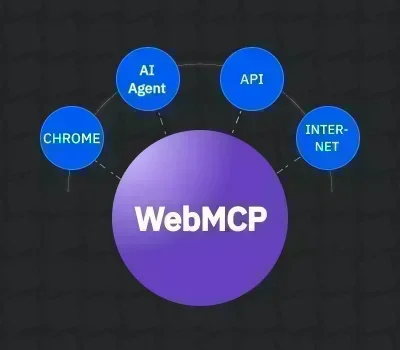
MCP + WebMCP: Building AI-Native Platforms
The combination of MCP and WebMCP represents the next stage of AI-native digital infrastructure.
AI-Agent Friendly Websites
Websites optimized for AI agents provide structured information, contextual accessibility, and machine-readable content that supports intelligent interactions.
AI-Readable Infrastructure
AI-readable infrastructure enables intelligent systems to navigate, interpret, and utilize information more effectively.
This capability becomes increasingly important as AI-powered discovery replaces traditional search experiences.
Future of AI-Native Experiences
Future digital experiences will involve continuous collaboration between humans and intelligent agents.
Organizations investing in AI-native infrastructure today will be better positioned to lead tomorrow's digital economy.
Future of MCP and AI-Native Applications
The evolution of MCP is closely tied to the future of intelligent software systems.
Autonomous Software Systems
Software applications are becoming increasingly autonomous, capable of making decisions, coordinating workflows, and adapting dynamically to changing conditions.
Agent Ecosystems
Future enterprises may operate entire ecosystems of specialized AI agents working collaboratively across departments and business functions.
AI-First Internet Infrastructure
The internet itself is evolving toward AI-first architectures where intelligent agents become primary consumers and coordinators of information.
Industry experts increasingly view context-sharing protocols as essential infrastructure for this transformation.
Real-World Scenario: How MCP Creates Business Value
Consider a healthcare organization managing thousands of patients across multiple facilities. A patient schedules an appointment through a mobile application, communicates with an AI assistant regarding symptoms, receives diagnostic recommendations, and later consults with a physician.
Without MCP, each interaction exists in isolation, requiring repeated data entry and manual coordination. With MCP, contextual information flows seamlessly between systems, ensuring every participant has access to relevant information. The result is faster service delivery, improved patient outcomes, and enhanced operational efficiency.
Industry Statistics Highlighting the Need for MCP
|
Business Trend
|
Industry Observation
|
|
Enterprise AI Adoption
|
More than 70% of organizations are actively exploring AI initiatives
|
|
Customer Expectations
|
Consumers increasingly expect personalized digital experiences
|
|
AI Agent Growth
|
Businesses are investing heavily in autonomous AI workflows
|
|
Data Fragmentation
|
Organizations often manage hundreds of disconnected applications
|
|
Automation Demand
|
Enterprises seek intelligent coordination across systems and departments
|
Final Thoughts
Artificial Intelligence is moving beyond isolated models toward interconnected ecosystems of intelligent agents, applications, and services. As organizations accelerate AI adoption, the ability to share context effectively becomes a critical competitive advantage. Model Context Protocol addresses this challenge by providing a scalable framework for contextual intelligence, interoperability, and coordinated AI experiences.
Businesses that invest in MCP-ready architectures today will be better equipped to deliver personalized customer experiences, streamline operations, enable autonomous workflows, and support future AI innovations. As AI-native applications continue to reshape industries, MCP is poised to become a foundational technology that powers the next generation of intelligent digital platforms.
At TechQware Technologies, we help organizations design and develop AI-native applications, intelligent automation solutions, AI-agent-friendly platforms, enterprise AI ecosystems, and future-ready digital infrastructures. Whether you are building AI-powered mobile applications, enterprise automation platforms, conversational AI systems, or context-aware business solutions, our team can help you unlock the full potential of MCP and next-generation artificial intelligence.
Ready to build AI-native applications powered by intelligent context and seamless interoperability? Contact us today and accelerate your journey toward the future of AI-driven innovation.
FAQs
What is MCP in AI?
MCP, or Model Context Protocol, is a framework that enables AI systems, applications, and agents to share contextual information, improving continuity, collaboration, and decision-making.
Why is MCP important for AI applications?
MCP helps AI systems maintain context across interactions, resulting in more accurate responses, improved personalization, and enhanced workflow automation.
How does MCP improve AI agents?
MCP enables AI agents to access shared memory, coordinate activities, retrieve contextual information, and collaborate effectively with other intelligent systems.
What is the difference between MCP and APIs?
APIs primarily facilitate data exchange, while MCP focuses on contextual intelligence, enabling AI systems to understand relationships, workflows, and objectives.
What are AI-native applications?
AI-native applications are software products built around artificial intelligence capabilities from the ground up rather than incorporating AI as an additional feature.
Is MCP only useful for enterprises?
Although large enterprises benefit significantly from MCP, startups and mid-sized businesses can also use it to build scalable and intelligent AI-driven solutions.
What industries can use MCP?
Healthcare, finance, retail, logistics, SaaS, manufacturing, education, and numerous other industries can leverage MCP to improve AI performance and operational efficiency.
Abhinav Srivastav
With years of experience in driving digital transformation, Abhinav Srivastav is the CEO & Director of TechQware Technologies, helping businesses build innovative mobile apps, AI-powered applications, and scalable digital solutions.

 TechQware
.png)