Key Takeaways:
- AI agents automate tasks and take real actions, not just provide answers.
- Businesses are adopting AI agents to improve efficiency and reduce costs.
- Focused AI agent deployments deliver the fastest ROI.
- Strong integrations and security are key to successful implementation.
- Multi-agent systems are shaping the future of enterprise automation.
If you've sat in a leadership meeting any time in the last year, you've probably heard the phrase "AI agents" thrown around like it's the new email. Everyone's talking about them. Fewer people can actually explain what makes them different from the chatbots we've had for a decade, or why a CFO should care enough to sign off on a budget for them.
This guide is meant to close that gap. No hype, no jargon for jargon's sake just a clear, practical walkthrough of what AI agents actually are, why businesses are pouring money into them in 2026, what it costs to build one, and how to avoid the mistakes that sink most enterprise AI projects before they ever reach production.
Why AI Agents Are Becoming a Business Priority
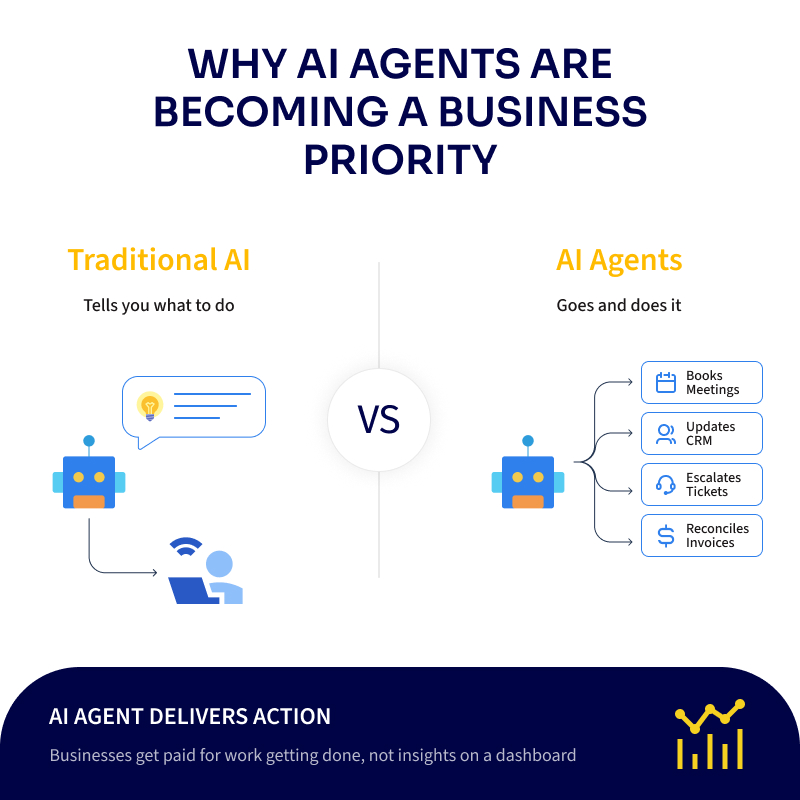
Something shifted in the last eighteen months. AI stopped being a "nice experiment in the innovation lab" and started showing up in board decks as a line item with real ROI expectations attached. The reason is simple: AI agents have crossed a threshold where they can reliably take action, not just generate text.
A traditional AI tool tells you what to do. An AI agent goes and does it books the meeting, updates the CRM, escalates the ticket, reconciles the invoice. That distinction, "advice versus action," is the entire reason boardrooms suddenly care. Businesses don't get paid for insights sitting in a dashboard; they get paid for work getting done, and agents finally do work.
Enterprise AI Adoption Statistics in 2026
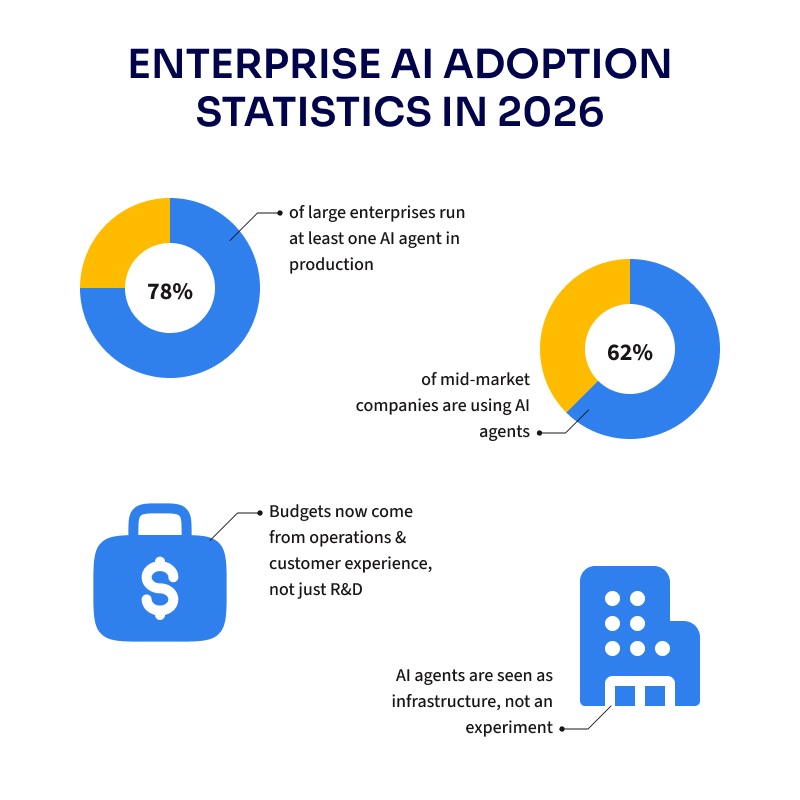
The numbers tell a story of acceleration rather than experimentation. The majority of large enterprises now report running at least one AI agent in a production environment, not just a pilot. Mid-market companies are following close behind, often skipping the "chatbot phase" entirely and jumping straight into agentic workflows because the tooling has matured enough to make that leap safe.
What's notable isn't just the adoption rate it's where the budget is coming from. AI agent spending increasingly sits inside operations and customer experience budgets, not innovation or R&D budgets. That's a tell. It means leadership sees agents as infrastructure, the same way they see their CRM or their cloud hosting bill, rather than as a speculative bet.
How AI Agents Are Different from Traditional Automation
Traditional automation (think RPA, rule-based workflows, "if this then that" scripts) is brittle. It works beautifully until something slightly unexpected happens a form field changes, a customer phrases their request differently than the script expects and then it breaks, often silently.
AI agents are built differently. Instead of following a rigid script, they reason about a goal, decide which tools or data sources they need, and adapt their approach based on context. A traditional bot can fill out a form. An agent can read an incoming email, figure out which form needs to be filled, decide which fields are missing, ask a clarifying question if needed, and then complete the task all without a human writing a rule for every possible scenario in advance.
What Are AI Agents?
Definition of AI Agents
An AI agent is a software system powered by a large language model (or a combination of models) that can perceive its environment, reason about a goal, make decisions, and take autonomous action usually by calling tools, APIs, or other systems with minimal human supervision.
The key word is "autonomous." A simple AI feature might summarize a document when you ask it to. An agent decides, on its own, that summarizing the document is the right next step toward completing a larger task, and then does it without being explicitly told to.
Core Characteristics of AI Agents
Most genuine AI agents share a handful of traits:
- Goal-directed behavior they work toward an outcome, not just a single response.
- Tool use they can call APIs, query databases, browse the web, or trigger other software.
- Memory they retain context across steps, and sometimes across entire sessions or days.
- Reasoning and planning they break a complex task into smaller steps and decide the order to execute them.
- Adaptability they adjust their plan when something doesn't go as expected, rather than failing outright.
If a system is missing most of these traits, it's probably a chatbot or a script wearing an "AI agent" label for marketing purposes.
AI Agents vs Chatbots vs AI Assistants vs AI Copilots
This is where a lot of confusion lives, so let's untangle it plainly:
- Chatbots respond to messages. They're conversational, but largely reactive they don't plan multi-step work or take action outside the chat window.
- AI assistants go a step further, helping with specific tasks (drafting an email, answering a question from a knowledge base) but typically still wait for a human to direct each step.
- AI copilots sit alongside a human inside a piece of software, offering suggestions and doing some of the work, but the human stays firmly in the driver's seat.
- AI agents can operate with a goal and far less moment-to-moment supervision, chaining together multiple actions and tools to get from "request" to "result."
Think of it as a spectrum of autonomy. Chatbots talk, copilots assist, agents act.
How AI Agents Work
At a high level, most AI agents follow a loop: perceive, reason, act, observe, repeat. The agent receives an input (a customer message, a triggered event, a scheduled task), reasons about what needs to happen using a language model, decides whether it needs more information or a specific tool, takes an action, observes the result, and decides what to do next continuing until the goal is met or it needs human input.
Underneath that loop sits a stack of supporting technology: a language model for reasoning, a memory layer for context, a set of tools and APIs the agent is allowed to use, and an orchestration layer that manages how all of these pieces talk to each other. We'll dig into each of these in the architecture section below.
Why Businesses Are Investing in AI Agents
Operational Efficiency and Workflow Automation
The most immediate appeal of AI agents is the sheer amount of operational drag they remove. Every business has dozens of workflows that are important but tedious: routing support tickets, chasing approvals, reconciling spreadsheets, updating records across three different systems because none of them talk to each other natively. Agents thrive in exactly this kind of work repetitive, rules-adjacent, but requiring just enough judgment that old-school automation used to fall short.
Reducing Manual Business Processes
Manual processes don't just cost time they cost accuracy. Every manual handoff between systems or people introduces a chance for error, delay, or simple human fatigue at 4pm on a Friday. AI agents reduce the number of manual touchpoints in a process, which often improves both speed and consistency at the same time. The agent doesn't get tired, doesn't forget a step, and doesn't take a long lunch.
Improving Customer Experience
Customers don't care about the technology behind the scenes they care about getting their answer fast and getting it right. AI agents that can actually resolve issues (not just deflect them to a human) change the customer experience in a way that scripted chatbots never could. A well-built agent can look up an order, process a refund, update a subscription, and confirm the change all in the same conversation, at any hour, without a hold queue.
AI Agent ROI Statistics and Business Impact
Companies that have moved agents into production tend to report impact in two buckets: cost savings from reduced headcount-hours on repetitive tasks, and revenue impact from faster response times and higher conversion in sales and support contexts. The businesses seeing the strongest returns tend to be the ones that picked a narrow, high-volume process to automate first, rather than trying to build one giant agent to "handle everything." Focused agents ship faster and prove ROI faster.
Types of AI Agents Used in Enterprises
Customer Support AI Agents
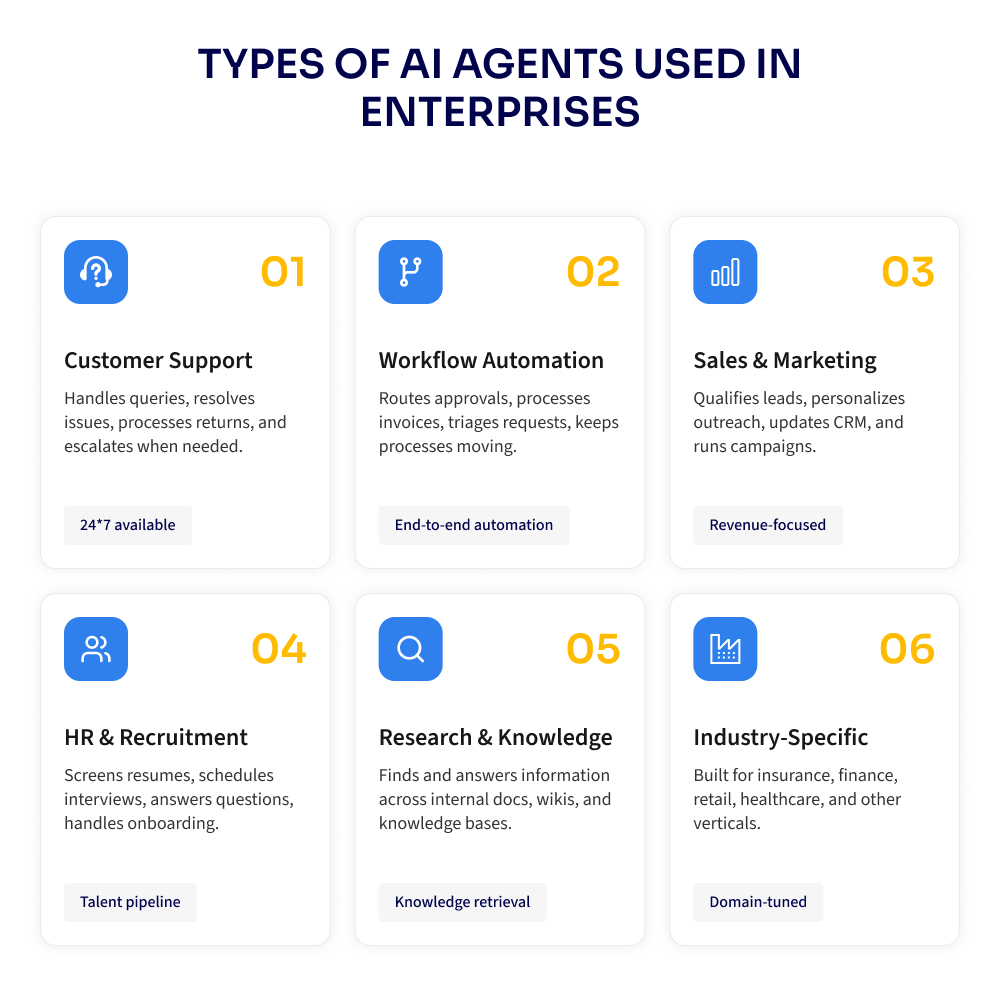
These agents handle inbound customer queries answering questions, processing returns, escalating complex issues to a human when genuinely necessary. The better ones are deeply integrated with order management, billing, and knowledge base systems so they can actually resolve issues instead of just sounding helpful.
Workflow Automation Agents
These agents live inside internal operations routing approvals, processing invoices, triaging incoming requests, and keeping multi-step business processes moving without someone having to babysit every handoff.
Sales and Marketing AI Agents
From qualifying inbound leads to drafting personalized outreach to updating CRM records after a call, these agents take on the busywork that eats into a sales team's actual selling time. Marketing-focused agents handle things like campaign performance monitoring and content drafting at a scale a human team simply can't match.
HR and Recruitment AI Agents
These agents screen resumes, schedule interviews, answer candidate questions, and handle onboarding paperwork freeing HR teams to focus on the parts of the job that genuinely need a human touch, like culture fit and difficult conversations.
Research and Knowledge Management Agents
Enterprises sit on mountains of internal documentation that nobody can find when they need it. Research agents index and search across that knowledge, answering employee questions instantly instead of forcing someone to dig through a wiki or ping five different Slack channels.
Industry-Specific AI Agents
Beyond general-purpose categories, many businesses build agents tuned to their specific industry claims processing agents in insurance, compliance-checking agents in finance, inventory-forecasting agents in retail. These tend to require deeper domain knowledge baked into the agent's prompts, tools, and data sources.
Industries Using AI Agents Successfully
Healthcare
Healthcare organizations use agents for appointment scheduling, insurance pre-authorization, clinical documentation support, and patient follow-up all areas where reducing administrative burden directly frees up clinical staff time. Compliance and data privacy requirements make this one of the more carefully governed use cases, but the administrative payoff is significant.
Fintech
Fintech companies use agents for fraud detection triage, customer onboarding (KYC), transaction monitoring, and personalized financial guidance. Speed matters enormously here an agent that can flag a suspicious transaction in seconds rather than hours has real financial value.
Logistics and Supply Chain
Agents help logistics companies track shipments, predict delays, optimize routing, and automatically communicate updates to customers. The unpredictability of real-world logistics weather, customs delays, vehicle breakdowns is exactly the kind of messy, adaptive problem agents handle better than rigid automation.
Retail and eCommerce
Retailers deploy agents for personalized shopping assistance, inventory forecasting, dynamic pricing, and post-purchase support. The agent that helps a shopper find the right product and the agent that handles their return six weeks later are often built on the same underlying platform.
Manufacturing
Manufacturers use agents for predictive maintenance, quality control monitoring, and supply chain coordination catching problems before a production line actually goes down, rather than reacting after the fact.
SaaS and Enterprise Software
SaaS companies increasingly embed agents directly into their products onboarding agents that walk new users through setup, support agents inside the product itself, and "do it for me" agents that complete configuration tasks on a user's behalf. This is quickly becoming a competitive expectation rather than a differentiator.
Enterprise AI Agent Architecture Explained
Large Language Models (LLMs)
LLMs are the reasoning engine of an AI agent the part that interprets instructions, makes decisions, and generates responses. Choosing the right model (or combination of models) involves trade-offs between reasoning quality, speed, and cost, and many enterprise systems use different models for different parts of a workflow rather than relying on a single model for everything.
Retrieval-Augmented Generation (RAG)
RAG lets an agent pull in relevant information from a company's own documents and data at the moment it needs it, rather than relying purely on what the underlying model already "knows." This is essential for enterprise use cases, where accuracy depends on grounding answers in the company's actual policies, products, and records.
Memory Systems
Memory is what lets an agent maintain context remembering what a customer said earlier in a conversation, or what happened the last time it handled a similar task. Memory systems range from simple short-term context windows to more sophisticated long-term memory that persists across sessions.
Vector Databases
Vector databases store information in a format that allows agents to search by meaning rather than exact keyword match. This underpins RAG and lets an agent find the most relevant document or past interaction even when the wording doesn't match exactly.
APIs and Tool Integrations
An agent is only as useful as the systems it can actually touch. Tool integrations connect an agent to CRMs, databases, payment systems, internal software, and external services, turning reasoning into real action.
Agent Orchestration Frameworks
Orchestration frameworks manage how an agent plans its steps, decides which tool to call, handles errors, and (in multi-agent setups) coordinates with other agents. This is the layer that turns a language model from a clever text generator into a system that can reliably complete a multi-step task.
Single-Agent vs Multi-Agent Systems
A single-agent system handles a task end to end on its own simpler to build and easier to debug. A multi-agent system splits work across several specialized agents (one for research, one for drafting, one for review, for example) that collaborate toward a shared goal. Multi-agent systems tend to handle more complex workflows better, but they're harder to design, test, and monitor.
Technologies Used in AI Agent Development
Popular AI Models and APIs
Enterprise agent development typically draws on a mix of large foundation models accessed through APIs, often combining a frontier-level model for complex reasoning with smaller, faster models for simpler subtasks to keep costs manageable.
AI Agent Frameworks
A growing ecosystem of frameworks helps developers build, orchestrate, and deploy agents without reinventing the wheel handling things like tool-calling, memory management, and multi-agent coordination out of the box.
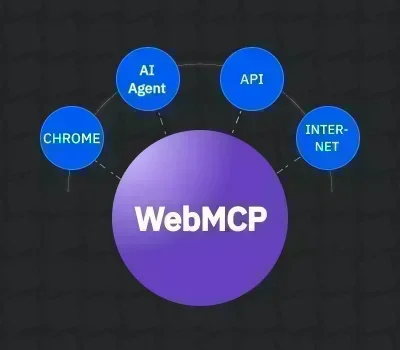
MCP (Model Context Protocol)
MCP has emerged as a standard way for AI agents to connect to external tools and data sources in a consistent, interoperable way. Instead of building a custom integration for every tool an agent might need, MCP provides a common protocol that lets agents discover and use tools more flexibly which is a meaningful step toward agents that can plug into a business's existing software stack without months of custom integration work.
AI Infrastructure and Cloud Platforms
Running agents at enterprise scale requires infrastructure for hosting models, managing data pipelines, and handling the compute load of constant reasoning and tool calls typically built on major cloud platforms that offer managed AI services alongside traditional infrastructure.
Security and Governance Technologies
As agents gain the ability to take real action, the technology stack around permissions, audit logging, access control, and monitoring becomes just as important as the agent itself. Enterprises increasingly require agents to operate inside strict guardrails limited permissions, logged actions, and human approval checkpoints for higher-risk decisions.
Real-World Business Use Cases of AI Agents
AI Agents in Customer Service
Agents now handle full conversations end to end verifying identity, looking up account details, resolving the issue, and only escalating to a human when the situation genuinely requires judgment a model shouldn't make alone.
AI Agents for Enterprise Automation
Internally, agents are stitching together processes that used to require several people and several systems approving expense reports, generating compliance documentation, or coordinating handoffs between departments.
AI Agents in Mobile Applications
Mobile apps are increasingly embedding agents that can complete tasks on a user's behalf directly inside the app booking, ordering, rescheduling rather than just answering questions about how to do those things.
AI Agents in Data Analysis and Reporting
Agents can pull data from multiple sources, generate reports, flag anomalies, and even answer follow-up questions about the numbers in plain language, cutting down the time analysts spend on routine reporting.
AI Agents in Internal Business Operations
From IT helpdesk tickets to internal policy questions, agents are taking over the kind of internal requests that used to clog up shared inboxes and Slack channels, often resolving them instantly.
Benefits of AI Agent Development for Businesses
Cost Reduction
By automating repetitive, judgment-light tasks, agents reduce the hours spent on work that doesn't require a human's full attention translating directly into lower operational cost over time.
Productivity Improvements
When agents handle the busywork, employees get more time for the work that actually needs human creativity, judgment, and relationship-building which tends to show up in both output and morale.
Faster Decision-Making
Agents can pull together information from multiple systems instantly, giving decision-makers a fuller picture faster than waiting on a person to compile a report manually.
Scalability and Automation
An agent that handles 100 conversations a day can usually handle 10,000 without needing to hire and train 99 more people a kind of scaling that's simply not available with human-only processes.
Competitive Advantage
Businesses that get agents right tend to respond faster, operate leaner, and deliver more consistent customer experiences than competitors still relying on manual processes and that gap tends to widen, not shrink, over time.
Challenges Businesses Face During AI Agent Development
AI Hallucinations
Language models can generate confident, plausible-sounding answers that are simply wrong. In an agent that's just answering questions, that's embarrassing. In an agent that's taking real action processing a refund, updating a record it can be costly. Strong grounding (via RAG), careful guardrails, and human checkpoints for high-stakes actions are essential mitigations.
Data Privacy and Compliance
Agents often need access to sensitive customer or business data to do their job well, which raises real questions about data handling, retention, and regulatory compliance especially in regulated industries like healthcare and finance.
Integration Complexity
Enterprises rarely have clean, unified systems. Connecting an agent to a decade's worth of legacy software, each with its own quirks and APIs (or lack thereof), is often the hardest and most time-consuming part of a project harder, frequently, than building the agent's reasoning itself.
AI Reliability and Monitoring
An agent that works perfectly in testing can still behave unpredictably in production when it encounters an edge case nobody anticipated. Ongoing monitoring, logging, and the ability to quickly intervene are non-negotiable for any agent handling real business processes.
User Trust and Adoption
Even a technically excellent agent fails if employees or customers don't trust it. Building that trust takes transparency about what the agent can and can't do, clear escalation paths to a human, and a track record of getting things right.
Cost of AI Agent Development in 2026
MVP AI Agent Development Cost
A focused, single-purpose agent handling one specific workflow with a handful of tool integrations is the fastest and cheapest way to get started, and the right approach for most businesses testing the waters before committing to a larger build.
Enterprise AI Agent Development Cost
A full enterprise deployment multiple agents, deep integrations across existing systems, robust security and monitoring, and ongoing tuning represents a significantly larger investment, reflecting the complexity of doing this safely and reliably at scale.
AI Infrastructure and API Costs
Beyond development, there are ongoing costs tied to model usage, hosting, and the infrastructure needed to keep an agent running reliably costs that scale with usage volume, so it pays to model expected usage carefully before committing to an architecture.
Maintenance and Optimization Costs
Agents aren't "build once and forget." They need ongoing tuning as business processes change, as new edge cases surface, and as underlying models improve so budgeting for maintenance from day one avoids unpleasant surprises later.
Factors Affecting AI Development Pricing
Pricing varies based on the complexity of the workflows involved, how many systems need integration, the level of security and compliance required, whether the project is single-agent or multi-agent, and how much custom data preparation (like building out a knowledge base for RAG) is needed.
How to Choose the Right AI Agent Development Company
Technical Expertise
Look for a team that can speak fluently about the architecture choices involved not just which model they'll use, but how they'll handle memory, tool integration, error recovery, and monitoring. Vague answers here are a warning sign.
Industry Experience
A development partner who has already solved similar problems in your industry will move faster and avoid mistakes that a generalist team might make on a first attempt at, say, healthcare compliance or financial regulation.
Security and Compliance Standards
Given how much access agents often need to sensitive systems and data, security shouldn't be an afterthought. Ask directly about data handling practices, access controls, and compliance certifications relevant to your industry.
Scalability Capabilities
An agent built well for 50 daily interactions should be able to grow to 5,000 without a complete rebuild. Ask how the proposed architecture handles scale before you commit.
Post-Launch Support
Launch is the beginning, not the end. Make sure whoever you work with offers real ongoing support for monitoring, tuning, and adapting the agent as your business and its needs evolve.
Future Trends in AI Agent Development
Autonomous Enterprises
Some organizations are beginning to explore entire business functions run largely by coordinated agents not replacing human leadership, but handling the operational execution layer with far less manual oversight than today.
Multi-Agent Ecosystems
Rather than one agent doing everything, businesses are increasingly building ecosystems of specialized agents that hand work off to each other a structure that mirrors how human teams already divide labor, just faster and more consistently.
AI-Native Applications
A new generation of software is being designed from the ground up around agents as the primary interface, rather than bolting an agent onto an existing app as an afterthought feature.
Agent-to-Agent Communication
As more businesses deploy agents, standards for how agents from different companies and systems can communicate with each other are becoming increasingly important enabling, for example, a customer's personal agent to interact directly with a company's support agent.
Future of Enterprise Automation
The direction is clear even if the exact pace is uncertain: more decision-making and execution shifting toward AI systems, with humans focused on oversight, strategy, and the judgment calls that genuinely require it.
Final Thoughts
AI agents in 2026 aren't a futuristic concept anymore they're a practical business decision, with real architecture, real costs, and real risks to manage carefully. The businesses getting the most out of them aren't the ones chasing the flashiest demo; they're the ones starting with a focused, well-scoped problem, building on solid architecture, and treating security and reliability as first-class concerns rather than afterthoughts.
The technology will keep moving fast. But the businesses that win with it will be the ones that stayed grounded solving real problems, for real people, one well-built agent at a time.
Whether you're scoping your first agent or scaling one across the business, TechQware's team can help you get the architecture, integrations, and guardrails right from day one. Let's talk about what you're trying to build.
FAQs
What is an AI agent in business?
An AI agent in business is a software system that can understand a goal, reason about how to achieve it, and take autonomous action using tools, data, and APIs to complete tasks with minimal human supervision.
How are AI agents different from chatbots?
Chatbots primarily respond to messages within a conversation. AI agents go further, planning multi-step tasks, using external tools, and taking real action to complete a goal rather than just generating a reply.
What industries benefit most from AI agents?
Healthcare, fintech, logistics, retail, manufacturing, and SaaS are among the industries seeing the strongest results, largely because each has high volumes of repetitive, judgment-light work that agents handle well.
How much does AI agent development cost?
Costs vary widely depending on scope a focused MVP agent costs far less than a full enterprise deployment with multiple agents and deep system integrations. Usage-based infrastructure costs and ongoing maintenance should also be factored into any budget.
What technologies are used to build AI agents?
Common building blocks include large language models, retrieval-augmented generation (RAG), vector databases, memory systems, tool and API integrations, agent orchestration frameworks, and increasingly, standards like the Model Context Protocol (MCP) for connecting agents to external tools.
Are AI agents secure for enterprise use?
They can be, when built with proper guardrails access controls, audit logging, data privacy safeguards, and human approval checkpoints for high-stakes actions. Security needs to be designed in from the start, not added afterward.
What is a multi-agent system?
A multi-agent system is an architecture where several specialized AI agents collaborate, each handling part of a larger task, rather than relying on a single agent to do everything end to end.
What is the future of AI agents?
Expect agents to take on more autonomous responsibility within businesses, to increasingly communicate and coordinate with each other across systems and companies, and to become a default part of how new software is built rather than an add-on feature.
Abhinav Srivastav
With years of experience in driving digital transformation, Abhinav Srivastav is the CEO & Director of TechQware Technologies, helping businesses build innovative mobile apps, AI-powered applications, and scalable digital solutions.

 TechQware