Key Takeaways:
- AI-native apps make intelligence a core part of the experience, not just an added feature.
- Context awareness, personalization, and automation help apps deliver smarter user experiences.
- AI agents enable natural interactions, predictive actions, and efficient workflows.
- Technologies like LLMs, MCP, and multimodal AI power future-ready mobile applications.
- Businesses adopting AI-agent friendly apps can improve engagement, efficiency, and competitiveness.
There's a quiet but significant question starting to shape how the best mobile product teams build: are we building this app for a human user only, or are we building it to work with an AI agent too?
For most of mobile app history, that question didn't exist. Apps were designed around the assumption that a person would be the one tapping the screen, reading the text, and deciding what to do next. That assumption is loosening. AI agents systems that can reason about a goal and take action to achieve it are increasingly acting inside and on behalf of users within mobile applications. Sometimes that's an AI assistant inside the app itself. Sometimes it's an external agent using the app's capabilities to complete a task for a user who delegated the work.
The apps that are ready for this shift feel noticeably different from the ones that aren't. They're faster to interact with, smarter about context, more capable of doing work rather than just displaying information, and more useful to both their human users and the AI systems increasingly operating alongside them. This piece is about what those differences actually are: the design choices, technical decisions, and capability investments that separate AI-agent friendly mobile apps from everything else.
Rise of AI-Native Mobile Experiences
The mobile experiences people are starting to expect in 2026 look meaningfully different from what was standard two years ago. The difference isn't just faster load times or prettier design, it's intelligence. Apps that anticipate rather than just respond. Interfaces that adapt rather than stay static. Features that take action rather than waiting to be instructed through a fixed sequence of taps. The consumer expectation dial has been turned by the best AI-powered experiences in the market, and it doesn't turn back.
Mobile development teams that built excellent apps by the standards of 2022 are now competing against products where AI is woven into the interaction model from the ground up. That's a different kind of competition than adding a feature or improving performance. It requires a fundamentally different way of thinking about what a mobile application is and what it's supposed to do.
Growth of AI-Powered Mobile Applications
The number of mobile applications with meaningful AI functionality, not just a chatbot widget bolted to a help screen, but AI integrated into core features and workflows, has grown rapidly. Lower barriers to AI integration, through accessible model APIs and maturing mobile AI frameworks, have brought AI-powered capabilities within reach of development teams that couldn't have justified the cost or expertise requirements even two years ago.
What's grown alongside the count of AI-powered apps is the sophistication of what "AI-powered" actually means. Early AI features in mobile apps were often narrow and brittle, a recommendation engine that ran on simple collaborative filtering, a voice command that only recognized a fixed vocabulary. Today's AI features in leading mobile apps are genuinely capable of handling the kind of natural, variable, context-dependent interactions that characterize real human communication. The gap between the best AI-powered mobile apps and the average app has widened, and it's widening faster.
AI Mobile App Market Statistics
Investment in AI mobile applications has followed the trajectory of capability. Enterprise mobile teams are allocating significant portions of their development budgets to AI features, and venture investment in AI-native mobile products has remained strong. The more telling data point isn't market size, it's retention and engagement metrics. Mobile apps with well-implemented AI personalization and assistance features consistently show better user retention than apps without them, often by margins that are difficult to achieve through traditional product improvements alone. That data has accelerated investment, because product leaders can show a CFO a number, not just a concept.
What Are AI Agent-Friendly Mobile Applications?
Definition of AI-Native Mobile Apps
An AI-native mobile app is one designed from the ground up with AI as a core part of its architecture, not an add-on feature applied to a traditionally-structured product. In an AI-native app, intelligence shapes how the interface is organized, how data flows through the system, how user intent is interpreted, and how actions are taken rather than being a module that sits alongside a conventional app structure.
The distinction matters because it's possible to build an app that has a GPT-powered chatbot and still be fundamentally a traditional app with an AI feature stapled to it. An AI-native app is different in kind: the AI is what enables the core value proposition, not a layer on top of something that would work almost as well without it.
Difference Between Traditional and AI-Agent Friendly Apps
Traditional mobile apps are deterministic machines. A specific input produces a specific output. Navigate to screen A, tap button B, see result C. The logic is fixed, the interface is static, and every user gets essentially the same experience in the same situation. This is great for predictability and terrible for handling the actual variability of human needs and contexts.
AI-agent friendly apps are probabilistic and adaptive. They interpret intent rather than just reading inputs. They adjust their behavior based on context rather than following fixed logic. They can handle situations the developer didn't specifically program for, because the AI can reason about what's needed rather than matching against a rulebook. And critically, they expose their capabilities in ways that allow AI agents, not just human fingers to interact with them effectively, either through conversational interfaces, structured APIs, or tool-based access patterns that agents can use programmatically.
Why Businesses Are Investing in AI-Native Mobile Experiences
Businesses are investing in AI-native mobile for two converging reasons. The first is user expectation. People who use the best AI-powered apps in their daily lives bring those expectations to every app they open, and products that fall short of that standard are increasingly perceived as dated rather than merely feature-sparse. The second is capability AI-native mobile apps can do things that traditional apps simply cannot, from handling complex, multi-step tasks through a single conversational interface to personalizing the experience so specifically that it feels built for an individual rather than a category of user.
The competitive implication is significant. In categories where AI-native products exist, traditional products lose users not because they got worse, but because the baseline expectation moved and they didn't move with it.
How AI Agents Work Inside Mobile Applications
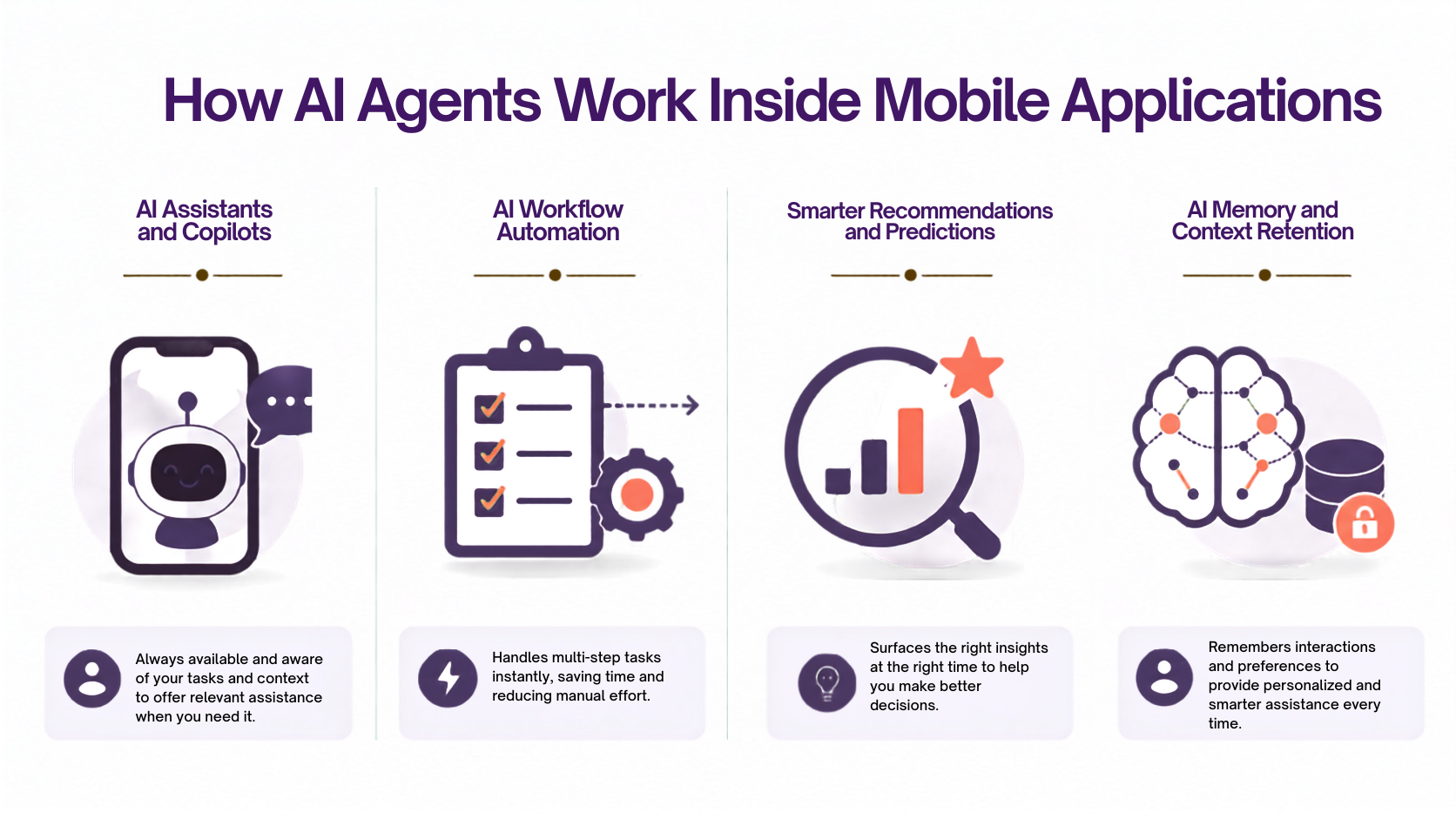
AI Assistants and Copilots
AI assistants embedded in mobile apps function as always-available intelligent partners rather than features to be activated occasionally. The best implementations understand the user's current task and context well enough to offer relevant assistance without waiting to be asked surfacing related information, flagging potential issues, suggesting next steps, or drafting content that the user can review and adjust rather than creating from scratch.
The distinction between an assistant that genuinely helps and one that just adds conversational noise is whether it has access to the context it needs to be actually useful. An AI assistant that knows what a user is working on, what they've done before, what their preferences are, and what information is available in the systems connected to the app can provide assistance that feels remarkably well-calibrated. One that operates without that context gives answers that feel generic, because they are.
AI Workflow Automation
AI agents inside mobile apps can take over the execution of multi-step workflows that previously required manual navigation through a sequence of screens. A user who says "schedule my follow-up calls for next week based on this week's outcomes" is delegating a task that would have required opening a calendar, reviewing CRM notes, creating multiple entries with specific details, and setting reminders all replaced by a single natural language instruction that the AI agent handles end to end.
Workflow automation becomes particularly powerful in mobile contexts where the friction of manual multi-step processes is amplified by the constraints of a small screen and often-divided attention. Reducing ten taps to one instruction isn't just more convenient; it's often the difference between a task that gets done in the field and one that gets deferred until the person is back at a desk.
Smart Recommendations and Predictions
AI agents in mobile apps surface recommendations and predictions proactively not just when a user navigates to a recommendation section, but woven into the workflow at the moment when a recommendation is most relevant and actionable. A procurement app that surfaces a suggested order based on predicted demand before a buyer manually reviews inventory. A sales app that flags an account showing churn signals before the rep's next call. A logistics app that suggests a routing change before a driver reaches the point where the change would be too late to make efficiently.
The value of recommendations and predictions is a function of their timing as much as their accuracy. AI-native mobile apps are designed to surface intelligence at the moment of highest relevance, which is where they convert prediction into action rather than turning it into information that gets noted and forgotten.
AI Memory and Context Retention
Memory is what transforms an AI agent from a stateless question-answering system into a genuine long-term assistant. AI-native mobile apps maintain memory of user interactions, preferences, decisions, and patterns across sessions, building a model of each user that makes every subsequent interaction better calibrated than the one before.
For AI agents in enterprise mobile apps, memory is particularly valuable for the kind of recurring, context-dependent tasks that characterize professional work. An agent that remembers how a user handled a similar situation six weeks ago, what their preferences are for a particular category of decision, and what the relevant background is for a specific customer relationship can provide assistance that a stateless system simply cannot.
Core Characteristics of AI-Agent Friendly Apps
Context Awareness
Context awareness is the foundation of AI-agent friendliness. A context-aware app understands not just what a user is explicitly requesting, but the broader situation that request exists within their role, their history with the app, the current time and location, what they've been doing recently, and what they're likely trying to accomplish. This context shapes how the app interprets ambiguous requests, what it surfaces proactively, and what it filters out as irrelevant.
For an AI agent operating within or through an app, context awareness is even more important. An agent needs to understand the current state of the app and the user's situation to make good decisions about what action to take. Apps that expose rich, structured context to AI agents allow those agents to behave much more intelligently than ones that provide only raw UI state.
Autonomous Decision-Making
AI-agent friendly apps can make decisions without waiting for explicit user input at every step. Within appropriate boundaries and with clear guardrails, these apps can decide which content to show, which workflow path to recommend, which notification to send and when, or how to prioritize a queue of tasks and act on those decisions without requiring the user to navigate a menu or tap through a configuration sequence.
This autonomy is what makes AI agents useful inside mobile apps. An agent that has to ask permission for every micro-decision isn't providing much value over a traditional interface. An agent that can exercise judgment within defined parameters, surfacing exceptions and asking for input only when genuinely needed, provides a qualitatively different kind of assistance.
Personalized User Experiences
AI-agent friendly apps personalize at a granularity that rules-based personalization can't match. Rather than assigning users to segments and presenting segment-level content, AI-powered personalization builds an understanding of each individual user that shapes everything from what appears on their home screen to what language is used in notifications to what workflow sequence is presented for a task they've done dozens of times before.
This personal relevance is what drives the retention advantages that AI-powered apps show in the data. When an app genuinely reflects a user's specific patterns and preferences, using it feels easier and more natural than using an alternative, even a technically superior alternative that treats them like an average user.
Real-Time Adaptability
AI-agent friendly apps adapt in real time, not just during configuration or setup. As conditions change a user's location, the time of day, a change in their task context, the availability of new data an AI-native app's interface and behavior shifts to reflect the new situation without requiring any explicit action from the user or the agent working within the app.
This real-time adaptability is particularly valuable in operational contexts where the situation changes quickly and the app needs to reflect current reality rather than the state of things when the user last explicitly updated a filter or navigated to a view.
Conversational and Voice Interfaces
Conversational interfaces and voice capabilities are not separate AI features; they're the natural interaction model for AI-native apps, because they allow users (and agents) to express intent in natural language rather than translating it into a sequence of navigational steps. An AI-native app that can understand "show me everything that came in this week with a response time over two days" and immediately surface the right view is fundamentally more useful than one that requires the user to navigate to a filter, set a date range, configure a metric, and apply the selection.
For AI agents, conversational interfaces provide the most natural integration point: an agent that can call the same natural language interface a human user would interact with can accomplish a wide range of tasks without requiring specially built programmatic access.
Technologies Powering AI-Agent Friendly Mobile Apps
Large Language Models (LLMs)
LLMs are the reasoning core of most AI-native mobile applications, the technology that enables natural language understanding, content generation, conversational interaction, and the kind of flexible, context-sensitive reasoning that traditional software logic can't replicate. Mobile LLM integration in 2026 takes multiple forms: cloud-based API calls for complex reasoning tasks, smaller distilled models running on-device for low-latency common tasks, and hybrid architectures that route between on-device and cloud inference based on the complexity and sensitivity of each request.
MCP (Model Context Protocol)
The Model Context Protocol has emerged as an important standard for how AI agents connect to tools and data sources, and its relevance to mobile apps is growing. MCP allows AI agents to access the capabilities of a mobile app or the backend systems the app connects to in a structured, interoperable way, rather than requiring custom integration for every tool an agent might need to use. For mobile apps that want to be accessible to AI agents operating across multiple systems, implementing MCP-compatible interfaces is increasingly a meaningful architectural choice.
Multimodal AI
Multimodal AI allows mobile apps to work with the full range of inputs that modern devices support not just text, but images, audio, and the combinations thereof that characterize real mobile interactions. A field service app that can analyze a photograph of damaged equipment. A healthcare app that can transcribe a clinical conversation and extract structured information. A retail app that can identify a product from a customer's photo and surface its catalog record. These capabilities are enabled by multimodal AI models that handle multiple input types in a unified reasoning framework.
On-Device AI and Edge Intelligence
Running AI inference on the device itself rather than making a cloud call provides several important properties for mobile apps: dramatically lower latency for real-time features, full functionality in offline or low-connectivity environments, and stronger privacy guarantees when sensitive data doesn't need to leave the device. Modern smartphones include dedicated neural processing hardware that makes a meaningful range of AI inference feasible on-device and the models optimized for on-device use (smaller, quantized, efficiently architected) have improved to the point where on-device AI quality is genuinely impressive for the use cases it covers.
Vector Databases and AI Memory
Vector databases enable the semantic search and retrieval capabilities that underpin AI memory and context in mobile applications. Rather than exact-match retrieval from a traditional database, vector search finds semantically relevant information: the previous conversation that's most similar in meaning to the current one, the document that most closely answers the question being asked, the past decision that's most relevant to the current situation. On-device vector stores for personal data and cloud-based vector databases for enterprise knowledge are both active components of AI-native mobile architectures.
AI Orchestration Frameworks
Orchestration frameworks manage how AI agents plan their actions, coordinate between multiple tools or models, handle errors and unexpected situations, and maintain coherent behavior across multi-step tasks. In mobile app development, orchestration frameworks are what allow AI agents to do genuinely complex, multi-step work inside an app rather than making a single model call and hoping the result is good by managing the sequencing of reasoning and action that complex tasks require.
AI-Friendly UX and Mobile Experiences
Conversational UX
Conversational UX replaces hierarchical navigation structures with natural language as the primary interface. Instead of drilling through menus to find a feature, a user describes what they want to accomplish. Instead of configuring filters to see the right data, a user asks for it directly. Conversational UX doesn't eliminate visual interfaces; it sits alongside them, providing an alternative interaction path that's often faster for users who know what they want and don't want to navigate to it manually.
Designing conversational UX well requires more than adding a chat input to an existing app. It requires thinking carefully about how the conversation integrates with the visual interface, how the app communicates uncertainty or the need for clarification, and how transitions between conversational and traditional interaction patterns feel natural rather than jarring.
Voice-First Interfaces
Voice-first design starts from the assumption that speech is the primary input, and designs the interaction model around that constraint. Voice-first mobile experiences matter most in contexts where hands and eyes are occupied a surgeon, a warehouse worker, a driver but the discipline of voice-first design, which forces extreme clarity about what an interface is actually trying to accomplish, produces better interactions even when voice isn't the primary modality in practice.
Voice-first in 2026 means more than speech-to-text it means AI that can understand the full semantic content of a spoken request, handle natural language variation and ambiguity, maintain context across a multi-turn voice interaction, and respond in ways that work as audio rather than requiring the user to read a screen.
Adaptive User Interfaces
Adaptive user interfaces change their layout, content, and behavior based on context rather than presenting a fixed structure to every user in every situation. A dashboard that shows different widgets based on the time of day and the user's current task. A navigation structure that surfaces the features a user uses most frequently rather than presenting the same options to everyone. A form that pre-fills based on patterns from past entries. Each of these reduces the friction between a user's intent and their ability to act on it.
AI-native adaptive interfaces go further; they can make adaptation decisions based on patterns that aren't explicitly configured, learning from user behavior rather than requiring manual personalization settings to be tuned.
Predictive Mobile Experiences
Predictive mobile experiences surface the right content, action, or information before a user explicitly requests it, based on AI modeling of their current context and likely intent. A productivity app that prepares a briefing on a company before a scheduled call with them. A logistics app that surfaces a route update just before the point at which the driver needs to make a decision. A retail app that checks inventory status for a customer's past purchase items before a field rep goes into a meeting.
The measure of a predictive mobile experience is whether the things it surfaces proactively are actually useful often enough to justify the attention they ask for which requires a quality of AI prediction that distinguishes AI-native apps from those that are merely guessing.
Industry-Specific AI-Native Mobile App Use Cases
Healthcare
AI-native mobile apps in healthcare are tackling some of the sector's most persistent operational problems. Clinical documentation apps that listen to a patient-provider conversation and generate a structured note, eliminating the hours of after-hours documentation that contribute to clinician burnout. Diagnostic support apps that analyze patient-provided photos or reported symptoms and surface relevant differential considerations. Care coordination apps that use AI to optimize the scheduling and routing of home health visits based on patient acuity and geographic clustering.
The healthcare AI mobile opportunity is significant, and so are the constraints regulatory requirements, data sensitivity, and the stakes of clinical error mean that healthcare AI mobile apps face more rigorous validation requirements than most other categories. The best products in this space treat those constraints as design requirements rather than obstacles.
Fintech
Financial services AI mobile apps have matured from early chatbot experiments into sophisticated platforms that handle genuinely complex financial interactions. Conversational banking that can explain a transaction, dispute a charge, and confirm a resolution in a single natural language exchange. AI-powered investment guidance that personalizes recommendations based on individual financial situations and goals. Real-time fraud protection that analyzes behavioral patterns to flag suspicious activity before a transaction completes rather than after.
Fintech is also one of the spaces where AI agents operating autonomously have the most direct business value agents that can monitor accounts, execute routine transactions within defined parameters, and surface exceptions for human review represent a meaningful operational capability for both individual and institutional users.
Logistics and Transportation
Logistics AI mobile apps manage the complexity that makes logistics genuinely hard too many variables, too much real-time change, and consequences for getting things wrong that cascade through an entire operation. AI-optimized routing that accounts for live traffic, delivery window constraints, vehicle load, and driver hours simultaneously. Voice-first apps for drivers that allow safe interaction with dispatch and navigation while in motion. Predictive exception management that identifies developing delays before they affect customers and surfaces options for resolution before the window to act closes.
The ROI of AI mobile in logistics is unusually clear because the operational variables are measurable and the cost of inefficiency is direct. That clarity has driven investment and deployment velocity that other sectors are still catching up to.
Retail and Commerce
Retail AI mobile apps serve both customer-facing and operational purposes. On the customer side, visual product search, AI shopping assistants, and personalized offers that reflect individual purchase history and browsing behavior have moved from competitive differentiators to table stakes in leading retail apps. On the operational side, field merchandising apps with AI-guided planogram compliance, inventory management apps with AI-powered reorder prediction, and store operations apps with AI-assisted task prioritization all represent active investment areas with clear operational returns.
The retail AI mobile space is also where the concept of "agentic commerce" is taking shape, most concretely AI agents that can complete a purchase, track a delivery, or handle a return on a customer's behalf, with the customer setting parameters and reviewing outcomes rather than navigating each step manually.
Enterprise Productivity Apps
Enterprise productivity AI mobile apps are rethinking what it means to help someone do knowledge work on a mobile device. Instead of mobile versions of desktop productivity tools, the most capable products in this category are redesigning the interaction model around AI treating the AI as a collaborator that handles drafting, research, scheduling, and synthesis while the human focuses on judgment, direction, and the parts of knowledge work that genuinely require human intelligence.
Meeting preparation apps that brief a user on context before an important call. Document creation apps where the AI drafts and the human edits rather than the reverse. Task management apps where an AI agent handles routine scheduling and delegation while escalating decisions that require human input. These represent a meaningfully different paradigm for mobile productivity, and the products that have gotten it right have shown strong engagement metrics that reflect the genuine time they save.
Benefits of AI-Agent Friendly Mobile Apps
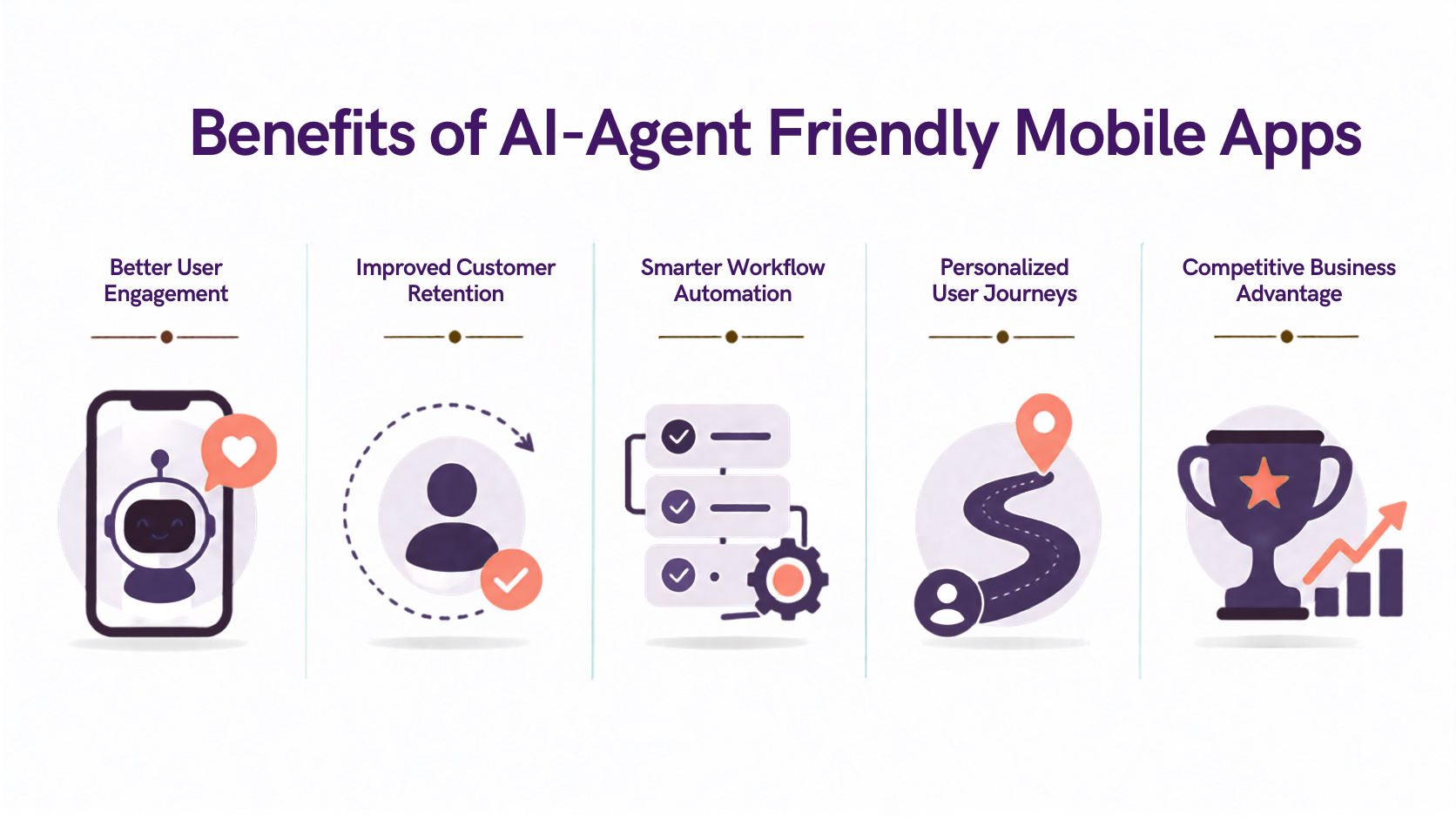
Better User Engagement
Engagement in AI-native mobile apps tends to be qualitatively different from engagement in traditional apps. Users aren't just opening the app more often, they're using it more deeply and accomplishing more meaningful work per session. AI that makes each interaction more efficient and more relevant creates a virtuous cycle where the app becomes genuinely useful in ways that justify continued use, rather than engaging through habit or gamification mechanics that don't translate into real value.
Improved Customer Retention
Retention is where AI-native mobile apps show their most measurable advantage. The combination of personalization that makes the app feel individual, AI assistance that reduces the effort of using it, and proactive intelligence that provides value without requiring the user to seek it creates a stickiness that's hard to replicate with features alone. Users who experience an AI-native app that genuinely works well for them personally tend to evaluate alternatives through a much higher bar one that generic apps rarely clear.
Smarter Workflow Automation
AI-native apps automate in a fundamentally different way than rule-based automation. They can handle variation user intent that's expressed slightly differently each time, situations that don't match a predefined template, decisions that require weighing multiple considerations rather than following a fixed rule. This means they automate more, more reliably, with less need for human fallback when something unexpected happens. The cumulative workflow efficiency gains across a user base or a workforce compound into business impact that's genuinely significant.
Personalized User Journeys
Personalized journeys in AI-native apps don't just show different content they shape every aspect of the experience around each individual user's patterns, preferences, and current context. The result is an app that gets more useful the more it's used, rather than plateauing at a fixed level of capability. This progressive improvement in personal relevance is one of the most powerful retention dynamics in consumer technology, and AI-native mobile apps are the delivery vehicle for it at scale.
Competitive Business Advantage
The competitive dynamic around AI-native mobile apps is not unlike the dynamic around mobile-first design a decade ago. Early movers developed capabilities, user expectations, and data advantages that compounded over time, making it progressively harder for latecomers to close the gap even with significant investment. Businesses that invest in genuine AI-native mobile experiences now are building advantages in personalization data, AI model quality, and user expectations that will be difficult for competitors starting later to overcome.
Challenges in AI-Native Mobile App Development
Privacy and Security Concerns
AI-native mobile apps collect and process more user data, behavioral signals, conversational content, and contextual information than traditional apps, which amplifies both the importance of privacy protection and the reputational and regulatory risk of getting it wrong. On-device AI processing reduces some privacy exposure by keeping sensitive inference local, but doesn't eliminate the need for careful data governance around what gets collected, how it's stored, how long it's retained, and how it's used.
The privacy conversation around AI mobile apps is evolving alongside regulatory frameworks in multiple jurisdictions, and building with privacy principles rather than the minimum required compliance is increasingly not just an ethical position but a competitive one. Users who understand what AI apps do with their data are beginning to choose accordingly.
AI Reliability and Hallucinations
AI systems can generate confident, plausible-sounding outputs that are simply wrong and in a mobile app context where users may not be in a position to verify AI-generated information, the consequences can be more serious than they'd be in a desktop context where fact-checking is easier. Robust grounding of AI outputs in verified data sources, clear indicators of AI uncertainty, human review requirements for high-stakes actions, and honest design that avoids making AI-generated content appear more authoritative than it should be are all important mitigations that AI-native mobile apps need to address in design, not just as engineering afterthoughts.
Infrastructure Complexity
AI-native mobile apps are architecturally more complex than traditional apps managing the interplay between on-device and cloud inference, maintaining AI memory and context across sessions, integrating with LLM APIs while handling failures and latency gracefully, and building the data pipelines that feed AI features with the right information in real time. This complexity is manageable with the right expertise and the right architectural choices, but it requires engineering skills and tooling familiarity that go beyond traditional mobile development.
High AI Processing Costs
AI inference costs whether on-device (in terms of battery and processor load) or cloud-based (in terms of API costs per call) are meaningfully higher than the compute costs of traditional mobile app logic. At development and pilot scales, these costs are manageable. At production scale with millions of users and frequent AI interactions, infrastructure cost optimization becomes an important engineering discipline in its own right. The economics of AI-native mobile apps require thoughtful architecture that matches model capability to task complexity rather than using the most powerful model for every interaction regardless of whether it's warranted.
Integration Challenges
AI-native mobile apps typically need to integrate with a wider range of backend systems than traditional apps AI model APIs, vector databases, data pipelines, enterprise system APIs, and the existing mobile backend infrastructure and these integration points are often where the most challenging engineering problems live. Reliability, latency management, graceful degradation when integrations fail, and maintaining coherent AI behavior across a complex integration landscape all require engineering investment that should be scoped realistically from the start.
Cost of AI-Agent Friendly Mobile App Development
AI Infrastructure Costs
AI infrastructure costs for mobile apps include the cloud compute required for AI inference and model hosting, the managed services for vector storage and retrieval, the data pipeline infrastructure that feeds AI features, and the monitoring and observability tooling required to operate AI systems in production responsibly. These costs are ongoing rather than one-time, and they scale with usage in ways that require careful architecture to keep manageable at production scale.
AI API and Model Costs
LLM API costs represent a meaningful operating expense in AI-native mobile apps, and their scale depends heavily on how many AI interactions occur per user per day and how token-intensive each interaction is. Thoughtful prompt engineering, intelligent caching of common responses, and routing simpler tasks to smaller and cheaper models while reserving frontier models for complex reasoning are all levers for managing API costs without degrading the AI experience in ways users notice.
Development Team Requirements
Building AI-native mobile apps requires a broader skill set than traditional mobile development. AI/ML engineers who understand model integration and deployment, data engineers who can build the pipelines that feed AI features, security specialists who understand the specific risks of AI systems, and mobile developers who understand how to build responsive, reliable interfaces on top of probabilistic AI backends all need to work together effectively. Teams building this capability for the first time often find that learning curves across the team are one of the significant non-obvious costs of the first AI-native mobile project.
Maintenance and Optimization Expenses
AI-native mobile apps require ongoing maintenance that goes beyond what traditional apps need. AI models need to be monitored for quality degradation as real-world usage patterns diverge from training data, periodically updated or retweaked to reflect changes in underlying model versions from API providers, and tuned as user expectations and product requirements evolve. Treating AI-native mobile apps as products that require continuous improvement rather than systems that can be built and left running is the mindset that leads to sustained quality over time.
Future of AI-Native Mobile Applications
Autonomous Mobile Experiences
The direction of AI-native mobile is toward increasingly autonomous experiences where the app is actively working on a user's behalf rather than waiting to be instructed. Not full autonomy in the sense of operating without oversight but meaningful autonomy within defined parameters, handling the routine and predictable while surfacing the exceptions and decisions that genuinely need human attention. An app that manages a user's communications queue, prepares for upcoming meetings, tracks progress on delegated tasks, and surfaces the things that need the user's attention rather than presenting everything with equal weight is providing a fundamentally different kind of value than a traditional mobile app.
AI Operating Systems
Looking further out, the distinction between an AI-native mobile app and an AI-native mobile operating system is beginning to blur. AI layers that operate across apps understanding context from multiple sources, enabling agents to take action across application boundaries, and providing a unified AI interface that sits above individual app experiences are beginning to emerge. Mobile operating systems that have AI understanding of what a user is doing and trying to accomplish, regardless of which app they're in, represent a significant shift in the architecture of mobile computing.
Agentic App Ecosystems
Agentic ecosystems where AI agents can operate across multiple apps, taking information from one and acting in another, coordinating between specialized agents each handling their domain are moving from research concept to early practical reality. Mobile applications that are designed to participate in these ecosystems rather than operate as isolated islands will be able to provide value that no single app can provide alone. The technical standards for how apps expose their capabilities to AI agents are still being established, but the direction is clear.
Future of Intelligent Mobile Interfaces
The ultimate trajectory of AI-native mobile is a mobile interface that is genuinely intelligent rather than just powerful one that understands what a user is trying to accomplish at a level that allows it to be a real partner in achieving it, rather than a sophisticated tool that requires the user to know exactly how to wield it. Whether that interface is primarily visual, conversational, voice-based, or something not yet clearly defined is less certain than the direction itself: mobile experiences that understand, adapt, act, and improve are where the medium is heading, and the apps and businesses that get there first will have built something that's genuinely difficult to replicate from behind.
Final Thoughts
The question in the title what makes a mobile app AI-agent friendly has an answer that's simpler than the technical components it requires: an AI-agent friendly mobile app is one built around the principle that intelligence should be a structural property of the application, not a feature bolted to its surface.
That principle has implications for architecture, for design, for the skills a development team needs, and for the ongoing investment required to keep a living, learning system running well. None of those implications are trivial. But neither is the alternative watching the gap between your mobile product and the AI-native experiences your users are comparing it to quietly widen, until catching up requires twice the investment that building it right the first time would have.
The bar is moving. The businesses that are already building to meet it are the ones that won't be scrambling to clear it later.
At TechQware, we help businesses build AI-agent friendly mobile apps with the right architecture, AI integrations, and scalable solutions. Create a future-ready application that evolves with AI, connect with our experts today.
FAQs
What is an AI agent-friendly mobile app?
An AI agent-friendly mobile app is designed to work effectively with both human users and AI agents exposing its capabilities in ways that allow AI systems to interact with it naturally, while providing the contextual intelligence and adaptive behavior that makes those interactions genuinely useful rather than technically possible but practically limited.
How are AI-agent friendly apps different from traditional apps?
Traditional apps respond to explicit user inputs through fixed interface flows. AI-agent friendly apps interpret intent, adapt to context, support natural language and voice interaction, can take autonomous action within appropriate boundaries, and expose their capabilities to AI agents in structured ways that allow programmatic access and action.
What features make a mobile app AI-agent friendly?
The key features are context awareness, natural language and voice interfaces, adaptive UI that responds to user patterns and situations, AI memory that retains context across sessions, autonomous action capabilities within defined parameters, and structured tool or API access that allows AI agents to interact with the app's capabilities programmatically.
What technologies power AI-native mobile apps?
Core technologies include large language models accessed via API or running on-device, Model Context Protocol for structured AI tool access, multimodal AI for handling images and audio alongside text, edge AI frameworks for on-device inference, vector databases for semantic memory and retrieval, and orchestration frameworks for managing multi-step AI agent behavior.
Which industries are adopting AI-native mobile apps?
Healthcare, fintech, logistics and transportation, retail and commerce, and enterprise productivity are among the leading adopters, each driven by specific, high-value use cases where AI intelligence in a mobile context creates measurable operational or user experience improvements.
Are AI-agent friendly apps secure?
They can be, when built with security as a first-class design requirement. On-device AI processing reduces data exposure for privacy-sensitive inference. Proper authentication, encryption, and access controls apply to AI-native apps as much as traditional ones. The specific risks of AI systems model behavior, data used in training, outputs that might expose sensitive information require additional security engineering attention beyond traditional mobile app security practices.
How much does AI-native mobile app development cost?
AI-native mobile app development costs more than traditional mobile development, reflecting the broader skill set required, the additional infrastructure complexity, and the ongoing AI model and API costs that become part of the operating budget. The right cost comparison isn't AI-native versus traditional, it's the cost of AI-native capability versus the value it creates, which for the right use cases produces clearly favorable economics.
What is the future of AI-native mobile applications?
AI-native mobile applications are heading toward increasingly autonomous experiences that work on a user's behalf, participation in agentic ecosystems where AI agents operate across app boundaries, and ultimately mobile interfaces that are genuinely intelligent partners in accomplishing complex goals rather than sophisticated tools that require detailed instruction at every step.
Abhinav Srivastav
With years of experience in driving digital transformation, Abhinav Srivastav is the CEO & Director of TechQware Technologies, helping businesses build innovative mobile apps, AI-powered applications, and scalable digital solutions.

 TechQware