Key Takeaways:
- B2B mobile apps are now essential for improving business productivity and real-time operations.
- AI, automation, IoT, and cloud technologies are shaping the future of enterprise mobility.
- Security, integrations, and user experience are key to successful B2B mobile apps.
- Industries like healthcare, logistics, manufacturing, and finance are leading adoption.
- Starting with an MVP helps businesses validate ideas before scaling.
The enterprise smartphone has come a long way from the days when "mobile" meant a scaled-down version of a desktop app that barely worked on a 4G connection. The B2B mobile applications that matter in 2026 are purpose-built for the way businesses actually operate field teams without reliable connectivity, warehouse workers who can't stop to sit at a desk, managers who need accurate operational data at 7am on a Tuesday before they've walked through the office door.
What's changed is not just the technology, though the technology has changed enormously. What's changed is the expectation. Enterprise employees now arrive at work having used consumer apps so well-designed and intelligent that clunky enterprise software feels like a step backward. The bar for what a B2B mobile app needs to do and do well has risen steadily, and the businesses that understand that are building a real competitive advantage from mobility that their peers are still treating as an IT checkbox.
This guide covers where B2B mobile applications are heading, what technologies are driving the change, which industries are moving fastest, and what businesses need to understand to make smart investment decisions in this space.
Evolution of Enterprise Mobility
Enterprise mobility started as a conversation about email on phones and basic field data collection on ruggedized handheld devices. Neither category required much sophistication mobile was an extension of the office, not an operating environment in its own right.
That framing has been completely overtaken by reality. Today's B2B mobile applications are full-capability business platforms running AI inference, integrating with multiple enterprise systems in real time, handling sensitive transactions with enterprise-grade security, and serving as the primary interface for entire categories of work that have no desktop equivalent. The evolution hasn't been linear. There have been waves smartphones, cloud, 4G, the consumerization of enterprise UX, AI and each wave has reset expectations about what mobile can and should do in a business context.
Growing Demand for B2B Mobile Applications
Demand is being driven from both directions. From the bottom up, employees who depend on mobile tools to do their jobs have become increasingly vocal about the gap between consumer-app quality and enterprise-app quality and organizations that ignore that gap pay for it in adoption rates and workaround behavior. From the top down, executive teams who've seen what AI-enabled mobile operations look like are accelerating investment to close the gap between what their teams have now and what's clearly possible.
The specific demand drivers vary by industry, but some themes are consistent: the need to extend enterprise capabilities to people who are rarely at a desk, the desire to make real-time operational intelligence available at the point of decision rather than in a report reviewed hours later, and the recognition that a workforce equipped with smart mobile tools is meaningfully more productive than one that isn't.
Enterprise Mobility Market Statistics and Growth Trends
Enterprise mobility has been one of the most consistently growing segments of the broader enterprise software market, and the growth has accelerated as AI integration has expanded what mobile apps can credibly offer. Adoption across industries that were historically conservative about mobile manufacturing, healthcare, financial services has increased significantly as the tooling for building secure, compliant, and reliable mobile apps has matured.
The most telling statistic isn't market size it's the shift in where enterprise mobile investment is coming from. Increasingly, it's moving from IT budgets (where mobile was treated as infrastructure) to operations budgets (where mobile is treated as a capability). That shift reflects a business community that has moved from asking "should we have a mobile app?" to asking "how do we build mobile operations that actually change what our people can do?"
What Are B2B Mobile Applications?
Definition of B2B Apps
B2B mobile applications are software platforms designed for use within business operations, built to be used by employees, partners, or suppliers rather than end consumers. They exist to enable, streamline, and enhance the way businesses carry out work whether that's managing a warehouse, coordinating a field service team, processing enterprise transactions, or giving managers real-time visibility into operational performance.
Unlike consumer apps that optimize for casual, intermittent use, B2B mobile apps are typically mission-critical used repeatedly throughout a working day, often in demanding physical environments, and expected to be reliable enough that a failure has operational consequences.
Difference Between B2B and B2C Mobile Apps
The differences between B2B and B2C mobile apps go well beyond the obvious distinction of who uses them. B2C apps optimize for discovery, delight, and conversion getting someone who doesn't yet use the app to download it, enjoy it, and keep coming back. B2B apps optimize for reliability, depth, and operational integration getting people who have to use the app to be able to use it effectively and trust it completely.
B2B apps are typically more complex under the hood. They integrate with enterprise backends ERPs, CRMs, supply chain systems, identity management platforms that B2C apps never interact with. They need to support multiple user roles with different permissions and workflows. They carry data security requirements that would be extreme for a consumer app but are standard in an enterprise context. And they're evaluated by different buyers IT departments, operations leaders, and procurement teams rather than individual consumers making a personal choice.
Why Businesses Need Enterprise Mobile Solutions
The case for enterprise mobile is fundamentally about where work happens. Work increasingly doesn't happen at a desk. Field technicians work at a customer's premises. Warehouse teams work on a floor. Healthcare professionals work at a patient's bedside. Sales people work in a customer's office. Logistics teams work in transit. For all of these people, a desktop-centric enterprise system is either inaccessible during their actual work or creates a workflow where they do the work first and record it in a system later a pattern that introduces delays, errors, and the kind of data lag that undermines the entire value of having an enterprise system in the first place.
Enterprise mobile brings the system to where the work is, in real time, in a form that works in the actual working environment. That's not a convenience it's a fundamental change in how reliably and efficiently work can be done.
Why Enterprise Mobility Is Becoming a Business Priority
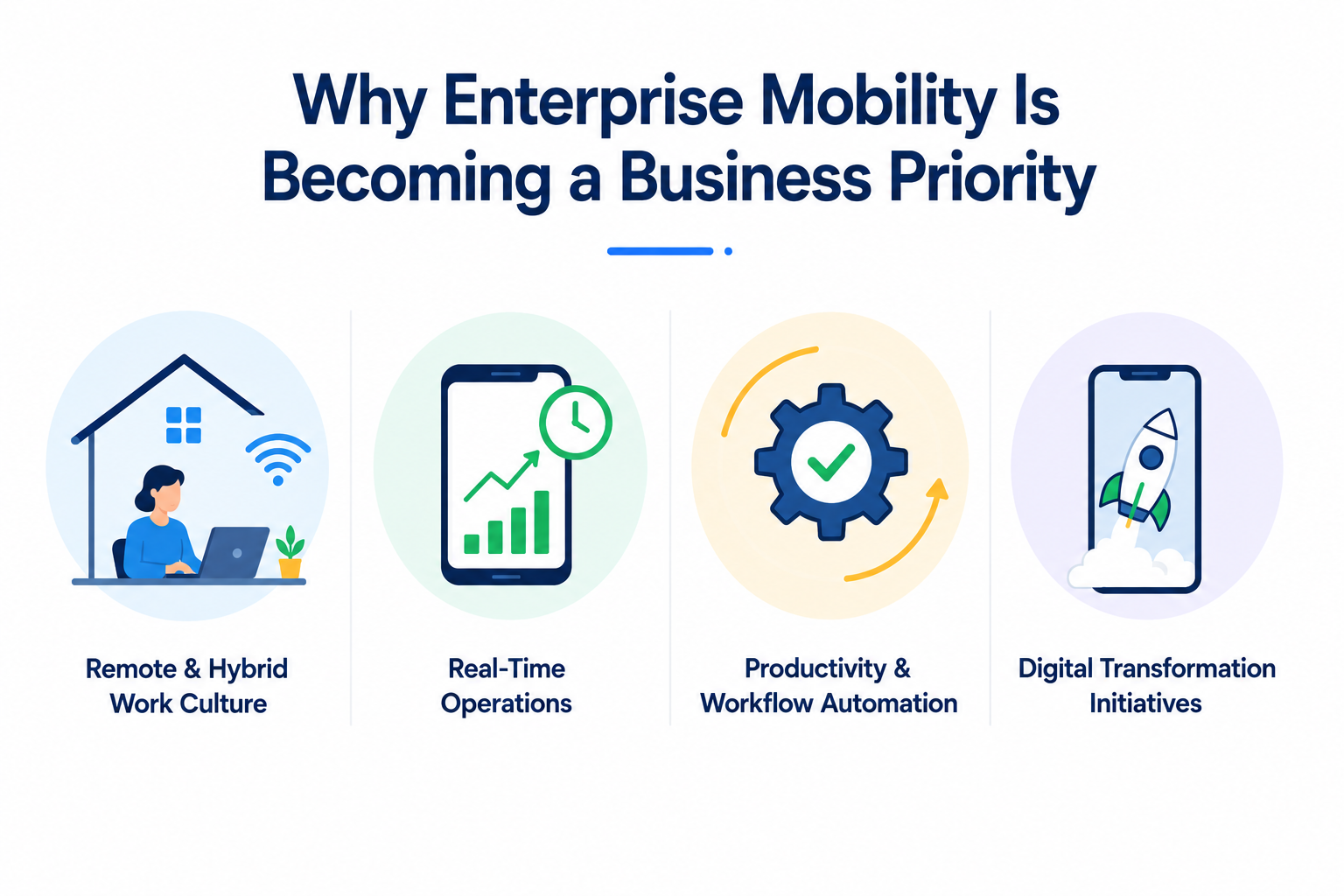
Remote and Hybrid Work Culture
The normalization of distributed work has made enterprise mobility non-optional in a way it wasn't when everyone was in the same office. IT teams can no longer assume workers are on a managed corporate network, sitting at a corporate device, in a controlled environment. Enterprise mobile infrastructure secure access, device management, mobile-optimized applications has become core to how businesses support a workforce that might be working from a home office, a customer site, a hotel, or an airport at any given moment.
Demand for Real-Time Business Operations
Operational decisions made on yesterday's data are increasingly inadequate in markets that move fast. Enterprise mobile apps bring real-time operational visibility to the people who need to act on it managers who need to make staffing decisions based on what's actually happening right now, not a report that was generated overnight. Dispatch teams who need to reroute based on a delay that occurred fifteen minutes ago. Sales leaders who want to know how the day is tracking against target before it's over. Real-time mobile access to operational data changes the speed at which decisions get made and, with it, the quality of outcomes.
Productivity and Workflow Automation
Enterprise mobile apps that do more than display information that actively guide workers through processes, automate routine steps, and connect actions taken in the field directly to backend systems generate compounding productivity gains. A field technician whose app automatically logs the job, generates the service report, updates inventory, and triggers the billing workflow completes meaningfully more work per day than one who does all of that manually after returning to the office. Multiply that across a field team and the operational impact is significant.
Digital Transformation Initiatives
Enterprise mobile investment doesn't happen in isolation it's typically one of the highest-impact workstreams within broader digital transformation programs. Organizations that are re-engineering their processes around digital tools consistently find that mobile capability is the piece that determines whether the transformation reaches the people who actually do the work, rather than stopping at the management layer where desktop tools are already well-established.
Top B2B Mobile App Development Trends in 2026
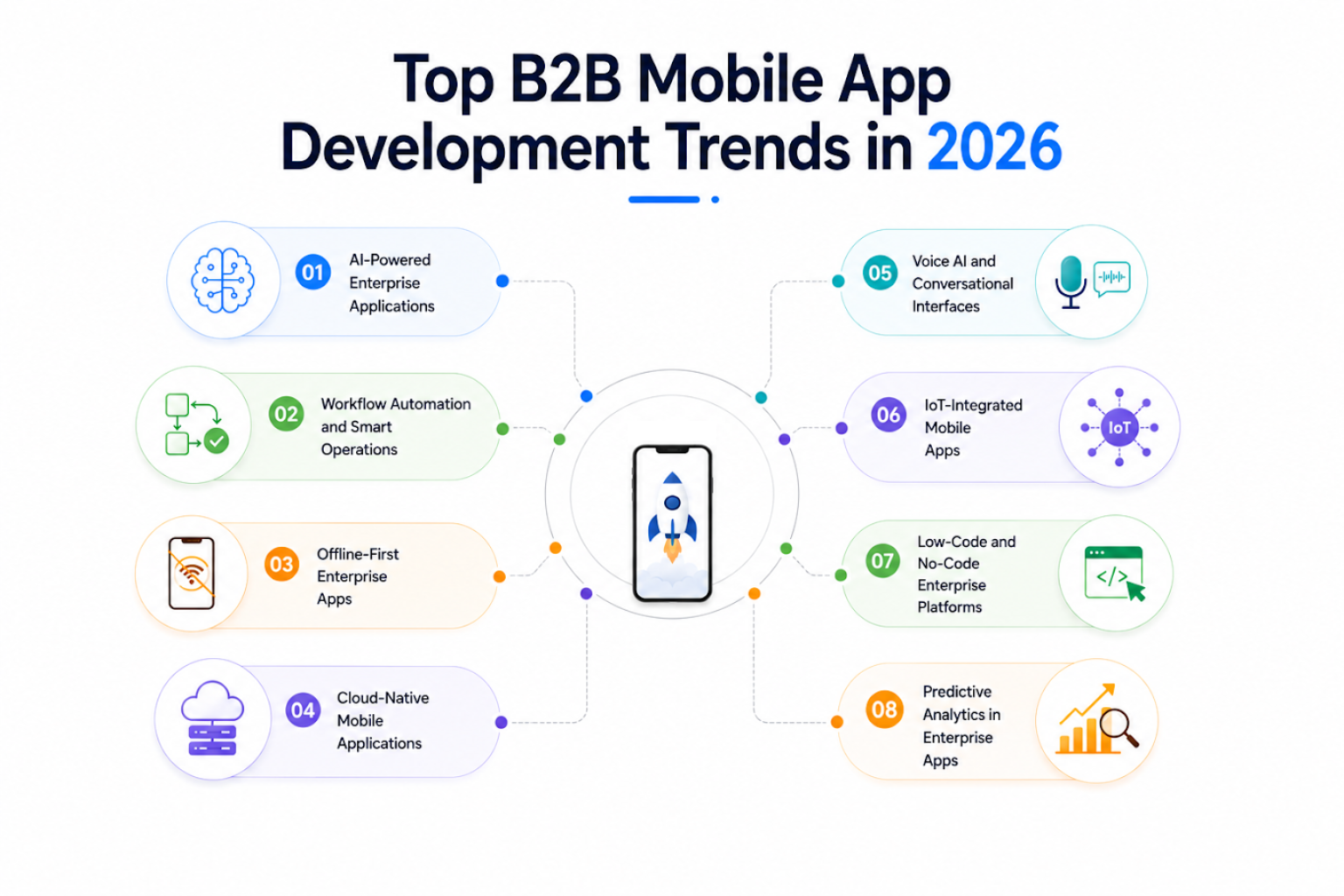
AI-Powered Enterprise Applications
AI has moved from being a feature some enterprise apps offer to being a capability that users expect and that differentiates competitive products from commodity ones. AI in B2B mobile apps shows up as intelligent automation of repetitive decisions, natural language interfaces that replace complex navigational structures, real-time recommendations that surface the right action at the right moment, and predictive intelligence that lets workers stay ahead of problems rather than reacting to them. The apps that matter in 2026 aren't just mobile they're mobile and intelligent.
Workflow Automation and Smart Operations
Enterprise mobile apps are increasingly the orchestration layer for complex multi-step workflows rather than just tools for individual tasks. Smart workflow automation routing, approvals, escalations, data handoffs embedded in a mobile interface means that coordination that previously required email chains, phone calls, and manual status updates happens automatically as work progresses. The result is faster cycle times, fewer dropped handoffs, and operational visibility that was previously impossible to maintain in real time.
Offline-First Enterprise Apps
Reliable connectivity remains a real constraint in many enterprise environments warehouses with poor signal, field locations with limited coverage, manufacturing facilities that block wireless for safety or security reasons. Offline-first design where the app is fully functional without connectivity and syncs intelligently when connection is restored has moved from a nice-to-have to a design requirement for enterprise apps that will be used in the real world rather than just in a well-connected office.
Cloud-Native Mobile Applications
Cloud-native architecture has become the default for new enterprise mobile development, enabling the scalability, resilience, and deployment flexibility that enterprise operations require. Cloud-native B2B apps can be updated continuously without disrupting users, scaled to handle usage spikes without pre-provisioning infrastructure, and integrated with the cloud-based data and analytics services that are increasingly the backbone of enterprise operations.
Voice AI and Conversational Interfaces
Voice has found its place in enterprise mobile apps as a genuinely practical interface for workers whose hands are occupied warehouse teams, field technicians, healthcare professionals, manufacturing operators. Voice AI that can understand natural speech, handle domain-specific vocabulary, maintain context across a multi-step interaction, and interface with backend systems through spoken commands removes a significant friction point in environments where stopping to type is either difficult or genuinely unsafe.
IoT-Integrated Mobile Apps
The proliferation of connected industrial sensors, equipment monitors, and tracking devices has created enormous opportunity for mobile apps to serve as the human interface for IoT data. A maintenance technician with a mobile app that shows real-time sensor readings from the equipment they're servicing, flags anomalies before they cause failure, and guides them through the correct diagnostic and repair sequence has a fundamentally different and more effective working experience than one with a paper checklist and a separate monitoring system.
Low-Code and No-Code Enterprise Platforms
Low-code and no-code platforms have changed who can build enterprise mobile apps and how fast. Business teams with deep domain knowledge but limited engineering resources can now build functional, integrated mobile workflows without writing code or can work alongside developers to build more sophisticated applications in a fraction of the time a fully custom build would require. The tradeoffs (less flexibility, platform dependency, constraints on performance optimization) are real but acceptable for a wide range of enterprise use cases.
Predictive Analytics in Enterprise Apps
Predictive analytics embedded in mobile interfaces give frontline workers and managers intelligence that was previously only available to analysts with access to BI tools. A procurement manager whose mobile app surfaces a predicted stock-out risk two weeks in advance can act before the problem materializes. A sales rep whose app flags which accounts show behavioral signals of churn risk can prioritize outreach before the customer has decided to leave. The value of predictive intelligence compounds when it's available at the point where decisions are actually made, not in a dashboard someone might check once a week.
AI and Automation in B2B Mobile Applications
AI Assistants for Enterprises
Enterprise AI assistants embedded in mobile apps are a meaningful step beyond chatbots. A well-built enterprise AI assistant understands the user's role and context, has access to the systems and data relevant to their work, can take action rather than just provide information, and maintains context across a working session. For knowledge workers, this means a capable assistant for drafting, analysis, and decision support that travels with them. For frontline workers, it means real-time guidance and problem-solving support available exactly when and where it's needed.
AI-Based Reporting and Analytics
Reporting has historically been something that happened after the fact data was collected during work, aggregated in a system, and reviewed in a report or dashboard later. AI changes this by enabling real-time narrative analytics in mobile interfaces: an app that can summarize what happened today, flag what's unusual, answer follow-up questions in natural language, and proactively alert to developing situations rather than waiting to be consulted. This is a category change in how operational intelligence reaches the people who need to act on it.
Smart Task Automation
AI-powered task automation in enterprise mobile apps goes beyond scripted workflows to handle the judgment-light decisions that slow down human workers routing tasks to the right person, prioritizing a queue intelligently based on business rules and real-time context, pre-filling form data from available information, and escalating exceptions that require human attention while handling routine cases automatically. The cumulative time savings from smart automation across a workforce's daily work compounds into meaningful operational efficiency gains.
AI-Driven Customer and Workforce Management
For businesses managing large field workforces or complex customer relationships, AI-driven management tools on mobile bring a level of optimization that spreadsheet-based planning simply can't match. AI-optimized scheduling that accounts for skill matching, travel time, workload balance, and customer priority. Customer relationship intelligence that surfaces the right context for an account conversation. Real-time workforce visibility that lets managers make informed decisions about resource allocation without being tied to a desk. These are capabilities that AI makes viable at scale in a mobile format.
Industry-Specific B2B Mobile App Use Cases
Manufacturing
Manufacturing mobile apps serve two distinct audiences: plant floor workers who need guidance, quality data, and safety information at the point of work, and managers and engineers who need real-time visibility into production performance. AI-assisted predictive maintenance, mobile quality control with computer vision, digital work instructions that adapt to the specific job being performed, and real-time production dashboards that managers can monitor from anywhere in the facility are all active use cases with measurable impact on efficiency and output quality.
Healthcare
Healthcare mobile apps have to thread a demanding needle: clinical utility, rigorous compliance with health data regulations, integration with complex existing systems, and reliability that healthcare environments demand. Clinician-facing apps for documentation at the point of care, patient-facing apps for engagement and remote monitoring, and operational apps for scheduling, supply management, and staff coordination all represent significant investment categories in healthcare enterprise mobile each with specific compliance and integration requirements that make healthcare one of the more technically demanding verticals for B2B mobile development.
Logistics and Supply Chain
Logistics is where enterprise mobile has found some of its highest-ROI applications. Driver apps with AI-optimized routing that accounts for load, traffic, delivery windows, and vehicle constraints. Warehouse management apps that guide workers through picking sequences, verify accuracy, and integrate with inventory systems in real time. Supplier and carrier communication platforms that give logistics coordinators a single mobile interface into a complex multi-party supply chain. The operational density of logistics many people, many decisions, many physical assets moving through many locations simultaneously makes mobile intelligence particularly valuable.
Retail and Distribution
Retail and distribution mobile apps span both customer-facing and operational use cases. Field sales reps with mobile order management, customer history, and inventory availability in a single app. Merchandising teams with mobile planogram compliance tools and in-store analytics. Distribution managers with mobile visibility into delivery performance and exception management. Each of these represents a workflow where mobile access to the right information and the right tools meaningfully changes what's achievable in a day's work.
Banking and Financial Services
Financial services B2B mobile applications range from banking apps used by business customers to manage treasury and payments, to internal tools used by relationship managers, advisors, and analysts in the field. The security requirements in financial services are among the most demanding of any industry, and the regulatory environment creates specific compliance requirements around data handling, audit trails, and access controls that shape architecture decisions from the ground up. The mobile opportunity in banking services is substantial the industry has historically been slow to extend sophisticated capability to mobile and is now being pursued aggressively.
Construction and Field Services
Construction and field services represent some of the most demanding B2B mobile environments physically demanding, connectivity-challenged, safety-critical, and highly variable from job to job. Mobile apps for site documentation, safety compliance, progress reporting, materials management, and workforce coordination have to work reliably in conditions that would be challenging for any technology. Offline-first architecture is particularly important here, as construction sites and remote field locations frequently have poor connectivity that a city-office-tested app would handle badly.
Key Technologies Powering Modern B2B Mobile Apps
Artificial Intelligence
AI is no longer a separate technology layer that some B2B mobile apps happen to use it's increasingly woven into the foundation of what competitive enterprise mobile applications offer. On-device inference for low-latency intelligence. Cloud-based LLMs for sophisticated language understanding and generation. ML models for prediction, anomaly detection, and recommendation. The variety of AI techniques deployed within modern enterprise mobile apps reflects how broadly applicable the technology has become across different kinds of enterprise problems.
Cloud Computing
Cloud infrastructure underpins most modern B2B mobile applications, providing the scalability, resilience, and managed services that enterprise operations require. Managed databases, real-time data sync, serverless compute, and cloud AI services have made it possible for enterprise mobile development teams to build sophisticated applications without maintaining complex infrastructure allowing engineering focus to stay on the application and business logic rather than the infrastructure that runs it.
Edge Computing
Edge computing brings compute closer to where data is generated, enabling low-latency processing that cloud-only architectures can't match for time-sensitive use cases. In enterprise mobile contexts, edge computing matters for applications where real-time response is critical quality control systems that need to flag a defect before the production line moves on, safety monitoring that needs to alert before an incident rather than after, or field operations where cloud round-trip latency would degrade the user experience unacceptably.
IoT Connectivity
The convergence of IoT and mobile is one of the more powerful dynamics in enterprise technology. Mobile apps that can interface with connected sensors, equipment, and infrastructure give workers a real-time window into physical systems that previously required separate monitoring infrastructure and desktop interfaces. The practical effect is a much richer operational picture available to the people doing the work and correspondingly better decisions made with better information.
APIs and Enterprise Integrations
Modern B2B mobile apps are integration platforms as much as they are standalone applications. They connect to CRMs, ERPs, HR systems, identity providers, third-party data sources, and dozens of other enterprise services through APIs that enable a unified mobile experience layered over what might be a complex, heterogeneous backend. The quality of these integrations their reliability, their security, their ability to handle the quirks and failures of real enterprise systems often determines whether an enterprise mobile app actually works well in practice or just in a demo.
Blockchain for Enterprise Security
Blockchain finds practical application in enterprise mobile in specific use cases that benefit from its core properties: immutable audit trails for compliance-sensitive workflows, supply chain provenance tracking where multiple parties need to verify the integrity of data without trusting a central party, and digital asset management where ownership verification matters. It's not a universal answer to enterprise security challenges, but for the use cases where its properties are relevant, blockchain provides guarantees that traditional architectures can't match.
Importance of UX in Enterprise Mobile Applications
Employee Productivity and Adoption
Enterprise apps have historically gotten away with poor UX because users had no choice the app was mandated, and people used it however badly designed it was. That calculus has shifted. Organizations now understand that poorly designed apps that people find ways to work around are not actually generating the value the investment was supposed to deliver. Good UX in enterprise mobile apps directly influences how fully and effectively a tool gets used which determines whether the investment in building it actually pays off.
Simplified Enterprise Workflows
The most impactful UX improvement in enterprise mobile apps is the simplification of complex workflows into clear, guided sequences that don't require training to navigate correctly. Instead of exposing the full complexity of an enterprise system in a mobile interface, well-designed B2B apps present the right information and the right actions for the specific task and user role at each moment hiding complexity without hiding capability.
Accessibility and Cross-Device Experiences
Enterprise mobile apps increasingly need to work well across a range of devices smartphones, tablets, ruggedized handhelds, and sometimes large-format displays in operational contexts and for users with varying levels of technical fluency. Accessibility is also a genuine requirement for organizations committed to inclusive employment practices, not an afterthought. Cross-device consistency and accessibility support add development scope but significantly expand the operational reach of an enterprise mobile tool.
Personalization in B2B Apps
Personalization in enterprise mobile apps looks different from consumer app personalization it's less about surfacing content someone might enjoy and more about surfacing the tools, data, and workflows that are most relevant to a specific user's role, location, and current task. A site manager and a finance controller using the same enterprise platform should have meaningfully different mobile experiences that reflect what each of them actually needs to do their job, not a one-size-fits-all interface that serves neither role particularly well.
Data Security and Compliance in Enterprise Apps
Enterprise Authentication and SSO
Single sign-on integrated with enterprise identity providers is now the baseline expectation for any serious B2B mobile app not a premium feature. Workers managing separate credentials for every enterprise application they use represents both a security vulnerability (password reuse, poor credential hygiene) and a friction point that degrades adoption. Proper SSO integration with How to Implement Two-Factor Authentication (2FA) in Your Mobile App: Enhancing User Security and Providing Peace of Mind
Encryption and Data Protection
Enterprise mobile apps handle data that is sensitive by definition customer information, financial data, operational intelligence, employee records and encryption at rest and in transit is a non-negotiable requirement, not a security enhancement. Beyond encryption, data protection in enterprise mobile apps includes controls on local caching of sensitive data, protections against data leakage through device features like screenshots and copy-paste, and clear data retention policies that comply with relevant regulations.
Regulatory Compliance
The regulatory landscape for enterprise mobile apps is industry-specific and evolving. Healthcare apps must comply with patient data regulations. Financial services apps must meet data handling and audit requirements set by financial regulators. Apps operating across jurisdictions must navigate multiple data protection frameworks simultaneously. Building compliance in from the architecture stage rather than retrofitting it after a regulator asks questions is consistently less expensive and more effective.
Mobile Device Management (MDM)
MDM platforms enable enterprise IT teams to manage the devices and applications in their mobile fleet enforcing security policies, remotely wiping lost or stolen devices, controlling which apps can be installed, and maintaining visibility into the compliance status of the device fleet. Integration with the enterprise MDM environment is a requirement for enterprise mobile apps that will be deployed at scale in organizations with mature IT governance, and should be addressed in the design phase rather than treated as a post-deployment integration challenge.
Benefits of B2B Mobile Applications for Businesses
Increased Operational Efficiency
The efficiency gains from well-built enterprise mobile apps compound across a workforce. Workers have the information they need at the right moment. Data capture happens at the point of work rather than being reconstructed later. Workflows advance automatically without manual coordination. Decisions get made faster because the intelligence to make them is available in real time. Each of these individually produces a modest improvement; together across a large workforce, the operational efficiency impact is substantial.
Better Workforce Collaboration
Mobile apps that connect distributed teams real-time messaging, shared task management, mobile video, collaborative documentation change what's possible for organizations with workforces spread across locations, shifts, or roles. Coordination that previously required scheduled meetings, email threads, or phone chains can happen asynchronously and contextually, embedded in the workflows where the collaboration is actually needed rather than as a separate communication layer.
Real-Time Business Visibility
Real-time operational visibility knowing what's actually happening across the business right now rather than what was happening when the last batch report ran is one of the highest-value outcomes of enterprise mobile investment. Managers who can see live operational status on a mobile device make faster, better-informed decisions and can intervene in developing problems before they become serious ones.
Reduced Operational Costs
Mobile apps that automate manual data entry, reduce coordination overhead, eliminate paper-based processes, and enable more efficient routing and scheduling produce measurable cost reductions. The business case for most B2B mobile apps starts with a cost efficiency argument how many hours of manual work does this eliminate, at what fully-loaded cost and is frequently enhanced by revenue and quality arguments once the system is operational and showing additional benefits.
Improved Decision-Making
Decisions made with better information, faster, at the point where action is taken are better decisions. This is the most fundamental benefit of enterprise mobile intelligence, and it's one that's genuinely difficult to quantify but very real in its operational impact. When the people doing the work have access to the same quality of intelligence that previously only existed in a management reporting layer, the quality and speed of execution across the organization improves.
Challenges in Enterprise Mobile App Development
Complex Integrations
Integration is consistently where enterprise mobile projects encounter the most difficulty and the most budget overrun. Enterprise systems that weren't designed to be integrated are common. APIs that exist on paper but behave unpredictably in practice are common. Data quality issues in source systems that only surface when you start actually using the data are common. Realistic scope and timeline planning for enterprise mobile projects requires treating integration as a major workstream in its own right, not a technical detail to be sorted out later.
Legacy System Compatibility
Many enterprises run on technology stacks that are decades old core banking systems, ERP deployments, manufacturing execution systems that predate smartphones. Building modern mobile interfaces on top of these legacy systems is possible but requires significant middleware engineering, often including custom API layers that translate between modern mobile architecture patterns and the data models and communication protocols of older backend systems.
Scalability Challenges
An enterprise mobile app that works well for a pilot group of fifty users needs different architecture than one serving fifty thousand users simultaneously across multiple regions. Planning for scale from the beginning rather than rebuilding the architecture later when the initial approach proves inadequate is an engineering decision that has significant cost and timeline implications at every stage of a project's life.
User Adoption Issues
Building a technically excellent enterprise mobile app that nobody actually uses is one of the most expensive ways to fail in this space. User adoption in enterprise mobile depends on how closely the app fits actual work patterns, how intuitively it handles the situations workers encounter most often, whether it makes their jobs meaningfully easier rather than just different, and how well the rollout was managed including training, change management, and the availability of support during the adjustment period.
Security Risks
Mobile devices expand the attack surface of enterprise systems in ways that desktop-only environments don't face: lost or stolen devices, unsecured wireless networks, malicious apps on personal devices used for work, and phishing attacks targeting mobile users all require specific mitigation. Enterprise mobile security is a discipline in its own right, and building apps that are genuinely secure across the range of environments where enterprise mobile devices actually operate requires security expertise embedded in the development process from the start.
Cost of B2B Mobile App Development
Factors Affecting Enterprise App Costs
Enterprise mobile app costs are shaped by a consistent set of variables: the complexity of the core functionality, the number and complexity of backend integrations, the security and compliance requirements applicable to the industry and use case, the device and platform scope (iOS, Android, ruggedized devices, cross-platform), the level of AI functionality involved, and the volume of users and data the system needs to handle reliably. Any credible cost estimate requires engaging with all of these factors rather than applying a generic industry average.
Infrastructure and Integration Costs
Infrastructure and integration are frequently the largest cost categories in enterprise mobile development often exceeding the cost of the mobile application itself. Cloud infrastructure, API development and management, data pipeline engineering, security infrastructure, and the middleware required to connect modern mobile apps to legacy backend systems all represent real, ongoing cost commitments rather than one-time build expenses.
MVP vs Enterprise-Scale Applications
The MVP versus enterprise-scale cost distinction is one of the most important planning decisions in enterprise mobile development. An MVP focused on the single highest-value workflow, for a limited initial user group, validates assumptions with real operational data at a fraction of the cost of a full enterprise deployment. The learnings from an honest MVP what works, what doesn't, what users actually need versus what was assumed consistently produce a better and more cost-efficient enterprise-scale system than building the full vision without validation.
Maintenance and Support Costs
Enterprise mobile apps are operational systems with ongoing maintenance requirements: platform updates as iOS and Android evolve, dependency updates for security patches, performance optimization as usage grows, new feature development as business requirements change, and user support for a workforce that depends on the app to do their job. Budgeting maintenance from the start at a realistic percentage of initial build cost avoids the unpleasant surprise of discovering that a system that cost a fixed amount to build costs a meaningful amount every year to keep running well.
Future of Enterprise Mobile Applications
AI-Native Enterprise Apps
The next generation of enterprise mobile applications won't just include AI features they'll be organized around AI as the primary interface. Instead of navigating menus and screens to find information and trigger actions, users will state a goal in natural language and the AI will orchestrate what needs to happen pulling data, taking action, updating records, notifying the right people surfacing results in a mobile interface that's organized around outcomes rather than features. This is a fundamental shift in how enterprise mobile apps are designed, not an incremental improvement on what exists today.
Autonomous Workflow Applications
Autonomous workflow applications take the workflow automation of today further toward systems that don't wait for a human to initiate each step. Within defined parameters and with appropriate human oversight and intervention capability, these systems will manage the operational execution layer of complex business processes routing, scheduling, exception handling, coordination with AI handling the judgment calls that don't require human involvement and escalating those that do. The enterprise mobile interface becomes primarily a visibility and intervention tool rather than a step-by-step process execution tool.
Smart Enterprise Ecosystems
Enterprise mobile apps of the near future will operate as participants in broader intelligent ecosystems coordinating with AI agents, IoT systems, external partner platforms, and each other through interoperability standards that are still being established but are moving quickly. The value of a single well-built enterprise mobile app will be multiplied by its ability to connect intelligently with the broader enterprise and external technology environment, rather than operating as a standalone tool.
Future of Workforce Mobility
The future of workforce mobility points toward a working environment where the right intelligence, the right tools, and the right connections are available to every worker, in every context, on whatever device makes sense for their situation without friction, without requiring technical sophistication to access, and without the artificial distinction between "working at a desk with full capability" and "working in the field with limited access" that has constrained enterprise mobile for too long. The organizations building toward that future now are the ones whose workforces will be meaningfully more capable than their competitors' in five years.
Final Thoughts
B2B mobile applications have crossed a threshold from operational convenience to competitive necessity. The businesses that treat enterprise mobility as a checkbox something to have, not something to invest in seriously are making a strategic choice they may not realize they're making. The gap between organizations with genuinely capable, intelligent mobile operations and those with outdated, friction-heavy enterprise apps is visible in workforce productivity, customer experience, and the speed at which operational problems get identified and resolved.
The technology has never been better, the costs have never been more accessible relative to capability, and the standards users bring to their enterprise tools have never been higher. For businesses willing to invest thoughtfully starting narrow, validating before scaling, and treating security and user experience as core requirements rather than afterthoughts enterprise mobile is one of the clearer value creation opportunities in the current technology landscape.
TechQware helps businesses build secure, scalable, and user-friendly B2B mobile applications that improve productivity and streamline operations. Connect with TechQware to explore how enterprise mobility can support your business goals.
FAQs
What are B2B mobile applications?
B2B mobile applications are software platforms designed for use within business operations by employees, partners, or suppliers to enable, streamline, and enhance the way businesses carry out work. Unlike consumer apps, they're typically mission-critical, deeply integrated with enterprise backend systems, and subject to rigorous security and compliance requirements.
How are B2B apps different from B2C apps?
B2B apps optimize for reliability, operational depth, and enterprise integration; B2C apps optimize for discovery, engagement, and broad consumer appeal. B2B apps serve defined user roles in specific workflows, integrate with complex enterprise systems, and face security and compliance requirements that consumer apps typically don't encounter.
What are the latest B2B app development trends?
The most significant current trends are AI integration across all feature categories, offline-first architecture for operational reliability, voice and conversational interfaces for hands-free contexts, IoT connectivity for physical operations, cloud-native architecture for scalability, and low-code platforms for faster development of workflow-specific tools.
Why is enterprise mobility important?
Enterprise mobility matters because work increasingly doesn't happen at a desk. Extending enterprise capability to where work actually occurs in the field, on the floor, at a customer site changes what's achievable in a working day and closes the gap between when a decision needs to be made and when the right information is available to make it.
What industries use B2B mobile apps the most?
Manufacturing, healthcare, logistics and supply chain, retail and distribution, construction and field services, and financial services are among the most active adopters, driven by the combination of high mobile usage in their operational environments and high value from the outcomes that mobile intelligence enables.
What security features are important in B2B apps?
Enterprise-grade security in B2B mobile apps includes SSO with multi-factor authentication, end-to-end encryption for data in transit and at rest, role-based access control, integration with MDM platforms for device management, audit logging for compliance, and specific controls relevant to the regulatory environment of the industry.
How much does enterprise mobile app development cost?
Enterprise mobile app development costs vary widely based on scope, integration complexity, platform requirements, security demands, and the level of AI functionality involved. Costs should be evaluated as a total investment including infrastructure, integrations, and ongoing maintenance not just the initial build.
What is the future of enterprise mobile applications?
The future points toward AI-native enterprise mobile apps where AI is the primary interface rather than a feature within one, autonomous workflow systems that handle operational execution with less human supervision, and smart enterprise ecosystems where mobile apps participate in broader intelligent environments connecting people, systems, and physical infrastructure.
Abhinav Srivastav
With years of experience in driving digital transformation, Abhinav Srivastav is the CEO & Director of TechQware Technologies, helping businesses build innovative mobile apps, AI-powered applications, and scalable digital solutions.
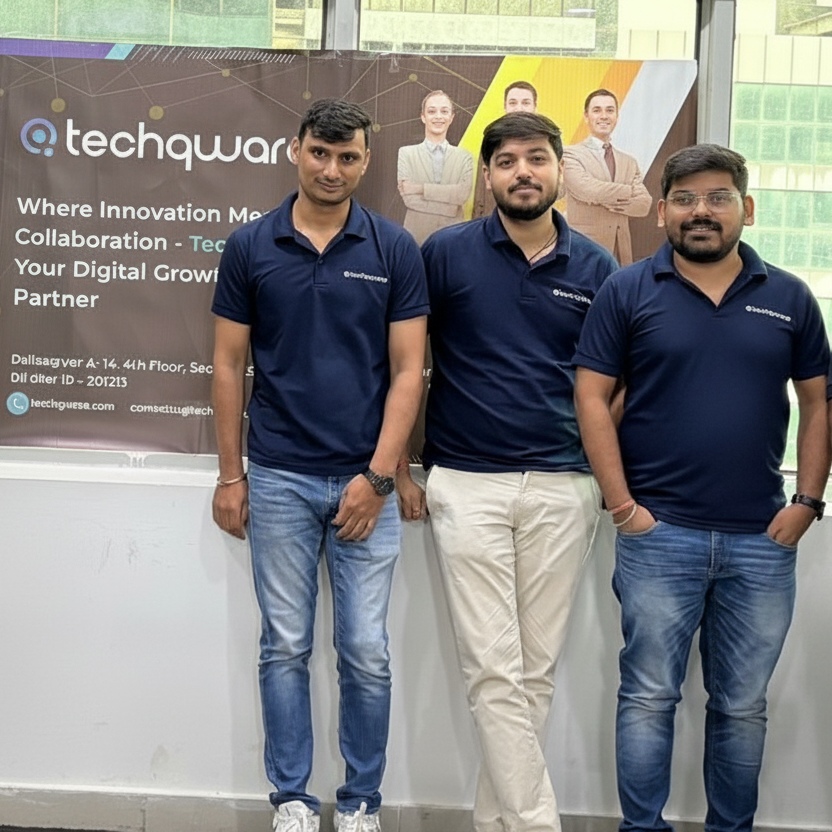
TechQware’s Mobile App Development Team
About Author
TechQware specializes in full-stack Mobile App Development, utilizing Swift for native iOS and Kotlin for native Android. For cross-platform solutions, we rely on Dart (Flutter) and JavaScript (React Native). Python is a foundational technology, powering the backend, RESTful APIs, and advanced Machine Learning features.

.png)