app development
DevOps Consulting: How It Speeds Up Software Delivery for Businesses
 TechQware
November 3, 2026
 TechQware
November 3, 2026
Software delivery has become a business-speed problem, not just a technical problem. Customers expect frequent updates, businesses need to respond quickly to market changes, and digital products must remain available while new features are continuously introduced.
Yet many organizations still rely on manual deployments, disconnected development and operations teams, inconsistent environments, and limited visibility into production systems. These challenges can turn a simple software update into a lengthy release cycle.
This is where DevOps consulting can make a measurable difference. DevOps brings development, operations, automation, security, infrastructure, testing, and monitoring together into a more efficient delivery process.
According to DORA’s software delivery performance metrics guide, software delivery performance can be evaluated through metrics including change lead time, deployment frequency, failed deployment recovery time, change fail rate, and deployment rework rate. Importantly, DORA's research indicates that speed and stability do not have to be opposing goals.
For businesses developing SaaS products, mobile applications, cloud platforms, and OTT services, a mature DevOps strategy can therefore become an important competitive advantage.
When users, content and features multiply, the technology underneath has to keep up quietly. TechQware helps growing businesses prepare their apps for higher demand, protect customer data and keep every update smooth. You stay focused on growth, and we handle the foundation.
Talk to Our TeamDevOps consulting is a professional service that helps businesses improve the way they build, test, deploy, monitor, secure, and operate software.
A DevOps consultant examines the organization's existing development and infrastructure processes, identifies bottlenecks, recommends an appropriate technology strategy, implements automation, and helps internal teams adopt better delivery practices.
DevOps commonly involves continuous integration, continuous delivery, Infrastructure as Code, monitoring, logging, security, automation, and collaboration. AWS’s Introduction to DevOps guide identifies CI, CD, IaC, monitoring and logging, communication, collaboration, and security as important components of a modern DevOps approach.
The goal is not simply to introduce new tools. The objective is to create a repeatable software delivery system where validated code can move from development to production efficiently and safely.
An in-house DevOps team can provide deep knowledge of the organization's applications, infrastructure, and business requirements. However, building a complete DevOps function internally can take significant time and requires expertise across cloud architecture, automation, security, containers, orchestration, monitoring, and release engineering.
A consulting partner provides specialized expertise when the internal team needs additional capability.
For example, a business may already have developers and system administrators but lack the expertise to design a complete CI/CD pipeline, automate cloud infrastructure, implement Kubernetes, or integrate security into the deployment process.
DevOps consultants can establish the required architecture while also documenting processes and transferring knowledge to internal teams.
DevOps consulting can benefit organizations experiencing slow releases, frequent production incidents, manual deployment processes, inconsistent environments, cloud infrastructure challenges, or increasing operational costs.
It is particularly valuable for businesses developing applications that need frequent updates and high availability.
Startups can use DevOps consulting to establish scalable engineering practices early, while established businesses can use it to modernize legacy applications and improve existing delivery processes.
Software delivery rarely becomes slow because developers are incapable of writing code. More often, delays occur between development, testing, infrastructure, deployment, and production support.
When development and operations work independently, every deployment can become a sequence of handoffs.
A developer may complete a feature, but another team may need to manually configure infrastructure before testing can begin. QA may then identify an issue that sends the change back to development.
This creates waiting time and makes responsibility for delivery unclear.
DevOps encourages shared ownership of the delivery lifecycle, bringing development, operations, QA, security, and infrastructure closer together.
Manual testing and deployment become increasingly inefficient as applications grow.
A team might manually create a build, run regression tests, configure servers, upload deployment packages, verify the release, and monitor the application.
Every additional manual step increases the possibility of delays or human error.
Continuous integration addresses part of this problem by automatically building and testing changes when developers merge code. AWS’s continuous integration guide explains that CI helps teams identify and address bugs earlier while reducing the time required to validate and release software.
Without delivery metrics, businesses may know that releases are slow without knowing where the delay occurs.
The problem could be testing, approvals, infrastructure provisioning, deployment, or post-release troubleshooting.
DORA recommends measuring delivery through specific performance indicators, allowing teams to identify whether throughput or stability is improving over time.
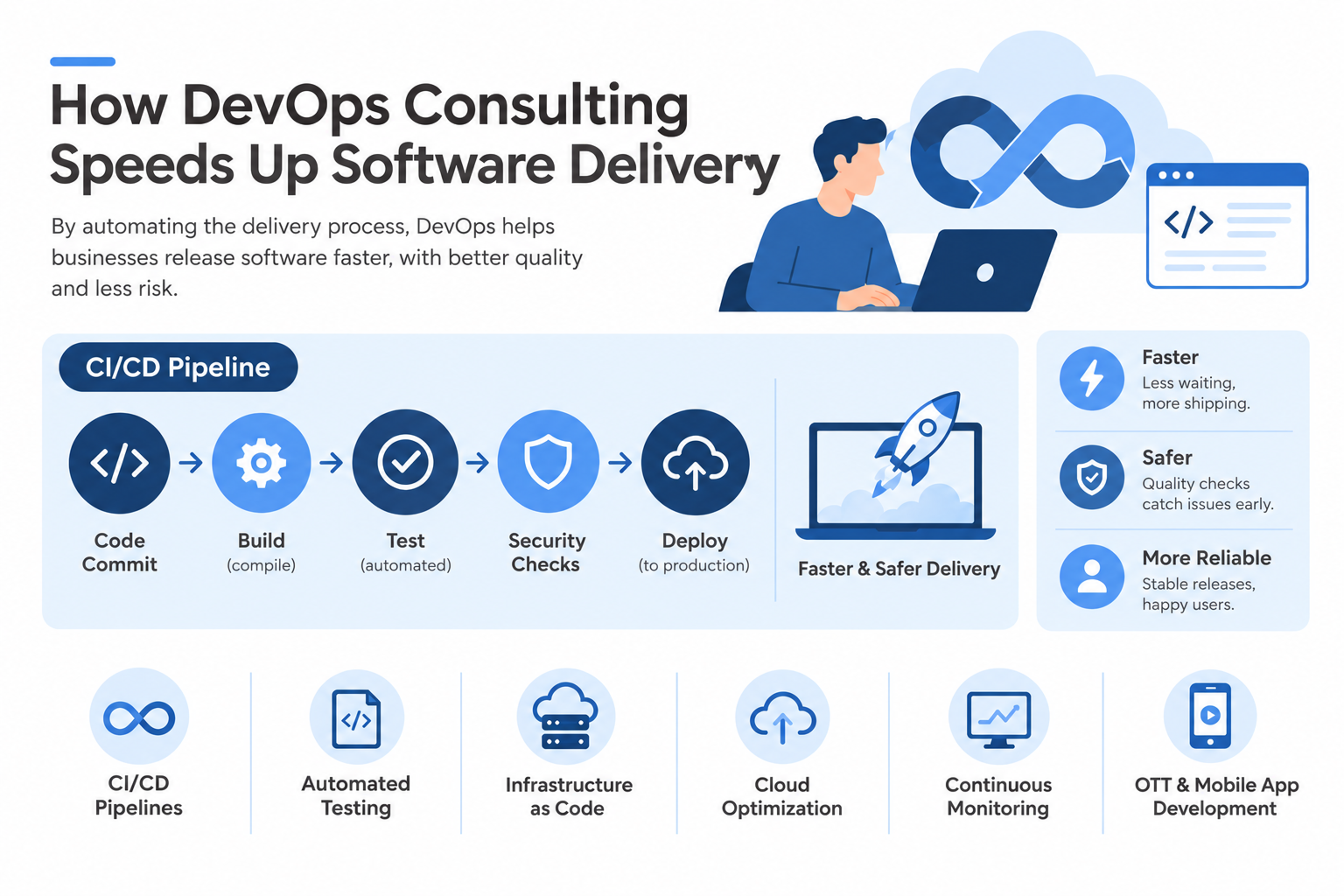
The primary value of DevOps consulting is eliminating unnecessary waiting and manual work while creating a safer and more measurable delivery process.
CI/CD pipelines automate repetitive stages of software delivery.
A typical pipeline can automatically retrieve source code, build the application, execute tests, perform security checks, create deployment artifacts, and deploy them to selected environments.
AWS describes continuous delivery as automatically preparing code changes for production after they have passed standardized testing and validation.
The earlier developers receive feedback, the easier it is to correct a problem.
Suppose a developer introduces a change that breaks an API. An automated CI pipeline can detect the failed integration test shortly after the code is committed instead of allowing the problem to remain hidden until a later QA or production release.
This shortens the feedback loop and reduces the cost of fixing defects.
DevOps encourages teams to deliver smaller changes more frequently instead of combining large numbers of changes into a single major release.
DORA's research has highlighted the value of smaller changes because they are easier to understand, test, deploy, and recover from when something goes wrong. DORA’s 2023 State of DevOps report
A mature DevOps pipeline can automate unit testing, integration testing, API testing, UI testing, dependency checks, vulnerability scanning, and other quality controls.
This does not eliminate manual QA. Instead, it allows QA teams to focus on exploratory testing, usability, complex business scenarios, and areas that require human judgment.
The result is a testing process that operates continuously rather than only immediately before a release.
Infrastructure as Code allows infrastructure configuration to be managed through code and version control.
Instead of manually configuring every server or environment, teams can define infrastructure requirements in reusable configuration files.
AWS describes IaC as applying software-development discipline to infrastructure provisioning and management, including version control and repeatable deployment.
This helps reduce differences between development, testing, staging, and production environments.
Cloud platforms provide businesses with flexible infrastructure, but simply moving an application to the cloud does not automatically make it efficient.
DevOps consultants can evaluate resource usage, deployment architecture, autoscaling, containerization, storage, networking, and monitoring to identify opportunities for optimization.
For an application with highly variable traffic, infrastructure can be designed to scale according to demand instead of maintaining maximum capacity continuously.
Monitoring gives teams visibility into application performance, infrastructure health, logs, errors, latency, and resource utilization.
When monitoring and alerting are properly configured, teams can identify unusual behavior earlier and begin investigation before a small technical problem becomes a major customer-facing incident.
|
DevOps Area |
Traditional Approach |
DevOps-Oriented Approach |
|
Code integration |
Infrequent and manual |
Frequent automated integration |
|
Testing |
Primarily manual |
Automated and continuous |
|
Deployment |
Manual release process |
Automated CI/CD |
|
Infrastructure |
Manually configured |
Infrastructure as Code |
|
Security |
Mostly pre-release |
Integrated throughout delivery |
|
Monitoring |
Reactive troubleshooting |
Continuous observability |
|
Scaling |
Manual infrastructure |
Automated cloud scaling changes |
OTT platforms have particularly demanding delivery requirements. An OTT ecosystem can include mobile applications, web applications, backend APIs, authentication services, subscription systems, analytics, content delivery networks, connected-TV applications, and content-protection technologies.
This makes DevOps an important part of building and operating an OTT product.
OTT traffic can increase dramatically when a major movie launches, a popular series releases a new episode, or a live event attracts large audiences.
A cloud-based DevOps architecture can use automated scaling and load-management strategies to accommodate changing demand.
For example, an OTT application may have normal traffic throughout the afternoon but experience a significant increase immediately before a major live event. Automated infrastructure can respond to that change more efficiently than manual server provisioning.
Streaming quality depends on the entire technology ecosystem, not only the mobile application.
Backend APIs, databases, authentication, content delivery, infrastructure, and monitoring must work together.
Continuous monitoring can help identify API latency, infrastructure saturation, service failures, or unusual error rates that could affect playback or user experience.
OTT platforms regularly introduce features such as personalized recommendations, new subscription options, improved search, parental controls, redesigned interfaces, and playback enhancements.
CI/CD enables these changes to pass through standardized automated testing and controlled deployment processes.
Teams can also use techniques such as staged releases and feature flags to limit the impact of a problematic change.
OTT businesses handle customer accounts, subscription information, authentication credentials, payment-related information, and valuable digital content.
DevSecOps can integrate security checks into the development and deployment lifecycle, including vulnerability scanning, dependency analysis, secrets management, access controls, and infrastructure security.
AWS also identifies security as a cross-cutting DevOps concern rather than something that should only be addressed at the end of development.
An OTT business may release its service across Android, iOS, web, smart TVs, and other connected devices.
DevOps helps standardize backend deployment, APIs, testing, infrastructure, monitoring, and release processes across this multi-platform ecosystem.
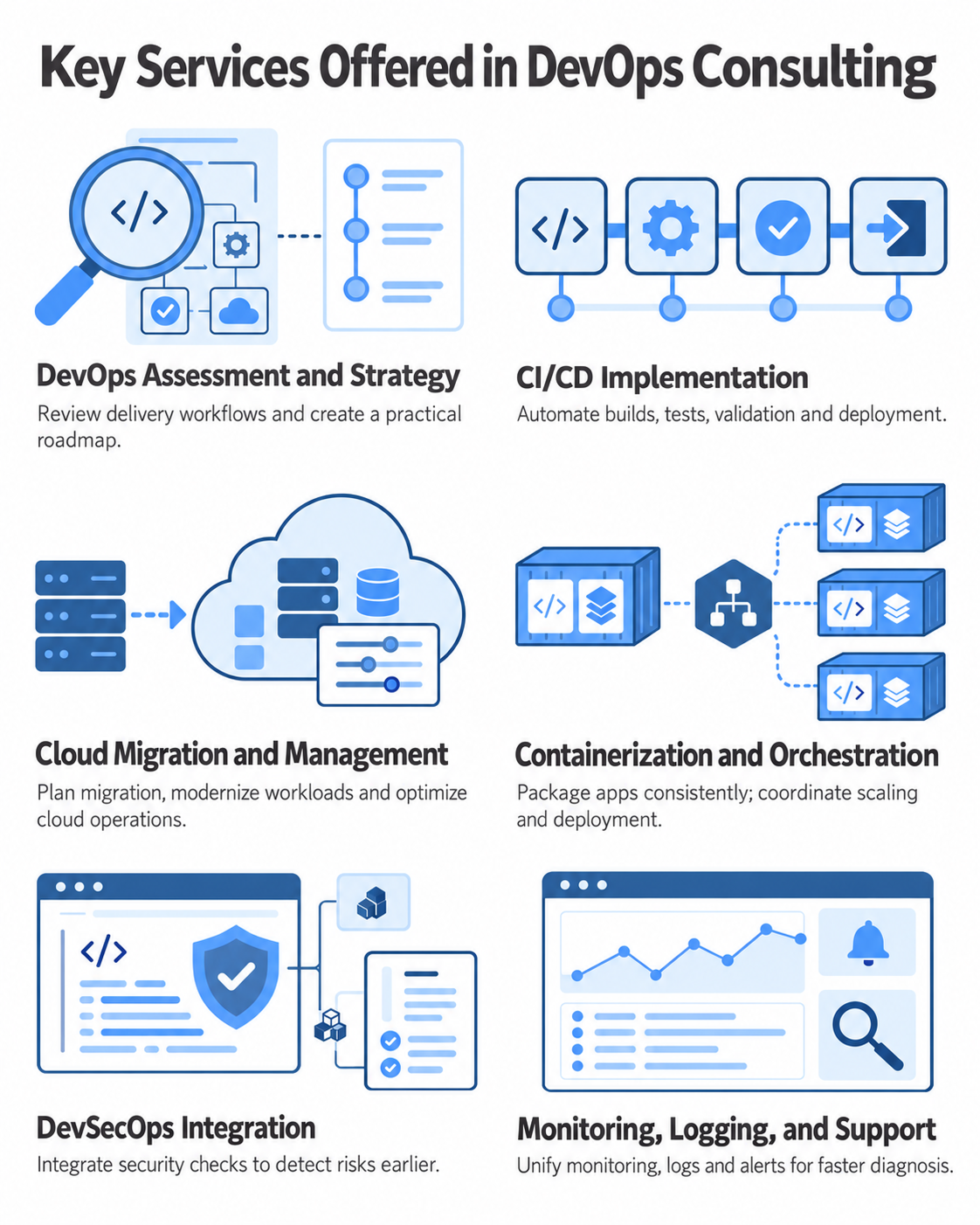
A DevOps engagement normally begins with an assessment of the existing software delivery lifecycle.
Consultants review source control, development workflows, testing, infrastructure, deployment procedures, cloud architecture, monitoring, security, and team responsibilities.
The result is a practical roadmap based on the organization's current maturity and business priorities.
Consultants design and implement automated pipelines that build, test, validate, and deploy applications.
The pipeline can include automated approvals and governance where required while removing unnecessary manual steps.
Businesses moving from traditional infrastructure to AWS, Azure, Google Cloud, or another cloud environment may need support with migration planning, architecture, workload modernization, cloud governance, and optimization.
Containers package applications and their dependencies into standardized units that can run consistently across environments.
Kubernetes is increasingly established as a production platform. The CNCF’s 2025 Kubernetes adoption findings reported that 82% of container users were running Kubernetes in production in 2025, up from 66% in 2023.
For businesses with complex containerized workloads, DevOps consultants can help design orchestration, scaling, networking, deployment, and monitoring strategies.
DevSecOps brings security into the software delivery process.
Security controls can be integrated into CI/CD pipelines so that vulnerabilities, insecure dependencies, configuration issues, and other risks can be detected earlier.
DevOps consulting can establish centralized monitoring, logging, alerting, dashboards, and incident-response processes.
This gives development and operations teams a shared view of application health and helps reduce the time required to diagnose production problems.
Automation reduces the time spent waiting for builds, testing, infrastructure provisioning, approvals, and deployment.
This allows businesses to move validated features into production more quickly.
DORA's current performance model specifically measures deployment frequency and change lead time as throughput indicators, alongside stability measures.
Automation reduces repetitive operational work and can decrease the engineering time required for routine deployment and infrastructure management.
Cloud optimization can also help organizations identify resources that are over-provisioned or unnecessarily running.
Automated testing, standardized deployments, Infrastructure as Code, monitoring, and controlled releases create multiple opportunities to detect problems before they reach customers.
The objective is therefore not simply faster deployment. It is faster reliable deployment.
DevOps encourages development, QA, security, infrastructure, and operations teams to work toward shared outcomes.
Instead of each team optimizing only its own responsibilities, the organization can measure the complete journey from code creation to customer delivery.
In crowded markets, the business that improves its product steadily wins attention, and the slower one gets compared unfavorably. We help founders turn slow, stop-start releases into a dependable rhythm of improvements, without risking quality. Book a short conversation and see how your delivery compares.
Claim Your Free Strategy Session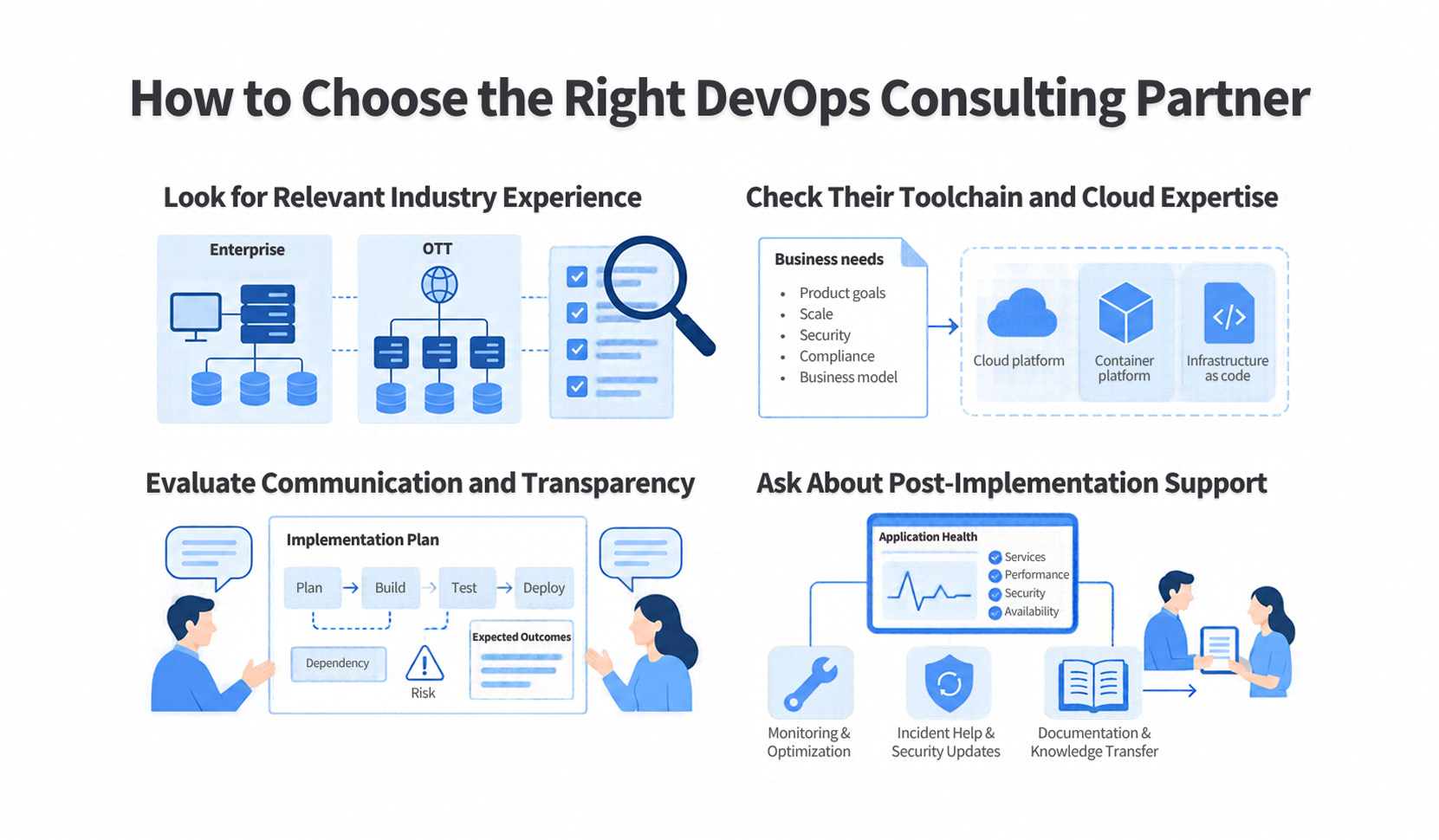
DevOps requirements vary significantly between industries and products.
A company developing an internal enterprise application will have different requirements from an OTT platform handling high-volume streaming traffic.
Look for a partner with experience relevant to your application's architecture, scale, security requirements, and business model.
The right consulting company should be comfortable working across modern cloud and DevOps technologies.
Depending on your requirements, this may include AWS, Azure, Google Cloud, Docker, Kubernetes, Terraform, CI/CD platforms, Git-based workflows, monitoring systems, security tools, and observability platforms.
The partner should recommend technology based on business requirements rather than forcing every client into the same toolchain.
DevOps transformation involves technical and operational decisions that can affect budgets, timelines, security, and internal teams.
A reliable consulting partner should explain architecture decisions, implementation stages, risks, dependencies, and expected outcomes clearly.
DevOps does not end when a pipeline goes live.
Applications change, dependencies become outdated, infrastructure requirements evolve, traffic increases, and security risks change.
Ask whether the partner provides monitoring, optimization, incident support, documentation, security updates, and knowledge transfer after implementation.
Buying a CI/CD platform or moving an application to Kubernetes does not automatically create DevOps.
DevOps also involves processes, collaboration, ownership, automation, security, monitoring, and continuous improvement.
CNCF's latest cloud-native research similarly emphasizes that people, culture, and organizational alignment remain important alongside technology adoption.
Releasing software faster without appropriate security controls can create significant technical and business risks.
Security should therefore be incorporated into development, testing, infrastructure, and deployment processes instead of being treated as a final approval step.
A business does not need to transform every application and team simultaneously.
A better approach is to select a suitable application, identify its biggest delivery bottlenecks, introduce targeted automation, measure the results, and then expand successful practices.
|
Business Challenge |
DevOps Response |
Business Outcome |
|
Slow software releases |
CI/CD automation |
Faster time to market |
|
Frequent deployment errors |
Automated testing |
More reliable releases |
|
Environment |
Infrastructure as Code |
Consistent environments inconsistencies |
|
Traffic fluctuations |
Cloud scaling |
Better availability |
|
Security gaps |
DevSecOps |
Earlier risk detection |
|
Production blind spots |
Monitoring and observability |
Faster issue resolution |
|
Rising infrastructure costs |
Cloud optimization |
Better resource utilization |
Software delivery speed has become a competitive factor for modern businesses. Customers expect continuous improvements, while businesses need to respond quickly to new market opportunities.
DevOps consulting helps organizations replace slow, manual, disconnected processes with an automated and measurable delivery system.
CI/CD reduces waiting. Automated testing catches problems earlier. Infrastructure as Code improves consistency. Cloud optimization supports scalability. Monitoring provides production visibility. DevSecOps integrates security throughout the lifecycle.
For OTT mobile app development, these capabilities become even more important because streaming businesses must handle unpredictable traffic, frequent releases, multiple platforms, sensitive user information, and valuable digital content.
At TechQware, we help businesses build technology environments that are designed for speed, scalability, reliability, and long-term growth. From DevOps strategy and CI/CD implementation to cloud infrastructure, automation, monitoring, and DevSecOps, our approach focuses on solving the operational challenges behind faster software delivery.
If your development team is spending more time managing deployments than building new features, it may be time to rethink your delivery infrastructure. Talk to Us about building a DevOps strategy that makes your software delivery faster, more reliable, and ready to scale.
Abhinav Srivastav
Let’s chat about your goals and explore how TechQware can support your journey ahead.


app development . Oct 27, 2026
DevOps Consulting: How It Speeds Up Sof…
Mobile App Development . Oct 22, 2026
Why Dubai's Property and Construction S…