Mobile App Development
Launching an Online Store App in Dubai in 2027 : What It Really Costs and Where the Money Goes
 TechQware
November 5, 2026
 TechQware
November 5, 2026
A founder in Dubai asks three agencies for a quote on an online store app and gets three very different answers. All three can be honest. The gap comes from scope, platform choices, payment and delivery integrations, and what you pay after launch. This guide explains online store app cost in Dubai in plain terms: what each stage of the build costs, which UAE-specific items move the budget, what running the app costs each year, and which mistakes waste the most money. By the end, you will be able to read a quote, plan a realistic first-year budget, and decide whether an app is the right move now.
Most online store apps in Dubai fall into three budget bands: a lean MVP, a mid-range store app and a full marketplace. Published prices vary widely, so use ranges for planning, not as promises.
|
Tier |
Published agency range (AED) |
Timeline published by agencies |
Source |
|
Lean MVP |
25,000–80,000 (about USD 7,000–22,000) |
2–4 months; another agency lists 6–10 weeks |
|
|
Mid-range store app |
180,000–400,000 (mid-size e-commerce and marketplace apps) |
4–6 months |
|
|
Full-scale marketplace |
Upper end of one agency’s e-commerce range: 500,000+ |
No reliable published figure found |
Please note: Every price in this guide is an estimate, not a final quote. The figures come from prices that Dubai agencies publish on their own websites (accessed October 2026). They are not official statistics. Your real cost depends on your scope, platforms, integrations and the team you choose, so always ask for an itemised written quote.
Development is not the whole bill. Licensing, marketing, hosting and maintenance come on top, and the sections below cover each one.
Dubai customers expect a smooth, stylish and fast experience from the first tap to the doorstep. That means a bilingual design that feels natural, easy payments, reliable delivery updates and an app that reflects the quality of your brand. Work with a team that builds store apps for Dubai businesses and understands what local shoppers love. Tell us your vision and we will turn it into an app your customers enjoy using.
Book a Free Founder Call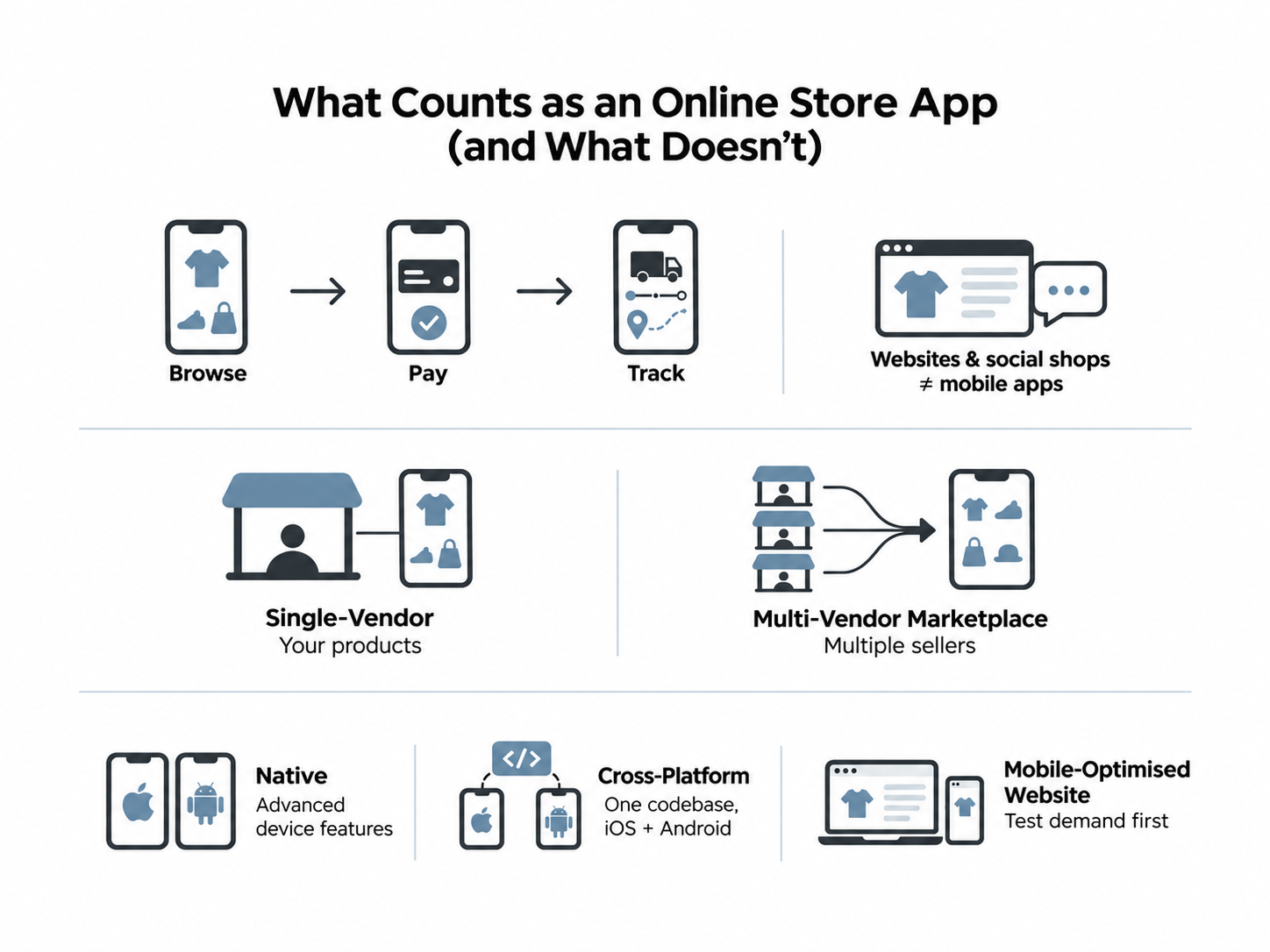
An online store app is a mobile app, on iOS, Android or both, where customers browse your catalogue, pay and track orders. A mobile-friendly website, a WhatsApp catalogue or an Instagram shop is useful, but it is a different and cheaper product.
A single-vendor app sells your own products. A multi-vendor marketplace lets many sellers list products, which adds seller onboarding, commissions, payouts, disputes and dashboards.
In our experience, most founders should prove demand with a single-vendor app before building a marketplace.
Cross-platform suits most store apps. Native suits apps that need heavy animation or advanced device features. A mobile-optimised website suits demand testing.
|
Option |
Build cost |
Speed to launch |
Best for |
Trade-off |
|
Native (Swift, Kotlin) |
Higher: two codebases |
Slower |
Heavy animation, AR, advanced device features |
Two codebases to maintain |
|
Cross-platform (Flutter, React Native) |
Medium: one shared codebase |
Faster |
Most store apps |
Some device features need extra work |
|
Mobile-optimised website |
Lowest |
Fastest |
Testing demand |
No app-store presence, fewer native features |
Shopify, WooCommerce and no-code builders can put a store online in weeks. They are a sensible way to test demand before paying for custom code. Limits appear when you need custom loyalty rules, an Arabic-first experience, unusual delivery logic or full control over the customer data. At that point, a custom app starts to make sense.
Dubai raises the bar on design, payments and delivery, and the market is already crowded. Shoppers expect a premium, bilingual, fast experience, and meeting that expectation adds work a generic quote may skip.
The market explains the pressure. UAE e-commerce reached AED 42.2 billion in 2025 (EZDubai report via WAM, 2025), and it has grown at about 19% a year since 2020 (EZDubai and Arabian Business, 2025). Connectivity is no barrier: DataReportal counted 23.0 million mobile connections in late 2025, equal to 202% of the population (DataReportal, Digital 2026). Connections include multiple SIMs per person, so read this as “near-universal phone access”, not 23 million unique shoppers.
UAE shoppers compare before they buy. A Checkout.com study found that 44% browse in-store but shop online, and 62% plan to shop online more next year (Checkout.com via Zawya, 2025). Statista estimates about 7.82 million digital commerce users in 2026 (Statista via Khaleej Times, 2026).
Practical result: clear delivery times, easy returns and fast checkout are budget items, not polish.
Bilingual means more than translated labels. Right-to-left (RTL) layouts mirror the whole interface, from navigation to progress bars. You also need Arabic fonts, bilingual product data, search that understands both languages and Arabic notifications.
Building RTL in from the start is usually cheaper than adding it after launch, because every screen has to be redesigned and retested.
You will compete with names such as Noon, Amazon.ae, Ounass, Mumzworld, Sharaf DG and Carrefour Online. Electronics alone is the largest category, at 34% of UAE e-commerce revenue (ECDB, 2025).
Do not try to match their catalogue. Pick a niche, make a clear delivery promise and build loyalty. That keeps the feature list, and the budget, smaller.
Features are the biggest lever you control. Every feature adds design, build, testing and maintenance, so choose carefully.
These features are valuable but expensive. Add them when data shows customers want them.
Good recommendations need data. A simple “related products” rule gets you far at launch. True AI personalisation pays off only once you have enough orders to learn from.
Points, tiers, expiry rules and fraud checks all need build and accounting work. Storing customer money in an in-app wallet can bring financial regulation, including Central Bank rules, into play. Get legal advice before building a stored-value wallet.
Map tracking depends on courier or driver apps and their APIs. If your couriers cannot supply live location data, the feature will not work however well it is built.
Sellers need onboarding, product tools, commission settings, payouts and dispute handling. This is often the single largest cost jump between a store and a marketplace.
Product reviews with photos, AR try-on, chatbots, subscriptions, gift cards, advanced analytics and voice search can all wait. Launch, measure, then build what customers actually ask for.
Most of the budget goes to design, front-end and back-end development and integrations. Testing and launch work take less but protect the whole investment. Each stage below is tagged Low, Medium or High relative to the total.
Cost weight: Low to Medium. This covers workshops, user flows, the feature list, technology choices and a prototype scope. It is the cheapest way to prevent expensive rework, and the stage founders most often skip.
Cost weight: Medium. Product pages, search, cart and checkout need to feel premium and work in Arabic and English. Custom design systems and animation raise the price.
Cost weight: High. The front end is what customers see. The back end holds accounts, catalogue, cart, orders, security and business rules. Founders often underestimate the back end because it is invisible.
Cost weight: Medium. Your team needs to upload products, manage stock, process orders and refunds, run promo codes and read reports. Bulk uploads and syncing with an ERP or POS system add cost.
Cost weight: Medium to High. Each integration, such as payment gateway, courier, SMS or analytics, needs building, testing and sometimes provider approval. The more providers, the longer and costlier the build.
Cost weight: Medium. Testing covers many phones and OS versions, Arabic layouts and edge cases such as failed payments or double taps. Cutting QA does not save money. It moves the cost to your customers.
Cost weight: Low. This covers developer accounts, store listings, privacy declarations and review cycles. Apple charges an annual developer fee and Google a one-time registration fee, so check current rates. A rejected build delays launch.
Local payments, buy now pay later (BNPL), cash on delivery and last-mile delivery are the integrations most likely to change your quote. Ask every agency to price each one separately.
Cards remain the base, but wallets are growing fast. Digital wallets held 43.92% of UAE e-commerce payments in 2025 (Mordor Intelligence, 2026). Another survey found that 93% of UAE shoppers still use cards, while wallet use rose from 41% in 2020 to 53% in 2024 (Gulf News, 2025). Support cards, Apple Pay and Google Pay at minimum. Gateways usually ask for a valid trade licence during onboarding.
Providers such as Tabby and Tamara are well known to UAE shoppers, and BNPL is the fastest-growing payment method, at a 13.27% CAGR to 2031 (Mordor Intelligence, 2026). Technical integration is usually modest, but merchant fees and payout timing affect your margin and cash flow. Ask each provider for current rates and test refunds before launch.
Cash on delivery (COD) is declining, with usage down 53% since 2020 (Checkout.com via Zawya, 2025), but some customers still want it. COD adds cash reconciliation, courier collection, failed deliveries and fake orders. If you offer it, set order limits and consider a small prepaid deposit.
Your app needs delivery zones, shipping rates, delivery slots and courier APIs. Capture an accurate delivery location, for example with a map pin, and confirm it with the customer. Pick courier partners before design is finished, because their APIs shape the checkout flow.
Customers expect support on WhatsApp, plus SMS, email and push notifications, in Arabic and English. Budget for message templates in both languages and for messaging fees charged by your provider.
Five factors explain most price differences between quotes: who builds it, which technology they use, how complex the design is, how fast you need it and how much the scope changes.
Freelancers cost less but carry more delivery risk. Agencies bring design, development, QA and project management in one team. An in-house team gives control but means salaries, hiring and management time. Team location affects price, communication and accountability, so compare the same scope across locations.
One shared codebase is cheaper than two native apps. Proven frameworks and ready-made components cost less than custom-built ones. Ask why the team chose the stack, and who will be able to maintain it in three years.
A clean design built on standard components is quicker to build and test. Custom animation, 3D product views and unusual navigation add design hours, development hours and testing time.
Rushed projects need larger teams working in parallel, and rush work usually costs more. Rushing also raises the risk of mistakes. A realistic timeline is often the cheapest option.
Changing scope mid-build causes rework, and rework is expensive. Agree a clear scope, a change-request process and a priced list of “later” features before development starts.
Before launch you need a licence, data-protection compliance and legal documents. These costs rarely appear in a developer’s quote, so budget for them separately.
Selling online in Dubai needs a licence with an online selling activity. On the mainland, the Department of Economy and Tourism (DET) issues it (Binderr, 2026); in a free zone, the free zone authority does. One adviser lists the home-based e-Trader licence, for UAE and GCC nationals, at AED 1,370 in government fees (Virtuzone, 2026). Companies need a fuller licence whose cost depends on activity and office. Confirm current fees with DET or your free zone.
Federal Decree-Law No. 45 of 2021 (the PDPL) has been in force since 2 January 2022. Its detailed Executive Regulations were reported as still not issued in the 2026 edition of Chambers’ guide (Chambers and Partners via BusinessDubai, 2026), and sources disagree on enforcement, so ask a UAE lawyer for the current position. Build for it anyway: clear consent, a privacy policy, data minimisation and account deletion. DIFC and ADGM have their own regimes. Consumer rules also apply: transparent prices, clear return terms and honest delivery promises.
Budget for terms of service, a privacy policy, a returns policy and, for marketplaces, a seller agreement. Make sure your contract with the developer says you own the code and design. Consider cyber and product liability insurance once volumes grow.
Many founders spend the whole budget on development and have little left to attract customers. Plan the marketing budget before you sign the development contract.
App store optimisation (ASO) covers title, keywords, screenshots and ratings, in English and Arabic. Paid ads, such as Apple Search Ads, Google App campaigns and social ads, bring first installs. Track cost per install and cost per first order, not installs alone.
Instagram, TikTok and YouTube strongly shape UAE shopping habits. Influencer fees vary widely, so ask for audience data and past campaign results before paying. Product content, such as photos and video, is also a cost.
First-order discounts, free delivery and referral rewards drive early orders, and they come straight out of your margin. Model them as a marketing cost and set a cap.
Expect to pay every year to keep the app running, safe and current. Ask each agency for a written maintenance quote, not a verbal promise.
Servers, databases, file storage, SMS, WhatsApp messaging, email, maps, analytics and crash-reporting tools usually bill monthly, and the bill grows with usage. Ask for a usage forecast at launch and at ten times that volume.
Apple and Google release new OS versions every year, and apps must adapt. Maintenance covers bug fixes, library updates and compatibility. Agencies commonly sell it as a retainer, usually quoted as a share of the build cost. Get the exact terms in writing.
Payment and customer data make a store app a target. Plan for security patches, access reviews, backups and periodic security testing. Rules also change, as the e-invoicing timeline shows, so keep a small budget for compliance updates.
Once orders grow, you will want features from your “later” list and more server capacity. Reserve a yearly improvement budget, so growth does not need a new funding round.
The wrong partner can cost you time, money and your first impression with customers. Before you sign with anyone, talk to our team about your project and ask us anything, from who will work on your app to how we handle delays and changes. If you already have quotes, bring them along and we will help you compare them fairly.
Free Expert AdviceThese three profiles use the bands from the table at the top of this guide. Each shows what the money buys and what it leaves out. Remember that the ranges are estimates, not final prices.
Best for one niche and one product line. Expect cross-platform development, a basic admin panel, one payment gateway with Apple Pay, simple delivery rules and a bilingual interface. Loyalty, AI and live tracking stay out. One Dubai agency prices a launch-ready shopping-app MVP at AED 60,000–80,000 (Royex, accessed October 2026), which fits within the published lean range in the table above.
Best for brands that already sell and want repeat orders. Adds BNPL, a loyalty programme, order tracking, richer admin reporting, push campaigns and a more polished design. Expect more integrations, more testing and a longer timeline.
Best for funded teams with a clear seller supply. Adds seller onboarding, dashboards, commissions, split payments, dispute handling, advanced search and strong security. Treat it as running a platform business, with operations and support staff alongside the build.
Timelines scale with scope. The table at the top shows the timelines agencies publish, where available, and the build phase is always the longest part.
Every project runs in the same order: discovery and design, then development and integrations, then testing, then store review and launch. A lean MVP compresses each phase. A marketplace stretches them and adds extra rounds of seller testing. Each extra integration or user role adds weeks.
Most budget problems come from four avoidable mistakes. Each one is easier to fix before you sign than after.
A big first version delays launch and hides what customers want. Cut the list to what a customer needs to find, buy and receive a product, then add features based on real use.
A budget that ends at launch is not a budget. Add the first year of hosting, maintenance, marketing and compliance to the plan before approving the build.
The cheapest quote often leaves out QA, Arabic support, integrations or admin tools, and they return as change requests. Compare what is included, not only the total.
Test the prototype with real Dubai shoppers, in both languages, before full development. Watching five people try to check out will teach you more than any internal review.
You can lower the cost by building less at first and reusing what already works. You should not lower it by cutting testing or security.
Launch the core shopping journey, learn from real orders, then fund the next phase from results. Phasing also reduces the risk of building something customers do not want.
Authentication, payments, notifications and admin tools are solved problems. Using proven components saves time and brings fewer bugs than writing them from scratch.
For most store apps, one shared codebase delivers both iOS and Android for less. Keep native development for features that truly need it.
An app is worth it when repeat customers produce enough profit to repay the build, marketing and running costs. Work through the numbers before you commit.
Two figures matter. Customer acquisition cost (CAC) is marketing spend divided by new customers. Contribution per order is the order value minus product cost, delivery, payment fees and discounts. If CAC is higher than contribution from a typical customer’s lifetime orders, growth loses money.
Break-even orders = total first-year cost (build, licence, marketing and running costs) ÷ contribution per order.
Divide that by your expected monthly orders to see how many months recovery takes. Use your own numbers, and test slower scenarios too.
Wait if your catalogue is tiny, customers rarely reorder, your delivery process is unproven or there is no marketing budget. A Shopify store or a marketplace listing is often the better first step. Build the app once the demand is clear.
Choose the partner who shows proof, explains trade-offs and puts everything in writing. A confident sales pitch is not evidence of skill.
Ask for live apps you can download. Check store ratings, Arabic support and checkout speed. Ask what the team built and what results the client saw, and speak to a past client if possible. Be careful with portfolios that show screenshots only.
A good quote lists features, stages, integrations, testing, timeline and payment milestones. The contract should state that you own the source code, design files and accounts. It should also cover change requests, warranty on bugs and handover after launch.
Bring these answers to every agency, so quotes can be compared fairly.
An online store app works best when it is planned well and built by an experienced team. TechQware provides custom e-commerce app development for Dubai businesses, including Arabic and English support, local payment integrations and scalable design. We review your scope and build a clear, phased plan, so you know where every dirham goes before launch.
Planning a store app in Dubai? Get a free estimate from TechQware.
Abhinav Srivastav
Let’s chat about your goals and explore how TechQware can support your journey ahead.


Mobile App Development . Oct 30, 2026
Launching an Online Store App in Dubai …
app development . Oct 27, 2026
DevOps Consulting: How It Speeds Up Sof…